Leonard Weber
July 16, 2023
On my nature walks in Eliza Howell Park at this time of the year, I regularly stop by patches of False Sunflowers. I look at — and sometimes reflect upon — the relationships that exist among a particular species of flower and two insect species.
Red aphids love to suck sap from the stems of False Sunflower.

And Ladybugs love to eat the aphids.

False Sunflower is a perennial that is abundant in the wildflower field where I watch butterflies. It is in full bloom now, in the middle of July. It grows 4 – 5 feet high and has daisy-like flowers.

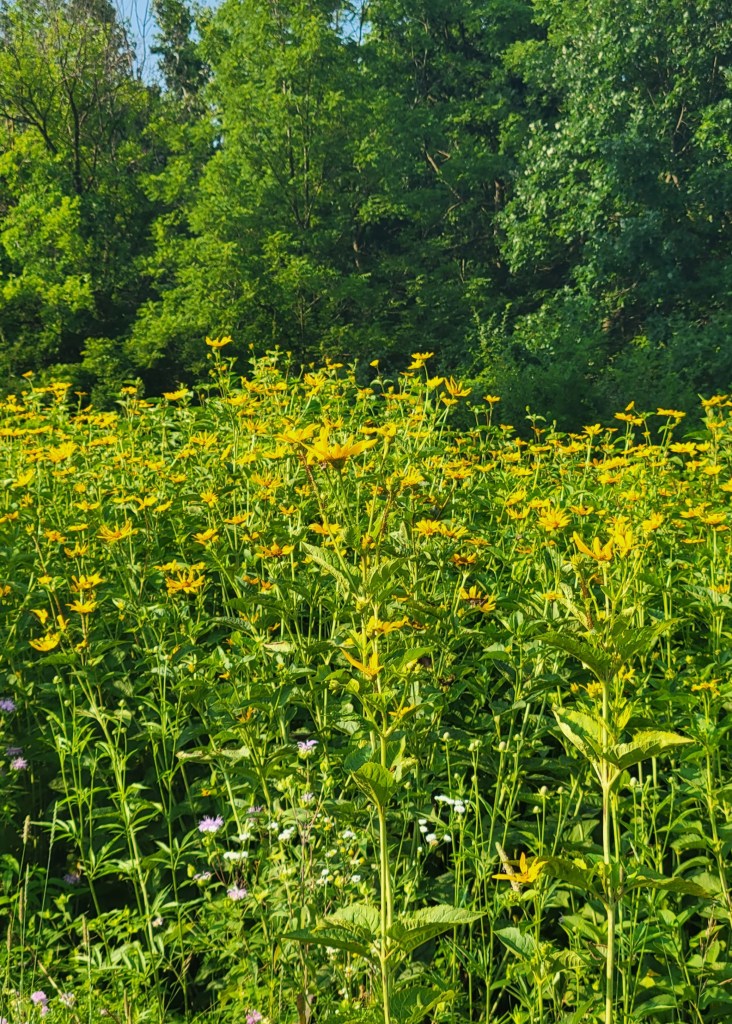
In Eliza Howell, Red Aphids clearly prefer False Sunflower to other plants. There are dozens of plants that have stems lined with dozens of sap-eating Red Aphids.

Red Aphids are tiny, only about 0.15 inches in length. There are tiny, but collectively they can take enough sap to harm plants. One of the methods that humans have used to control this “pest” is biological, using aphid-eating insects.
Seven-spotted Ladybugs, the kind present here, were introduced from Europe in the 20th century for the purpose of biological insect control. They can now be found pretty much wherever aphids are abundant.
Seven-spotted Ladybugs are voracious aphid eaters; it’s been estimated that each adult beetle is capable of consuming 50 aphids a day.


When looking for some of the glamorous butterflies that visit the Eliza Howell wildflower field these days, it is easy to miss or downplay the story of Red Aphids and Seven-spotted Ladybugs that is happening daily on the stems of False Sunflower.
I am finding it very much worth it, however, to stop and watch and, perhaps, to gain a little more understanding of nature’s fascinating ways.


 Eliza Howell Nature Walk
Leave a comment