Leonard Weber
November 20, 2023
Just a few weeks ago, many species of insects were present in good numbers in Eliza Howell Park. Now, as Thanksgiving approaches, I see very few.
Knowing they will be back next year, it is natural to want to know where they are now and how they spend the winter.
There is not just one answer, of course. Different species survive the winter in different ways. Here are a few examples.
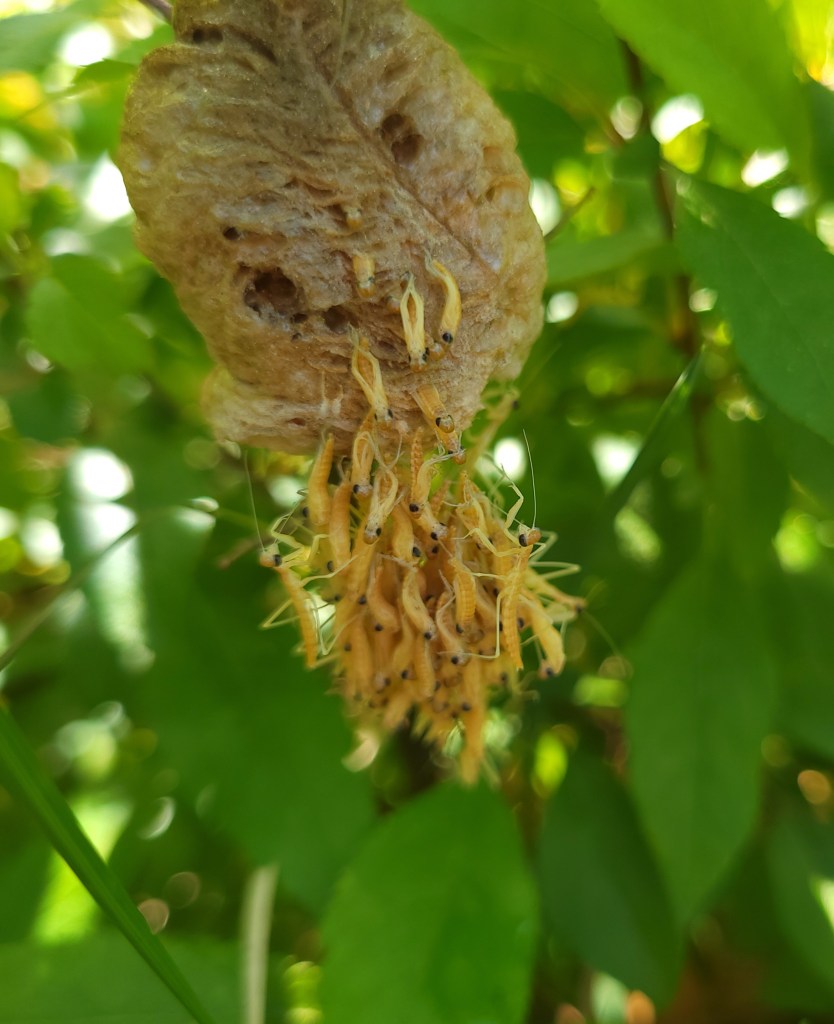
1. Praying Mantis: wintering as eggs

The most common Praying Mantis in the park is the Chinese Praying Mantis. By the end of September or soon thereafter, they have mated, females have laid eggs, and both males and females have died, their lives completed. The mantises that we will see in 2024 are now just eggs, in the egg cases (often called “oothecae”).

If the eggs survive the winter, they will hatch and emerge as a mass when the weather warms sufficiently (usually in late May here).
2. Large Milkweed Bug: migration
Some insects survive northern winters by getting away from the cold climate; they migrate south. The Monarch butterfly is probably the best-known migrating insect, but there are others that are also common. One is the Large Milkweed Bug, an insect frequently seen in clusters⅕ on milkweed seed pods.


Shortly after feeding on milkweed seeds in the fall, they head south.
3. Yellowjacket Queens: hibernation
In a recent posting, “Yellowjackets: The Death of a Colony,” I noted that all Yellowjackets except the recently mated females died at the end of the active season, about the end of October.

in the year
These future queens find protected locations to spend the winter in hibernation. I spotted one last year after rolling over a log in the woods.

The new queens that survive the winter will each begin her own colony in the spring.
4. Blackberry Knot Gall Wasp: wintering in the larval stage
Many insects go from egg to larva (or caterpillar) as part of their development. Some wasps, including the Blackberry Knot Gall Wasp, lay eggs on plants which they “persuade” (chemically) to grow galls to protect the insects as they develop inside.
There are many blackberry brambles in Eliza Howell and, with the fall leaf drop, the knot galls are easier to spot. They are quite common.

Inside these galls, the eggs hatch, and the larvae grow during winter to emerge as adult wasps in the spring. Each gall has multiple larvae; the larger the gall, the more young.

shapes and sizes
For demonstration purposes, I cut open a small gall to show the larvae inside.

in the fall
The larvae now in the galls, those that survive the winter, will emerge as adult wasps in 2024. (I have no photos of an adult of this small wasp species.)
5. Black Swallowtail: wintering in the pupa or chrysalis stage
Some insects, including butterflies and moths, have a non-eating stage between larva and adult during which they are transformed. Black Swallowtail is one of the butterflies that spends the whole winter in this stage.


Black Swallowtail butterfly is no longer active here this year. The adults have died. The caterpillars that I usually see in September are now spending the winter in the chrysalis stage. I have yet to find one of their chrysalises in the park.

I am slowly getting to know more of the insects — and more about the life cycles of the insects — that are present in Eliza Howell Park. Knowing something about how they spend the winter enriches my winter walks, even when they are not active.
 Eliza Howell Nature Walk
Leave a comment