Leonard Weber
March 16, 2024
It is always sunny when I encounter the first Eastern Garter Snake of the year in Detroit’s Eliza Howell Park.
We have reached the time this cold-blooded species is starting to seek the warmth of the sun after months of “brumation.” This year’s first sighting was on March 15, as I walked off-path on grass and fallen leaves.

March 15, 2024
Now is a good time for Garter Snake watching because they are not as quick to disappear: it seens like they just want to bask in the sunshine.
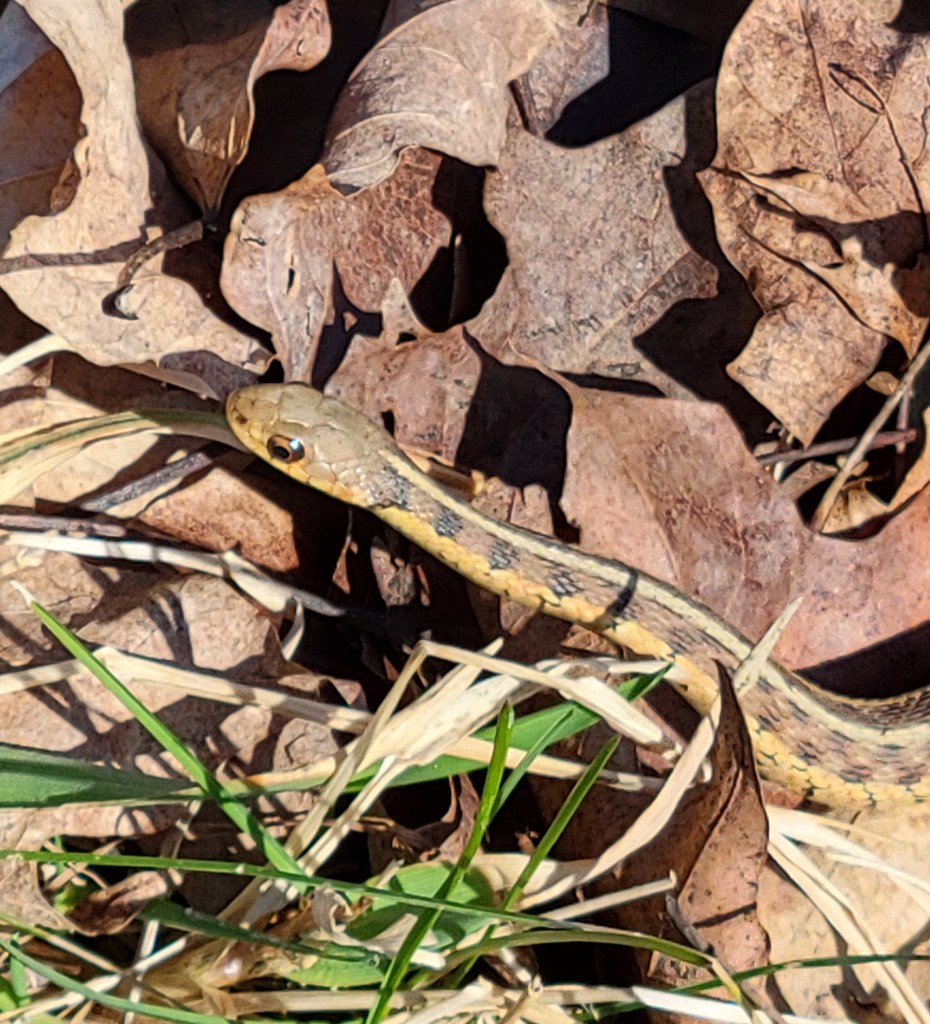
The date of the first sighting varies a little, the differences probably at least as much the result of where I happen to walk as when they first come out.
In recent years, my first-of-the-year sightings have been:
2023 — April 7
2022 — April 9
2021 — March 11
2020 — March 23
2019 — April 2

In March and April, it is often possible to observe carefully — to see the magnificent tongue and to note the scales in a way that is not possible in their more active season.


Eastern Garter Snake, a non-venimous species, is by far the most common snake in Eliza Howell Park. This fact and the close-up views on spring nature walks have inspired me to find out more about its life. Among other things, I have learned that
* Garter snakes are one of a minority of snakes (about 30 %) that give birth to live young instead of laying eggs (the other 70 %). The multiple young are not cared for by adults but need to find food on their own from day one.
* They can be active both in daytime and at night and are full carnivores (eating only animal matter); their prey consists of worms, slugs, insects, snails, amphibians, crayfish, bird eggs, etc.
* They spend the winter in groups underground (e g., in crayfish or mammal burrows) or in other protected locations. Their winter time of inactivity and torpor is called “brumation” in recognition of the differences in the way cold-blooded reptiles survive winter from the “hibernation” of warm-blooded mammals.
When they first emerge in the spring, there are often two or several together.

The next days and weeks, when the sun is shining, are the best time of the year to look for Eatern Garter Snakes,

to watch them, and, if one wishes, to photograph them.
 Eliza Howell Nature Walk
Leave a comment