Leonard Weber
August 16, 2024
The middle of August is a good time to visit different oak trees to get an early view of fall acorns. Most acorns are now large enough to locate – and to assess abundance – though they are not yet fully developed.
My primary interest in doing “acorn rounds” at this time is to refresh my familiarity with the oak species present in Eliza Howell Park and to identify what I want to know better.
The six included here all grow within the park road loop (as do some other species not included here). They provide a taste of the varieties present.

Northern Red Oak and Turkey Oak
Swamp White Oak

When I see one of Eliza Howell’s Swamp White Oaks, I am always reminded of the fact that the outer stems of this species often serve as hosts of Oak Bullet Galls, the sap-covered nurseries of a small wasp. The sweet gall exterior attracts larger insects that, by their presence, probably help protect the gall wasp from predation.

Shingle Oak

Shingle Oak acorns are small and the leaves are without lobes.
In Eliza Howell, Shingle Oak trees are the best examples of marcescence, the phenomenon of some deciduous trees retaining their dead leaves throughout the winter. The Shingle Oak leaves don’t fall until spring.

Pin Oak

Pin Oak acorns are small, but they take two growing seasons to mature; individual trees have mature acorns every other year. This is a year of abundance for my favorite Pin Oak tree.
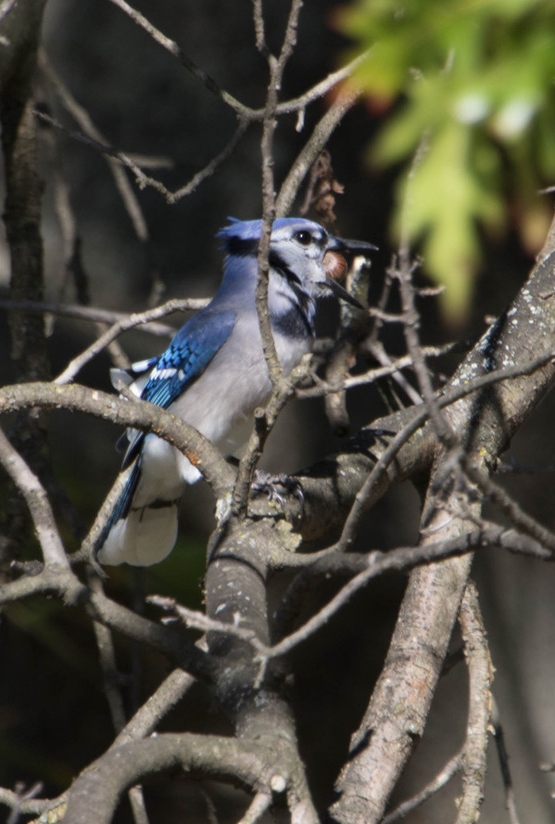
Many Blue Jays gather in the park every fall (starting in September), and they harvest countless acorns, both to eat and to cache.
The Blue Jays start the harvest with Pin Oak acorns and, since the acorns are plentiful this year, I know where to start watching the Blue Jay acorn harvest in about a month1.
Eliza Howell Park
Photo courtesy of Margaret Weber
White Oak

Above, I noted the presence of Oak Bullet Galls on Swamp White Oaks. Other insect galls can be found on other trees. The White Oaks in Eliza Howell seem to have a larger than average number and variety of galls. The following photos were taken during a brief stop at one White Oak tree.

Northern Red Oak

Of the six kinds of acorn pictured here, Northern Red Oak appears to be the furtherest along in development in mid-August. The acorns are full size, and though the color of the shell will still change, some are beginning to fall.
Turkey Oak

Turkey Oak is the one in this 6 pack that most clearly fits in the “trying to get to know better” category. It is the only one of the six not native to North America, and the trees present in the park are relatively small, perhaps not much more than three decades old.


The nuts are initially covered totally with the hairy or prickly cap, and many are still covered in the middle of August. These photos were taken very recently.

As the acorns continue to develop, the nuts will emerge (further), and the cap will cover about half of the acorn at maturity. I have not previously followed this development carefully.

…..
I look forward to further acorn walks in the next month or two. My favorite part of the oak year has begun.

 Eliza Howell Nature Walk
Leave a comment