Leonard Weber
November 10, 2024
Fall color season is over in Eliza Howell Park.

As often happens in the park, however, when one feature attraction fades, something else appears.
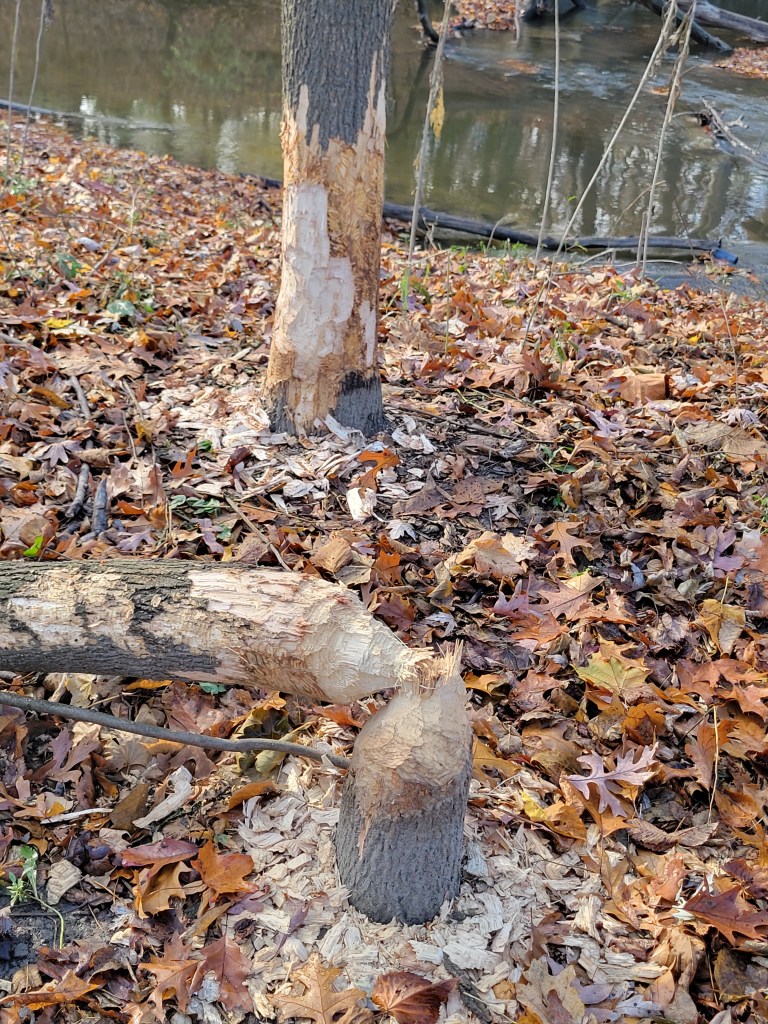
The new excitement is the presence of American Beaver. Beaver is mostly nocturnal, so I have no photos of the actual animal. “Observing” beaver consists of looking for and trying to learn about the animal from the signs of its nighttime activity along the river.
My Nature Walk colleagues Kathy and Mara first spotted a beaver-felled tree on November 1.
Beginning in the mid 1500s and continuing for about 3 centuries, felt top hats made from beaver pelts were fashionable among some European males. When beaver became scarce in Europe, suppliers began to seek the pelts in North America.
The beaver fur trade was a very important factor in the exploration (and settlement) by Europeans of large parts of North America.
In the 1800s, the once common American Beaver was trapped to near extinction — and silk hats became fashionable.
In the 21st century, after being extirpated here by the end of the 1800s, beaver has finally begun to return to rivers in southeast Michigan.

Beaver is a semi-aquatic mammal. Their dens (sometimes lodges, sometimes burrows in banks) normally have underwater entrances. They store their food under/in water.
This November marks the second time in recent years that there have been clear signs of beaver presence in the Rouge River in Eliza Howell Park. The other was November 2019. At that time, there were no new signs after several weeks. The beaver(s) apparently moved on, leaving behind many little stumps.

At about the age of two years, young beavers leave their family home to find a territory of their own; they might travel several miles. Perhaps the signs of beaver presence here, both now and 5 years ago, mean young beaver(s) starting out.
One of the fascinating things about beaver is that they can eat cellulose, which normally cannot be digested by mammals. In addition to small limbs and twigs, they eat bark and the soft tissue under the bark (cambium).
They often carry away, for later eating, the limbs and twigs of small trees they cut down. They gnaw the bark of larger trees. These are some of the easiest beaver signs to find as one walks the path along the river.


A close look at a cut tree shows the marks left by the famous beaver teeth.

It’s not possible to know now whether this time beaver will quickly move on or take up residence here.
At present, it’s exciting to “watch” a mammal that is unusual in Detroit parks. It’s exciting to know that a mammal of such historical importance has returned. It’s exciting to think that beaver may be a more common presence here for future generations than they have been for mine!

 Eliza Howell Nature Walk
Leave a comment