Leonard Weber
April 30, 2025
It happens at approximately the same time every year. One appears on the surface of dead trees and logs, and one flies in from Central America. As April turns into May, there are many species making their first annual appearance in Detroit’s Eliza Howell Park. Two of these are Dryad’s Saddle and Baltimore Oriole.
Dryad’s Saddle is an attractive and fast-growing shelf mushroom that I first see each year in April, usually late April. They are quite common and grow well into May.
These photos show examples from the last week of April 2025.


Over the last seven years, my first observation of Dryad’s Saddle in the park has been on these dates:
2019 – April 28
2020 – April 26
2021 – April 18
2022 – April 29
2023 – April 14
2024 – April 22
2025 – April 23
The seasonal predictability of Dryad’s Saddle’s emergence on dead wood is obvious from this record, but it is less precise than the appearance of the long-distance migrant Baltimore Oriole.
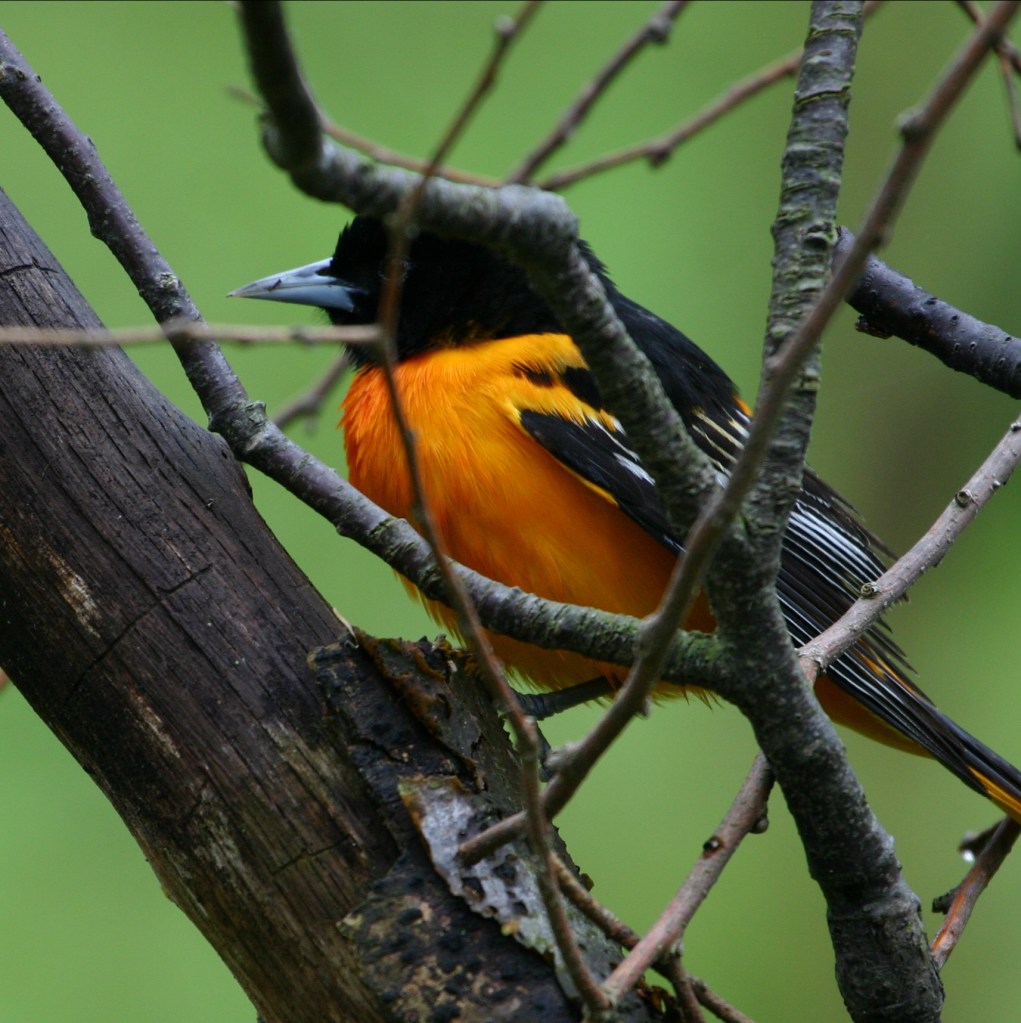
I have kept records of the first sighting of a Baltimore Oriole in the park for a longer period of time. 2025 is the 15th year.
2011 – May 8
2012 – May 1
2013 – May 5
2014 – May 6
2015 – May 6
2016 – May 7
2017 – May 1
2018 – May 4
2019 – May 5
2020 – May 4
2021 – May 2
2022 – May 4
2023 – May 6
2024 – May 1
2025 – April 30
Over these 15 years, I have first spotted one between April 30 and May 8 every single year. And they arrive on this predictable schedule after a flight of some 2000 milies.

Several Baltimore Orioles nests can be found in the park every year. After arriving about the beginning of May, we start finding nests within a couple weeks.

The time of the first observation of a Gray Catbird is just as consistent. Over these last 15 years, the first observation has been between April 29 and May 7 every year.

There are many other species appearances or other developments that are quite predictable. Every visit to the park, especially when spring is coming into its fullness, is a time of expectation: “It’s about time to see …”
There is something very satisfying and reassuring about Nature’s recurring cycle!
 Eliza Howell Nature Walk
Leave a comment