Leonard Weber
May 15, 2025
Some birds build nests in trees or shrubs; some birds nest on the ground; some birds nest in cavities (holes) in trees. Especially among cavity nesting birds, there can be competition, with two different species wanting the same site. I have recently been watching an example.

Cavity nesting birds will often use bird boxes (which are human-provided cavities). One in particular, built by a colleague using a design for a bluebird box, has been quite popular. In 2022, House Wrens used the box. In 2023 and 2024, Black-capped Chickadees used it.
In 2023, I wondered whether House Wrens would try to take the box when they returned to Michigan. They have a reputation of being very aggressive toward birds like Chickadees in the selection of nesting site. No Wrens came around the area that year.
After cleaning the box out last winter, I started checking it again in April.

There were no eggs yet on April 28, but the nest was characteristic of Black-capped Chickadees. Chickadees put down a layer of moss before adding other nesting material on top.
A little later, I heard and saw a Chickadee, confirmation of the nesters’ identity.

When it looked like no bird was in the box on May 5, I checked agian. The nest now contained 6 Chickadee eggs. Since no adult was present, my guess was that egg laying was not yet complete (it is not unusual for Chickadees to have an even larger clutch of eggs) and that incubation had not yet begun.

Twice in the days before May 5, I saw a pair of Eastern Bluebirds come to the box, look in a couple of times, then go away.
On May 8, the Bluebirds were back. This time, the female Bluebird went in the box and stayed for a while. As soon as the Bluebirds flew away, I hurried to the box to take a look.

The nesting material appeared to be a little deeper/higher, and I saw no evidence of Chickadee eggs, whole or broken. This now had the appearance of a Bluebird nest. I do not know what happened to the eggs. Perhaps they were just covered over?
On May 14, I again took a look.
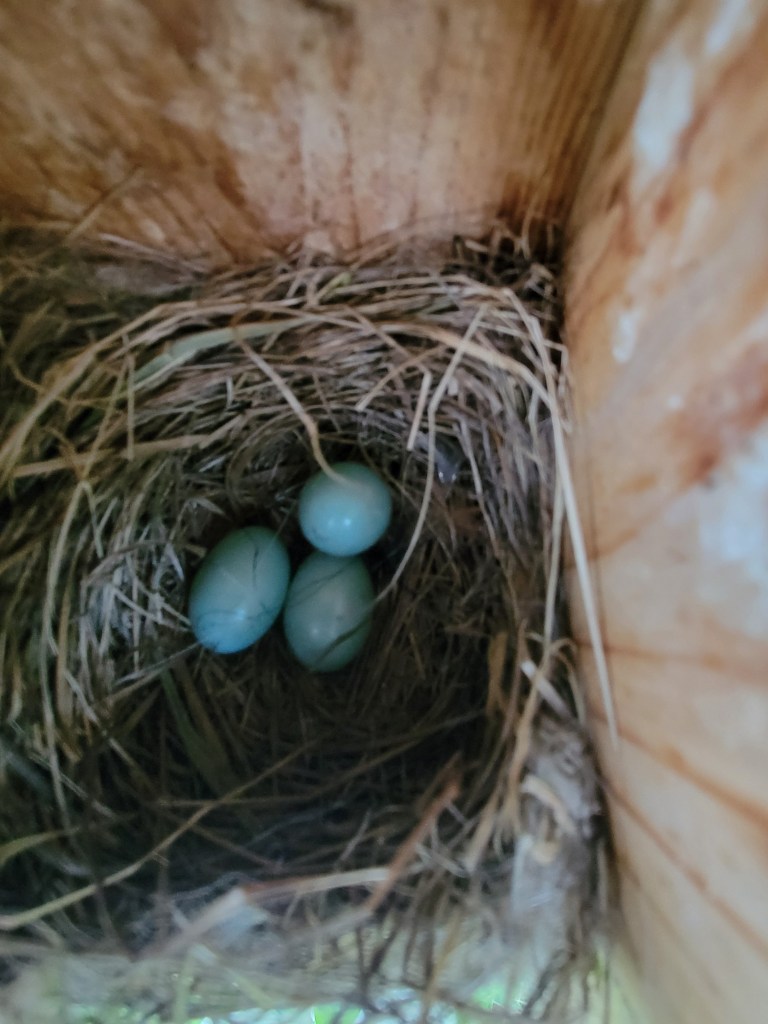
These are Bluebird eggs. While the fate of the Chickadee eggs is unknown, the Bluebirds have definitely taken over the box. The pair of Chickadees may have put up some resistance to being displaced, but Bluebirds are larger and, according published reports, they almost always succeed in securing a nesting box also wanted by Black-capped Chickadees.

The Chickadee pair is perhaps already starting another nesting attempt in another cavity. I do not know.
—–
There are, of course, other cases of competition between cavity nesting birds for particular sites: between Tree Swallows and Bluebirds, for example, or between European Starlings and Red-bellied Woodpeckers.
Some birds nest in trees. Some birds nest on the ground. Some birds compete for the same cavity nesting sites. There is always something more to learn about the behavior of birds in nesting season in Eliza HowellPark.
 Eliza Howell Nature Walk
Leave a comment