Leonard Weber
May 29, 2025
Bird watchers sometimes set out to see how many species they can see / hear in 24 hours. This is usually referred to as “the big day” count. In recent years, I have become aware of a variation of this: “the big sit.” Watchers stay within a 17-foot diameter circle and count the number of species seen / heard there in 24 hours.
On April 22 this year, I started counting the days for a Wood Duck incubation to be complete, another type of “big sit.”
My watching began on April 15, when I noticed several eggs (at least 4) in the wood shavings of one of the Wood Duck boxes.

A Wood Duck hen will typically lay an egg a day until the hutch is complete (perhaps 8 – 10 eggs) and then begin incubation. Since she was not on the nest regularly yet, I stopped by occasionally and stuck my phone in the entrance hole to get a sense of how things were going. I always knocked first so that, in case she was there, she would not be startled by the phone in the entrance hole.
Soon, I noticed that she had started adding white feather down from her body to line the nest.

I couldn’t see or count the eggs, but it was obvious that the nesting process was continuing.

On April 22, when my knock, as usual, resulted in no sound or movement inside, I was a little surprised when I looked at my quick photo and saw that the mother hen was on the nest.

Over the next four weeks, I kept my distance from the nest box, wanting to give her privacy and to do nothing that might disturb her.
The published reports on the normal length of Wood Duck incubation vary a little, but generally indicated that it lasts about 28 – 32 days.
When Wood Ducks hatch, they are ready to leave the nest. They have down feathers, are able to walk and swim, and able to feed themselves. To reach this stage of development before hatching, incubation, done by the female alone, is necessarily quite long.
On May 21, the 30th day since I first spotted her on the nest, I stopped by the bird box again. I heard nothing in response to my knock and tried to get a photo. It was a heavily clouded and very dark day, and I had a hard time getting a photo that showed what was in the box. I did see enough to know that the mother duck was still there.

Since she was still on the nest after a month, I knew that nothing had yet stopped the process. It was very likely now that the eggs would hatch soon.
I silently recognized her perseverance (she spends about 21 – 22 hours a day on the nest during incubation) and decided to come back in a few days, when, in all likelihood, the hen and ducklings would had left.
About a day after young Wood Ducks hatch, the ducklings respond to a call from the mother and climb up to the entrance hole — and jump out. Then they follow the mother to water. In this case, the location of the nest box is about 30 yards from the river.
I waited a few days before I looked in the box again. Seeing it empty of birds, I opened it to get a good look at the softest white down, all that remained.
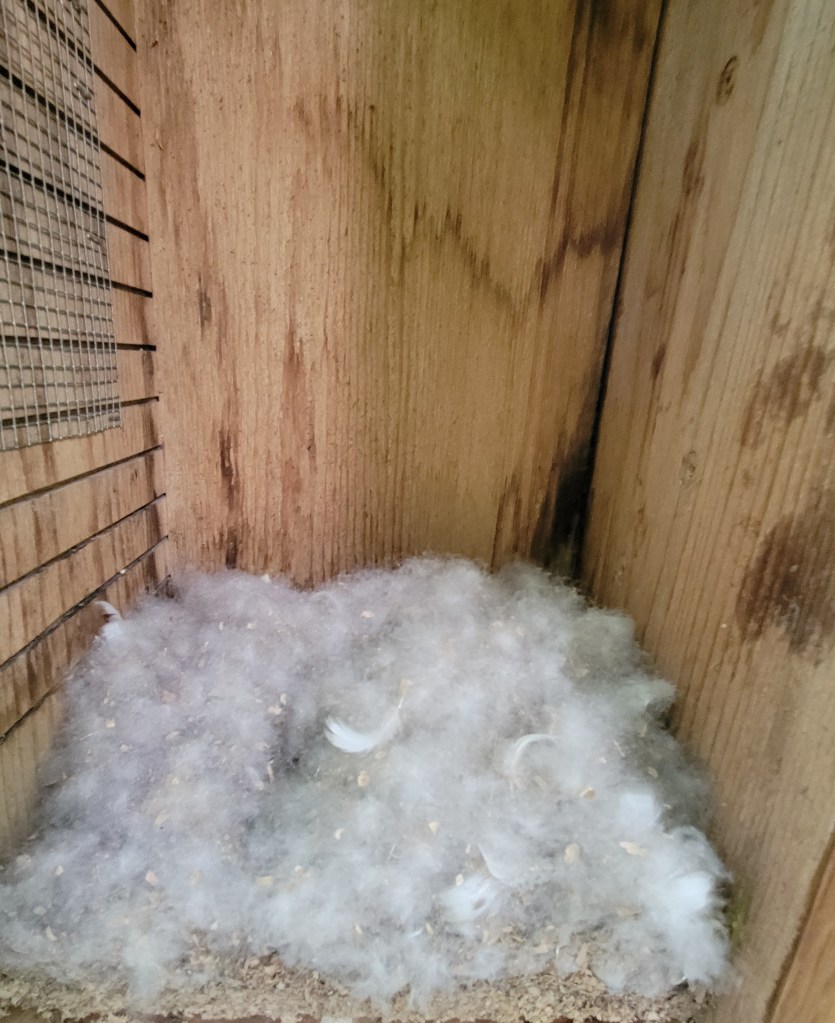
It appeared that the eggs had all hatched. If the hen had averaged 21 hours a day on the nest for 31 days, she had been there 651 hours. That is indeed a big sit!
The young are tended by the female alone. They are able to fly about 60 days after hatching.

After counting the incubation hours and days this spring, any occasion of seeing Wood Ducks in the future is likely to remind me of the hen’s many hours on the nest, her big sit.

 Eliza Howell Nature Walk
Leave a comment