Leonard Weber
June 4, 2025
Many of the biggest and brightest butterflies have not yet put in an appearance this year in Eliza Howell Park, though several smaller ones can now be found regularly.
Today, I pulled myself away from watching nesting-related bird activity to check for butterflies on and around the Red Clover that has recently begun to bloom.

Red Clover attracts nectaring butterflies and is now blooming, when many of the other wildflowers that butterflies seek out for nectar are still days to weeks away from flowering.

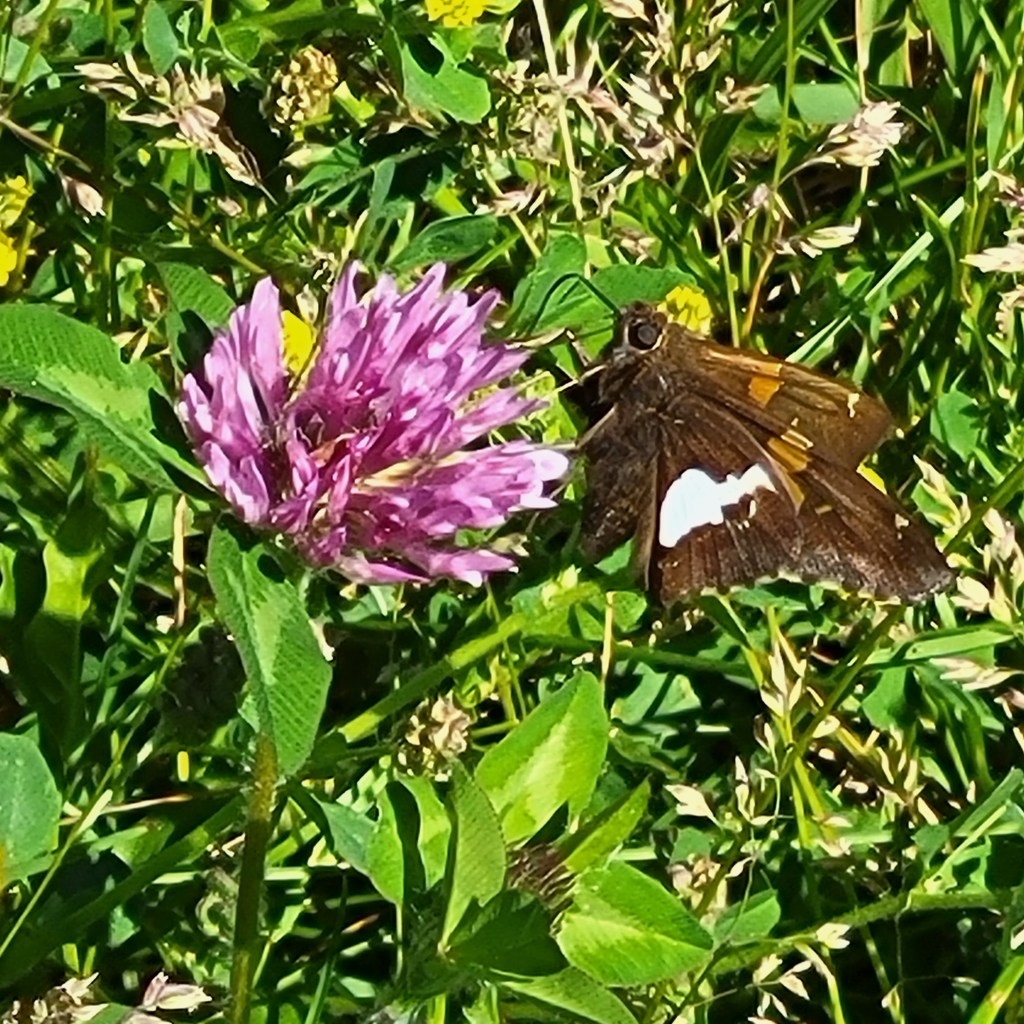
I succeeded today in finding several Peck’s Skippers on Red Clover — and in getting a couple photos of them. As is typical of skippers, Peck’s are very small.


In past Junes, I have seen a variety of other butterflies visiting Red Clover in Eliza Howell.
a previous June

a previous June

a previous June


a previous June
As these photos show, Red Clover serves as a food source for many adult butterflies. In addition, it is one of the host plants for the larvae of at least three buterfly species that are found in Eliza Howell Park: Eastern Tailed-Blue, Clouded Sulphur, and Orange Sulphur.
Red Clover was introduced from Europe, probably already in the 1600s, as a hay crop for cattle and as a cover
crop to improve soil (it is a legume that fixes nitrogen). It is one introduced plant that seems to have become well integrated into the lives of native insects.

Red Clover has long been a favorite flower of mine. I like the purple flower head made up of many individual flowers. I like the lighter-colored chevron (inverted V) in the leaves. I like that the species serves as a nectar source for butterflies and other insects during a season when nectar sources are not yet abundant.
 Eliza Howell Nature Walk
Leave a comment