Leonard Weber
June 12, 2025
June offers the best opportunity to spot turtles on dry land in Eliza Howell Park. In the last week, there has almost been enough traffic to consider placing a sign like this.

Three time in the last week, there has been a Snapping Turtle close to, or visible from, a walking path. Other walkers have reported additional sightings.


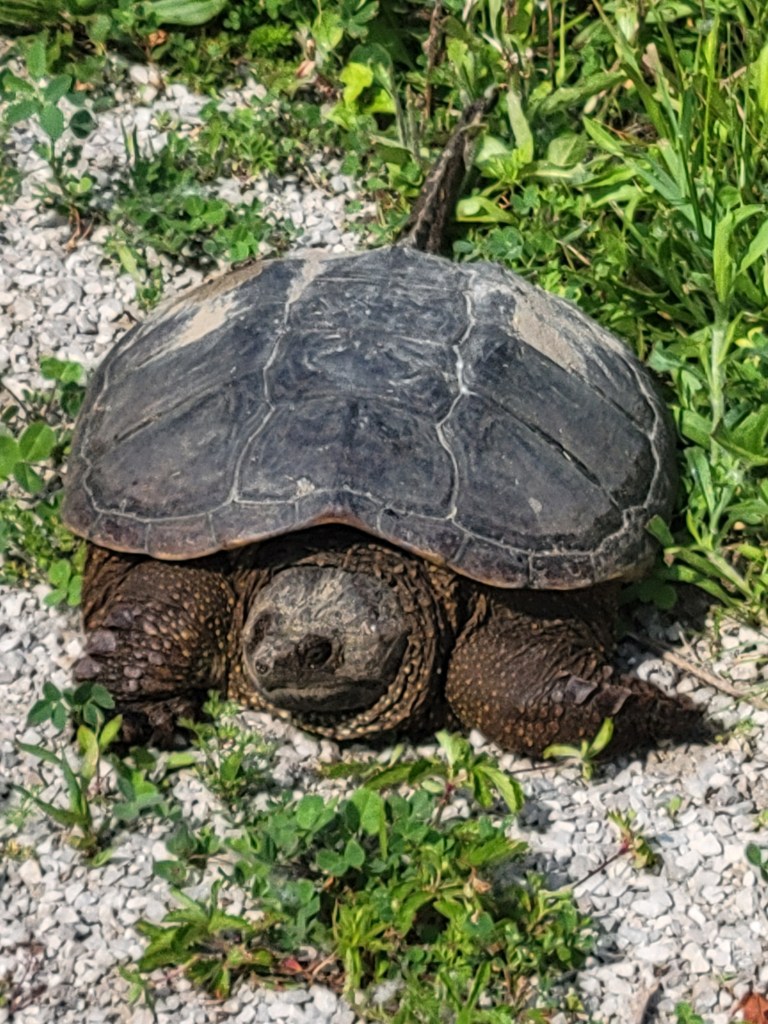
I was informed of the location of the most recent observation today by another park walker and arrived just as the turtle was finishing covering the eggs.

Completing egg laying.
Snapping Turtles spend almost their entire lives in water (and mud). The ones that we see away from water at this time of the year are, in all likelihood, females who are searching for a site to lay their eggs (or returning from egg laying).
Adult Snapping Turtles are large turtles; the carapace (top of the shell) can reach 20 inches in length. Adult Common Snapping Turtles have no non-human predators in Michigan and may live 40 years or so.
Three years ago, I had my first opportunity to observe an egg-laying snapper in the park.

Nesting Snapping Turtles dig a hole in loose dirt or sand, using their back legs, and deposit the eggs. Once the eggs are covered, the mother turtle is free to return to the water. The summer sun-heated dirt will be sufficiently warm for the eggs to hatch — usually after close to three months, depending upon the temperature.

June 12, 2025
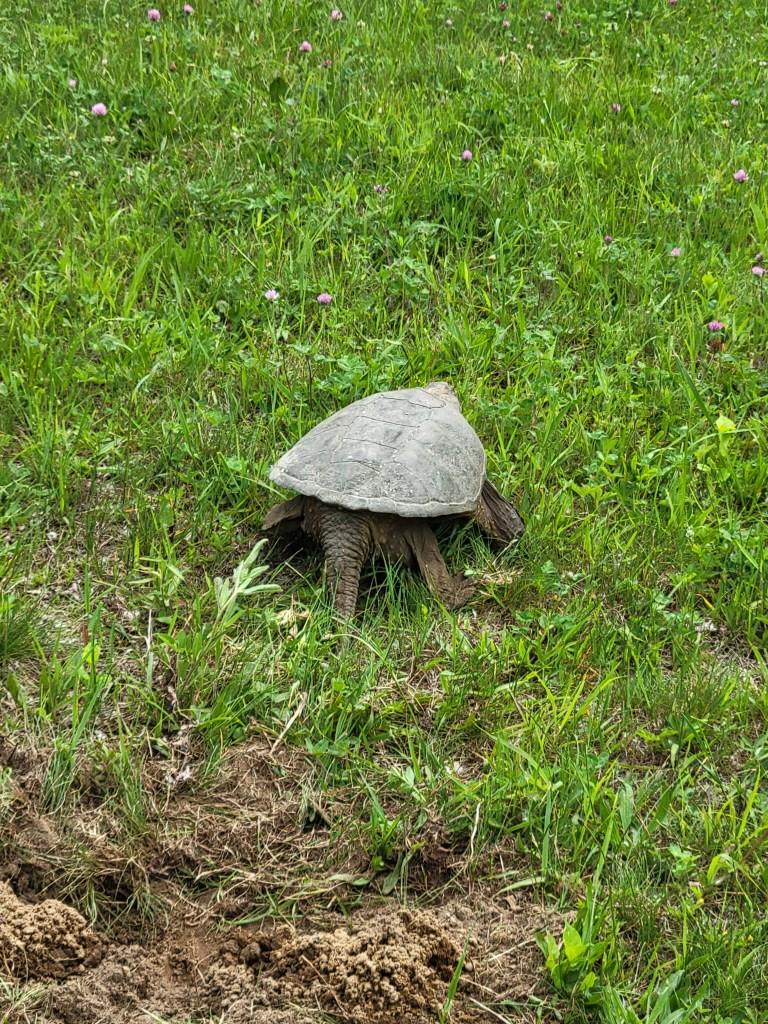
June 12, 2025
In 2022, I kept an eye on the calendar and started checking the nest location regularly in late August. On about day 80, the young emerged. They have to find their own way to water.

September 3, 2022
While adult Snapping Turtles have little risk of becoming food for predators, the situation is very different for the newly-hatched young. They do not yet have any shell protection, and published reports indicate that the vast majority do not survive the early months.

Ever since the experience in 2022, I have been hoping to find a nesting snapper again. But the excitement of seeing one today was matched by the excitement of seeing a Blanding’s Turtle, the first time I have been aware of one in the park.

June 12, 2025

Blanding’s Turtle is not a common species, found almost only in the Great Lakes area. The following map is from The Canadian Encyclopedia.
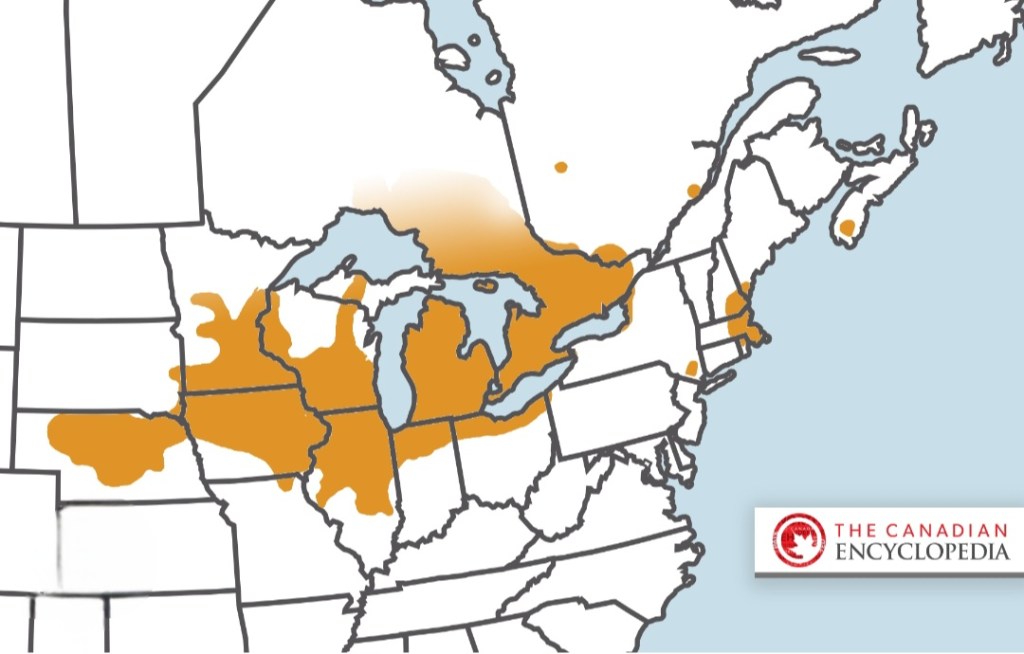
Blanding’s Turtle
Even in this limited area, it is uncommon, listed in most states and Ontario as a “threatened” species or a species of “special concern.” It has a ” special concern” status in Michigan. A Blanding’s Turtle on dry land in June is, like a Snapping Turtle, probably a female on an egg-laying mission.
The operator of the lawn mower on the “sledding hill” today asked if I could assist in moving a turtle so that he could continue mowing without injuring it. I definitely did not expect that it would be a Blanding’s Turtle, and I commend him for the “special concern.”
Blanding’s Turtle is a nedium sized turtle, with a carapace length of approximately 8 inches. Like the Snapping Turtle, it lays eggs in the ground, but if I understand correctly, it does so during the night.
Given its lack of abundance, there are not many places to see Blanding’s Turtles. It is great that it is present in Eliza Howell Park, another testimony to the wildlife riches here.
 Eliza Howell Nature Walk
Leave a comment