-
Eliza Howell Park: A Grateful Farewell
Leonard Weber
June 24, 2025
After over 20 years of frequent visits to Eliza Howell Park (some 2700 separate times), my regular nature walks here are at an end. Our new home is too far away for anything more than a very occasional visit.
I leave with many powerful memories and a deep sense of appreciation.

A path in the woods in fall I started blogging about nature observations in the park in late 2017. My first post was about “a sense of wonder.” My walks over the years have been filled with unexpected experiences and with great opportunities to learn, and my sense of wonder at the variety of the natural riches in this urban park has intensified.
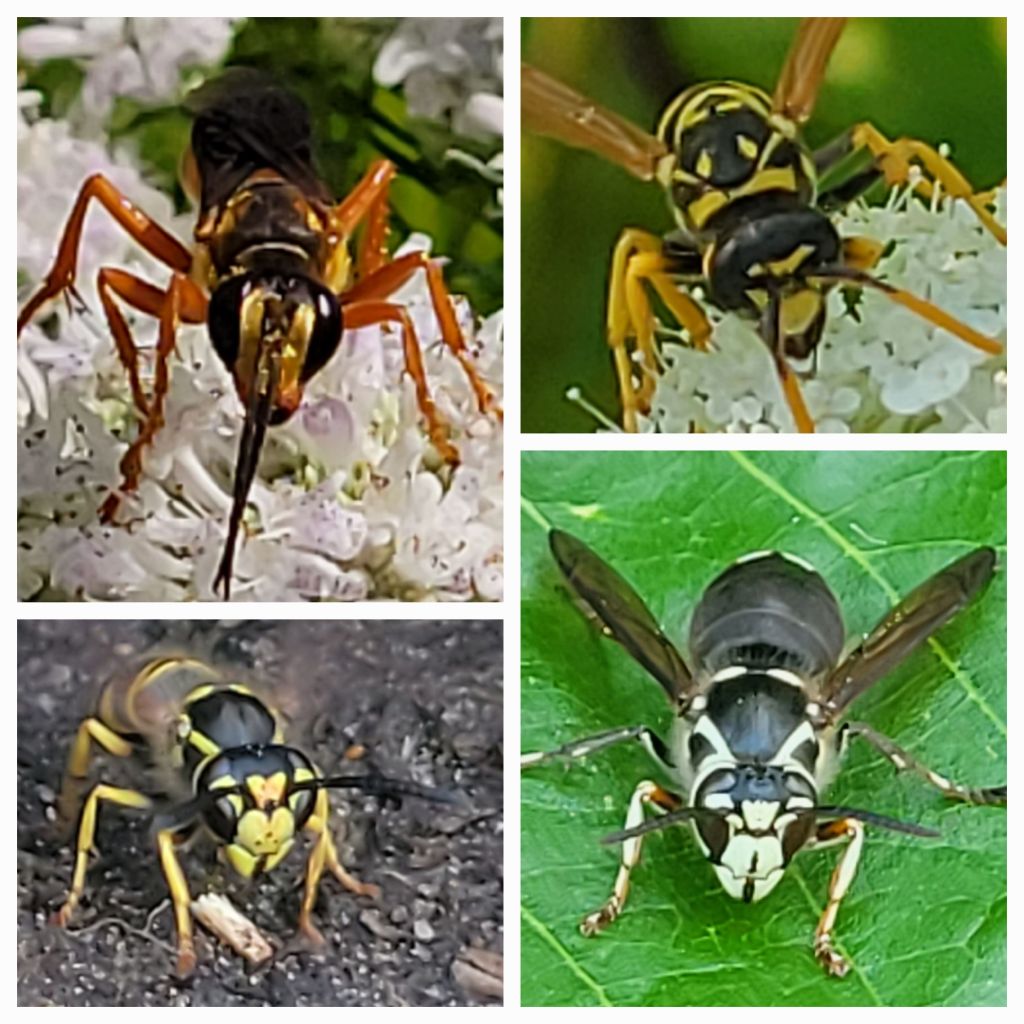
Four Eliza Howell wasps 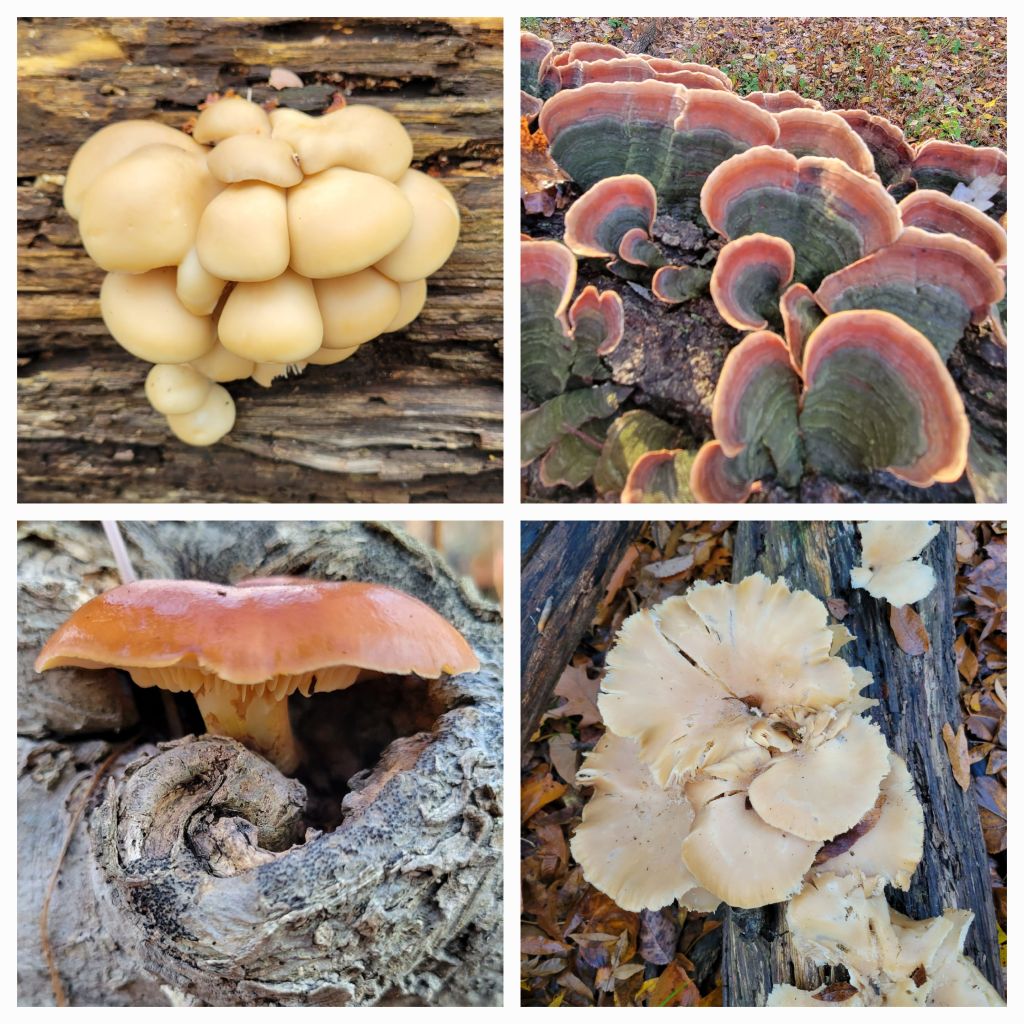
Mushrooms on logs 
The fruits of four climbing vines 
A sample of spring ephemeral wildflowers While I will not be posting regularly on current happenings in the park, I might occasionally report or reflect upon past Eliza Howell Park observations, using recorded information and photos that have not yet been presented.

Four of the many butterflies 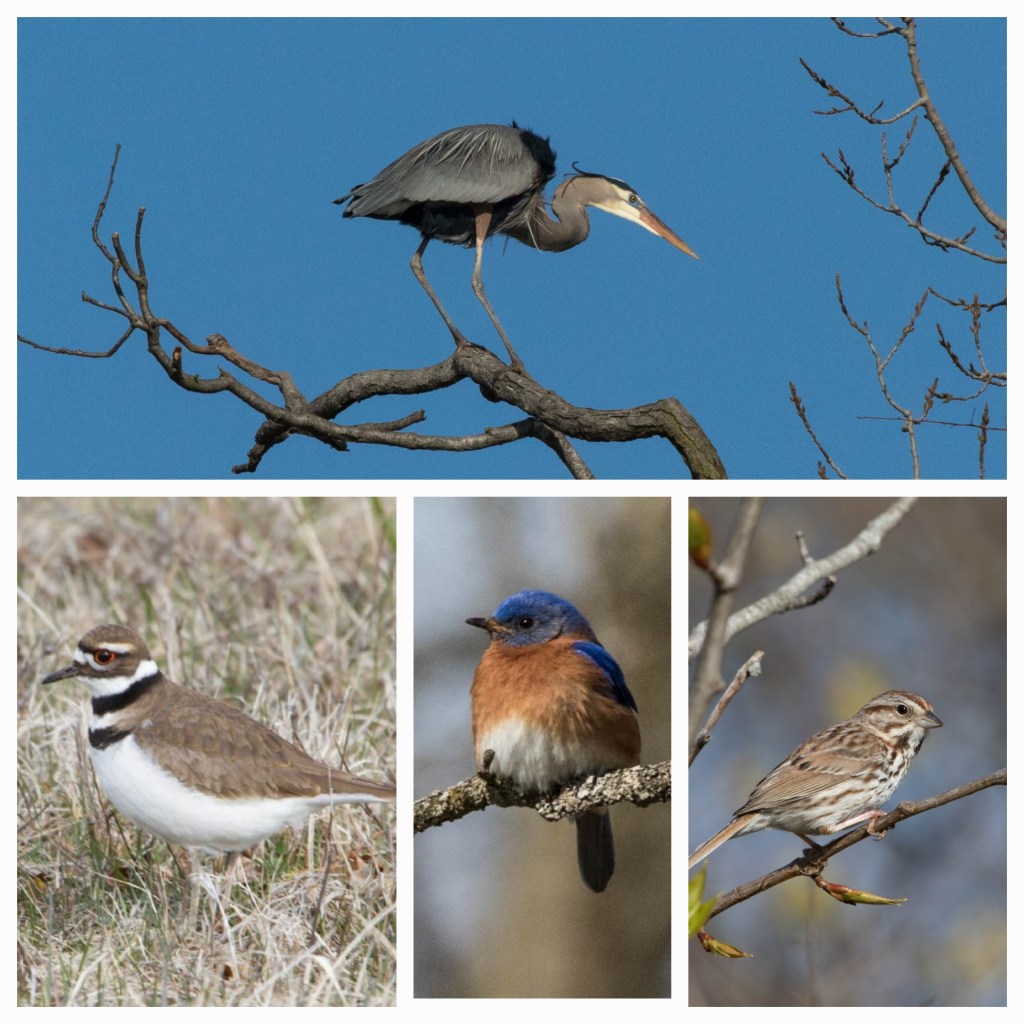
Four birds of summer
Photos courtesy of Margaret WeberWhen I first decided to devote most of my nature study to one park, I did so because of advice from nature writers that the best way to get to know nature well is to take the same walk repeatedly. I definitely benefitted from that advice.
I am immensely grateful for the approximate 8000 hours I was able to spend doing my slow, watchful walks in Eliza Howell Park in Detroit. I am also grateful for the opportunity to share my sense of wonder with others.
Farewell — for now.
-
Snapping Turtle and Blanding’s Turtle: June Is Nesting Time
Leonard Weber
June 12, 2025
June offers the best opportunity to spot turtles on dry land in Eliza Howell Park. In the last week, there has almost been enough traffic to consider placing a sign like this.

Three time in the last week, there has been a Snapping Turtle close to, or visible from, a walking path. Other walkers have reported additional sightings.

June 6, 2025 
June 9, 2025 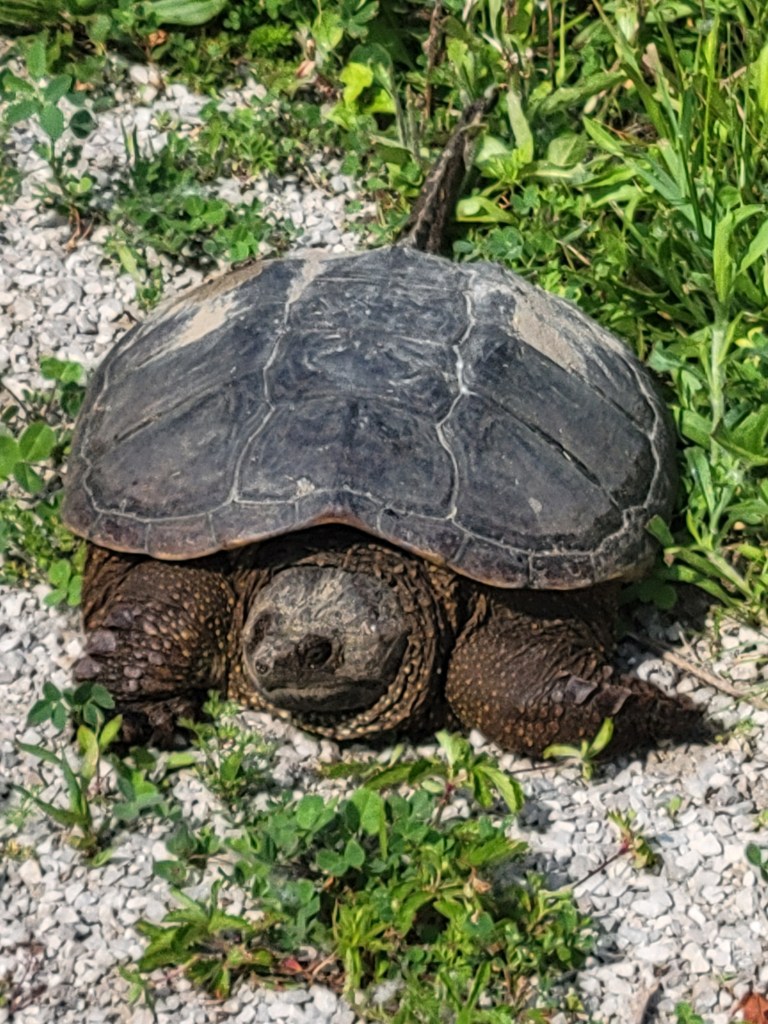
Another view, June 9, 2025 I was informed of the location of the most recent observation today by another park walker and arrived just as the turtle was finishing covering the eggs.

June 12, 2025.
Completing egg laying.Snapping Turtles spend almost their entire lives in water (and mud). The ones that we see away from water at this time of the year are, in all likelihood, females who are searching for a site to lay their eggs (or returning from egg laying).
Adult Snapping Turtles are large turtles; the carapace (top of the shell) can reach 20 inches in length. Adult Common Snapping Turtles have no non-human predators in Michigan and may live 40 years or so.
Three years ago, I had my first opportunity to observe an egg-laying snapper in the park.

Egg laying, June 15, 2022 Nesting Snapping Turtles dig a hole in loose dirt or sand, using their back legs, and deposit the eggs. Once the eggs are covered, the mother turtle is free to return to the water. The summer sun-heated dirt will be sufficiently warm for the eggs to hatch — usually after close to three months, depending upon the temperature.

Ready to leave the nest,
June 12, 2025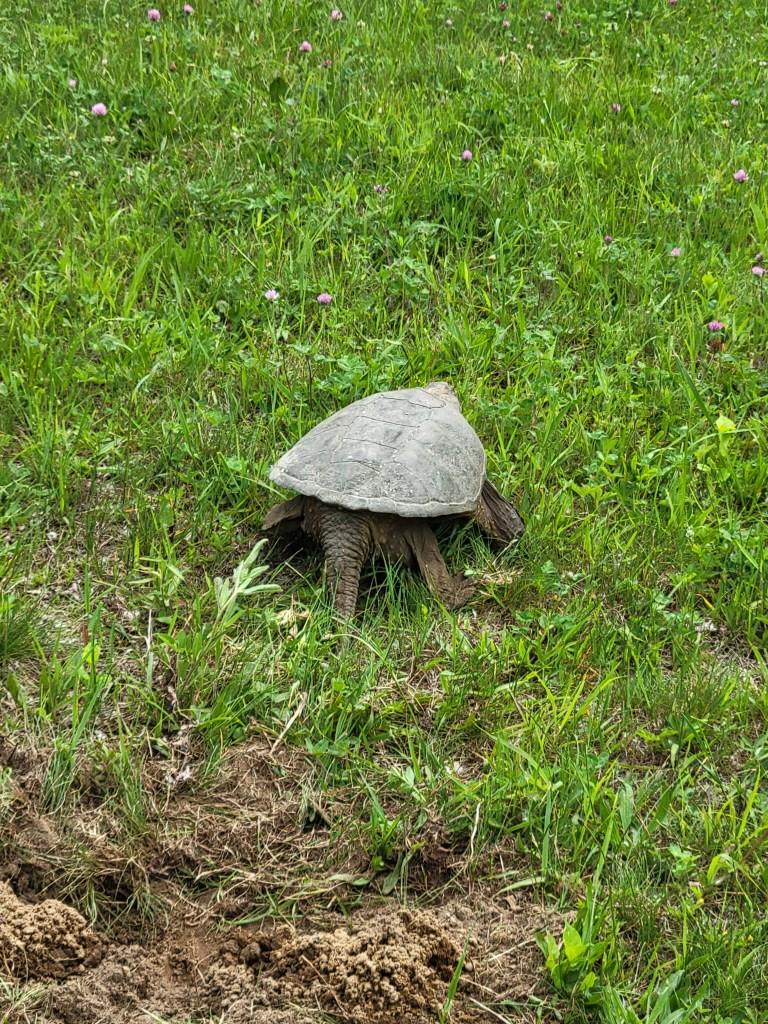
Walking away, nest completed.
June 12, 2025In 2022, I kept an eye on the calendar and started checking the nest location regularly in late August. On about day 80, the young emerged. They have to find their own way to water.

Leaving the nest,
September 3, 2022While adult Snapping Turtles have little risk of becoming food for predators, the situation is very different for the newly-hatched young. They do not yet have any shell protection, and published reports indicate that the vast majority do not survive the early months.

Baby Snapping Turtle, September 3, 2022 Ever since the experience in 2022, I have been hoping to find a nesting snapper again. But the excitement of seeing one today was matched by the excitement of seeing a Blanding’s Turtle, the first time I have been aware of one in the park.

Blanding’s Turtle,
June 12, 2025
Blanding’s Turtle is not a common species, found almost only in the Great Lakes area. The following map is from The Canadian Encyclopedia.
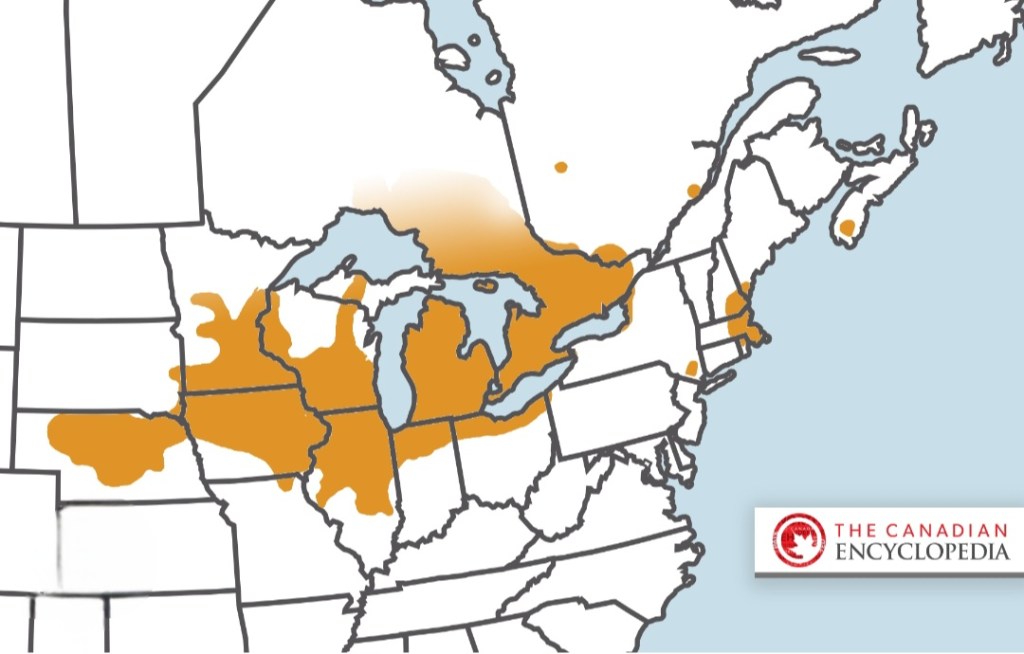
Range map for
Blanding’s TurtleEven in this limited area, it is uncommon, listed in most states and Ontario as a “threatened” species or a species of “special concern.” It has a ” special concern” status in Michigan. A Blanding’s Turtle on dry land in June is, like a Snapping Turtle, probably a female on an egg-laying mission.
The operator of the lawn mower on the “sledding hill” today asked if I could assist in moving a turtle so that he could continue mowing without injuring it. I definitely did not expect that it would be a Blanding’s Turtle, and I commend him for the “special concern.”
Blanding’s Turtle is a nedium sized turtle, with a carapace length of approximately 8 inches. Like the Snapping Turtle, it lays eggs in the ground, but if I understand correctly, it does so during the night.
Given its lack of abundance, there are not many places to see Blanding’s Turtles. It is great that it is present in Eliza Howell Park, another testimony to the wildlife riches here.
-
Red Clover and June Butterflies
Leonard Weber
June 4, 2025
Many of the biggest and brightest butterflies have not yet put in an appearance this year in Eliza Howell Park, though several smaller ones can now be found regularly.
Today, I pulled myself away from watching nesting-related bird activity to check for butterflies on and around the Red Clover that has recently begun to bloom.

Red Clover Red Clover attracts nectaring butterflies and is now blooming, when many of the other wildflowers that butterflies seek out for nectar are still days to weeks away from flowering.

Red Clover in the midst of a patch of smaller White Clover I succeeded today in finding several Peck’s Skippers on Red Clover — and in getting a couple photos of them. As is typical of skippers, Peck’s are very small.

Peck’s Skipper, June 2025 
Peck’s Skipper, June 2025 In past Junes, I have seen a variety of other butterflies visiting Red Clover in Eliza Howell.
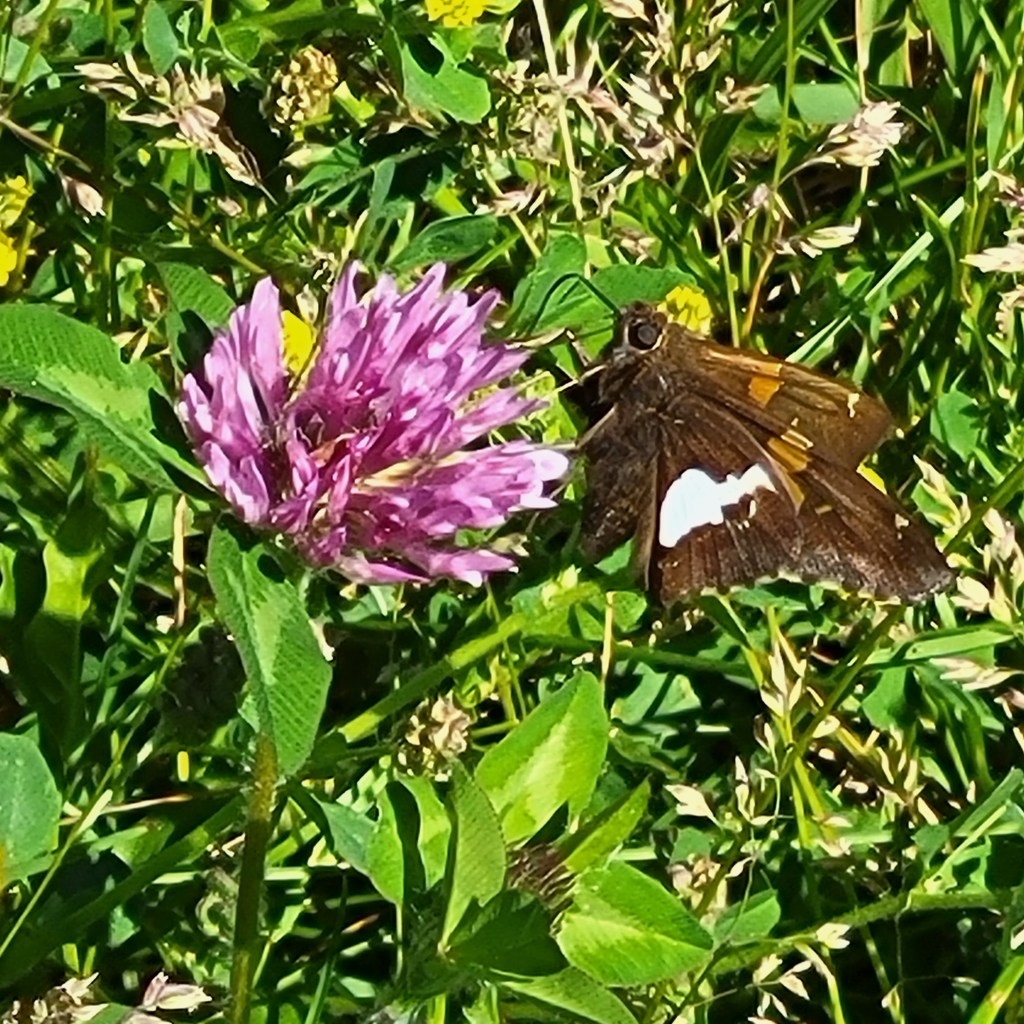
Silver-spotted Skipper,
a previous June
Eastern Tiger Swallowtail,
a previous June
American Lady,
a previous June
Monarch, a previous June 
Common Ringlet,
a previous JuneAs these photos show, Red Clover serves as a food source for many adult butterflies. In addition, it is one of the host plants for the larvae of at least three buterfly species that are found in Eliza Howell Park: Eastern Tailed-Blue, Clouded Sulphur, and Orange Sulphur.
Red Clover was introduced from Europe, probably already in the 1600s, as a hay crop for cattle and as a cover
crop to improve soil (it is a legume that fixes nitrogen). It is one introduced plant that seems to have become well integrated into the lives of native insects.

Red Clover has long been a favorite flower of mine. I like the purple flower head made up of many individual flowers. I like the lighter-colored chevron (inverted V) in the leaves. I like that the species serves as a nectar source for butterflies and other insects during a season when nectar sources are not yet abundant.
-
Wood Duck Incubation: The Big Sit
Leonard Weber
May 29, 2025
Bird watchers sometimes set out to see how many species they can see / hear in 24 hours. This is usually referred to as “the big day” count. In recent years, I have become aware of a variation of this: “the big sit.” Watchers stay within a 17-foot diameter circle and count the number of species seen / heard there in 24 hours.
On April 22 this year, I started counting the days for a Wood Duck incubation to be complete, another type of “big sit.”
My watching began on April 15, when I noticed several eggs (at least 4) in the wood shavings of one of the Wood Duck boxes.

April 15 A Wood Duck hen will typically lay an egg a day until the hutch is complete (perhaps 8 – 10 eggs) and then begin incubation. Since she was not on the nest regularly yet, I stopped by occasionally and stuck my phone in the entrance hole to get a sense of how things were going. I always knocked first so that, in case she was there, she would not be startled by the phone in the entrance hole.
Soon, I noticed that she had started adding white feather down from her body to line the nest.

April 18 I couldn’t see or count the eggs, but it was obvious that the nesting process was continuing.

April 21 On April 22, when my knock, as usual, resulted in no sound or movement inside, I was a little surprised when I looked at my quick photo and saw that the mother hen was on the nest.

April 22 Over the next four weeks, I kept my distance from the nest box, wanting to give her privacy and to do nothing that might disturb her.
The published reports on the normal length of Wood Duck incubation vary a little, but generally indicated that it lasts about 28 – 32 days.
When Wood Ducks hatch, they are ready to leave the nest. They have down feathers, are able to walk and swim, and able to feed themselves. To reach this stage of development before hatching, incubation, done by the female alone, is necessarily quite long.
On May 21, the 30th day since I first spotted her on the nest, I stopped by the bird box again. I heard nothing in response to my knock and tried to get a photo. It was a heavily clouded and very dark day, and I had a hard time getting a photo that showed what was in the box. I did see enough to know that the mother duck was still there.

May 21 Since she was still on the nest after a month, I knew that nothing had yet stopped the process. It was very likely now that the eggs would hatch soon.
I silently recognized her perseverance (she spends about 21 – 22 hours a day on the nest during incubation) and decided to come back in a few days, when, in all likelihood, the hen and ducklings would had left.
About a day after young Wood Ducks hatch, the ducklings respond to a call from the mother and climb up to the entrance hole — and jump out. Then they follow the mother to water. In this case, the location of the nest box is about 30 yards from the river.
I waited a few days before I looked in the box again. Seeing it empty of birds, I opened it to get a good look at the softest white down, all that remained.
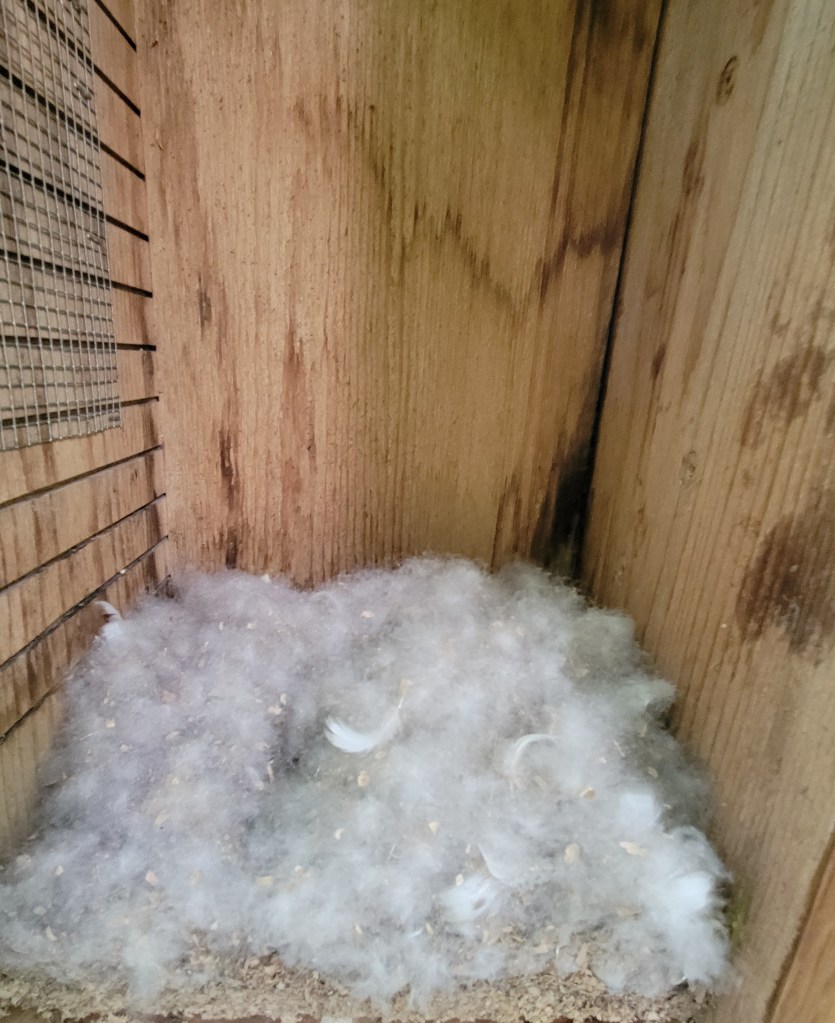
May 27 It appeared that the eggs had all hatched. If the hen had averaged 21 hours a day on the nest for 31 days, she had been there 651 hours. That is indeed a big sit!
The young are tended by the female alone. They are able to fly about 60 days after hatching.
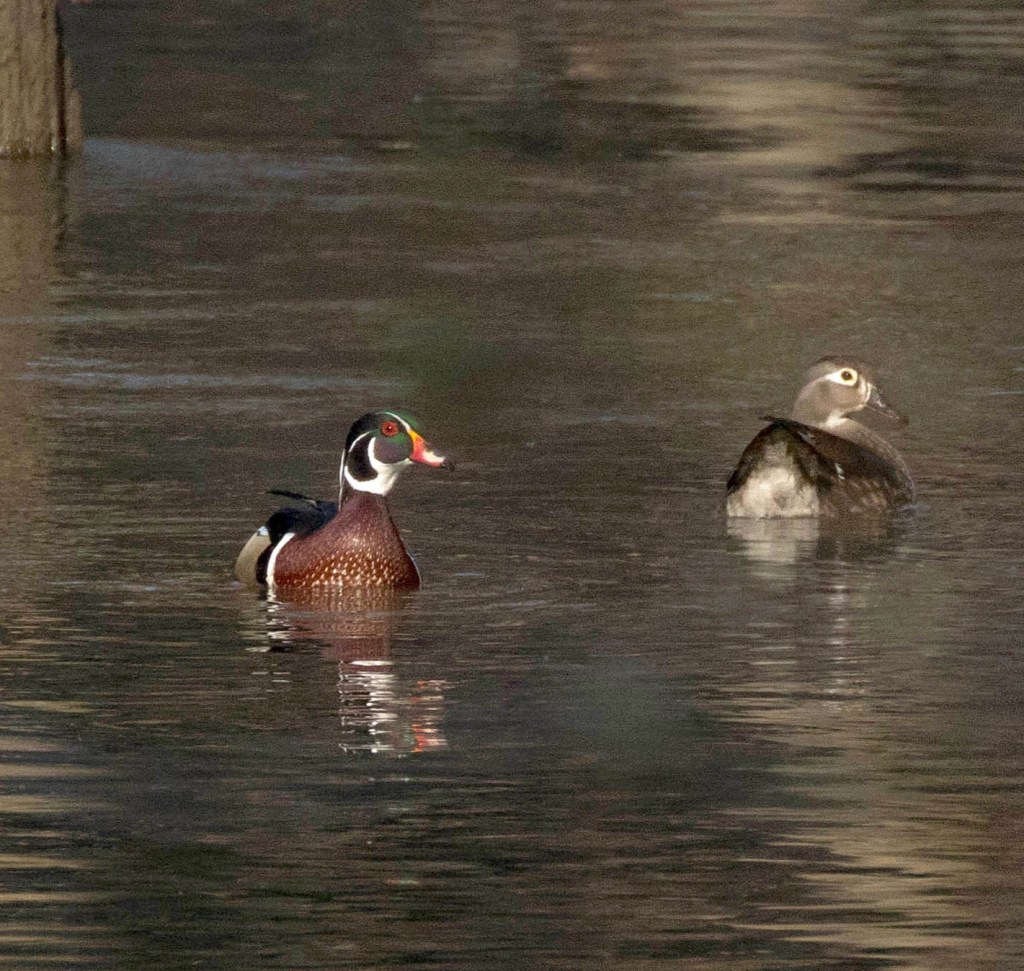
Adult male and female Wood Duck. Photo courtesy of Margaret Weber After counting the incubation hours and days this spring, any occasion of seeing Wood Ducks in the future is likely to remind me of the hen’s many hours on the nest, her big sit.
-
Golden Alexander — and Black Swallowtail
Leonard Weber
May 21, 2025
The season for enjoying the field / prairie wildflowers in Eliza Howell Park is just beginning in the second half of May. Recently, for example, I saw the first Wild Lupine in bloom in 2025.

Wild Lupine This year, the early field wildflower that has been catching much of my attention is Golden Alexander. It grows in small colonies, is about 1 – 2 feet high, and has yellow flowers in May and June.
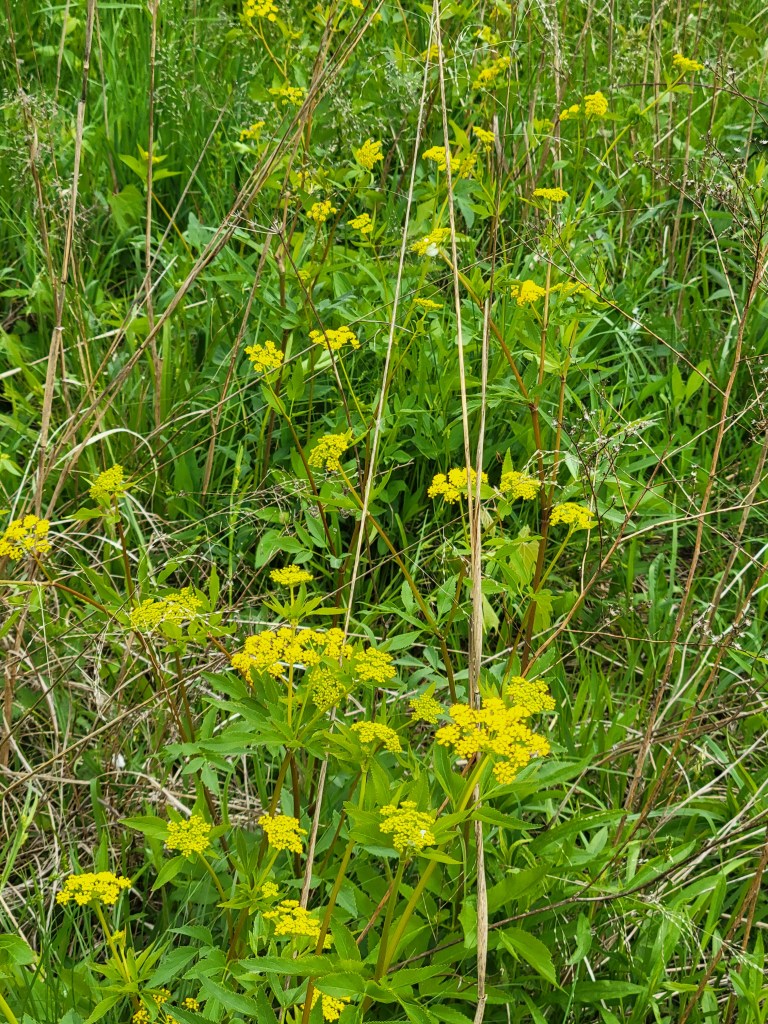
A patch of Golden Alexander 
Golden Alexander cluster of flowers Golden Alexander is found primarily in a wet soil area that was seeded with a prairie seed mix several years ago. It is a native plant that grows well in sunshine and is often included in such seed mixes.

It seems to be becoming more common in Eliza Howell Park; at least, I am becoming more aware of it here. It has, however, been well known for centuries in the eastern half of (what is now known as) North America. Native Americans used it medicinally (for example, to treat fever and to help heal wounds).
Golden Alexander is a member of the carrot plant family and, like other members of this family, is a host plant for the Black Swallowtail butterfly. This butterfly lays its eggs on the leaves of various carrot family plants; the caterpillars then feed on the leaves.

Black Swallowtail female 
Black Swallowtail male 
Black Swallowtail caterpillar (magnified) Black Swallowtails are quite common in Detroit and gardeners might find the caterpillars on their carrot or parsley plants. In the park, I have several times found them on Queen Anne’s Lace (sometimes called Wild Carrot). Now that Golden Alexander is spreading here, nature walkers might want to check the leaves of this plant for the next generation of Black Swallowtail.

Black Swallowtail The weather the last couple days has been cool and heavily overcast. When the sunshine returns, when the temperature rises, when the flowers open more fully, it will be time to check which pollinating insects are most attracted to the Golden Alexander small yellow flowers.
Golden Alexander is another addition to the flora and fauna that claim my attention during walks in the park.
-
Bluebirds Take Over Chickadee Nest
Leonard Weber
May 15, 2025
Some birds build nests in trees or shrubs; some birds nest on the ground; some birds nest in cavities (holes) in trees. Especially among cavity nesting birds, there can be competition, with two different species wanting the same site. I have recently been watching an example.

Nest box in Eliza Howell Park Cavity nesting birds will often use bird boxes (which are human-provided cavities). One in particular, built by a colleague using a design for a bluebird box, has been quite popular. In 2022, House Wrens used the box. In 2023 and 2024, Black-capped Chickadees used it.
In 2023, I wondered whether House Wrens would try to take the box when they returned to Michigan. They have a reputation of being very aggressive toward birds like Chickadees in the selection of nesting site. No Wrens came around the area that year.
After cleaning the box out last winter, I started checking it again in April.

Black-capped Chickadee nest in box, April 28 There were no eggs yet on April 28, but the nest was characteristic of Black-capped Chickadees. Chickadees put down a layer of moss before adding other nesting material on top.
A little later, I heard and saw a Chickadee, confirmation of the nesters’ identity.

Black-capped Chickadee nest, May 5 When it looked like no bird was in the box on May 5, I checked agian. The nest now contained 6 Chickadee eggs. Since no adult was present, my guess was that egg laying was not yet complete (it is not unusual for Chickadees to have an even larger clutch of eggs) and that incubation had not yet begun.

Black-capped Chickadee. Photo courtesy of Margaret Weber Twice in the days before May 5, I saw a pair of Eastern Bluebirds come to the box, look in a couple of times, then go away.
On May 8, the Bluebirds were back. This time, the female Bluebird went in the box and stayed for a while. As soon as the Bluebirds flew away, I hurried to the box to take a look.

No eggs visible, May 8 The nesting material appeared to be a little deeper/higher, and I saw no evidence of Chickadee eggs, whole or broken. This now had the appearance of a Bluebird nest. I do not know what happened to the eggs. Perhaps they were just covered over?
On May 14, I again took a look.
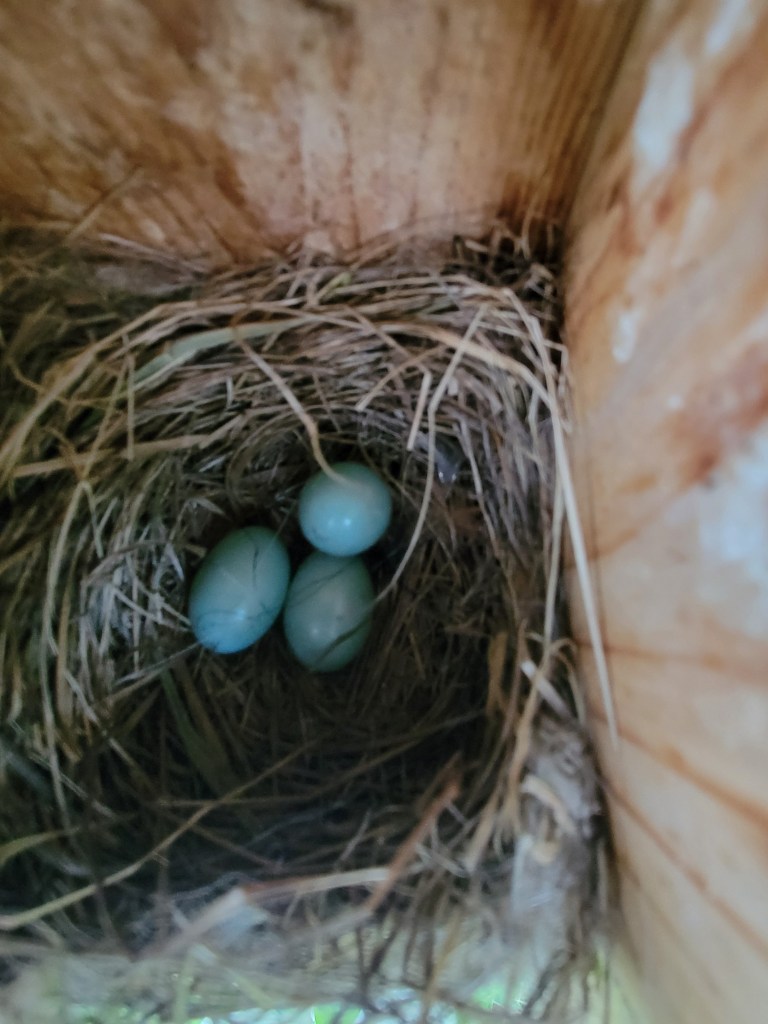
Eastern Bluebird nest, May 14 These are Bluebird eggs. While the fate of the Chickadee eggs is unknown, the Bluebirds have definitely taken over the box. The pair of Chickadees may have put up some resistance to being displaced, but Bluebirds are larger and, according published reports, they almost always succeed in securing a nesting box also wanted by Black-capped Chickadees.

Eastern Bluebird male. Photo courtesy of Margaret Weber The Chickadee pair is perhaps already starting another nesting attempt in another cavity. I do not know.
—–
There are, of course, other cases of competition between cavity nesting birds for particular sites: between Tree Swallows and Bluebirds, for example, or between European Starlings and Red-bellied Woodpeckers.
Some birds nest in trees. Some birds nest on the ground. Some birds compete for the same cavity nesting sites. There is always something more to learn about the behavior of birds in nesting season in Eliza HowellPark.
-
Mayapple in Bloom: Toxic with Medicinal Qualities
Leonard Weber
May 7, 2025
Mayapple is a very common plant found in parts of the Eliza Howell Park forest.
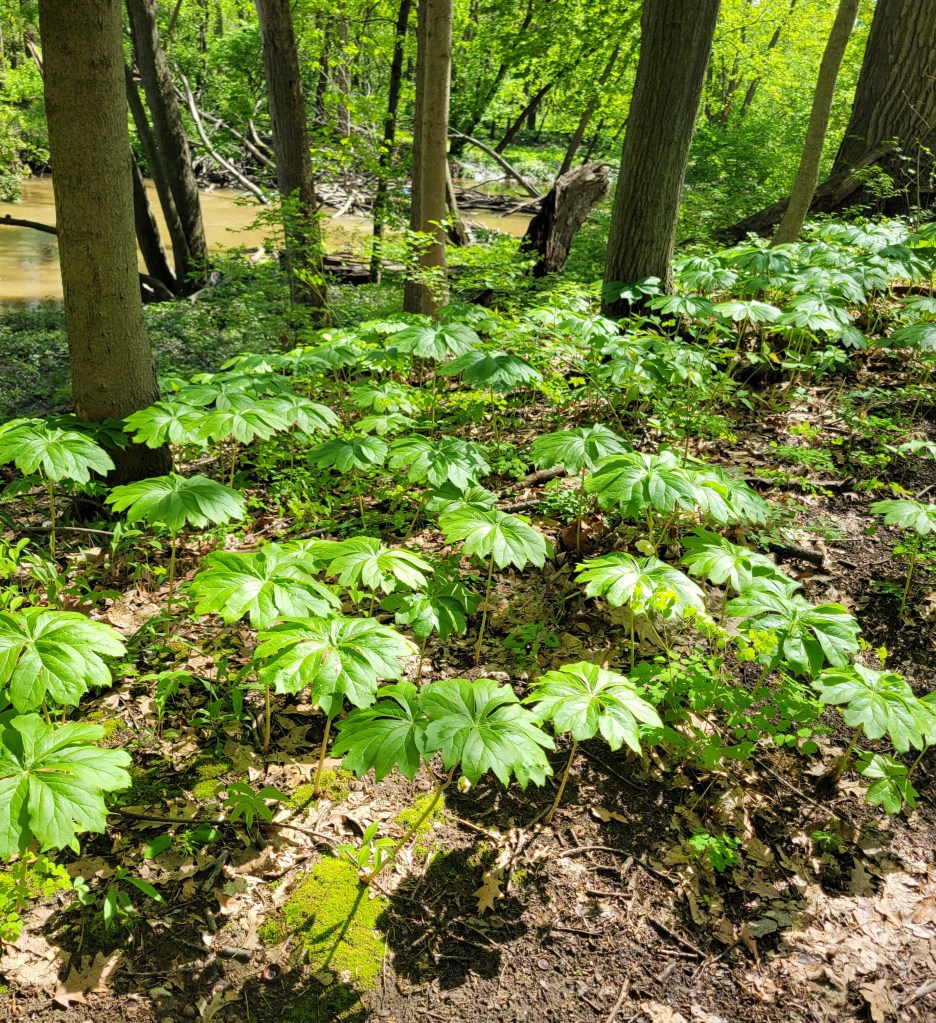
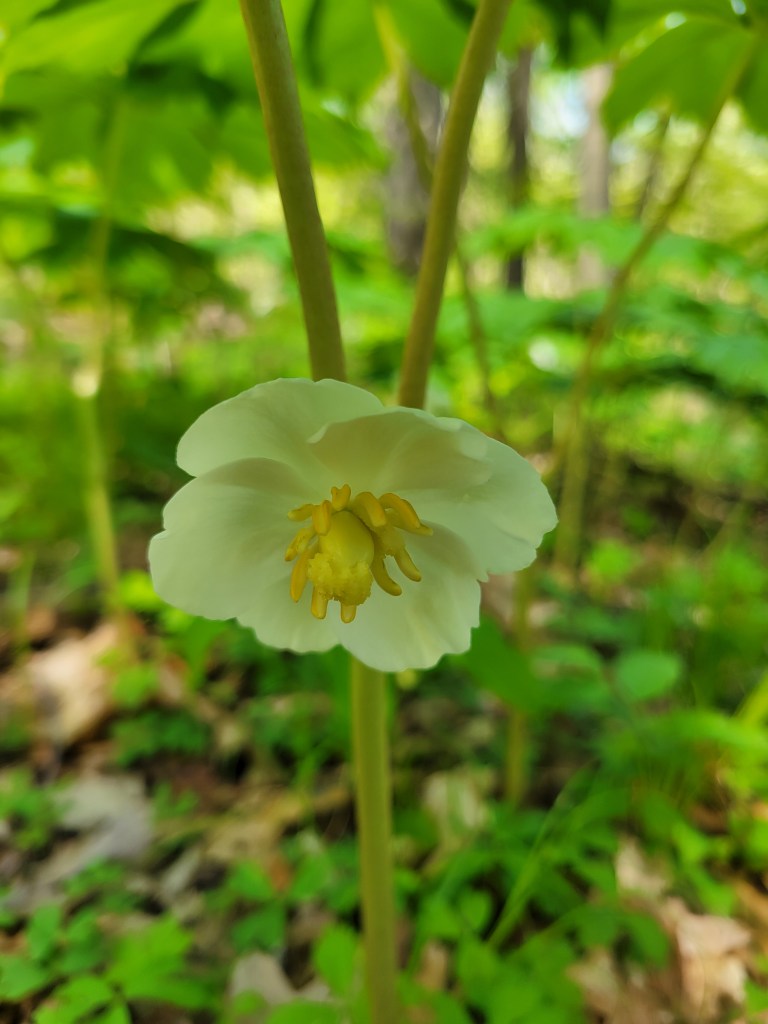
The plants resemble a group of umbrellas; the Cherokee name for it has been translated as “it wears a hat.” To see the flower and, later, the fruit, one needs to look under the umbrella.

Some plants have two leaves, with the flower/fruit stem growing from the point at which they separate.
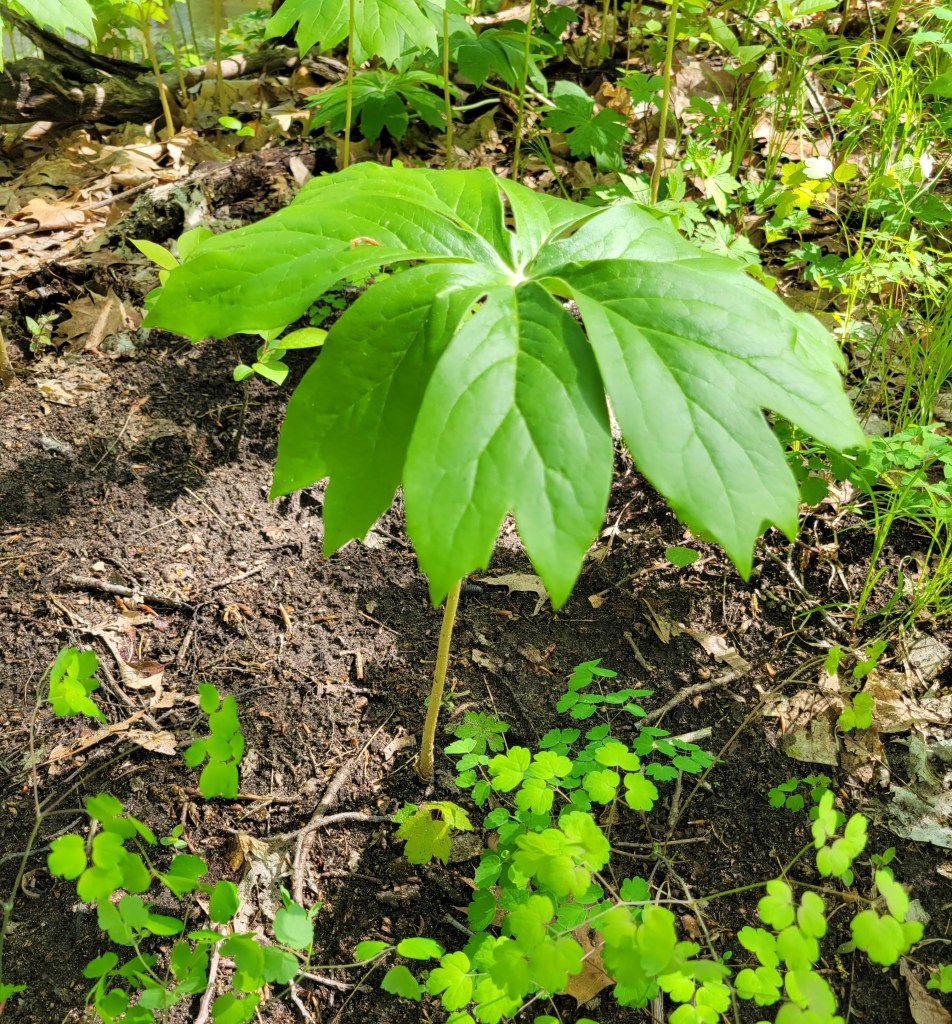
Some have only one leaf. In these cases, there is no flower.
Mayapple is flowering now, and the apple-like fruit matures in the summer. The fruit is green at first, ripening to yellow.
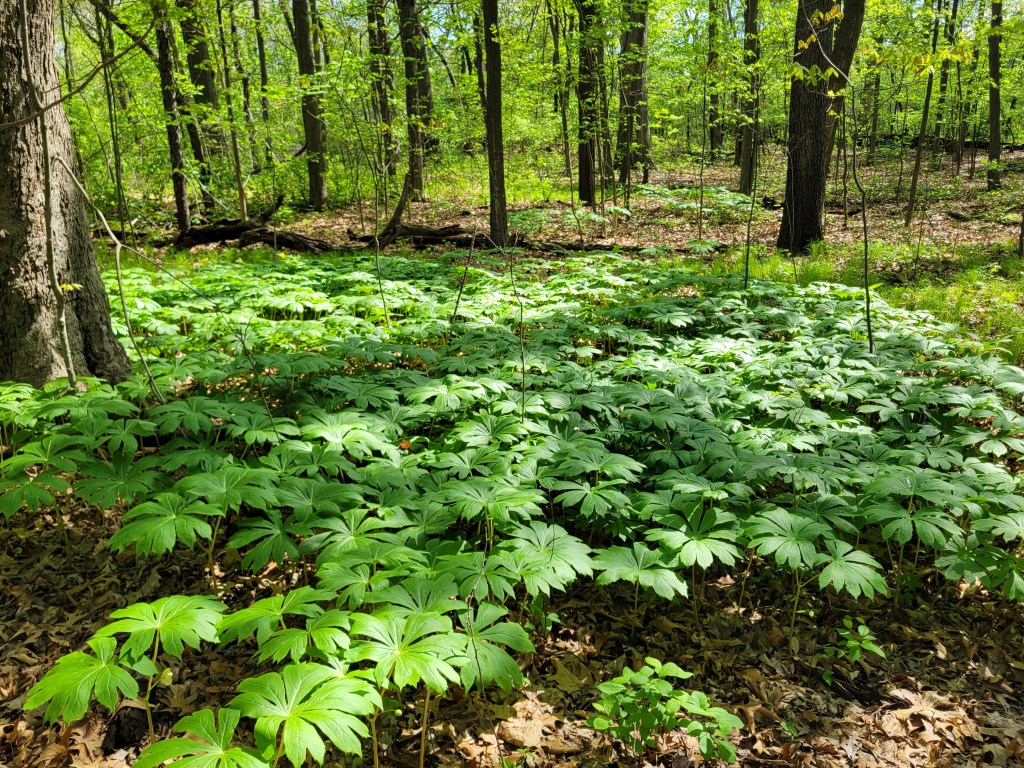
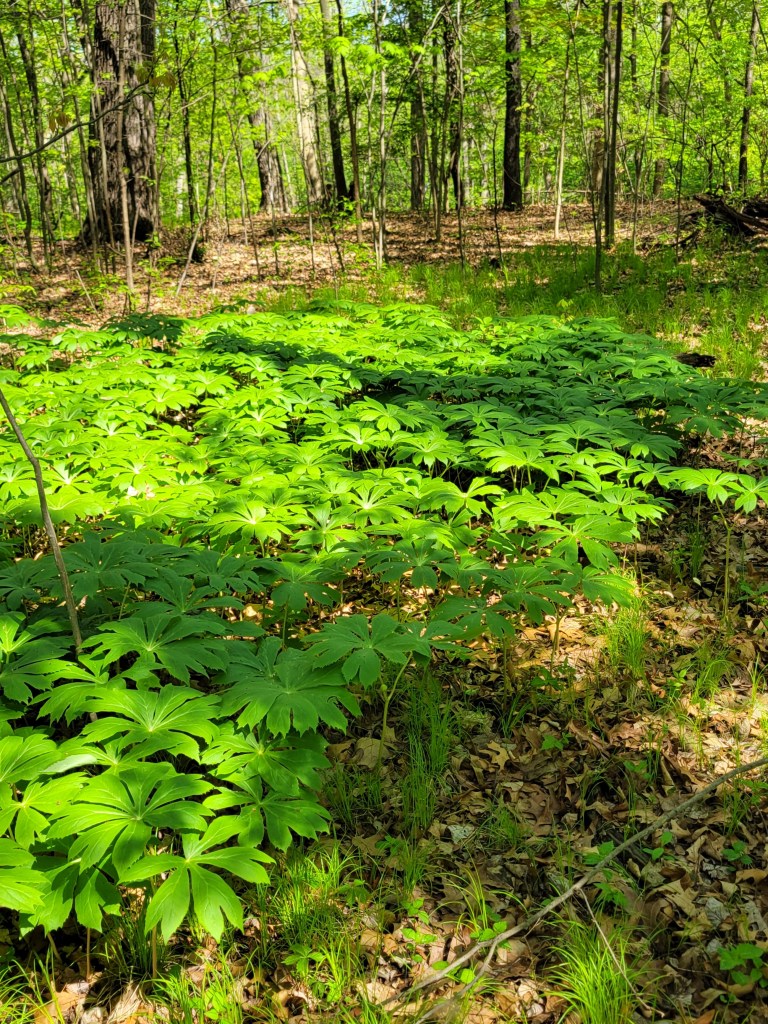
Mayapple spreads by rhizomes, with a common root system supporting many stalks.
Deer that are common in the park and consume many other green plants do not feed on Mayapple. Mayapple leaves, stems, roots, flowers, and fruit are all toxic to some extent.
The plant was considered medicinal by many indigenous Americans, used as a purgative as well as for other purposes. The Osage name for Mayapple is translated as “it pains the bowels.”
Even those of us who are old enough to remember “Carter’s little liver pills” might not know that Mayapple was the ingredient that made the pill a laxative.
Mayapple continues to be of medicinal interest, studied in recent decades especially for its anti-cancer properties.
I do not know of other Eliza Howell spring flowers that compare with Mayapple in terms of the historical and ongoing medical interest.
Long before I learned about their medicinal qualities, however, I greatly enjoyed coming upon a Mayapple patch. It is a fascinating colony flower, and this is the season it is in bloom. It is a highlight of the forest floor in May!
-
Dryad’s Saddle and Baltimore Oriole: Right on Time
Leonard Weber
April 30, 2025
It happens at approximately the same time every year. One appears on the surface of dead trees and logs, and one flies in from Central America. As April turns into May, there are many species making their first annual appearance in Detroit’s Eliza Howell Park. Two of these are Dryad’s Saddle and Baltimore Oriole.
Dryad’s Saddle is an attractive and fast-growing shelf mushroom that I first see each year in April, usually late April. They are quite common and grow well into May.
These photos show examples from the last week of April 2025.


Over the last seven years, my first observation of Dryad’s Saddle in the park has been on these dates:
2019 – April 28
2020 – April 26
2021 – April 18
2022 – April 29
2023 – April 14
2024 – April 22
2025 – April 23
The seasonal predictability of Dryad’s Saddle’s emergence on dead wood is obvious from this record, but it is less precise than the appearance of the long-distance migrant Baltimore Oriole.
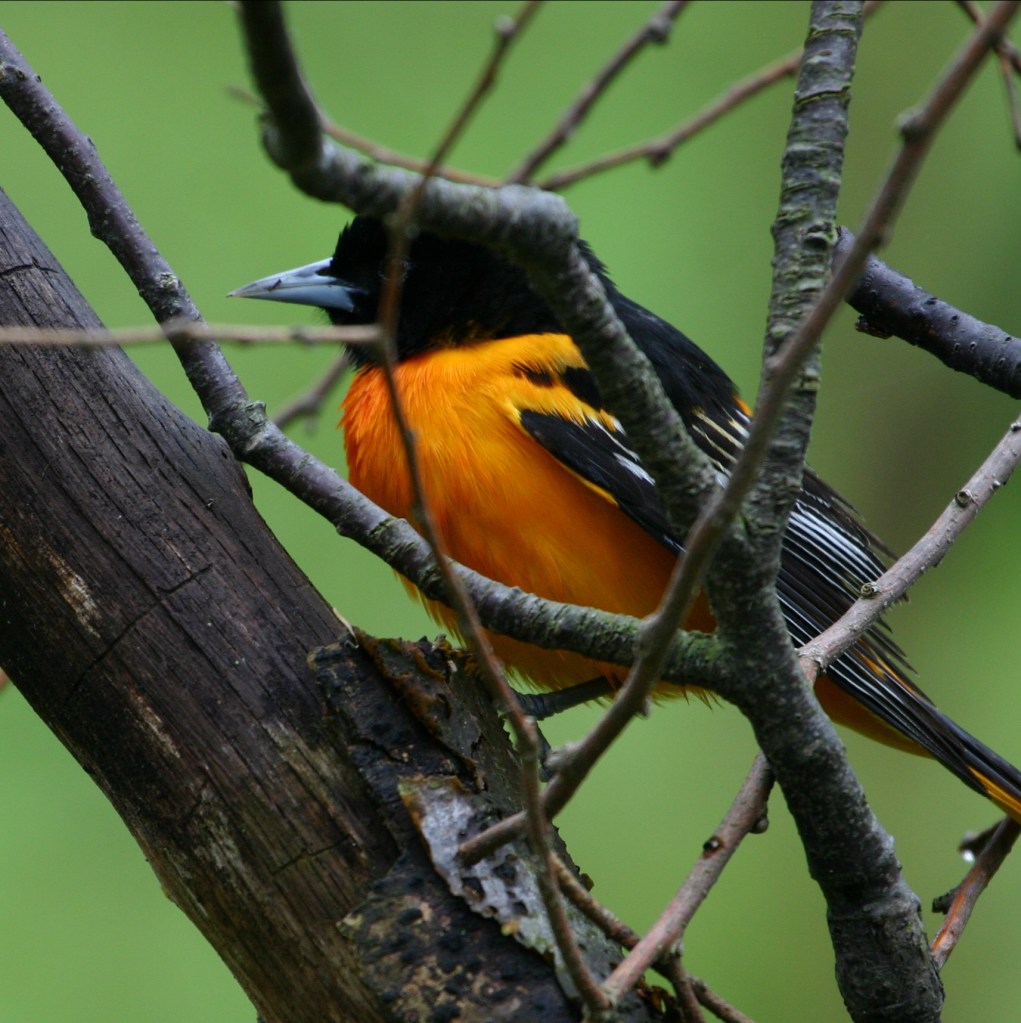
Baltimore Oriole male. Photo courtesy of Margaret Weber I have kept records of the first sighting of a Baltimore Oriole in the park for a longer period of time. 2025 is the 15th year.
2011 – May 8
2012 – May 1
2013 – May 5
2014 – May 6
2015 – May 6
2016 – May 7
2017 – May 1
2018 – May 4
2019 – May 5
2020 – May 4
2021 – May 2
2022 – May 4
2023 – May 6
2024 – May 1
2025 – April 30
Over these 15 years, I have first spotted one between April 30 and May 8 every single year. And they arrive on this predictable schedule after a flight of some 2000 milies.

Baltimore Oriole male. Photo courtesy of Margaret Weber Several Baltimore Orioles nests can be found in the park every year. After arriving about the beginning of May, we start finding nests within a couple weeks.

Baltimore Oriole female and nest. Photo courtesy of Margaret Weber The time of the first observation of a Gray Catbird is just as consistent. Over these last 15 years, the first observation has been between April 29 and May 7 every year.

Gray Catbird. Photo courtesy of Margaret Weber There are many other species appearances or other developments that are quite predictable. Every visit to the park, especially when spring is coming into its fullness, is a time of expectation: “It’s about time to see …”
There is something very satisfying and reassuring about Nature’s recurring cycle!
-
Watching Warblers: Neotropical Migrant Season Begins
Leonard Weber
April 21, 2025
Birds that breed in North America and winter in the “new world” tropics (Central / South Anerica and Mexico) are often called neotropical migrants. They migrate long distances and will be arriving soon in our area on their way to their 2025 breeding grounds.
Among the many species of neotropicals are warblers, a large family of small, often colorful, birds that include over 30 species that can be found in Michigan annually.
Here are some examples.

From top left clockwise: Magnolia Warbler, Chestnut-sided Warbler, Bay-breasted Warbler,
Cape May Warbler. Photos courtesy of Margaret WeberA number of warblers appear in Detroit’s Eliza Howell Park in the spring, though the exact number that stop here on their northward migration varies from year to year. The first ones will start arriving before the end of April, with their spring migration peaking in the first ten days to two weeks of May.
Below are 8 warbler species that are likely to be seen in the park during spring migration (though not on every visit).
1. Yellow-rumped Warbler

Yellow-rumped Warbler.
Photo courtesy of
Margaret WeberYellow-rumped Warbler is perhaps the most common warbler in spring migration here and is almost always the earliest to appear. They do not remain in this area to breed, passing through to their nesting area further north.
In 2025, Yellow-rumped Warbler is again the first to be seen, the first one spotted on April 21.
2. Palm Warbler
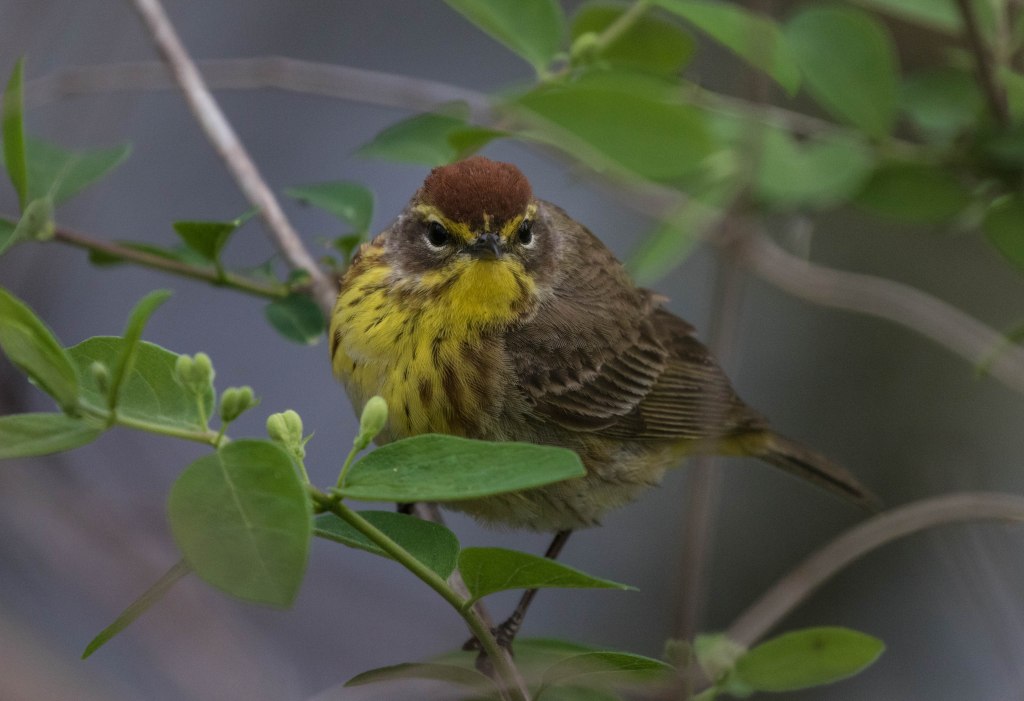
Palm Warbler.
Photo courtesy of
Margaret WeberPalm Warbler is another that is likely to be seen in April. Their migration is very long; most of them are headed to the boreal forests of Canada to breed.
Palm Warbler can sometimes be recognized by its tail bobbing.
3. Nashville Warbler

Nashville Warbler.
Photo courtesy of
Margaret WeberNashville Warbler has a misleading name. It appears in or near Nashville only in migration; it has no special connection to the city. It is often seen relatively close to the ground.
4. Black-and-white Warbler
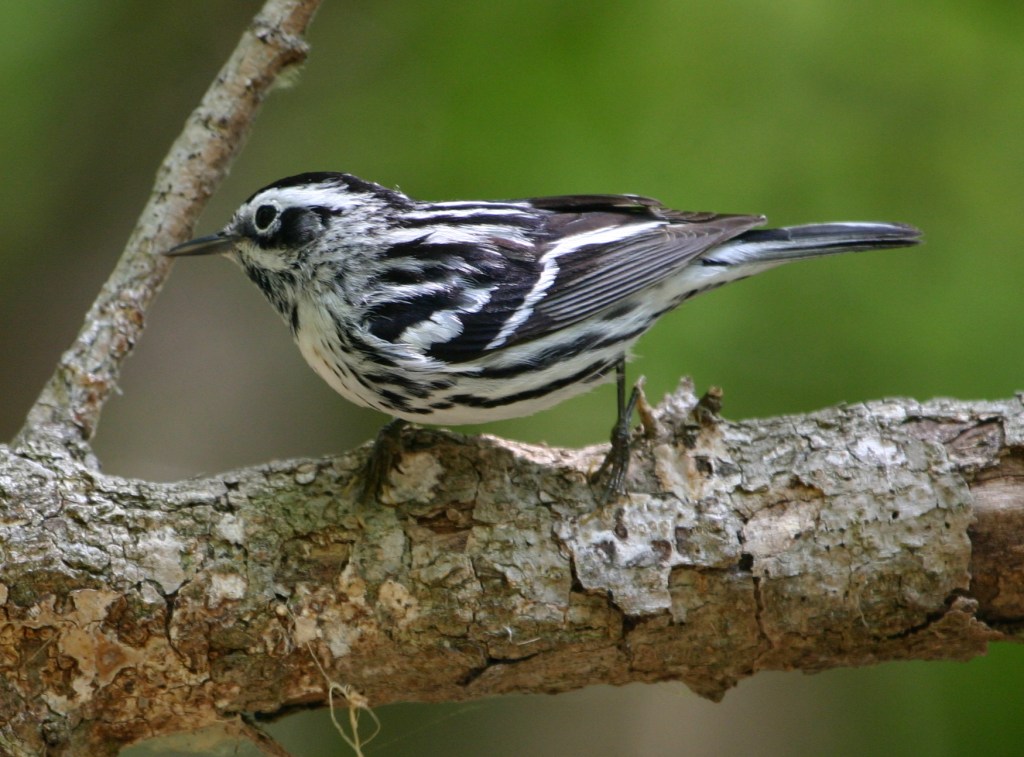
Black-and–white Warbler.
Photo courtesy of
Margaret WeberThis warbler’s behavior is a little different from that of other warblers. It is usually seen creeping along on larger limbs and trunks of trees, while other warblers typically forage among small limbs and leaves.
5. American Redstart

American Redstart.
Photo courtesy of
Margaret WeberThe male American Redstart is mostly black with red-orange patches. The female is more gray above, white below, with yellow wing and tail patches. The breeding range includes southern Michigan, though I am not aware of any nesting in the park in recent years.
6. Black-throated Green Warbler
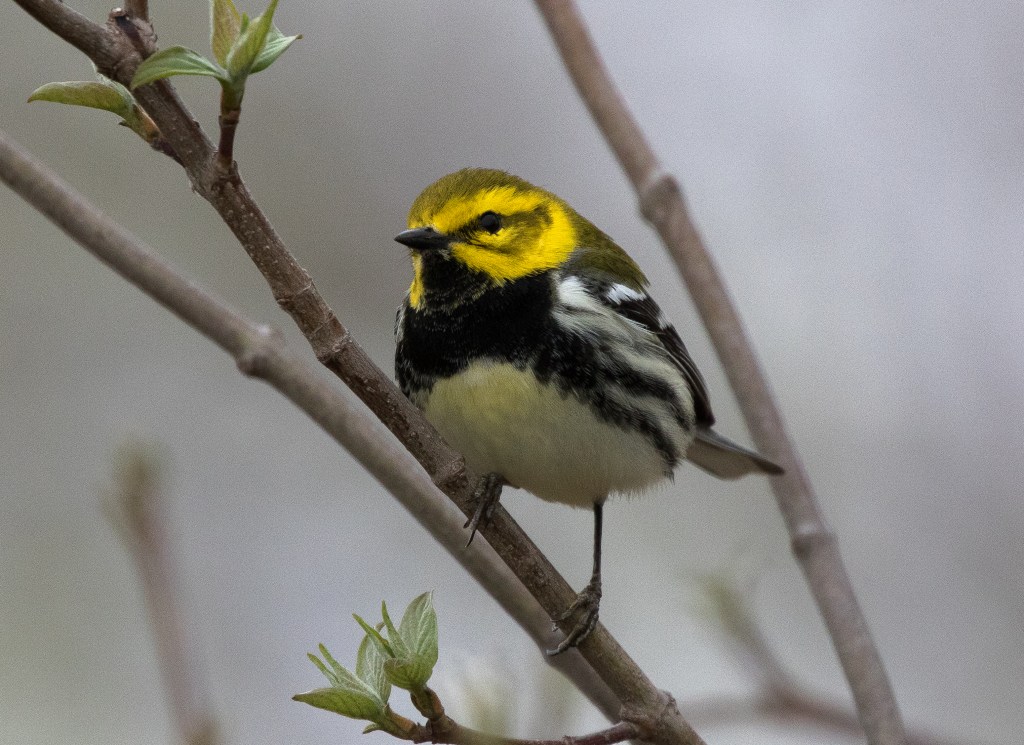
Black-throated Green Warbler. Photo courtesy of
Margaret WeberThis is a warbler that is often high in tall trees. The most distinctive feature is the yellow face. In females, the throat is mostly white.
7. Yellow Warbler

Yellow Warbler.
Photo courtesy of
Margaret WeberWhile many warblers have some yellow, this is the species that is named after the color. Yellow Warbler is the only warbler that I have found nesting in the park in my years of nature walks here.
8. Northern Parula

Northern Parula.
Photo courtesy of
Margaret WeberNorthern Parula is small, even for a warbler. Though it can be seen in Eliza Howell Park almost every spring, it is never in large numbers. Its small numbers, plus the distinctive colors, mean that seeing one is always exciting.
—
For many bird watchers, spring migration is the most exciting time of the year, and warblers are the most exciting part of spring migration. Because the warblers are only around for a few days each year and because there are so many species, getting to know them can be difficult.
A good recommendation is to get to know a few at a time. In Eliza Howell Park, these 8 might be a good start.
-
April Highlights: Flowers, Toads, Butterflies, Mushrooms, and more
Leonard Weber
April 13, 2025
Repeated visits to the same natural area over the years, season after season, allows one to know what to expect when. Based on past experience, here is a list of several spring events that nature walkers in Eliza Howell Park will have an opportunity to observe in the remainder of April.
1. Flowering Redbud
The Eastern Redbud is a small tree that blooms pink in the spring before its leaves appear.

Redbud in April 
The Eliza Howell redbuds are scattered and easily visible from the road and walking path when in full bloom before the end of April.
2. Nesting Killdeer
Killdeer nest on the ground, but the nests, out in the open, are very difficult to find.
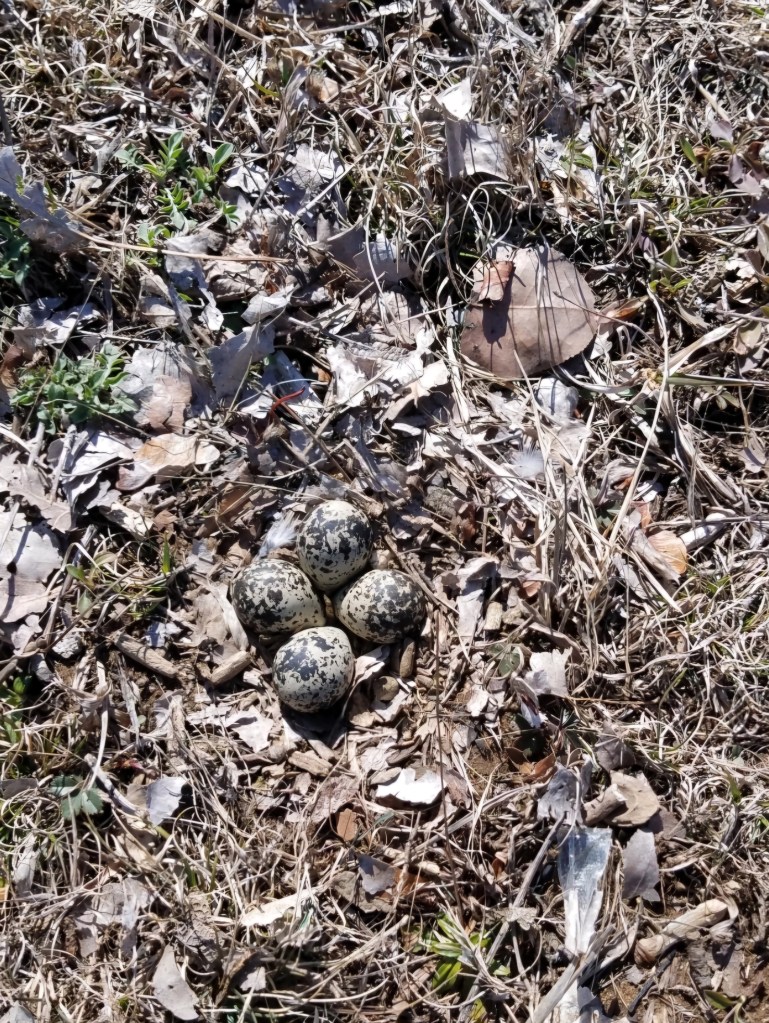
Killdeer nest and eggs 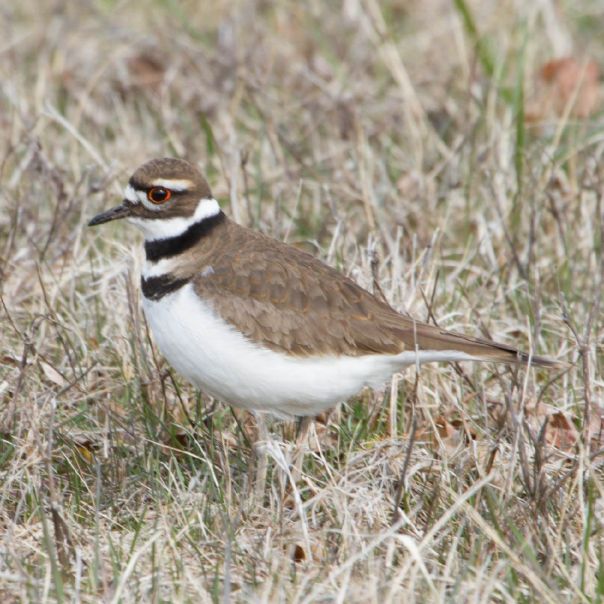
Killdeer. Photo courtesy of Margaret Weber While the nests are difficult to see, even when searching for them, the birds themselves are often both visible and loud as they try to distract the walker who gets close to a nesting site.
3. Woodland spring flowers
Every spring, before the forest floor is shaded, a variety of small flowers bloom for a short period of time before fading. They are often referred to as ephemerals.
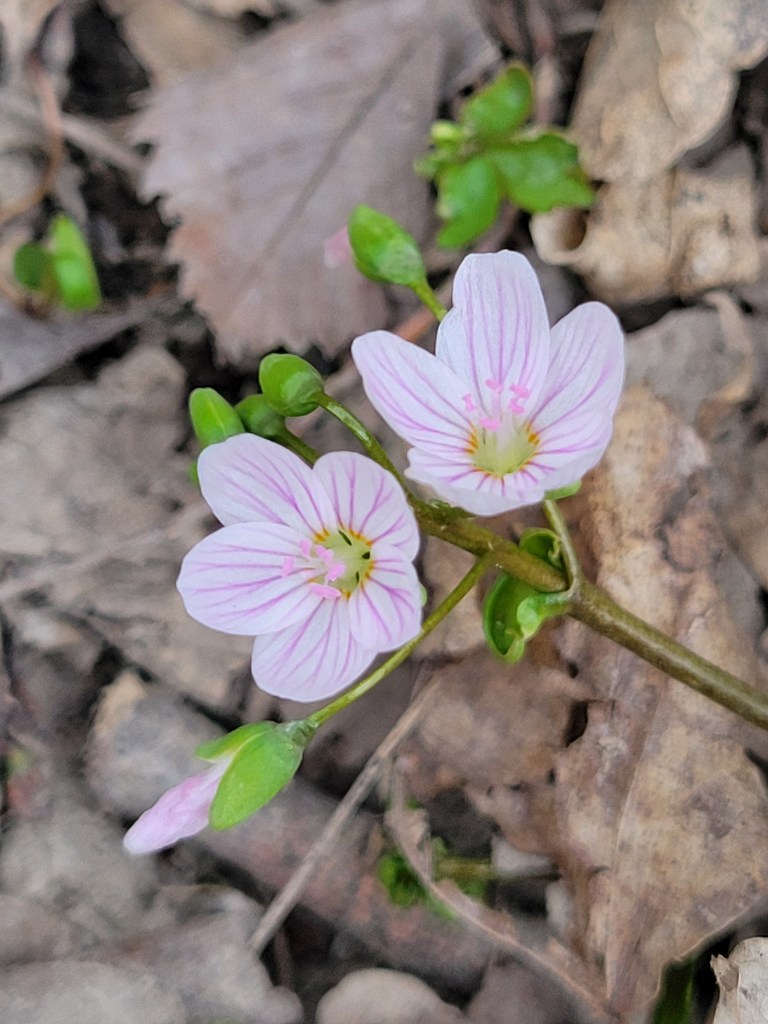
Spring Beauty 
Yellow Trout Lily 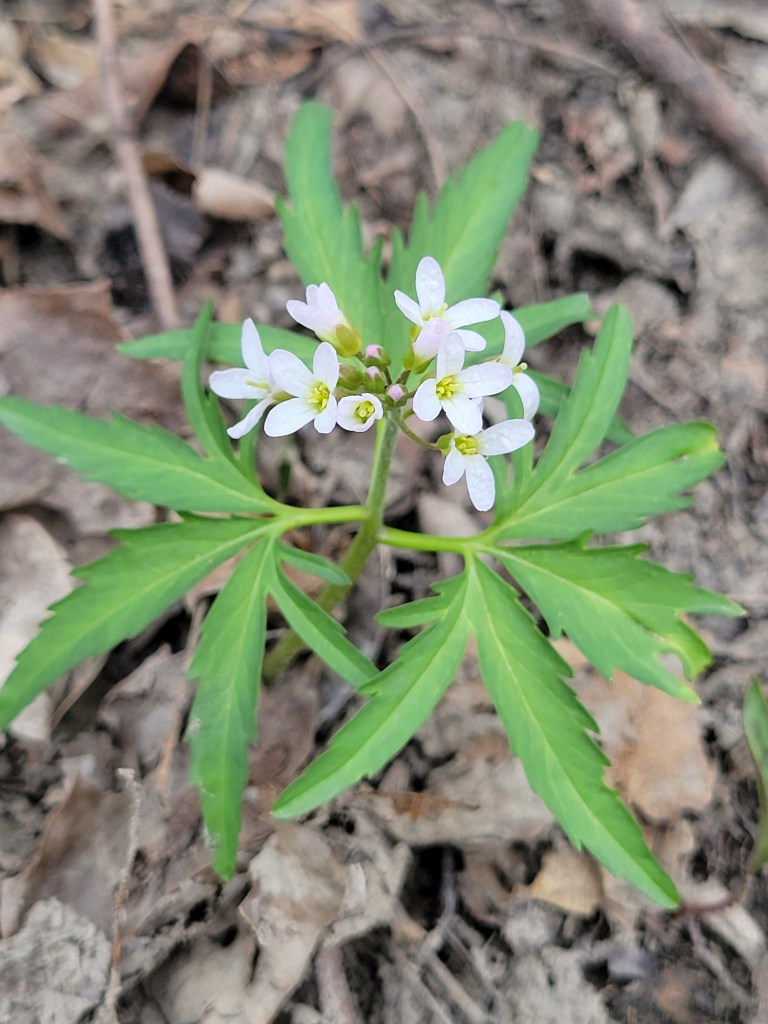
Cut-leaved Toothwort 
Bloodroot These four are just some of the species that regularly bloom in April.
4. Sunning Garter Snake
On sunny days in the spring, especially if one gets off the path, it is possible to come across a Garter Snake that is soaking up the sunshine, trying to get warm after a winter spent hibernating.

Eastern Garter Snake 
At this time of the year, the snakes are sometimes reluctant to move from a sunny spot and will allow someone to approach quite close (if one moves slowly), close enough to get a good view of the black-tipped red tongue.
5. Spring Azure butterfly
The second half of April is also an excellent time to see the first butterflies of the year, also on a sunny day. One that I look for is very small and not too colorful when the wings are closed. The blue-ish open wings are not often seen.
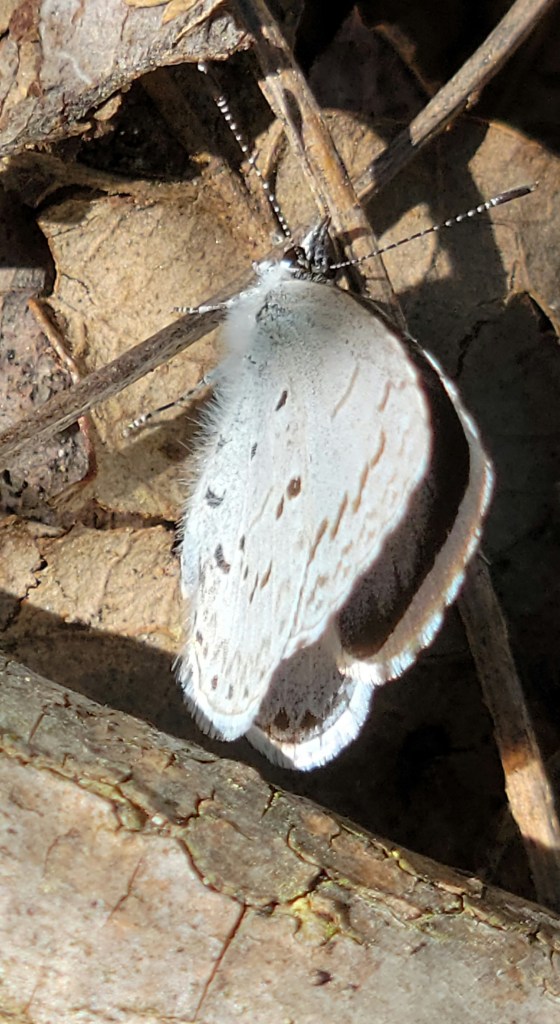
Spring Azure They are most likely to be seen in April in the woods, often on the ground. They will, however, sometimes come to the low-growing ephemeral wildflowers.
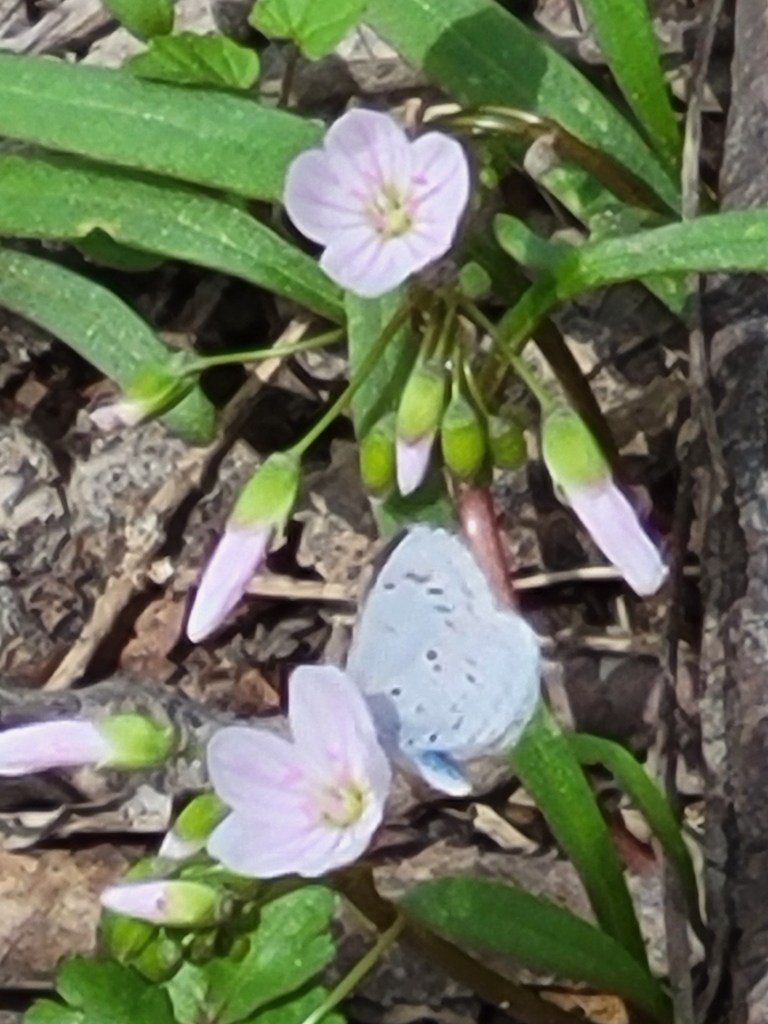
Spring Azure visiting
Spring Beauty6. Breeding American Toads
Every year in April, usually following a warm nighttime rain, male Toads will return to the pond and begin their loud mating calls. The calls can be heard at various times during the day. In Eliza Howell Park, they often gather at the meadow pond.
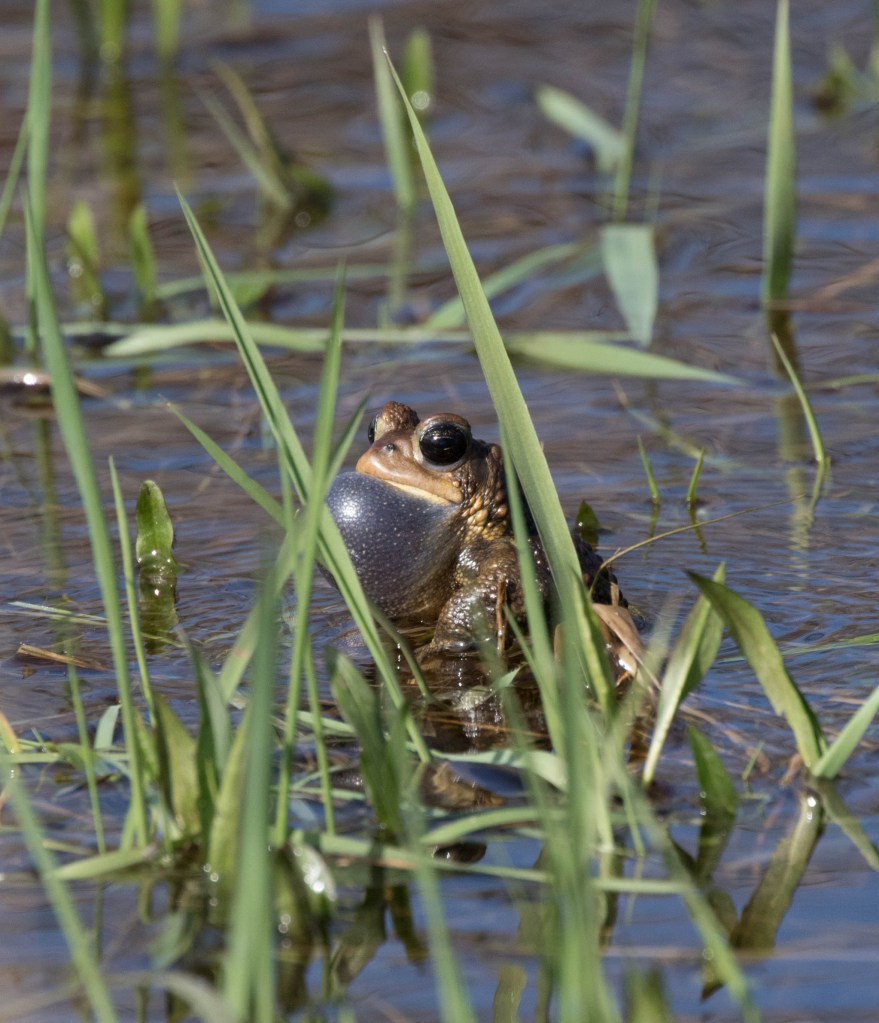
American Toad calling. Photo courtesy of Margaret Weber After a couple or a few days, the calling and egg laying are done, and the adults will again leave the water, letting the eggs hatch and the tadpoles develop over the next weeks.

Photo courtesy of
Margaret Weber7. Dryad’s Saddle mushrooms
One of the mushrooms that appears at almost exactly the same time every year is a shelf mushroom called Dryad’s Saddle. It grows on dead or dying trees (or on fallen logs). In Eliza Howell, the time for its initial appearance is near the end of April.

Dryad’s Saddle This mushroom can occasionally be found later in the summer, but the only time it is easy to find here is in the spring, starting in late April and going into May. It often grows in overlapping shelves.
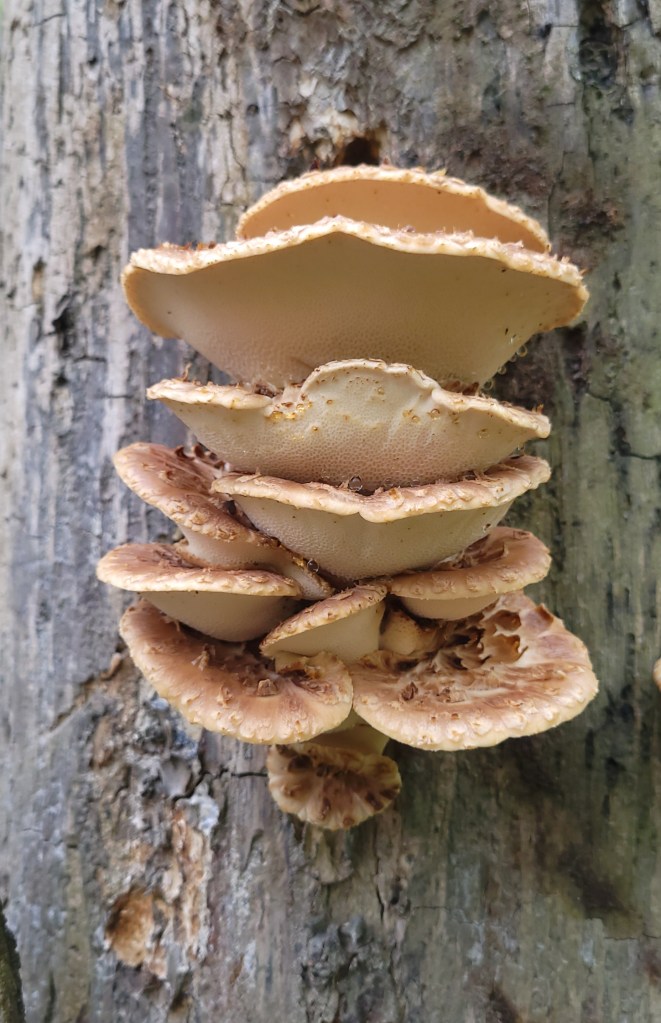
Dryad’s Saddle There are a number of other April highlights as well, but these 7 quickly came to mind as I was reviewing what to expect in the nest 2 and 1/2 weeks. It’s a wonderful time of the year.

-
Subscribe
Subscribed
Already have a WordPress.com account? Log in now.
 Eliza Howell Nature Walk