-
Nesting Season Begins: A Chickadee Memory
Leonard Weber
April 4, 2025
It is April. Bird nesting season is now beginning in Eliza Howell Park.
—–
NOTE: At the end of this post, there is information about a 5-week Birds Nesting field course in Eliza Howell Park this spring.
—–
Some of the earliest nesters in the park are Mourning Dove, American Robin, Red-bellied Woodpecker, and Killdeer.
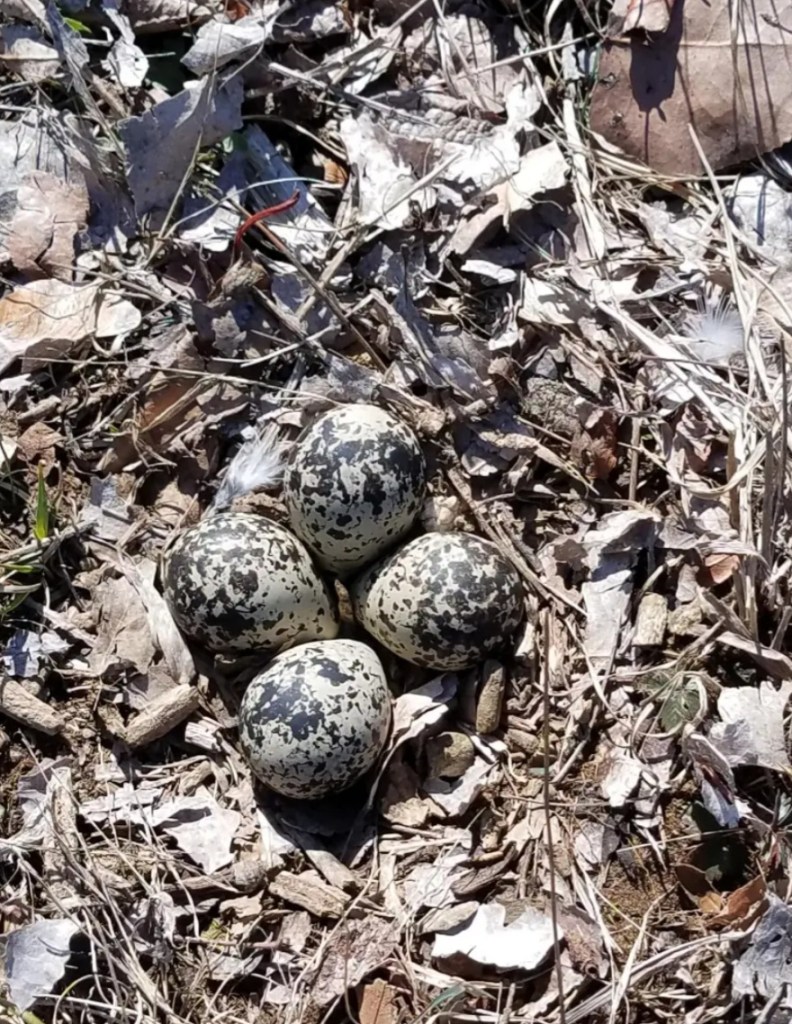
Killdeer nest in a previous April Another early nester is the Black-capped Chickadee. One of my favorite experiences watching birds making nests was in April 2019. I stopped frequently along the path in the woods over a period of a week to watch a pair of Chickadees working together to hollow our a small dead tree.
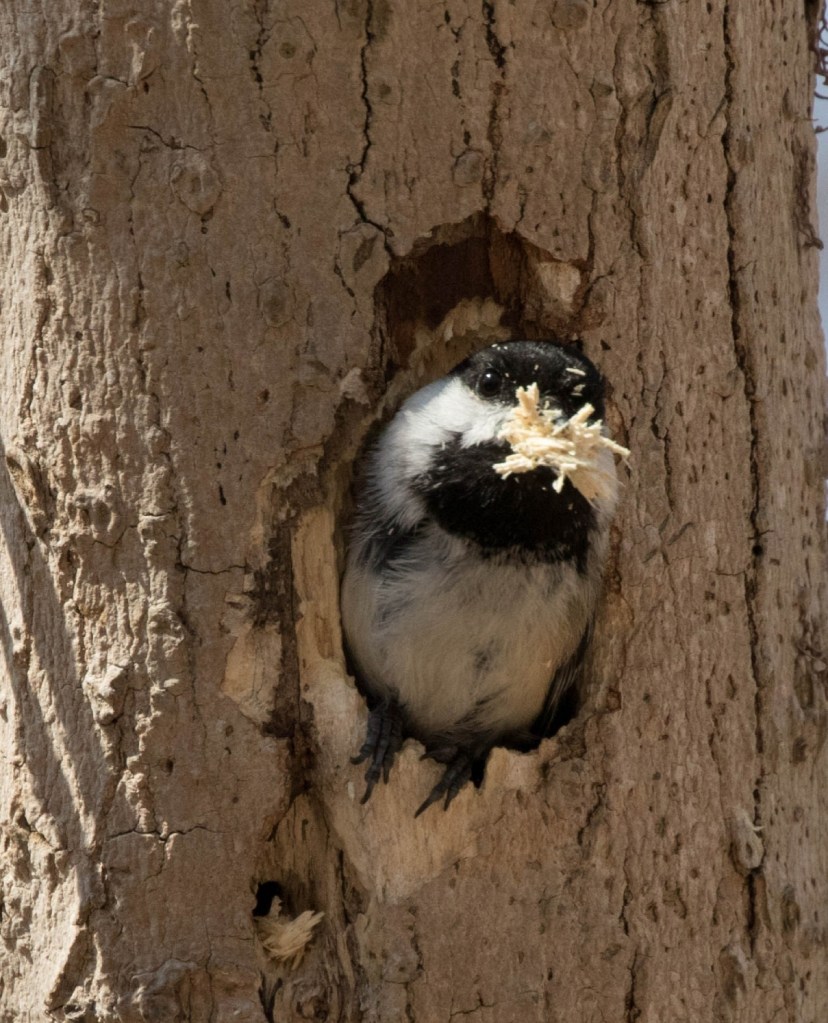
Photo courtesy of
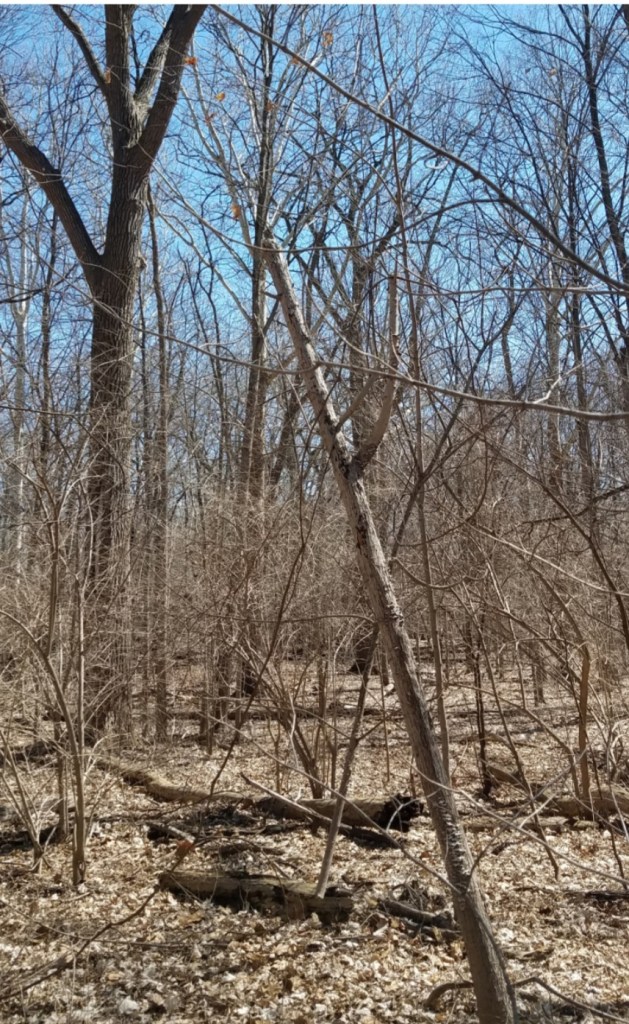
Margaret WeberChickadees are cavity nesters that will often use an existing cavity (a natural hole in a tree or an old woodpecker hole or a bird box), but they will sometimes make a new hole in dead wood. In this case, the pair was preparing their nesting site by excavating a hole about 12 feet high in a slim, slanting dead tree.
Chickadees do not have the beak and head perfectly suited for hitting hard wood
repeatedly, as woodpeckers do. Woodpeckers often chip out solid wood for a nest.Chickadees, when they make a new hole, seem to select softer, rotting wood. Once they get started, their excavating is not so much chipping away at the wood as it is pulling the soft wood apart. In the first picture above, the bird emerged with a beak full of wood chips only 3 or 4 seconds after entering the hole.
When woodpeckers excavate,
they bring the chips to the
opening and “spit” or drop them from the entrance.
Photo courtesy of
Margaret WeberChickadees, on the other hand, carry their excavated chips a good distance away from the nest before dropping them. They leave no clue of their work near the base of the tree, presumably not wanting to lead a predator to the nest.
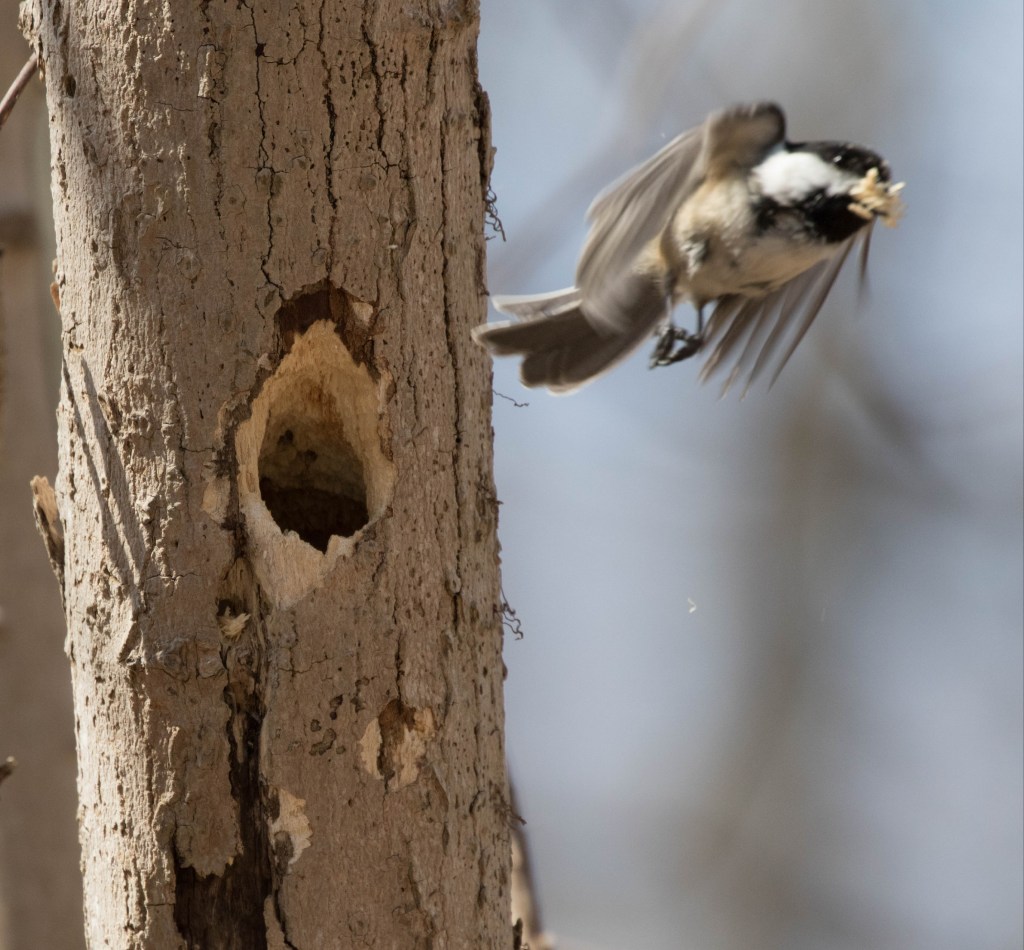
Photo courtesy of
Margaret WeberFemale and male work together to make the hole, but they have separate roles in some of the next phases. The female will make a nest of soft material in the cavity, lay the eggs (often 6 or more of them), and incubate them. While she is incubating, the male will feed her. The hatched young are tended by both parents.
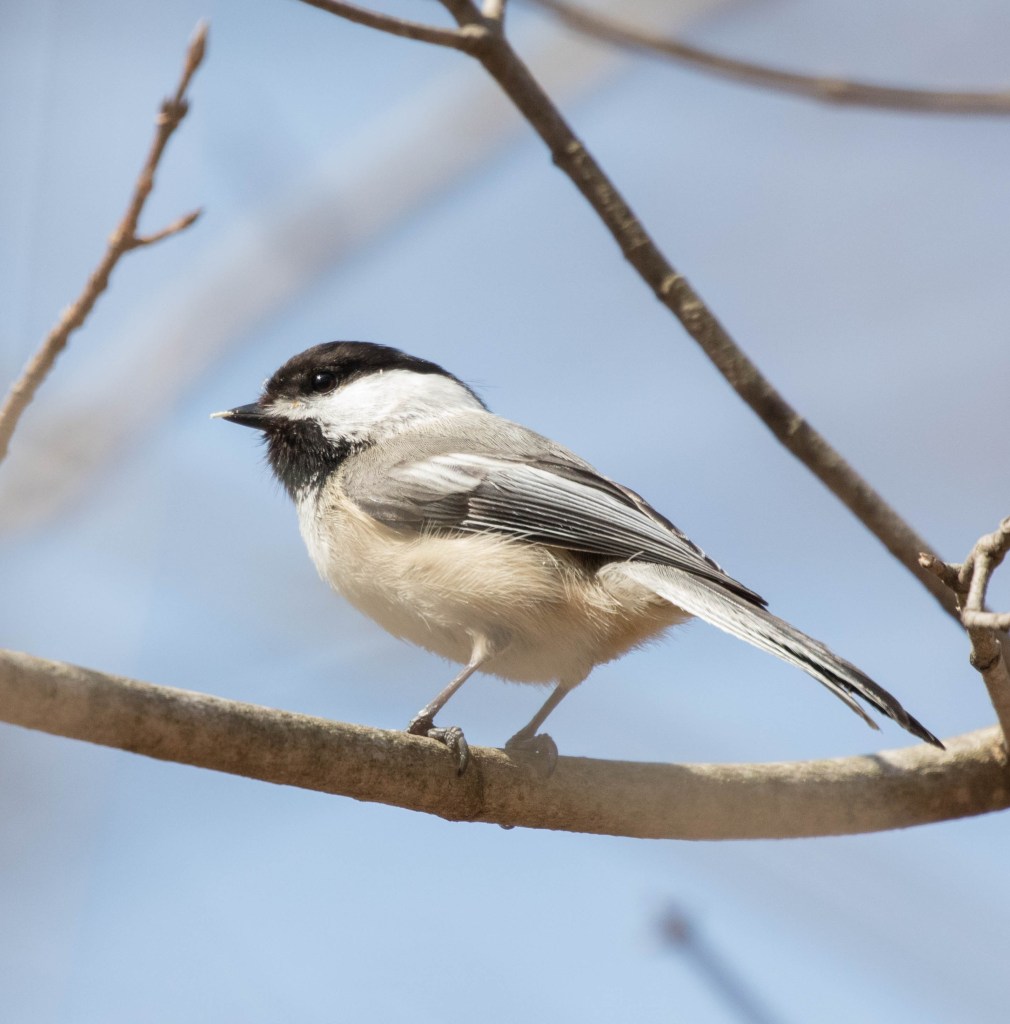
Photo courtesy of
Margaret WeberChickadee is just one of many bird species that regularly nest in Eliza Howell Park. The peak of the nesting season is late April to early June, but early nesting activities are starting now.
—–
As part of its “Be a Better Birder” program, Detroit Bird Alliance is offering a 5-session Birds Nesting field course on 5 Saturdays beginning on Saturday, April 26. This is an opportunity to learn more about the nesting behavior of perhaps a dozen different species. All sessions are in Eliza Howell Park.
More information can be found at the Detroit Bird Alliance website.
—–
-
Four Flowering Trees: Watching Spring
Leonard Weber
March 24, 2025
Spring is a time to look for the first flowers, including flowers that appear on trees before the leaves grow.
I start visiting the early flowering trees in Eliza Howell Park in Match, checking frequently, eager to see progress. This year, being relatively cold, the progress seems to be slower. But it is started.

Cornelian Cherry Dogwaood. Match 24, 2025 Cornelian Cherry Dogwood is sometimes the first to reach full bloom. The flower buds are still very small now, just starting to open. Soon, yellow flowers will be open all over the smaller branches of the leafless tree.
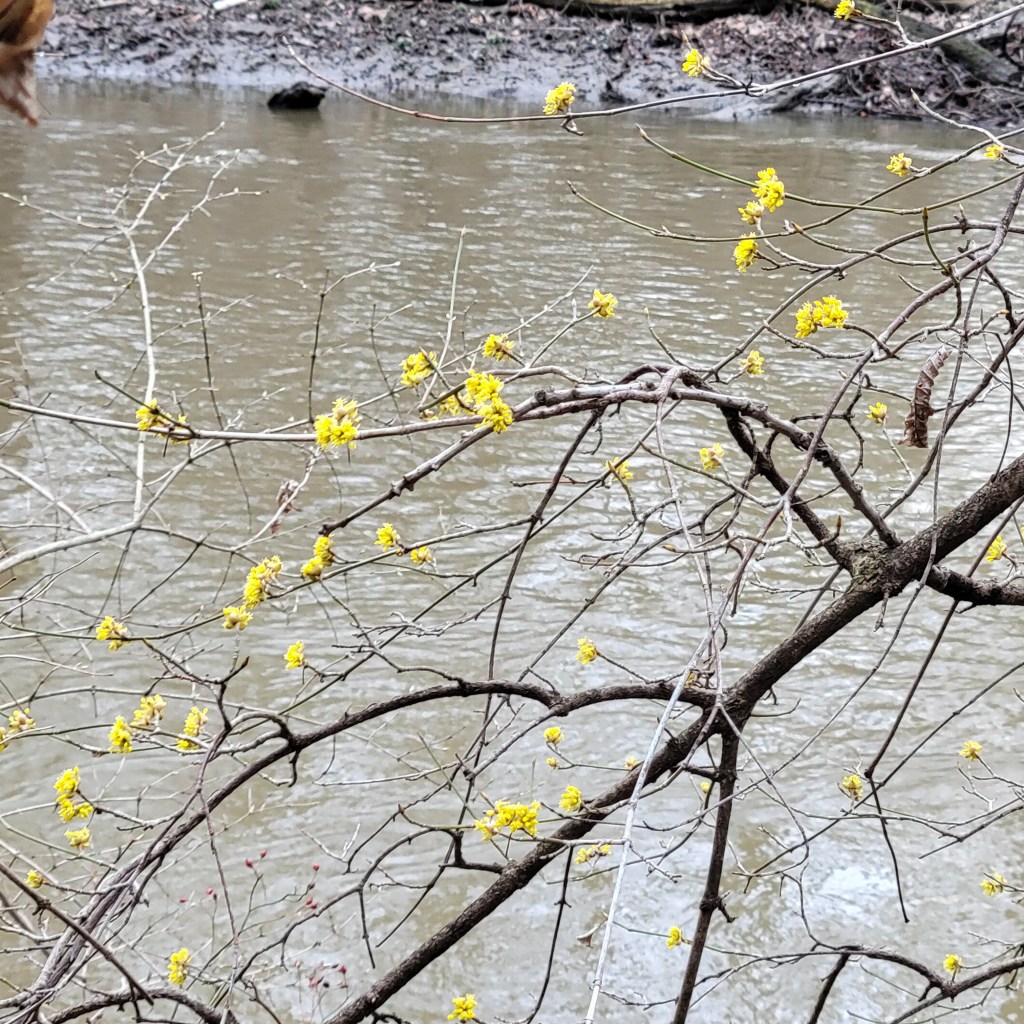
Cornelian Cherry Dogwood. A previous early April 
Cornelian Cherry Dogwood. A previous early April On most of my walks these days, I also stop at Red Maple trees.

Red Maple, male.
March 24, 2025
Red Maple, female.
March 24, 2025Red Maple usually has female and male flowers on separate trees, with only the female trees producing seeds, of course.

Red Maple, male. A
previous late MarchEastern Cottonwood also flowers before leaves appear, and it is another species in which the male and female flowers grow on separate trees.
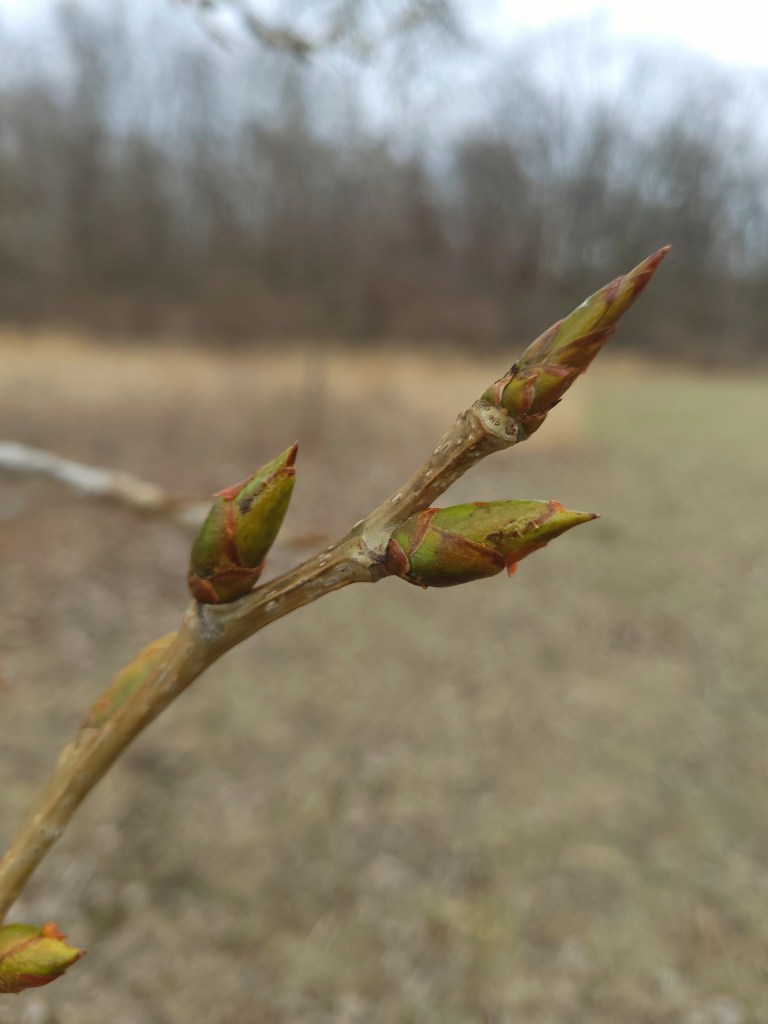
Eatern Cottonwood, male. March 24, 2025 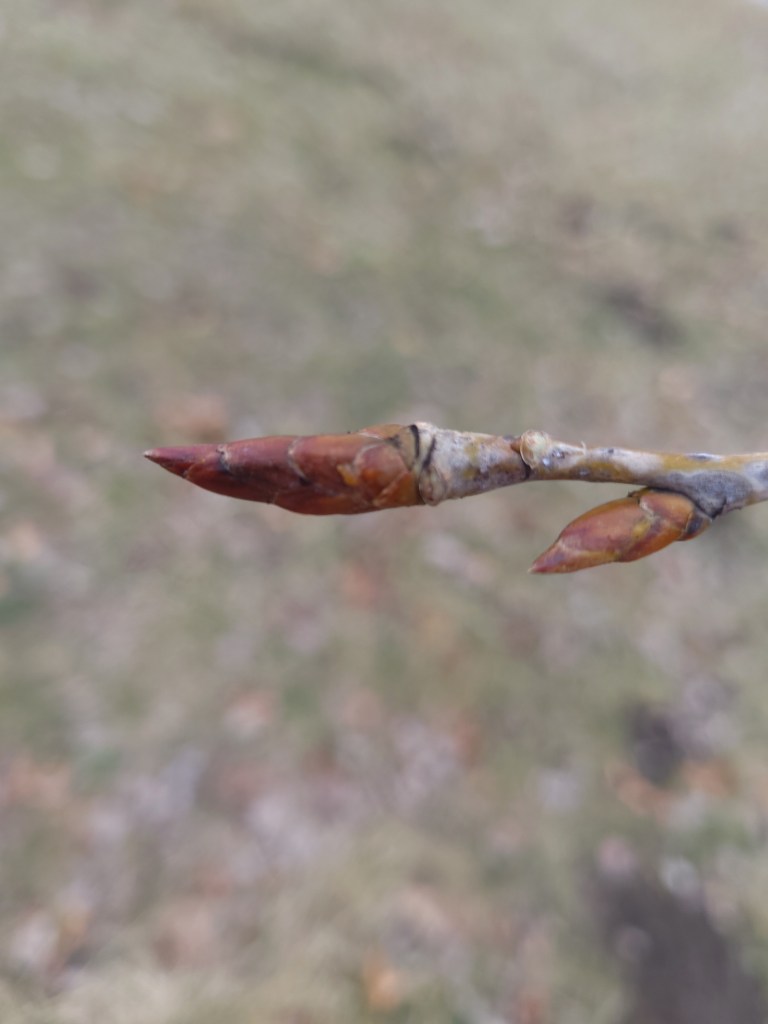
Eastern Cottonwood, female. March 24, 2025 The flower buds have started growing and will continue to develop significantly in the next few weeks.
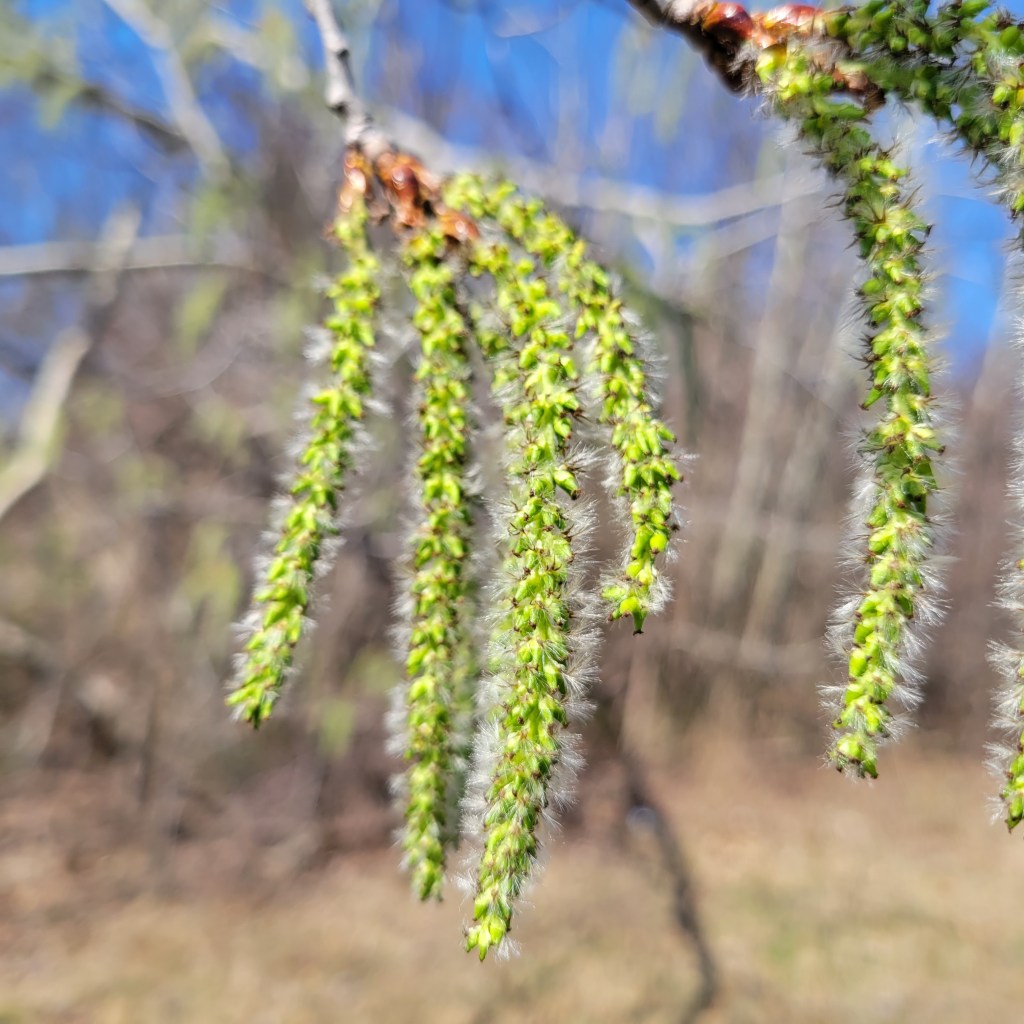
Eastern Cottonwood, female.
A previous AprilAt this April point, the “cotton,” attached to the seeds, is becoming evident.

Eatern Cottonwood, male. A previous April The fourth of the flowering trees that I have started checking recently is the Eastern Redbud.

Eastern Redbud.
March 24, 2025The Redbud flowers are just starting to develop now, but they too will be in full bloom before any leaves appear.

Eastern Redbud. A
previous April
Eastern Redbud. A
previous AprilWhen there are quite a large number of cold days late in the second half of March, as seems to be the case this year in Detroit, one becomes eager for clear signs of spring. That eagerness leads me to these four tree species repeatedly. And, fortunately, they always provide reassurance.
-
Wood Duck: The Return of a Favorite
Leonard Weber
March 14, 2025
I have been keeping records of the bird species observed in Eliza Howell Park since January 2005. This is the 21st year, and on Match 7 this year, I saw a pair of Wood Ducks for the 21st consecutive March.
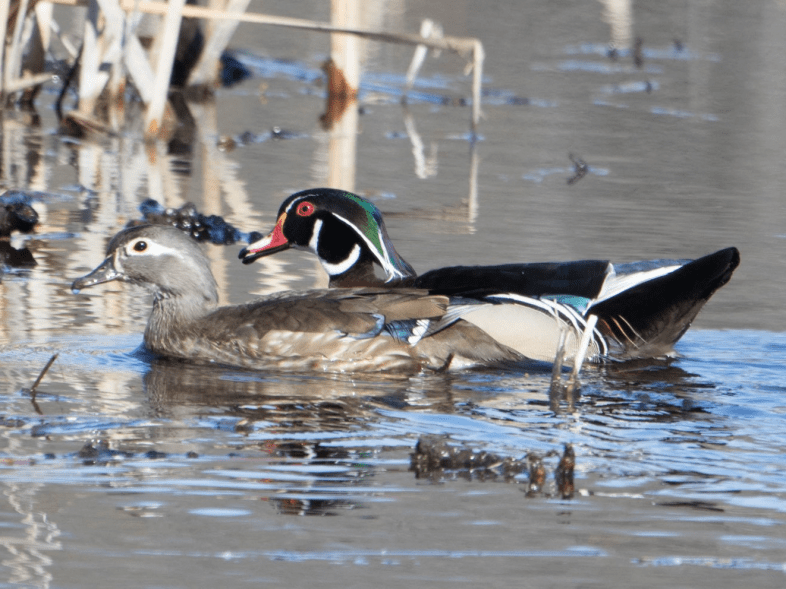
Female and Male Wood Duck. Photo courtesy of
Margaret WeberIt’s hard not to like Wood Ducks. They are eye-catching; they have fascinating nesting practices; they are an added attraction to early spring in the park.
Wood Ducks are occasionally found in southern Michigan in the winter, but only occasionally, in locations where the water doesn’t freeze.
When they start to return in early March, they have already formed breeding pairs. A pair can sometimes be spotted on the river if one is looking, but it is not easy to get a good look. They are wary of humans, quickly flying off as one approaches. The female can often be heard calling a distressed sounding “oo-eek, oo-eek” as two dark-looking birds fly low over the river.

Female Wood Duck.
Photo courtesy of
Margaret WeberPerhaps because our first knowledge of ducks is of ground-nesting species like Mallard, we are often surprised when we learn that some duck species nest in cavities in trees. Wood Duck is a cavity-nesting species.
Someone watching carefully close to the Rouge River early on a spring morning might see a pair of ducks up in trees, as the male acconpanies the female as she checks out different possible nesting locations. They often nest quite high in a natural tree hollow, but sometimes they find a seven-foot high birdbox (an artificial tree cavity) quite acceptable.

Bird box designed for
Wood DuckThe female typically lays one egg a day until the clutch is complete (the eggs usually number from 6 – 12). Incubation begins when all the eggs are laid and lasts about a month. It is all done by the female.
The nest is lined with down feathere plucked from the mother’s breast.

Wood Duck nest in birdbox 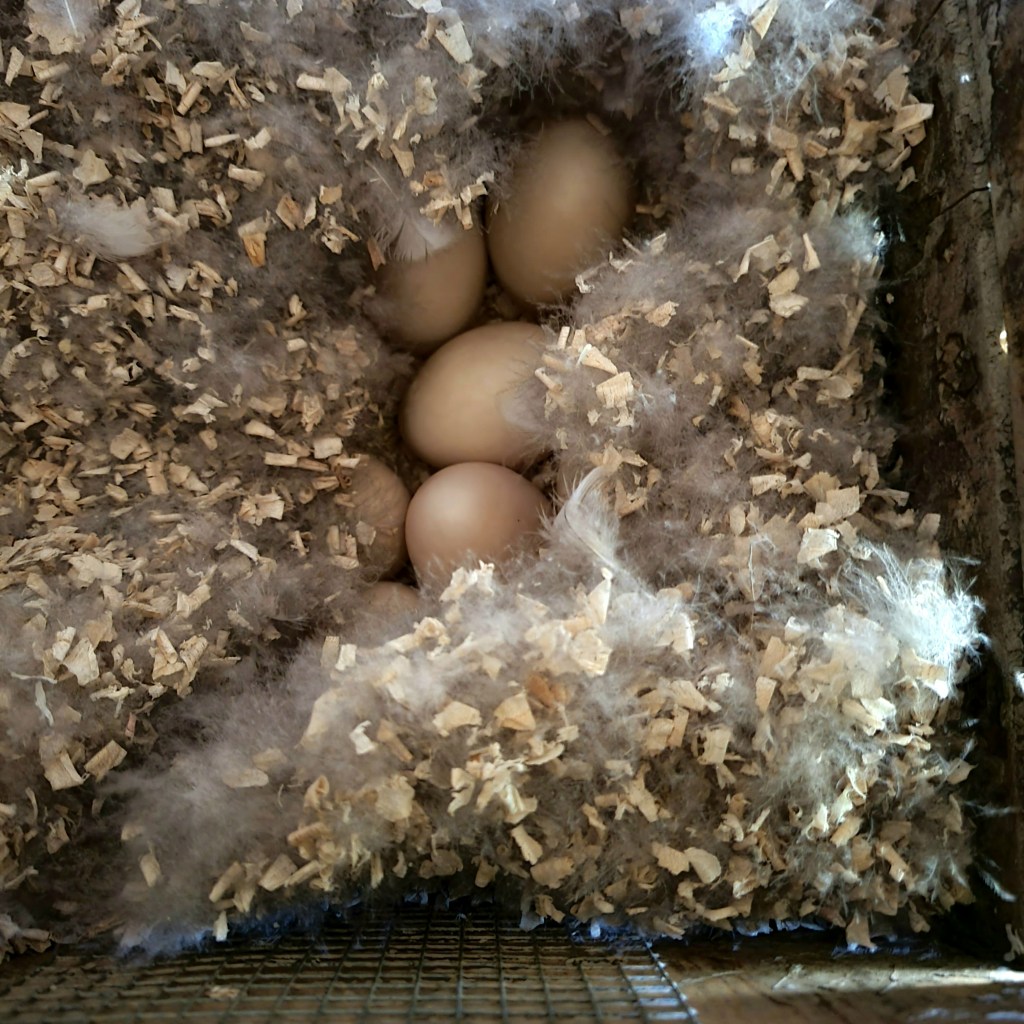
Eggs partly hidden by down (and small wood chips already in the box) Once incubation begins, the male is no longer involved in parenting. In addition to doing all the incubating, the female cares for the young by herself after they hatch.
While the young of some bird species emerge from the egg naked and helpless, Wood Duck young are among those (often termed “precocial”) who are much further along. They have feathers, are able to walk and swim, and can feed themselves.
About one day after they hatch, at the mother’s call, the young use their clawed feet to climb up the inside of the cavity to the entrance — and jump out. Even when the jump is from 50 feet up, they are uninjured and ready to follow the mother to the water.
The young stay with the mother for the next 6 weeks or so.

Vernal pool The mother keeps the young mostly at the edge of the river or in shallow little bodies of water, such as a vernal pool. Their diet varies, usually including both insects and plant-based food like seeds.

Male Wood Duck.
Photo courtesy of
Margaret WeberThe male, the drake, is so striking that few other species compare. The female, the hen, manages the roles of laying the eggs, hatching them, and trying to keep the young safe. The precocial young are ready to jump out of the nest and feed themselves at the age of one day.
It’s quite a species to watch! I am thrilled every March when they return for the breeding season. They are now back in Eliza Howell Park.
-
Trees in Winter
Kathy Garrett
and
Mara Crawford
March 4, 2025
This January, some friends and members of the Detroit Bird Alliance gathered at Eliza Howell Park to identify some tree species that are discernible in winter.

While many trees will maintain their anonymity in winter for most park visitors, some species have distinct markers in their leaves, seeds, or bark, even in winter.
One arboviral park resident that is identifiable by its leaves during winter is the Turkey Oak. It is a white oak whose distinctive leaves stay attached for most of the winter months. When leaves hang on to their leaves all winter, it’s called marcescence.

Turkey Oak Young Beech trees are noticeable because they retain their rust-colored leaves during winter.

Young American Beech Nearby is this older Beech with its distinctly smooth bark.

Mature Beech The Black Cherry tree has distinctive bark that is significantly darker and flakier than most of its neighbors
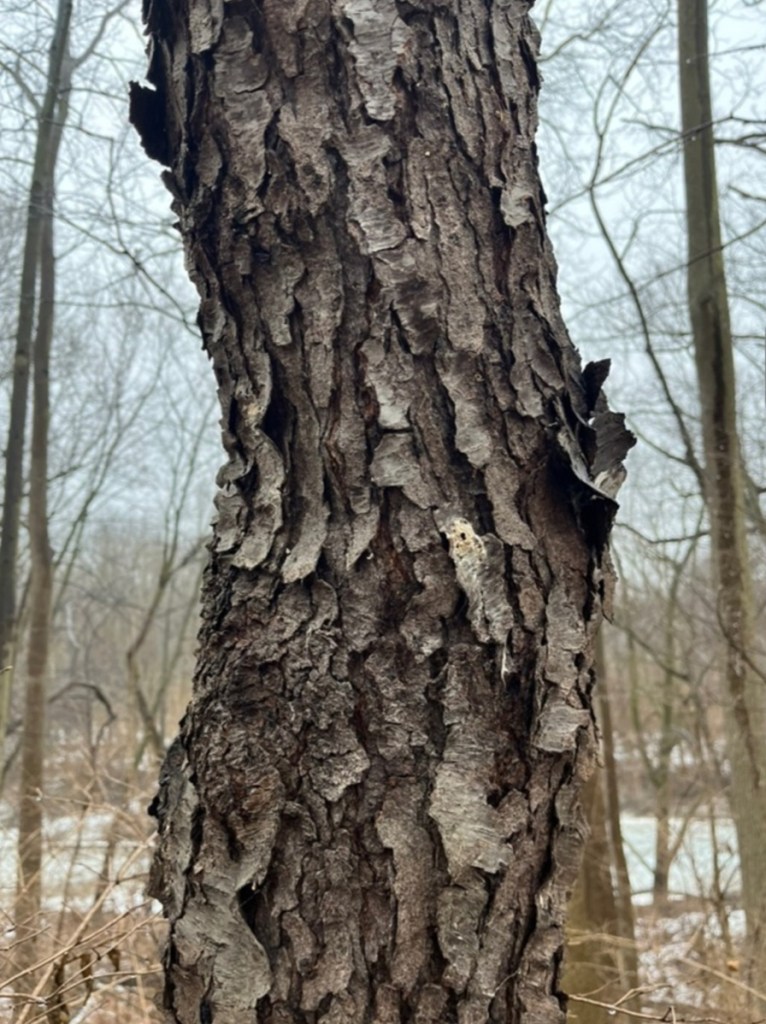
Wild Black Cherry Hackberry trees can be identified by their sharp ridges of layered bark that cover the trunk of the tree.
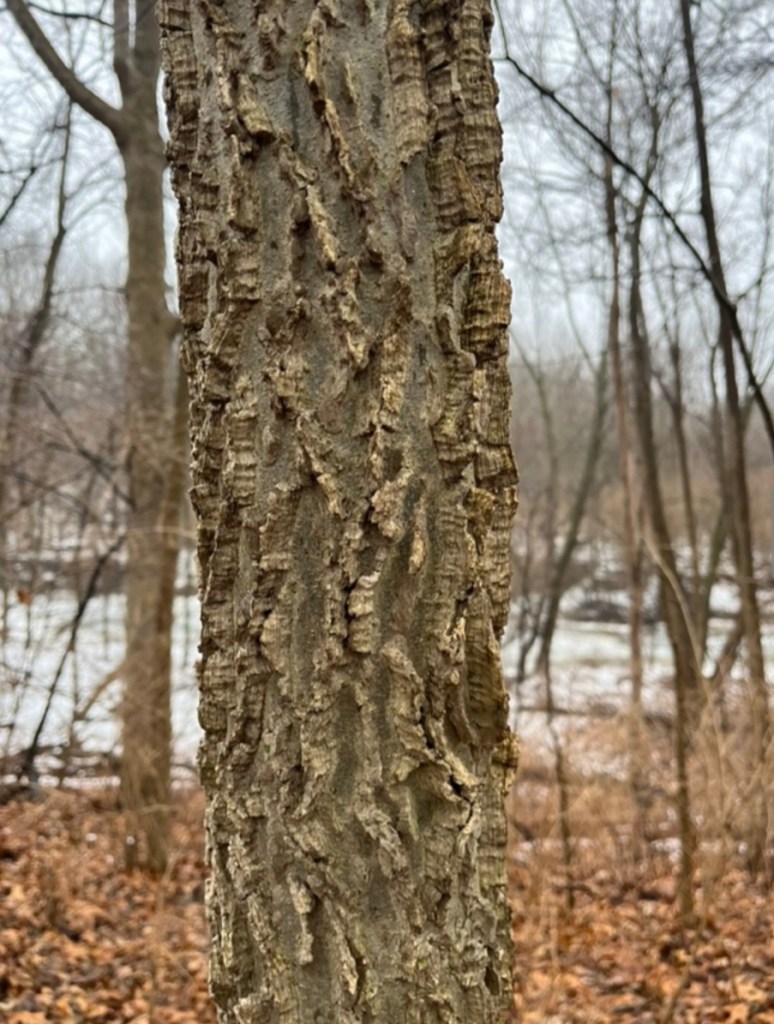
Hackberry Older Black Willows in the park often have patches on their trunks where lots of new branches are growing. Willow trees have adventitious buds that grow on the roots and trunk. These buds turn into new growth when a tree is pruned or damaged, giving them a distinct look.
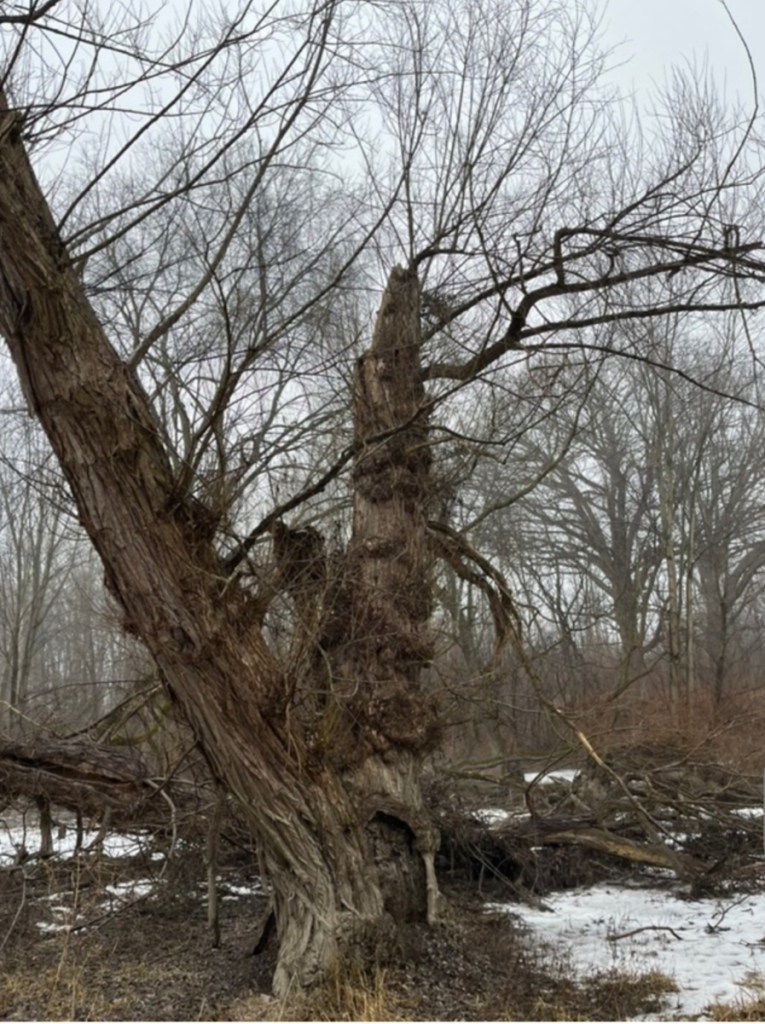
Black Willow The dense clusters of the Box Elder’s samara seeds stand out against a snowy forest floor, making it easy to identify even in winter.

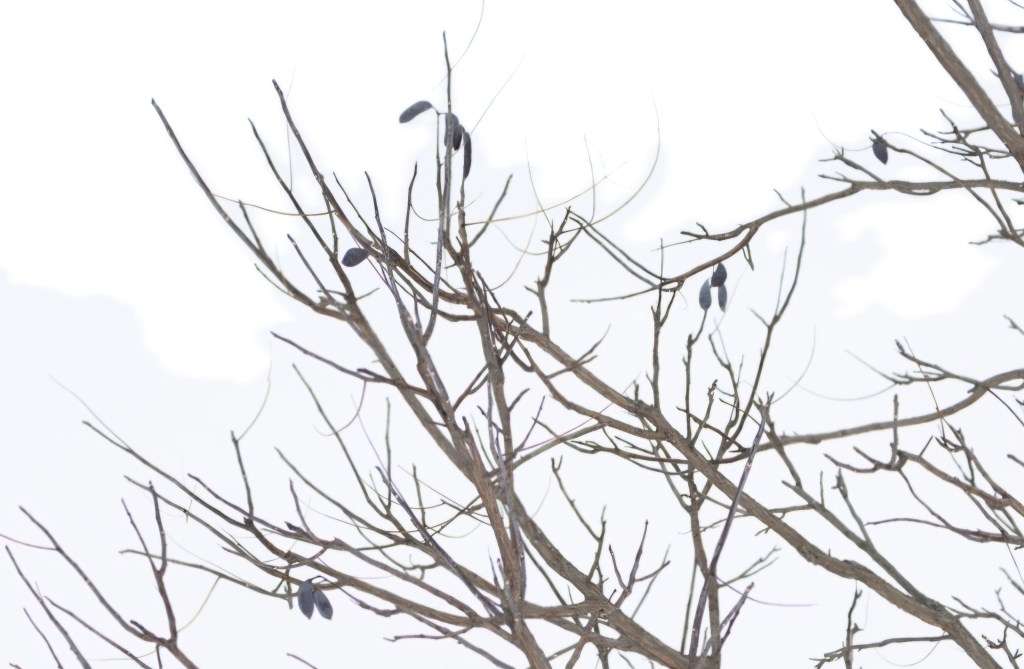
Box Elder Kentucky Coffee Trees have very distinct seed pods, if you can find them. They do not fall until spring.
Kentucky Coffee Tree Leaf buds are present on trees throughout winter. Some trees are easily identified by these buds if you can get close enough to examine them. These leaf buds are from a Norway Maple whose branches are low enough to see.

Norway Maple. Photo courtesy of Leonard Weber Sugar Maple leaf buds are distinctly different. The trees in the woods are harder to identify by their leaf buds as they are on branches far out of reach.

Sugar Maple. Photo courtesy of Leonard Weber One of the easiest ways to identify trees in winter is to familiarize yourself with their leaves and fruits (if visible) in the warmer months. Regularly visiting Eliza Howell Park is a great way to get to know the trees.
-
March 1: Spring Begins
Leonard Weber
February 28, 2025
It has been an exciting winter for nature observation in Detroit’s Eliza Howell Park this year: on-going Beaver activity, the frequent presence of a Merlin, several observations of Mink, of an American Kestrel, and of an Eastern Screech Owl. And thanks to the Screech Owl’s hunting skills, I can now confirm that Southern Flying Squirrels are present here.
Despite all this activity, winter is largely a time of quiet, of dormancy. It is now time to look forward to a reawakening, to another year of birth and growth. It is, in fact, already starting.

Harvesting the sweet sap of Sugar Maple trees. The sap starts flowing by March 1. We can live by different calendars for different purposes. The familiar way of marking the seasons is by the “astronomical calendar,” which is based on the position of the earth in relationship to the sun. According to this calendar, we wait until the vernal equinox to celebrate the beginning of spring (this year, March 20).
Another approach is referred to as the “meteorological calendar.” It is based on the annual temperature cycle. In this way of identifying the seasons, the three coldest months in the northern hemisphere – December through February – make up winter. Spring, the next 3 months, starts on March 1.
The annual changes in the flora and fauna are closely related to annual temperature changes, so I find it helpful to adopt the meteorological calendar for record keeping and for describing what can be expected to happen when.

Red-winged Blackbird,
male and female. Photo courtesy of Margaret WeberMany of the bird species that breed in the park migrate south for the winter. The first of these to return usually arrive right around March 1.
The first Red-winged Blackbird of 2025 was observed on February 28. This compares to similar dates in the previous 5 years:
2024 = February 28
2023 = March 2
2022 = March 1
2021 = March 1
2020 = February 24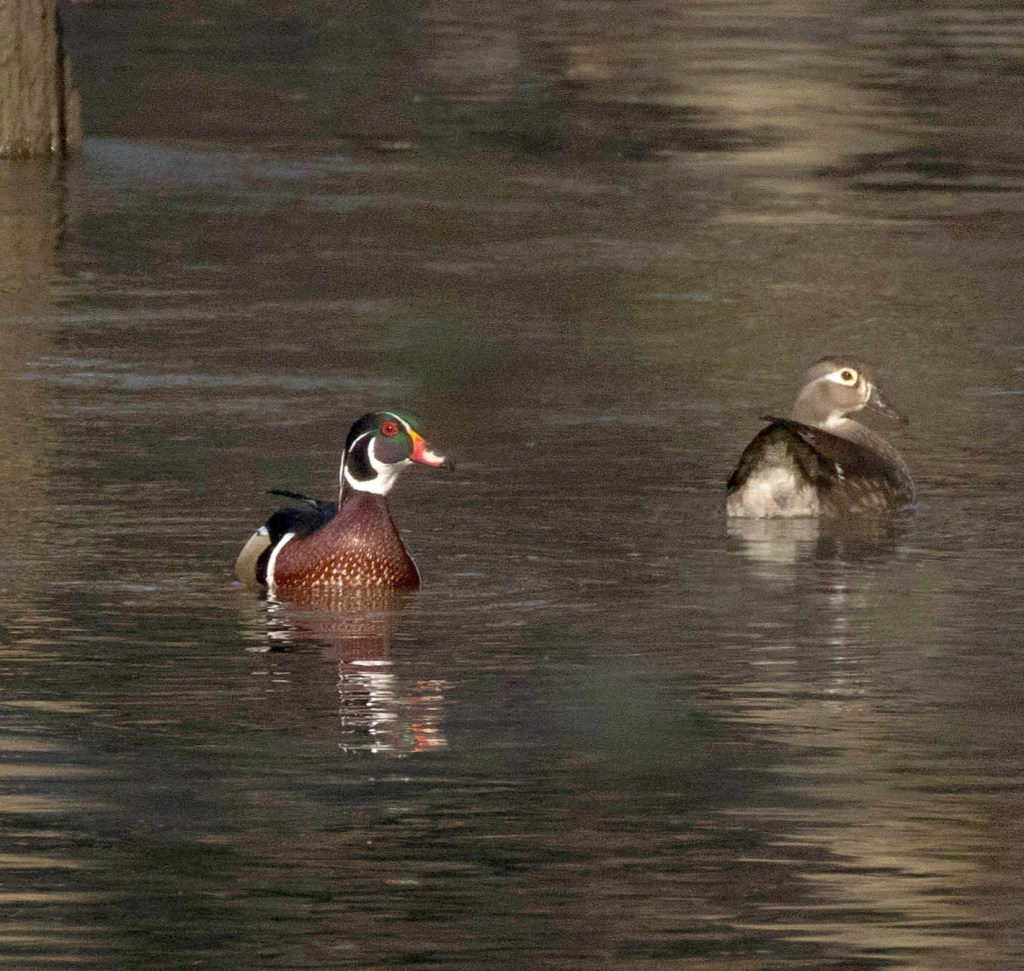
Wood Duck male and female. Photo courtesy of
Margaret WeberBy the end of March, other short-distance migrants that spend the warmer months south of here are again present. Here are some of them.
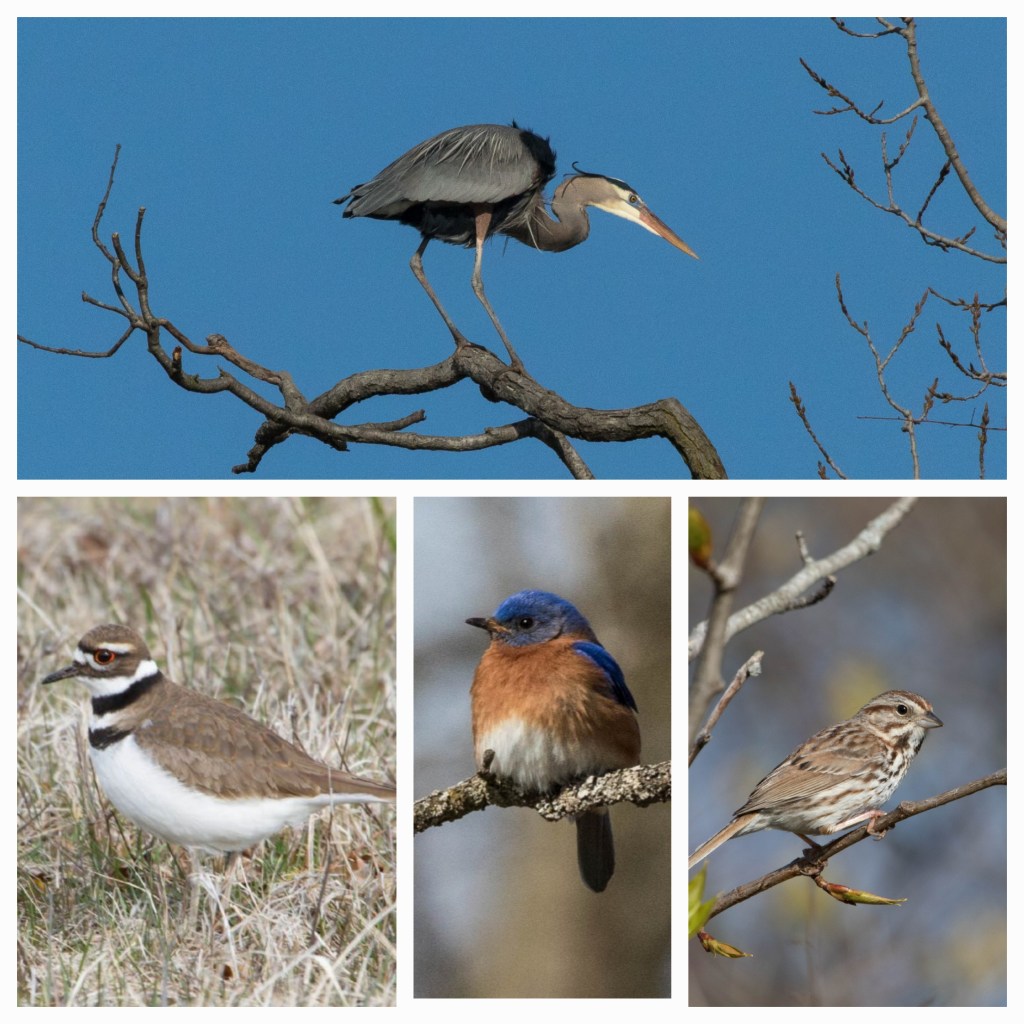
Top: Great Blue Heron.
Lower: Killdeer, Eastern Bluebird, Song Sparrow.
Photos courtesy of Margaret WeberEarly March is also the time to check the buds that are developing on flowering trees.

Red Maple flower buds in early March. 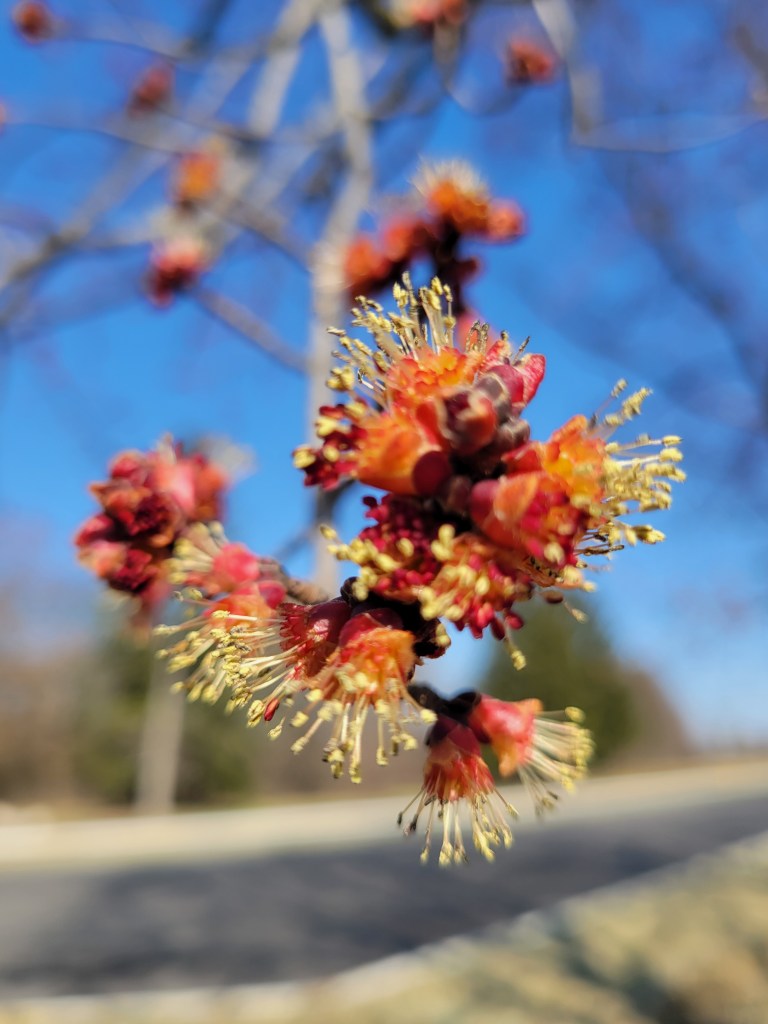
Red Maple flowers later in March. 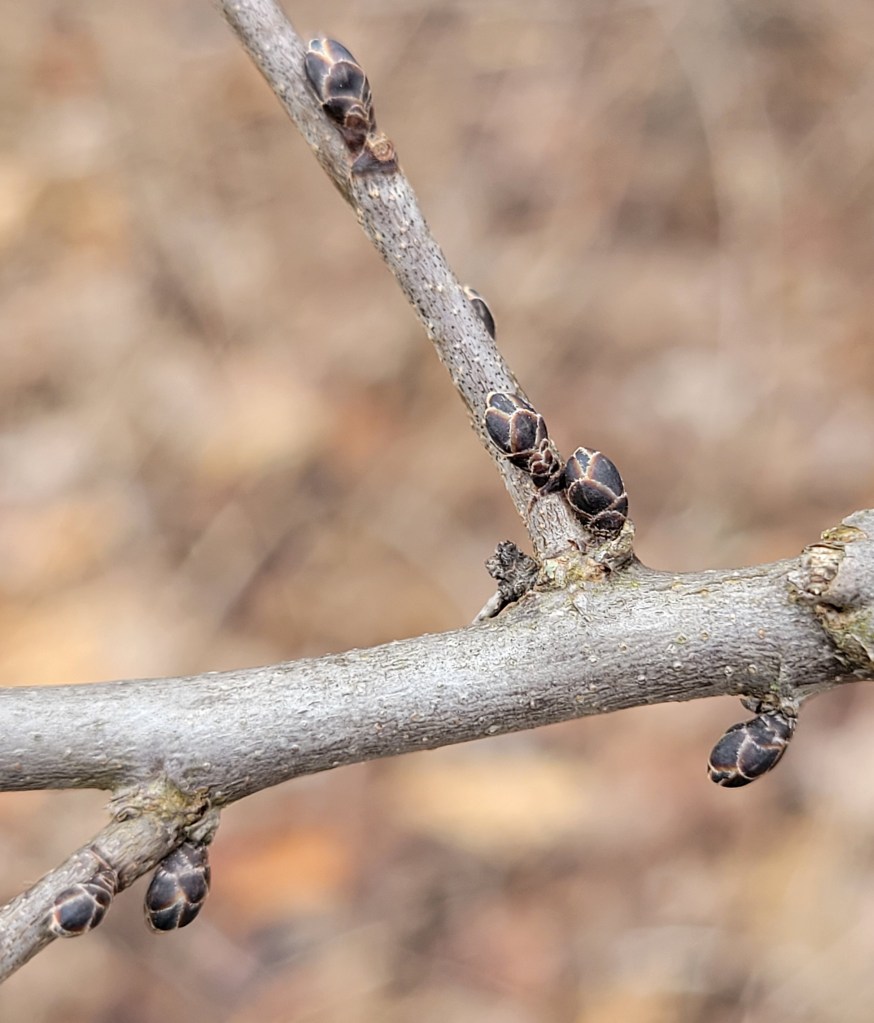
Redbud flower buds at the beginning of March. 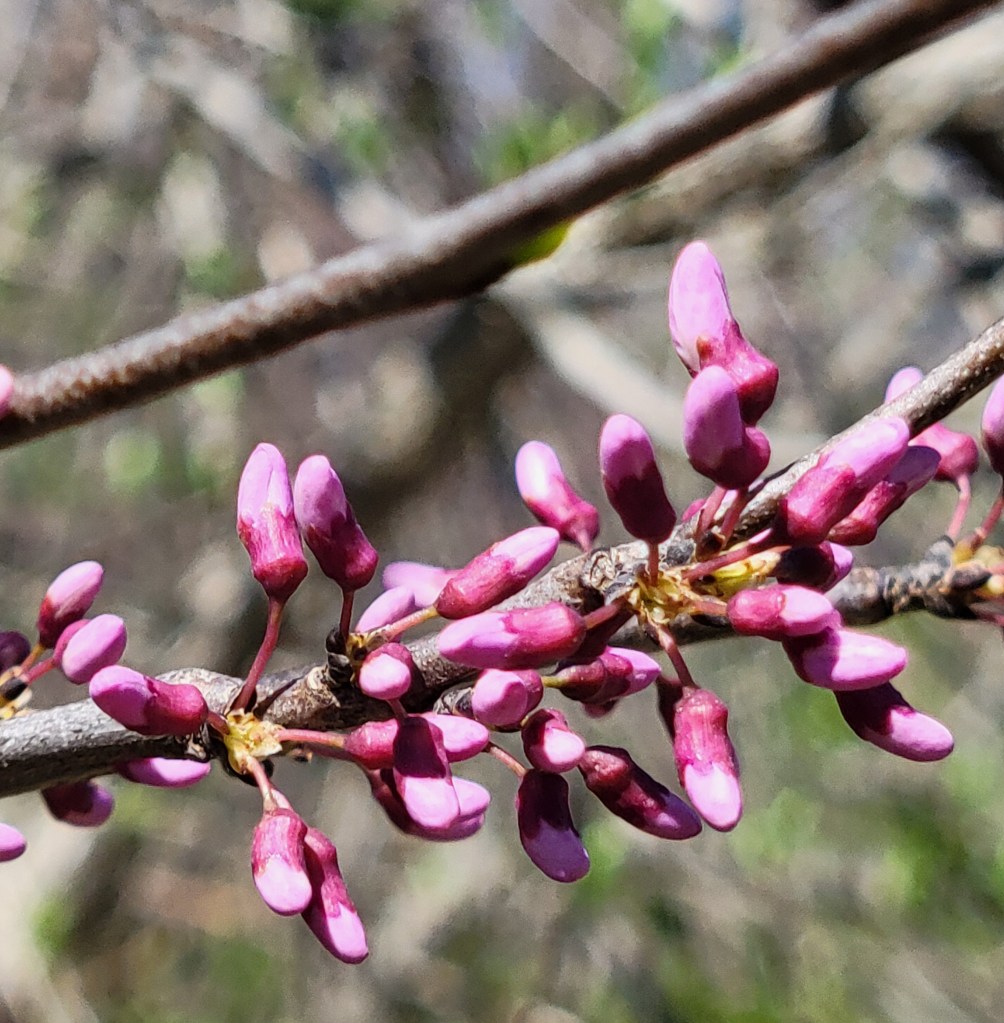
Redbud on April. March 1 can be a cold day, but the evidence is clear. The early bird migrants are starting to return, sap is flowing, flower buds on trees are beginning to develop. Many spring changes occur before the equinox.
March 1 is the time to start putting nature notes and photos in a different seasonal list.
SPRING is beginning!
-
Screech Owl and Flying Squirrels
Leonard Weber
February 20, 2025
This is part 3 of my report on Eastern Screech Owl activity in Eliza Howell Park this winter. (For previous observations, see posts from November 18, 2024, and February 4, 2025.)
As the winter has progressed, I have become increasingly fascinated by the owl’s activity in the park. Most recently, it has provided evidence that Southern Flying Squirrels are residents of Eliza Howell.
I have continued to check Wood Duck nesting boxes from time to time since discovering that they are being used by a Screech Owl both for daytime sleeping and for storing some prey for later eating.
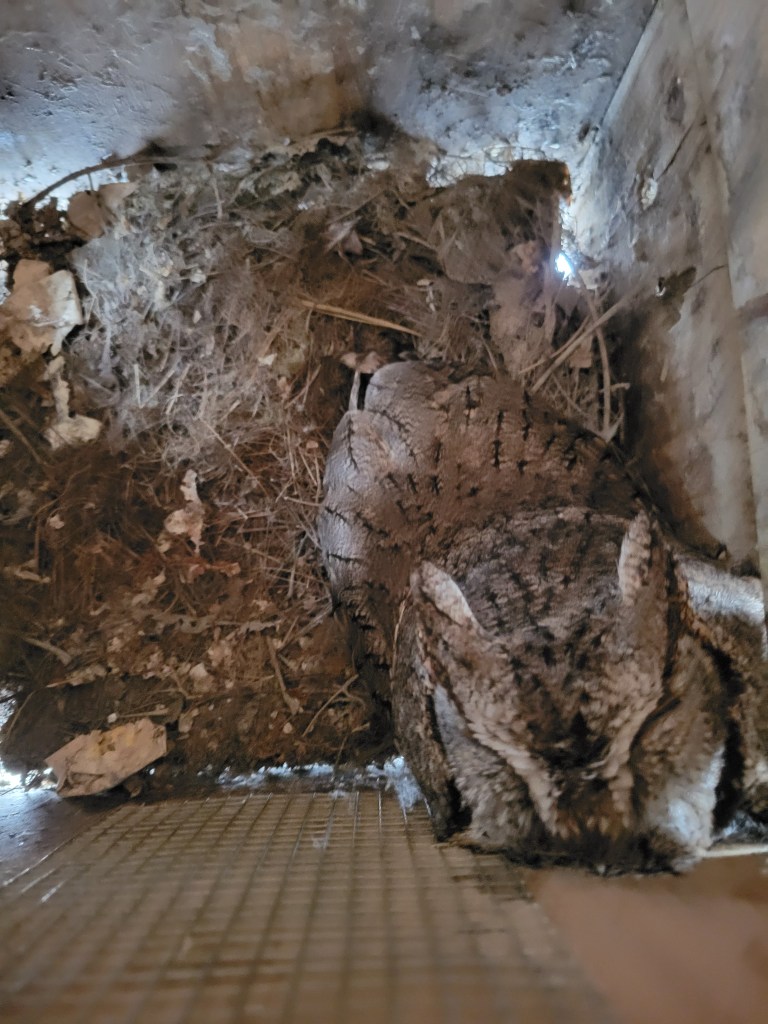
Screech Owl sleeping,
February 12, 2025Seeing the sleeping owl confirms its ongoing presence, and examining a stored food location provides information about its prey and its hunting / eating practices.
Owls, like other birds, do not have teeth. As they eat, they consume pieces of fur and feathers and bones, which are indigestible. These indigestible fragments get packed together and regurgitated as “pellets.”
On February 12, my colleague Kathleen Garrett and I spotted one such owl pellet in a nesting box being used at times by a Screech Owl.
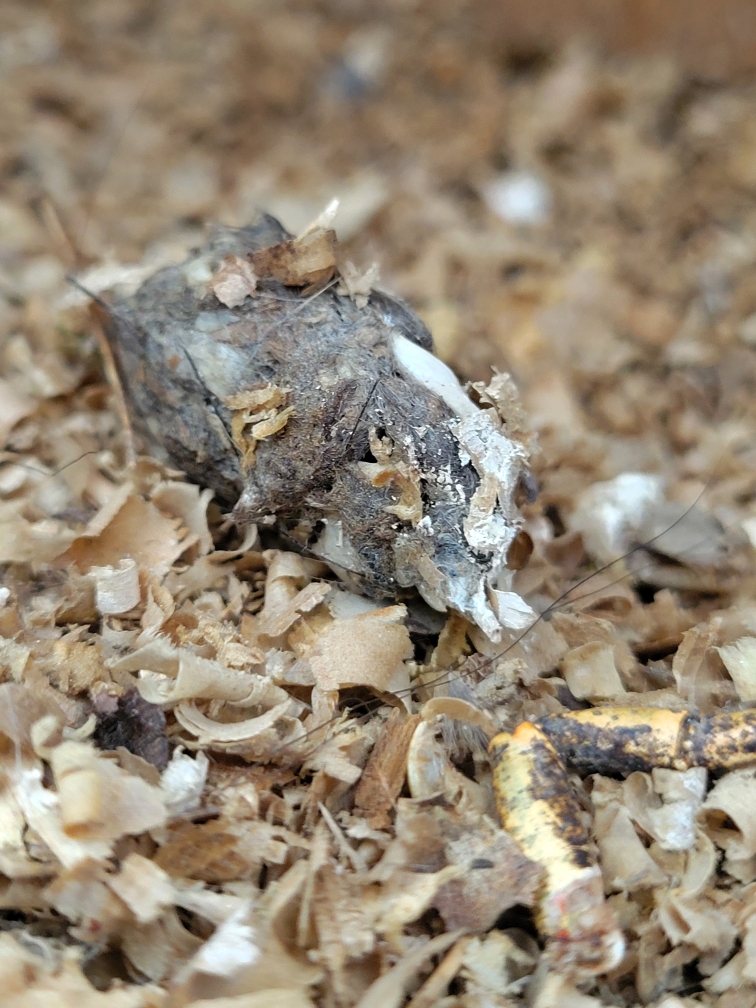
An owl’s pellet She later dissected it.
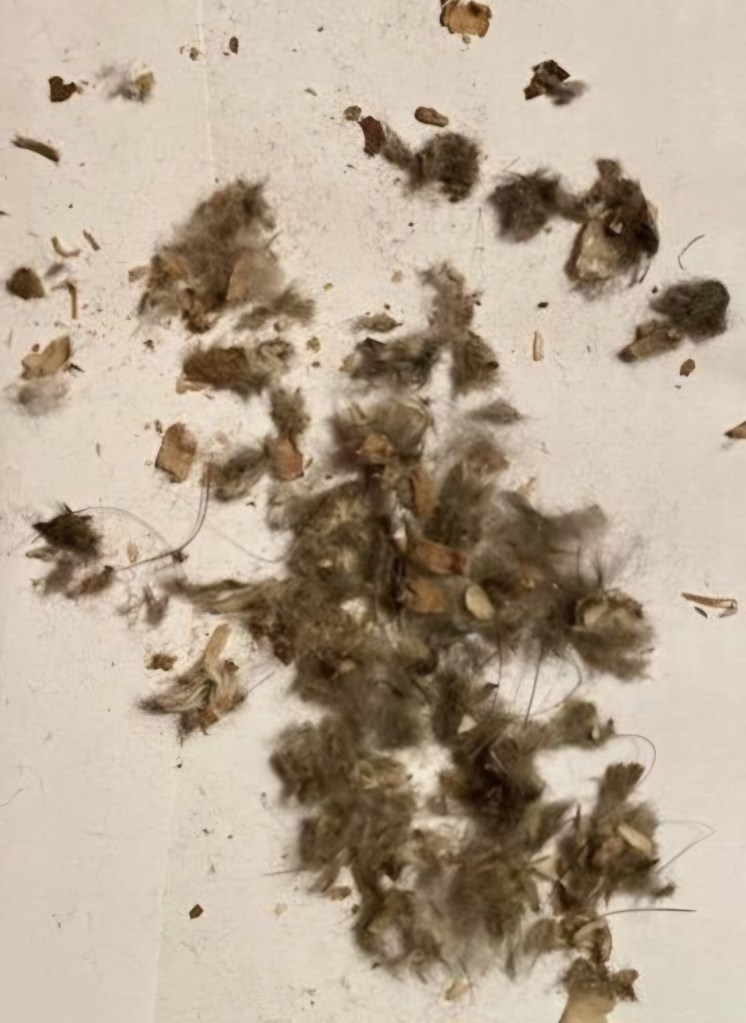
Photo courtesy of
Kathleen Garrett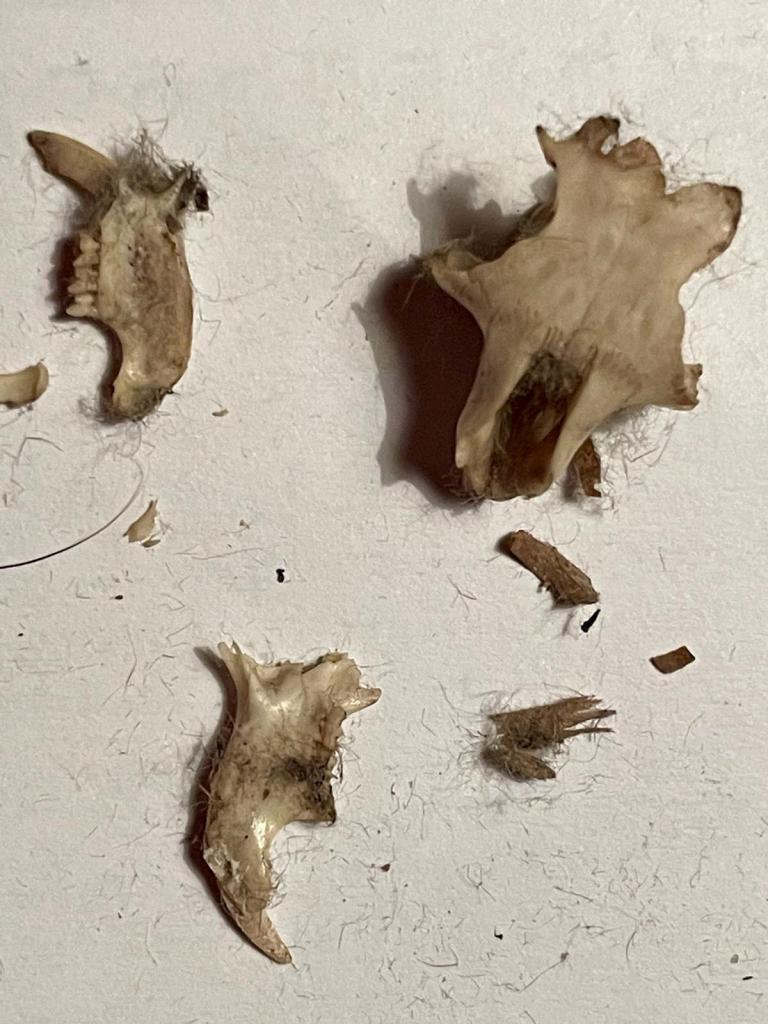
Photo courtesy of
Kathleen GarrettThe pellet’s contents included fur and bones, perhaps from a small rodent.
A few days later, the owl’s food storage box had two carcasses. One looked like a Deer Mouse. The other, a larger mammal, was more difficult to identify since there was neither head nor tail visible.
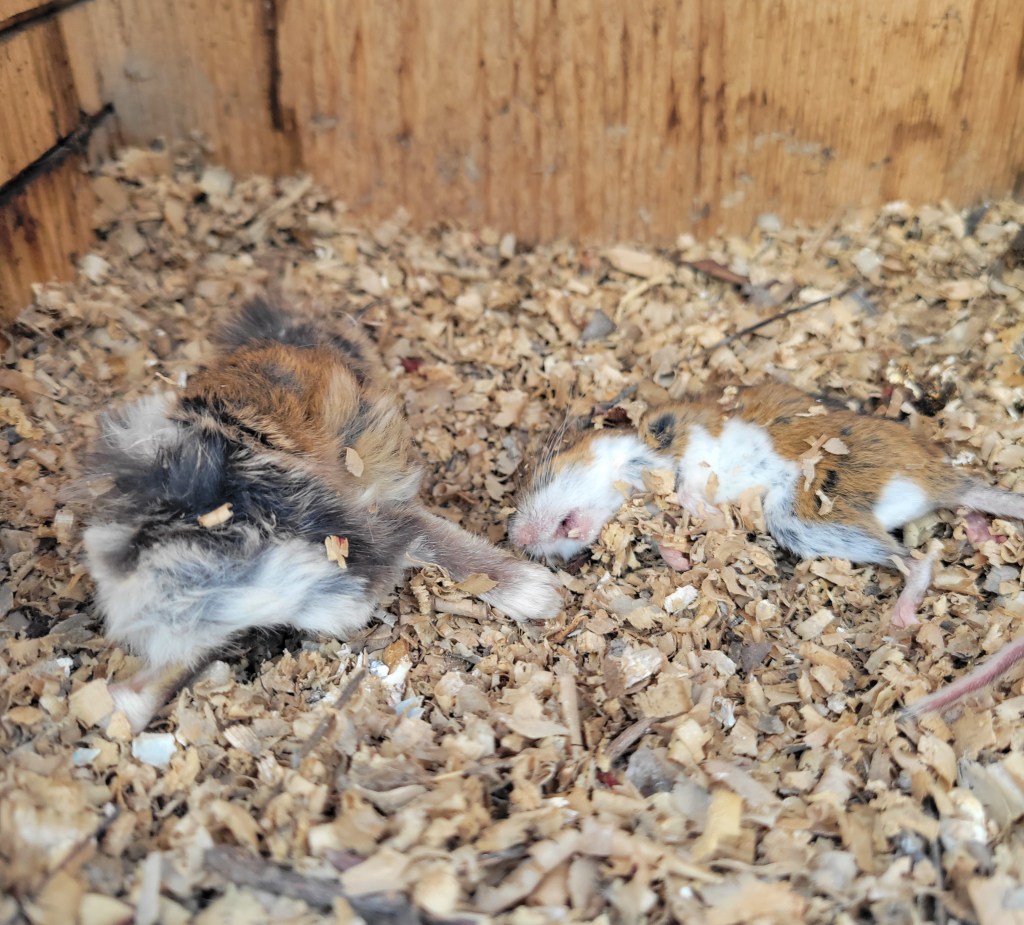
February 17 Owls often eat the head of their catch first. A theory (speculation?) is that the head is the most prized and nutritious part of their prey and the owls don’t want to take the chance that it will not be available later.
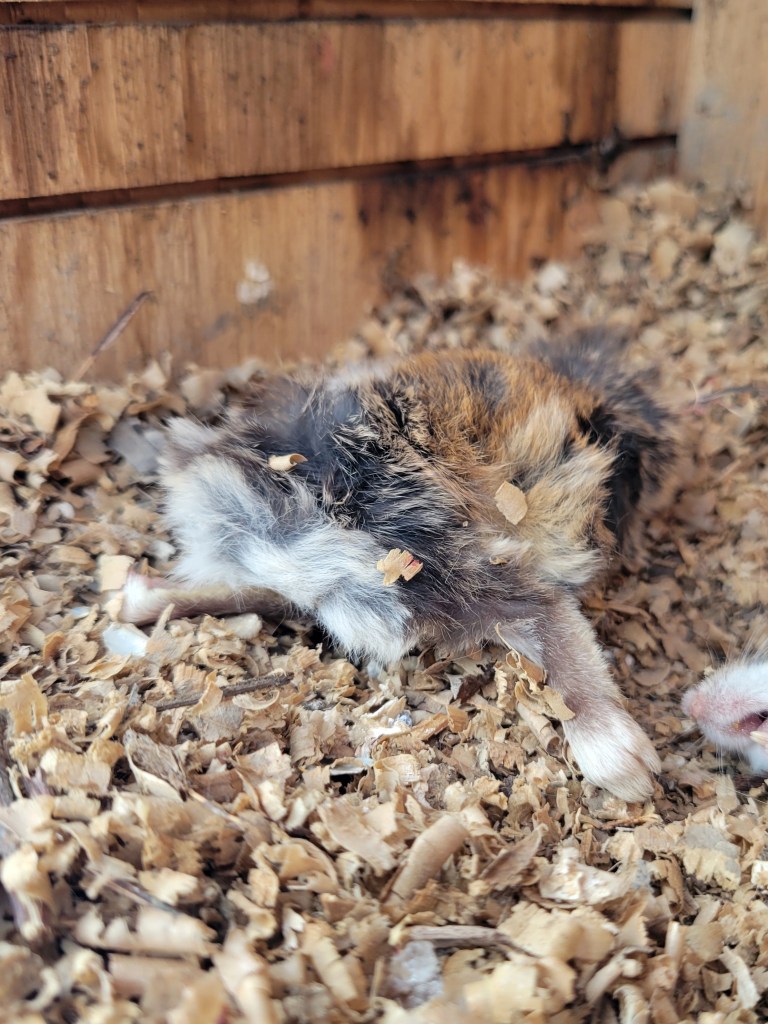
Headless and tailless
flying squirrel?After studying this photo — the size of the body and the colors of the fur, particularly the white underneath — I tentatively identified it as a Southern Flying Squirrel. I had never seen one up close, so my visual knowledge was limited.
Flying Squirrels are nocturnal and, while not uncommon in Michigan, are rarely seen. The mature forest of Eliza Howell is a quite suitable environment, though I am not aware that their presence in the park has been confirmed in the past.
Flying Squirrels sometimes spend the coldest parts of winter in groups, even huddling together to stay warm. If I knew this, I was sure the Screech Owl knew this as well. Having caught one, it would likely return to the same area hunting for more. Flying Squirrels frequently forage on the ground, which is where Screech Owls look for most of their prey.
I started checking the owl’s food storage box more frequently, hoping to get another look for better identification.
Two days later, I found what I was looking for. This one, while missing its head, did have a distinctive flat and slim tail. The overall length was about 9 inches or a little more, including the tail, and estimating the size of the missing head. That also fits Southern Flying Squirrel.

Southern Flying Squirrel without head 
Southern Flying Squirrel tail 
Southern Flying Squirrel feet I know of no local photographer who has an image of a live Southern Flying Squirrel, so I encourage the reader to look online or in a guidebook to see what the head looks like. Alive, it is often considered “cute.”
The flaps of skin that stretch between the legs of these squirrels allow them to catch air and glide when they launch themselves from trees (the reason they are called “flying”). They “steer” with their legs and tail.
—-
The Eastern Screech Owl has provided excellent opportunities this winter to learn more about what happens after dark in Eliza Howell Park on these cold winter nights. It is fascinating.
-
Moss Appreciation: Aided by a Bryologist
Leonard Weber
February 14, 2025
Ever winter, I stop several (or many) times at moss-covered logs in Eliza Howell Park. I stop to admire and, often, to take pictures. Moss is a plant green in winter.


I have learned over the years that what might look like a smooth uniform green carpet is complex and multicolored when viewed close up or magnified. Photos can assist in this close-up look.


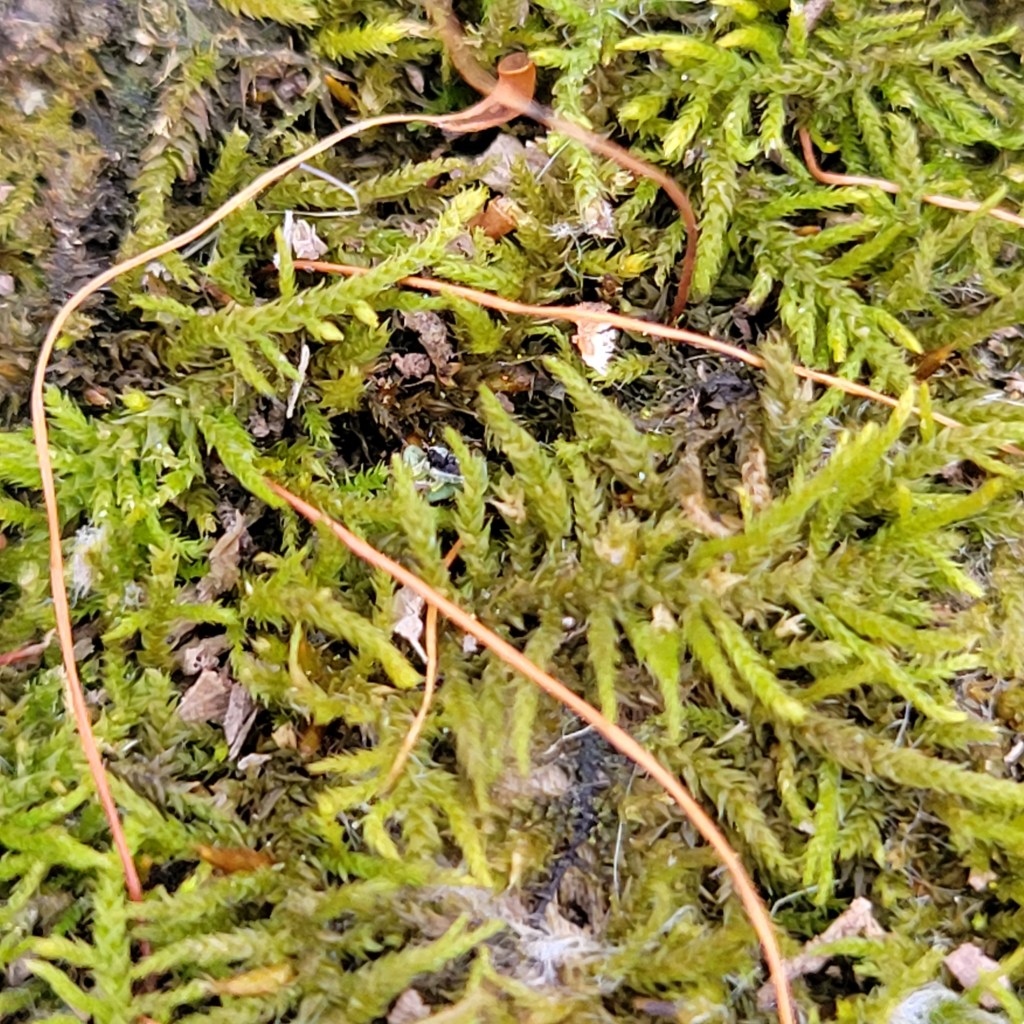
This year, my moss viewing has been enriched by reading GATHERING MOSS by Robin Wall Kimmerer. Kimmerer is a bryologist, the term for one who studies non-vascular plants like mosses and liverworts.

First published in 2002,
the 22nd printing was in 2024Kimmerer has the ability to combine scientific information about mosses with stories of her moss-related experiences in different settings and with a sense of appreciation of and respect for this ancient plant.
Mosses are true plants, but they do not have roots, and they do not flower. They have rhizoids, which help them adhere to logs or rocks or soil, but do not provide the plant with moisture and nutrients as roots do. Mosses get moisture from the atmosphere and absorb nutrients through their cells. They thrive in moist environments, which is where I know I can find them in the park.

Moss and mushrooms
share a logMoss is often used by birds in constructing nests.

Black-capped Chickadee nest in Eliza Howell Park,
with a base of mossThere is much to learn about moss, an ancient plant that includes many different species, about 12,000.
Kimmerer is an admirable nature author, in my opinion, because she writes both to describe how moss grows and to communicate her respect and admiration. She communicates a sense of awe and wonder, something that I often feel on my nature walks.

It’s great just to look at moss on logs in winter.

-
Eastern Screech Owl: Update
Leonard Weber
February 4, 2025
In November 2024, I reported the observation of an Eastern Screech Owl, sleeping soundly in a bird box in Eliza Howell Park.
This photo is from that post.
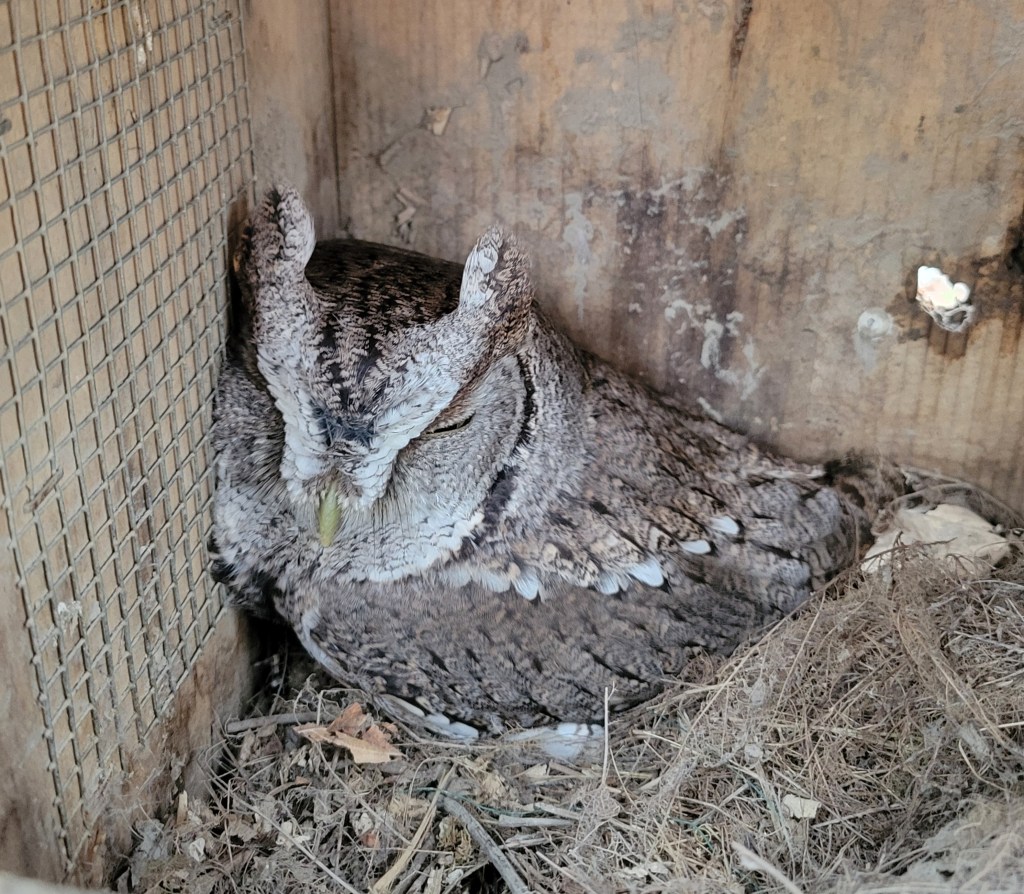
November 15, 2024 Some of the bird boxes that have been placed in the park are designed for Wood Ducks. This is the size box that Screech Owls tend to utilize, so I have been checking them occasionally this winter.
On December 31, one box contained the dead body of a mouse (probable species = Deer Mouse).

December 31, 2024. The next day, the mouse remains were gone.
Screech Owls are known to cache (store) prey in cavities at times for eating later. Mice are a common prey of Screech Owls. Further, these bird boxes are on poles that mammals are (presumably) unable to climb and are placed far from overhanging trees to prevent mammals from jumping from a tree to the box.

One of the Wood Duck boxes
in Eliza Howell ParkThere is no direct observation of a Screech Owl placing or retrieving this mouse, but the above considerations suggest that it was placed here, for temporary storage, by a Screech Owl.
A week later, I used my phone camera to peek into a third box.

Sleeping Screech Owl,
January 7, 2025I do not know whether this is the same Owl that was spotted in November, but the location leads me to think that it is.
Late in January, the box that had earlier been used as a mouse refrigerator was again put to that use. This time, the rodent, which was headless, had the shape and short tail of a Vole. Owls do decapitate prey on occasion.
The next day, the box was empty.
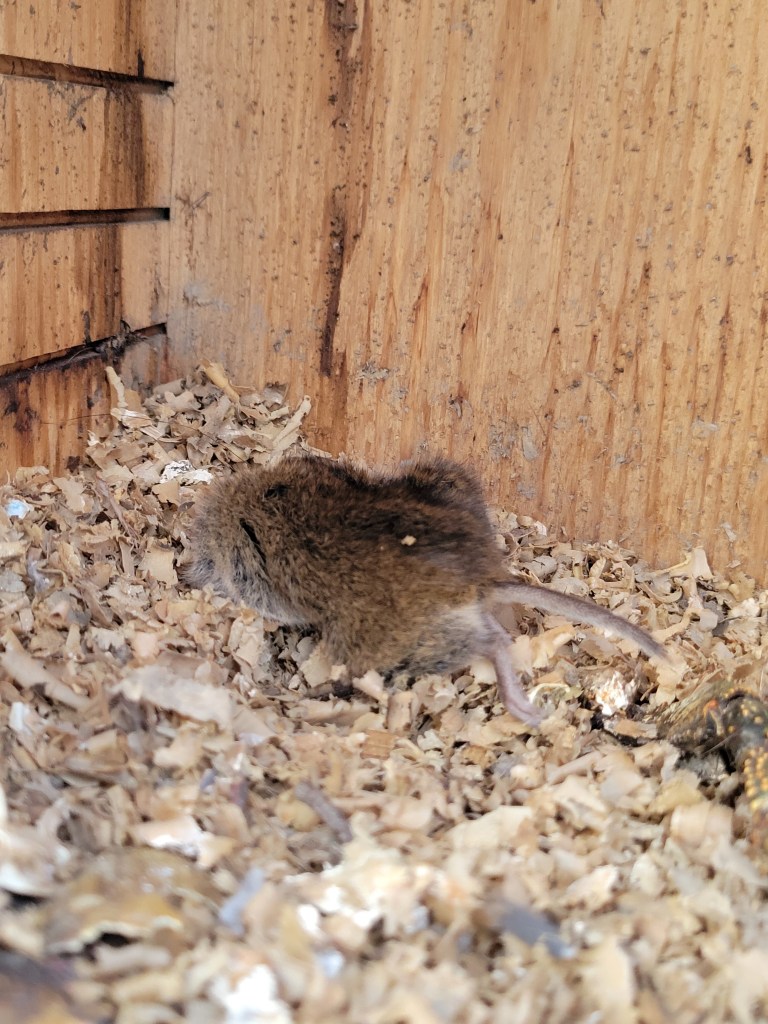
January 29, 2025 Until the end of winter (but not when nesting season is about to start), my nature walks will continue to include a few bird box stops.
-
Black-capped Chickadee: Winter Survival
Leonard Weber
January 28, 2025
It’s winter in Michigan and, for many birds that spend the winter here, survival is not easy. Knowing how difficult it has been at times to keep myself warm enough during my walks in Eliza Howell Park during the recent cold spell, I have begun to give more attention to the winter survival strategies of different species.
One winter species here is the Black-capped Chickadee, a year-round resident.

Black-capped Chickadee.
Photo courtesy of
Margaret WeberMy typical winter walk takes me over the river and into the woods. The area near the footbridge is a good place to stop to check for bird activity.

Path after crossing the footbridge I recently spotted a Black-capped Chickadee on a raised log by the walking path.

In their foraging, Chickadees usually move quickly from one location to the next. This one stayed in one spot long enough for me to observe that it had found something to eat.
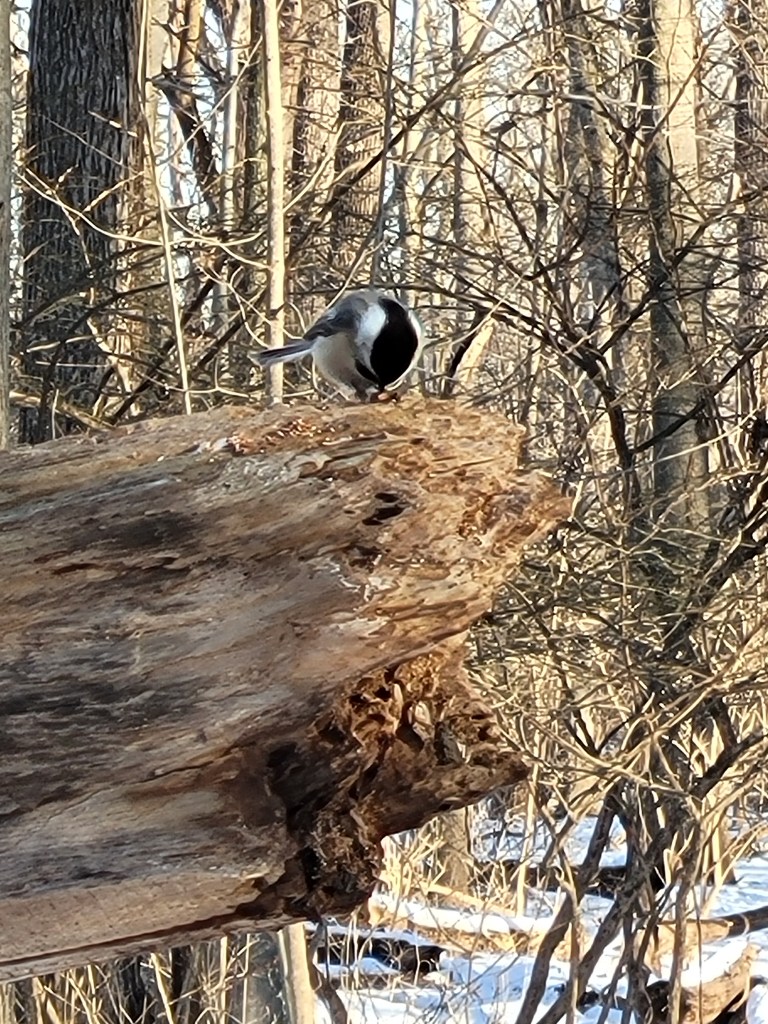
In the winter, Chickadees forage among tree branches looking for spiders and insects (often in the egg or pupa stage). They also eat food that they had previously stored.
Anyone who has watched a bird feeder has probably noticed Black-capped Chickadees grabbing a seed and immediately flying up into a nearby tree. Sometimes, they eat the seed, and sometimes they cache it, perhaps under an edge of bark.
Chickadees have the spatial memory skill that allows them to remember over a thousand different locations where they have stored food for later eating.
While I have long known about Chickadees storing food, I did not know about another winter survival skill until recently.
Black-capped Chickadees usually spend the winter nights in small cavities, by themselves. According to reports, on very cold nights, they conserve energy by significantly lowering their metabolism and body temperature — practicing a form of very short-term hibernation. In the morning, they warm themselves by shivering and then join others for another day in pursuit of sufficient food.

Photo courtesy of
Margaret WeberBlack-capped Chickadees are often seen in winter in a small mixed-species flock. In addition to the three companions shown in the collage below, the flock of small birds might include Brown Creeper or Golden-crowned Kinglet.
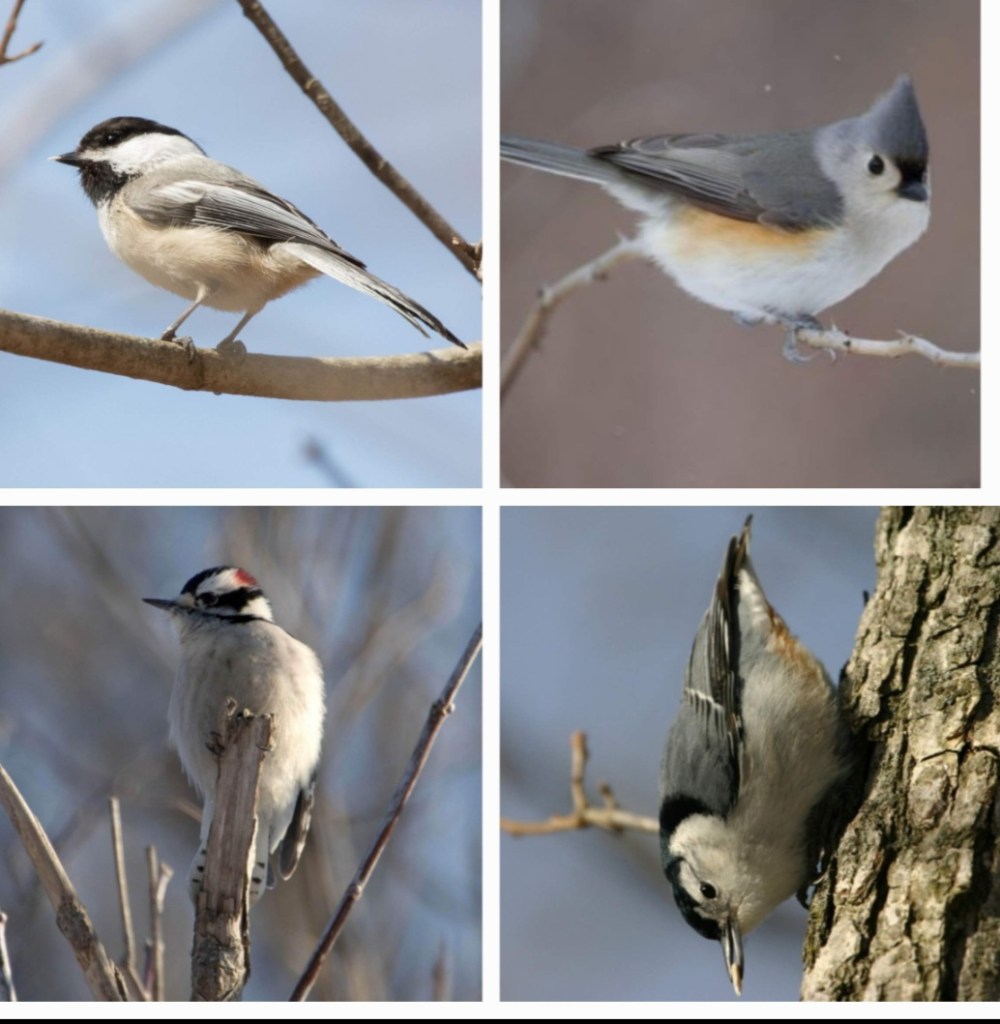
From top left, clockwise: Black-capped Chickadee, Tufted Titmouse, White-breasted Nuthatch, Downy Woodpecker. Photos courtesy of
Margaret WeberIn these foraging groups, Chickadees appear to be the leaders. They show up first and seem to determine the direction in which they all move. The other species pay attention to their calls
The Black-capped Chickadee has been a bird of special interest to me over the years in my study of nesting practices. It is fascinating to see this tiny bird excavate or enlarge a nesting site in a dead tree, almost as though it were a woodpecker.

Photo courtesy of
Margaret WeberOther small non-woodpecker cavity-nesting birds, like nuthatches and titmice, do not take such a constructive role in preparing the nesting site.
Chickadees sometimes choose to nest in bird boxes. When one pair did so in Eliza Howell Park, the nest contained nine eggs.

Black-capped Chickadee eggs The Black-capped Chickadee is an energetic bird in all seasons. It is fascinating to see them manage the coldest weather of the year.
-
13 Climbing Vines
Leonard Weber
January 21, 2025
The number of climbing vines that I have observed growing in Eliza Howell Park continues to grow. It is now 13.
Some are woody, some not. Some climb 50 feet, some only a few feet. Some are native to Michigan; some are not. Some have bright fruit, others don’t. They have different methods by which they climb trees and other plants. The variety is fascinating.
Here is a very limited look at and a brief comment on each, just an invitation to learn more in 2025.
1. Greenbrier.
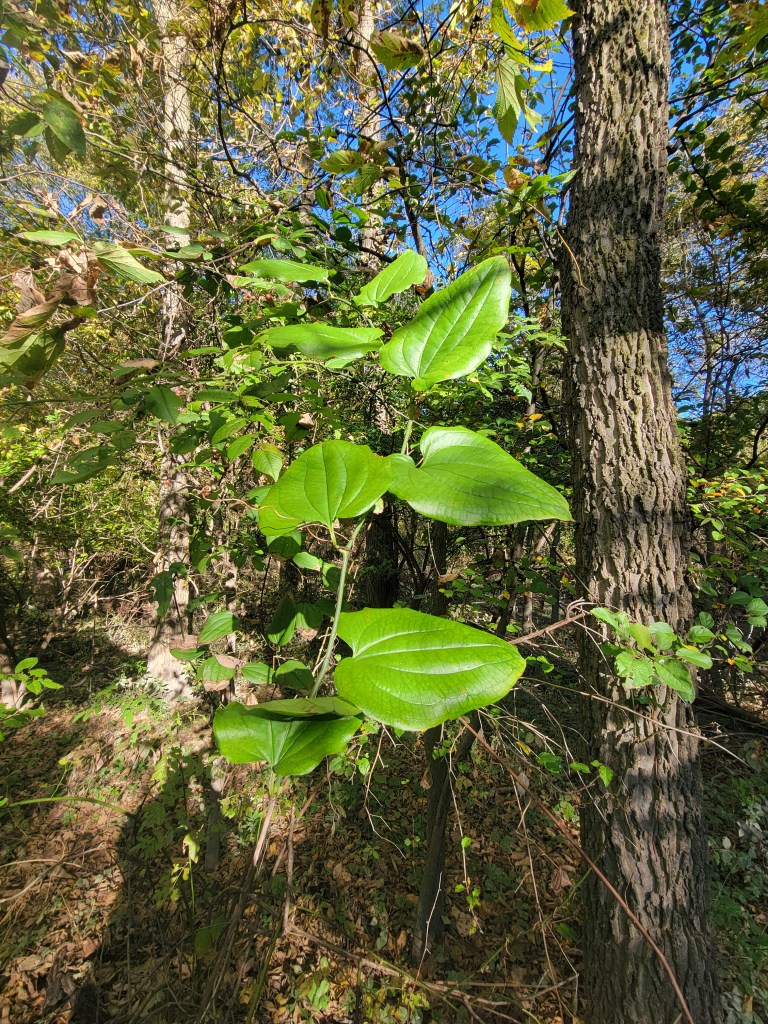
Greenbrier
leavesGreenbrier grows in the understory of the woods, usually fairly close to the river. The lower vines are green and thorny, and the leaves remain green until late in the fall.
2. American Groundnut
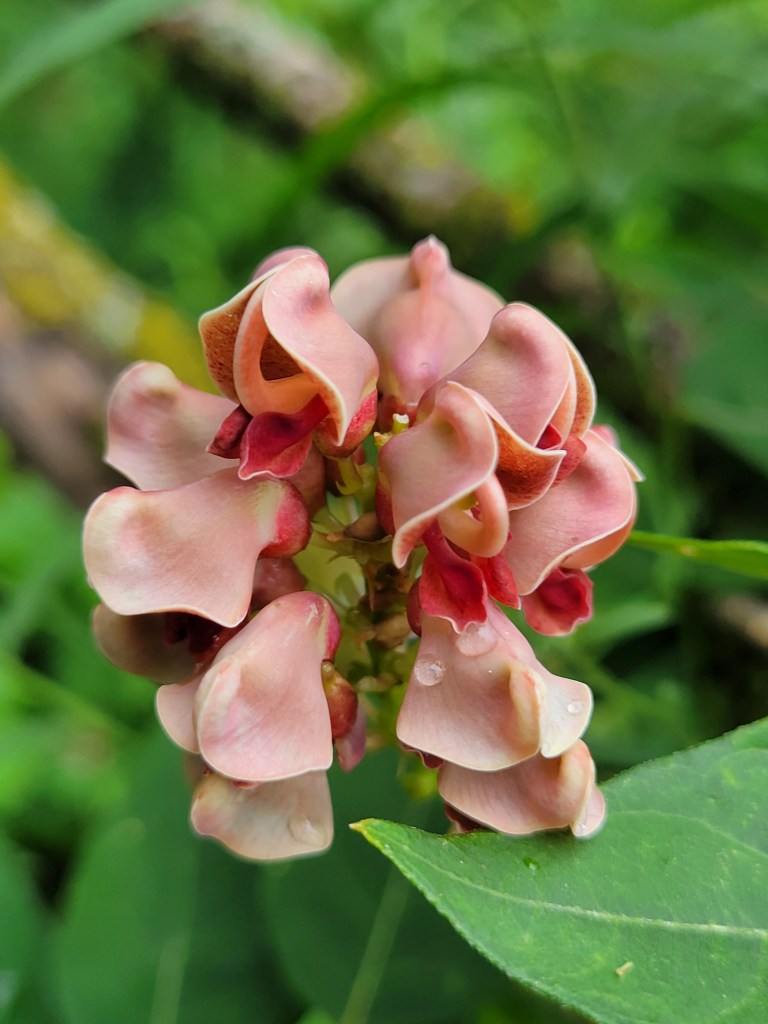
American Groundnut
flowerI am aware of only one patch of American Groundnut in the park. Growing among shrubs and climbing them, it is not very noticeable until the flowers bloom in August. Among those who forage for food, American Groundnut is known for its edible tubers.
3. Moonseed
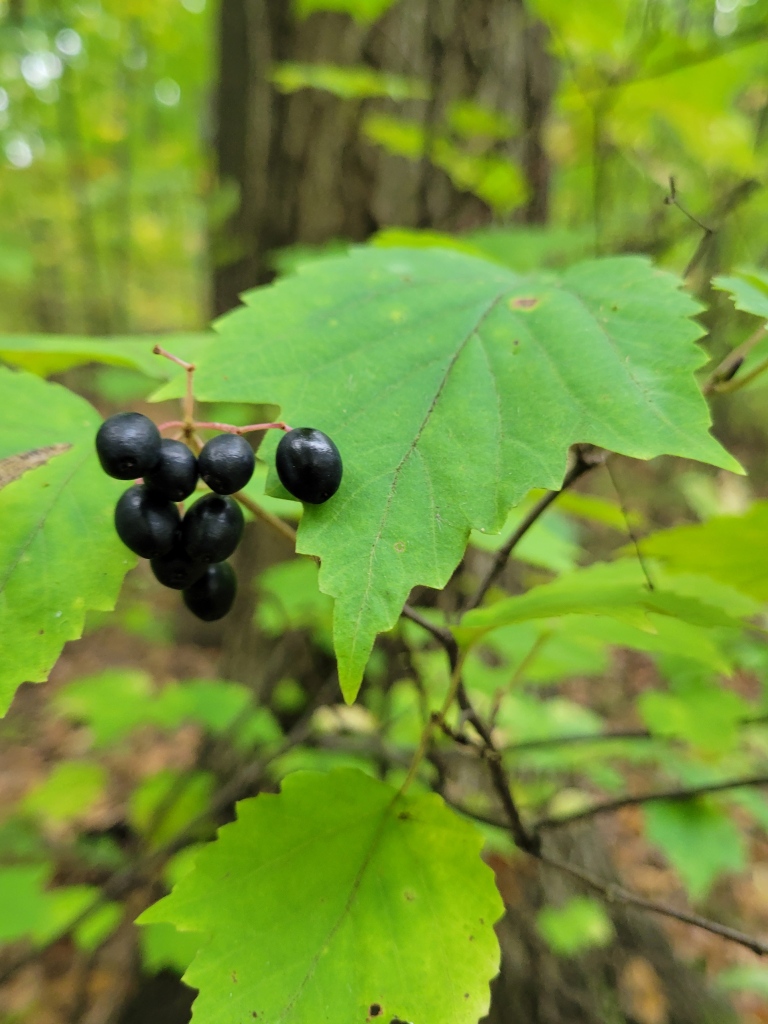
Moonseed
berries and leavesMoonseed gets its name from the fact that the single seed in each berry is shaped like a crescent. So far, I have seen it in only one area of the park. It climbs small trees by twining. (See the next vine.)
4. Oriental Bittersweet
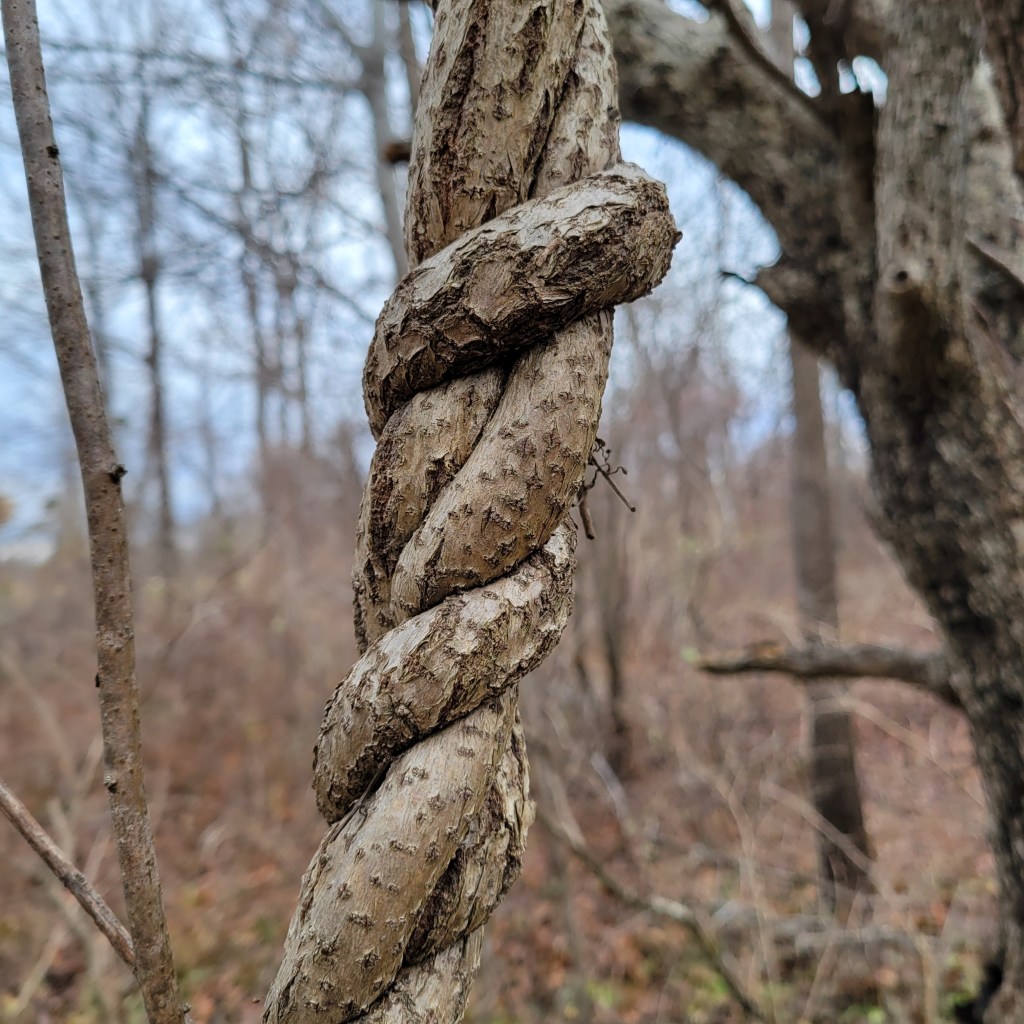
Oriental Bittersweet
twining vinesOriental Bittersweet is widespread in Eliza Howell, where it can be found on both small and large trees. It produces abundant fruit.
5. Winter Creeper
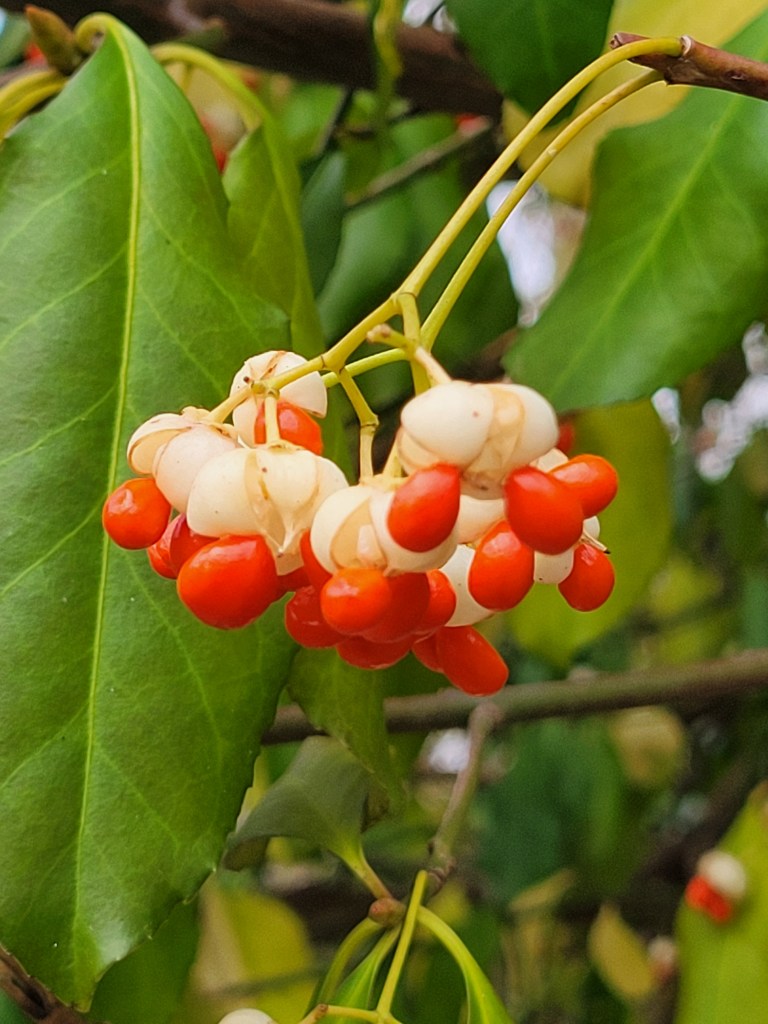
Winter Creeper
berries and leavesWinter Creeper is the only one of these 13 vines that is an evergreen. The fruit ripens late in the season, often still on the plant when the first snow comes in late November. It is located in only one area of the park, to my knowledge, where it climbs tree trunks.
6. Wild Grape
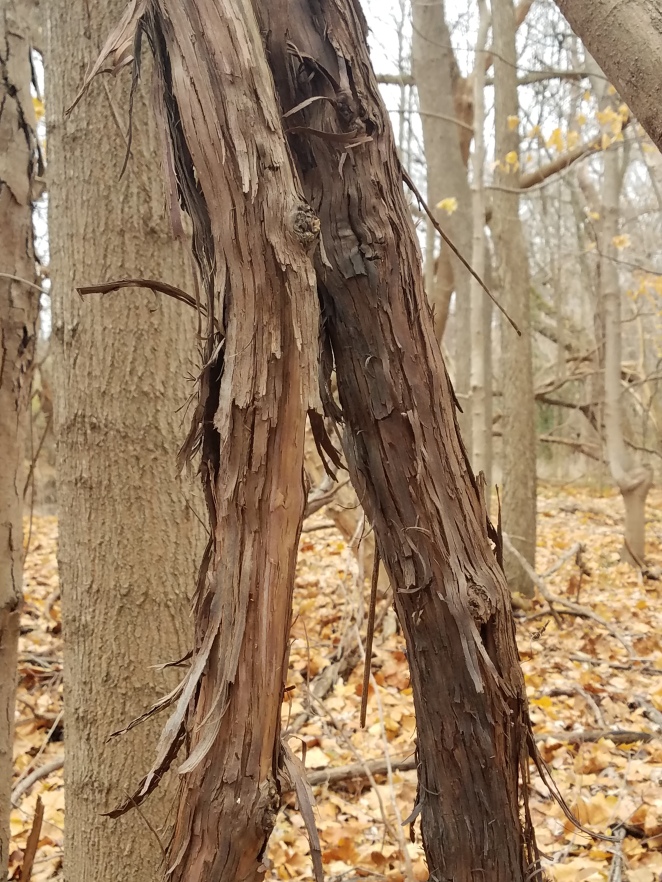
Wild Grape
old woody vinesGrape vines reach up very high on some trees in the woods, the large vines characterized by loose bark. The smaller leafy vines can have abundant fruit.
7. Wild Cucumber
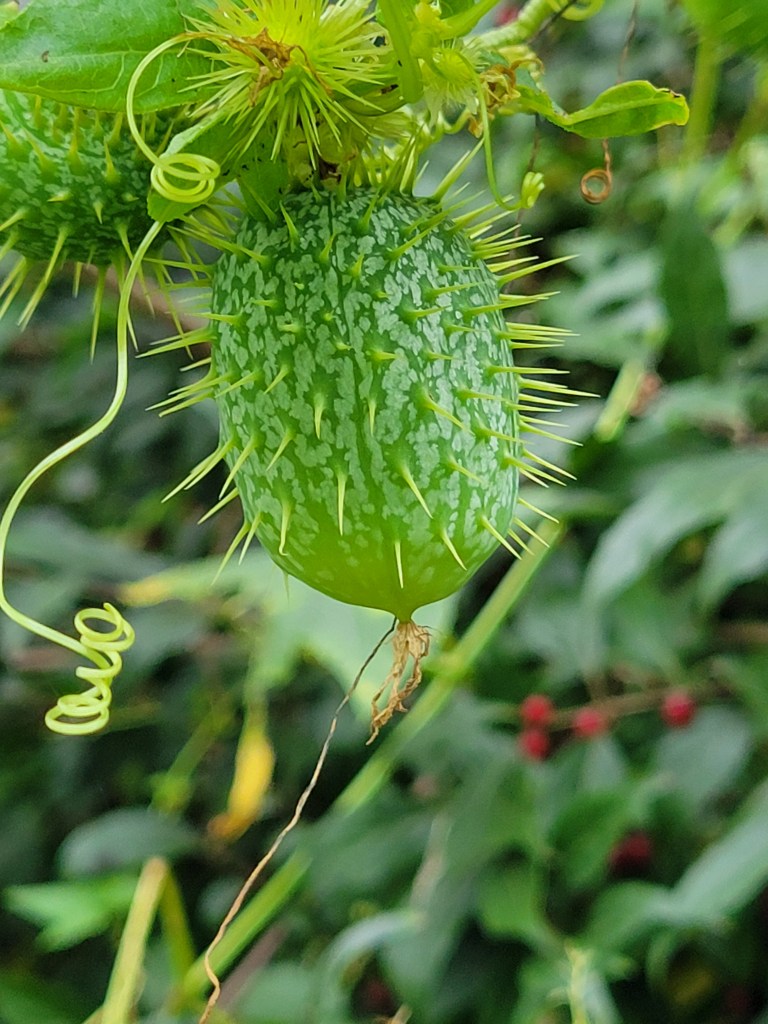
Wild Cucumber
fruit and tendrilsWild Cucumber is the only annual in this list, starting anew each year. It climbs quickly, using tendrils to attach and climb. The flowers are white.
8. Poison Ivy
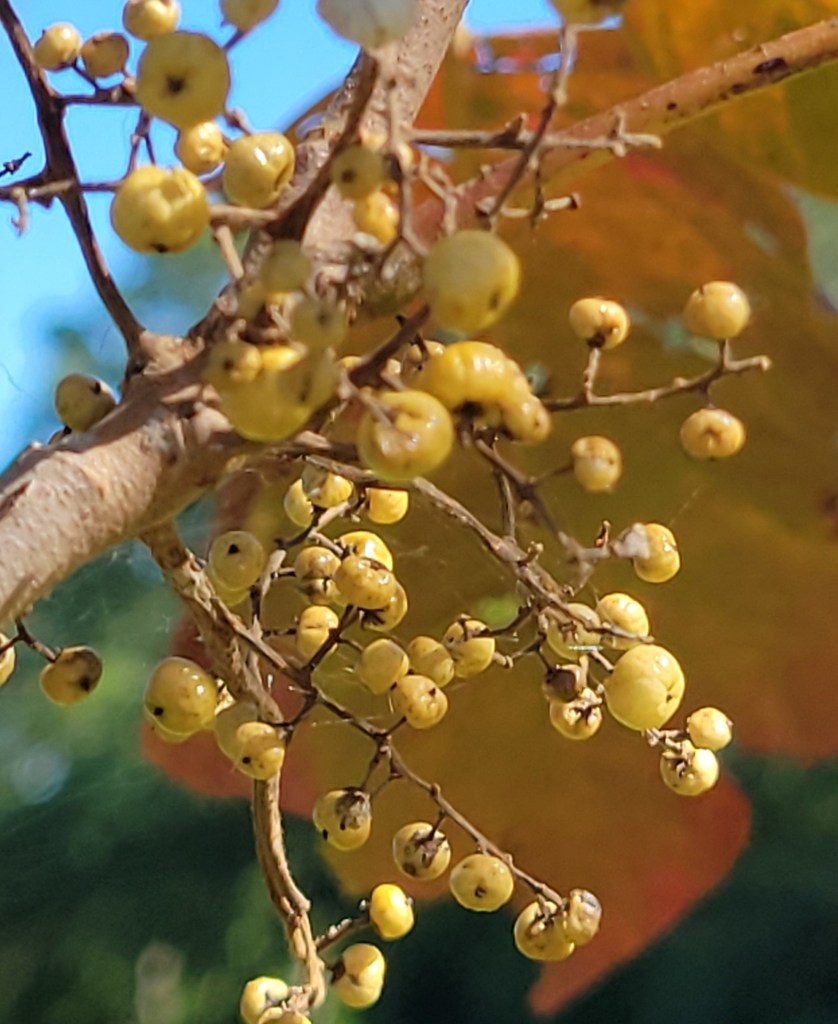
Poison Ivy
berriesPoison Ivy can be found climbing trees in both the woods and in the more open area of the park where the trees are scattered. The three leaflets are often noted, but it is the fruit that gets the attention of birds.
9. Virginia Creeper

Virginia Creeper
leaves in SeptemberVirginia Creeper is sometimes confused with Poson Ivy, but it has 5 leaflets. It has blue berries, on red stems, in early fall.
10. Climbing False Buckwheat
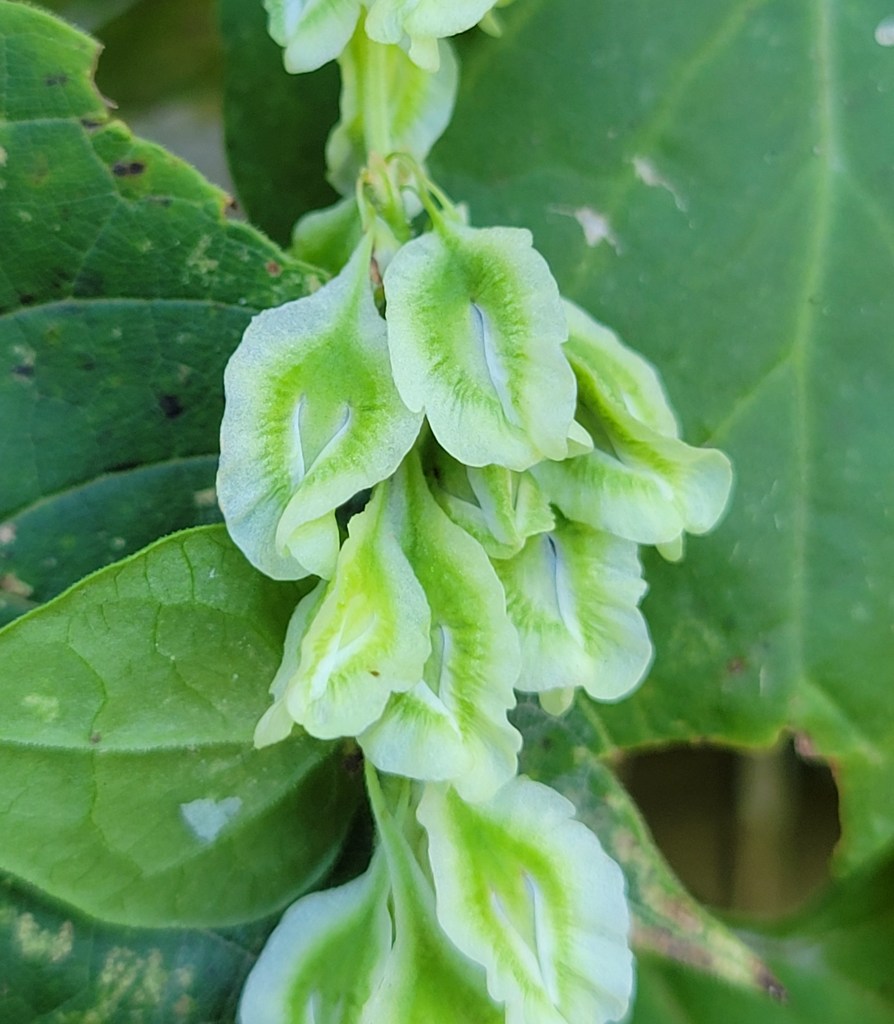
Climbing False Buckwheat flower and fruit cluster Climbing False Buckwheat seems to drape its vines over shrubs or small trees. It is not common in Eliza Howell Park and is easy to miss.
11. Climbing Nightshade
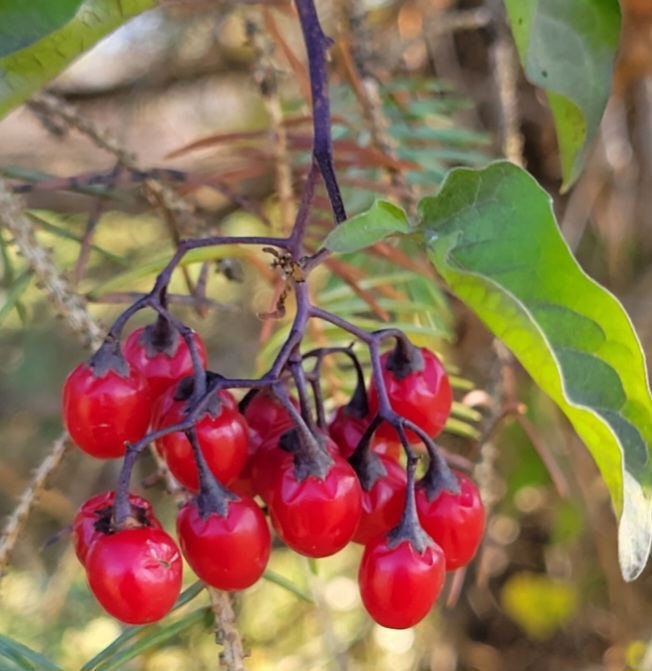
Climbing Nightshade
fruit and leafI am aware of only one location where Climbing Nightshade grows in the park, under and growing up in a small spruce tree. The berries ripen from green to red.
12. Virgin’s Bower
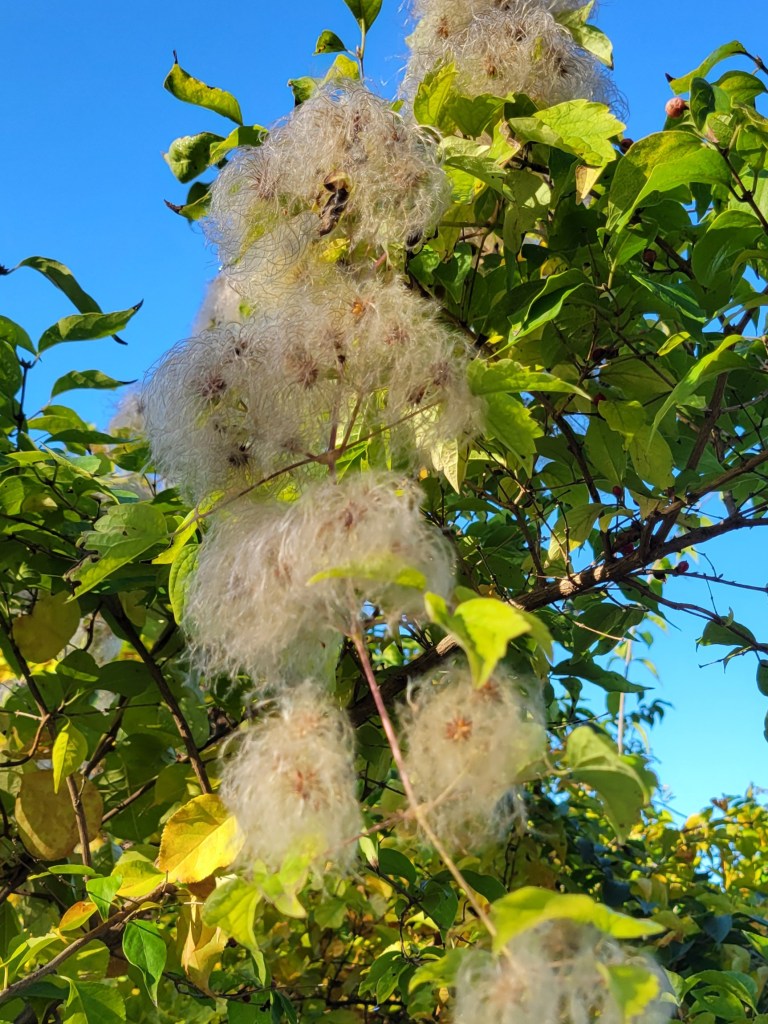
Virgin’s Bower
silky seed headsVirgin’s Bower is a native clematis, one that blooms quite late in the growing year. The seeds are dispersed by wind, and many hang on through October
13. Porcelain Berry
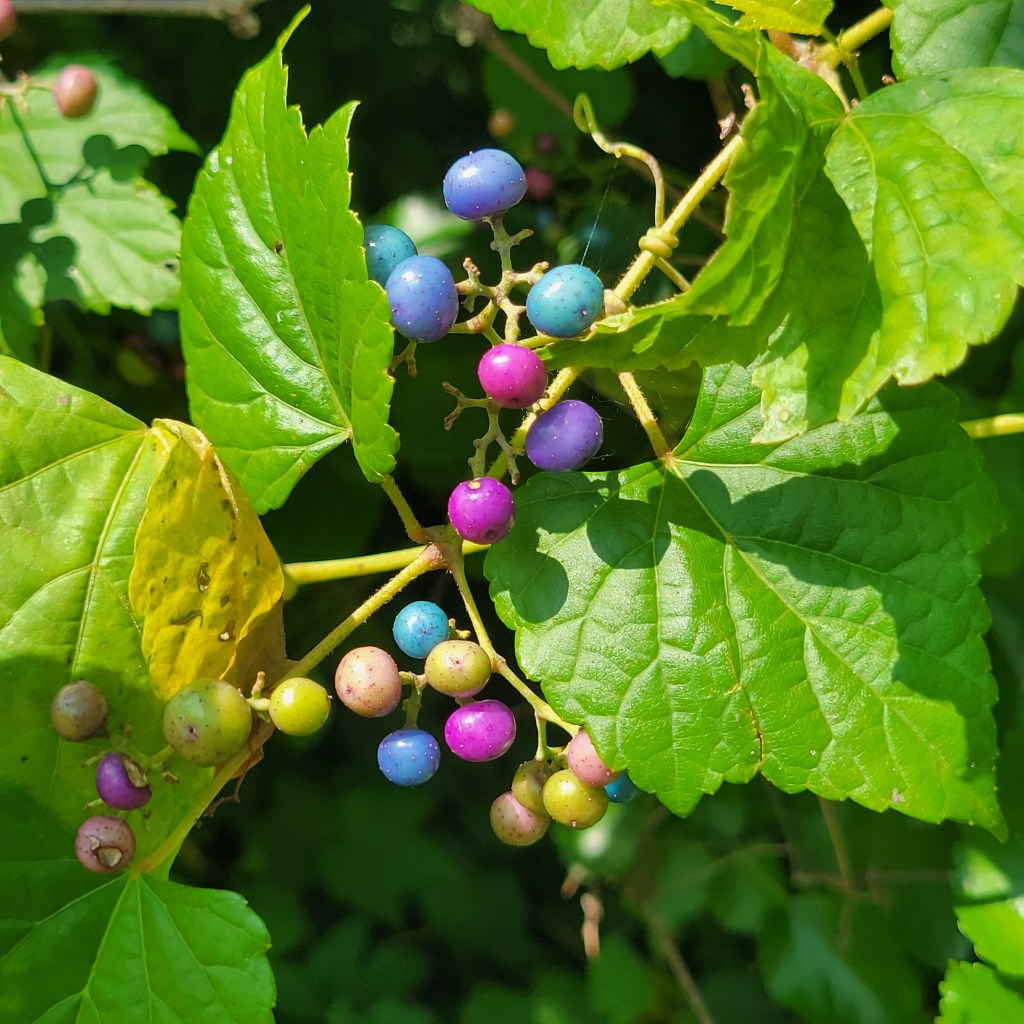
Porcelain Berry
leaves and fruitPorcelain Berry, in the grape family, is a vine that grows vigorously and can cover smaller trees. The colorful fruit is eaten by many birds.
….
The vines climb by different methods.
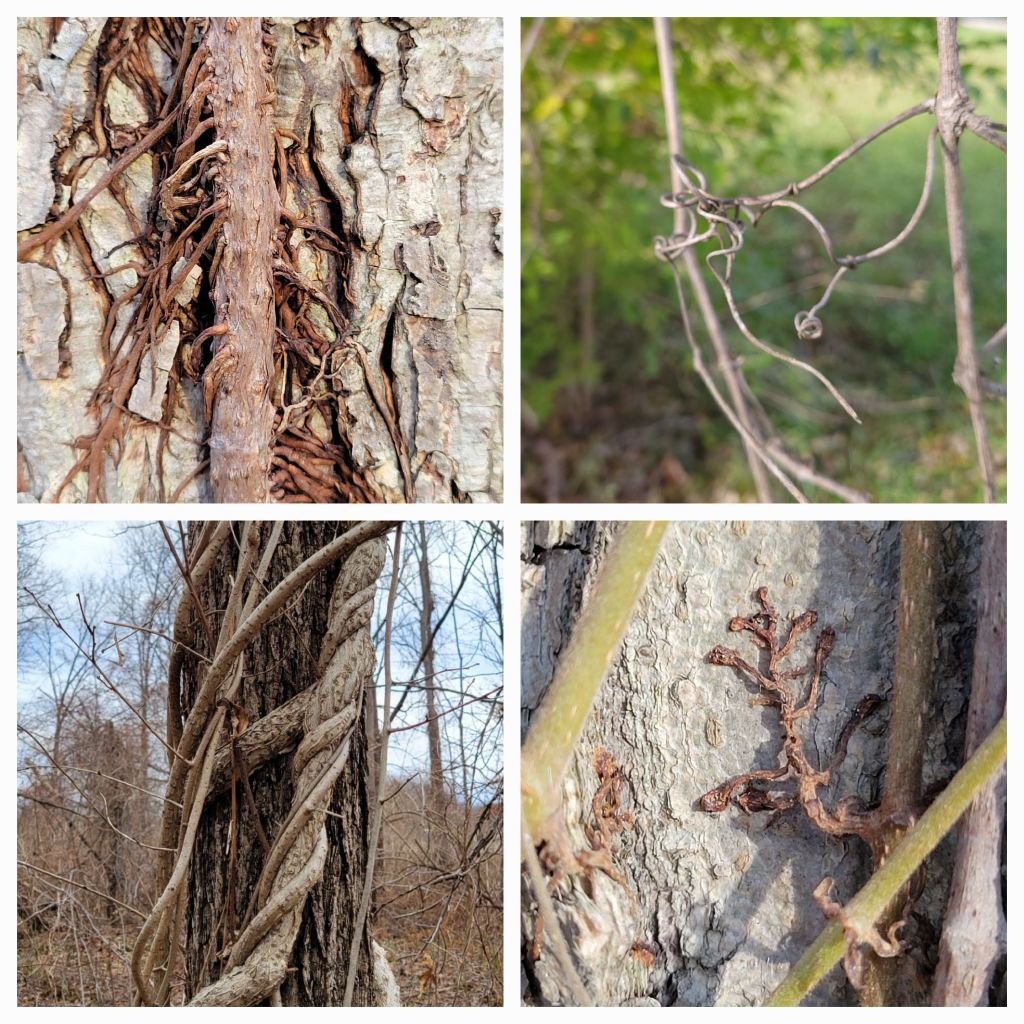
From top left clockwise: aerial roots (Poison Ivy), tendrils (Greenbrier), adhesive disks (Virginia Creeper), twining (Bittersweet) Each of these 13 vines has its own characteristics. I expect to continue stopping for further looks in 2025, to get to know them better.
I wonder what other climbing vines are here that I have not yet discovered.
-
Subscribe
Subscribed
Have a WordPress.com account? Log in now.

