-
Purple Coneflower: A Powerful Butterfly Magnet
Leonard Weber
August 5, 2023
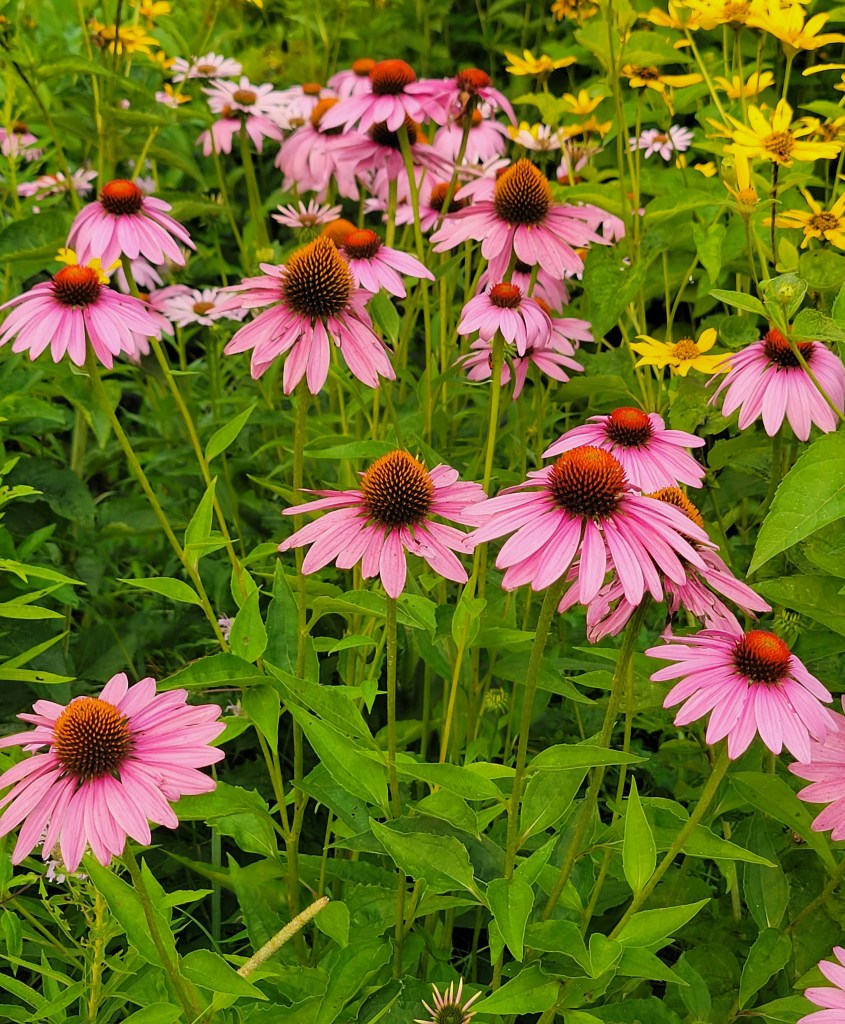
A perennial wildflower that blooms several weeks each summer in Eliza Howell Park is Purple Coneflower. I regularly visit these patches in July and August, often pausing for extended periods of time near them.

Purple Coneflower There are other flowers that attract butterflies in the park, but nothing compares with Purple Coneflower. Butterflies focused on sipping its nectar often let me get close enough to take photos with a phone camera.
Here are 17 butterfly species that I have (so far) been able to capture photographically while they and I visited Purple Coneflowers.
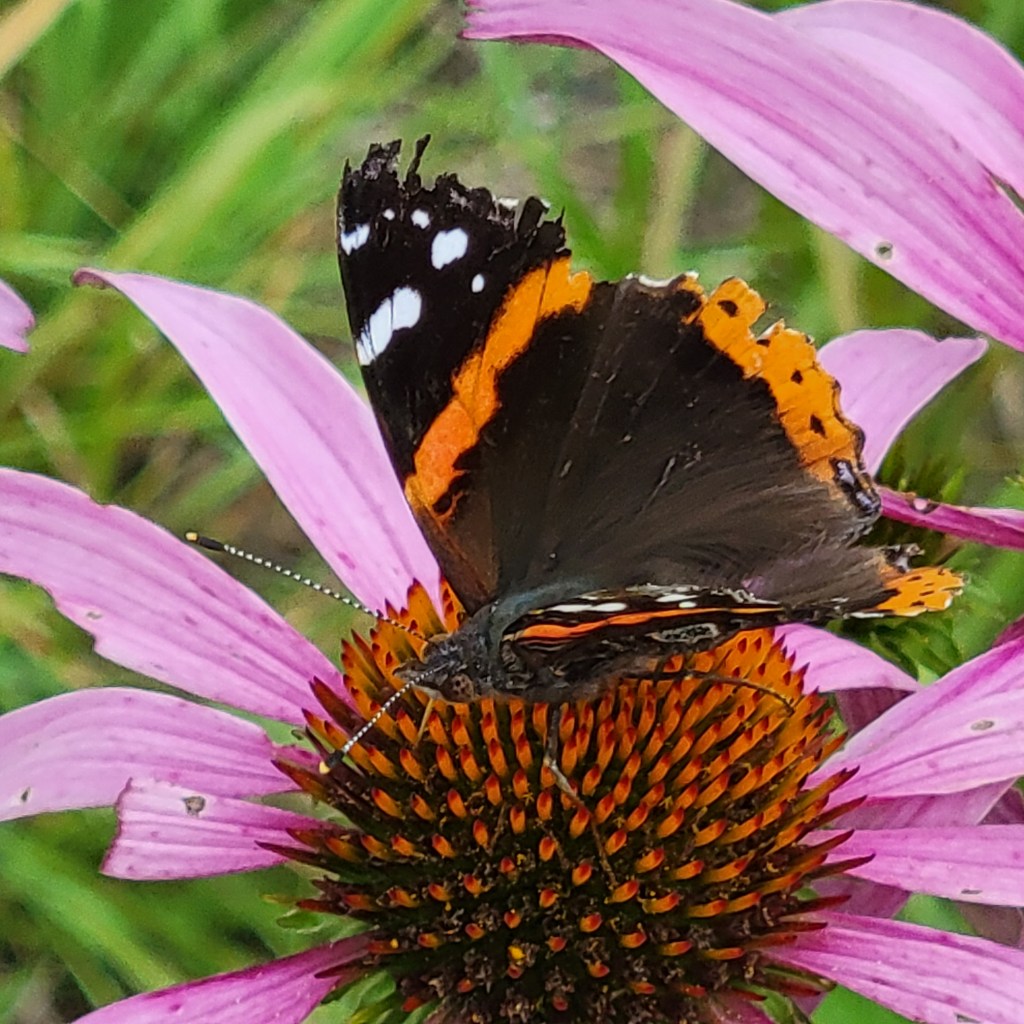
Red Admiral 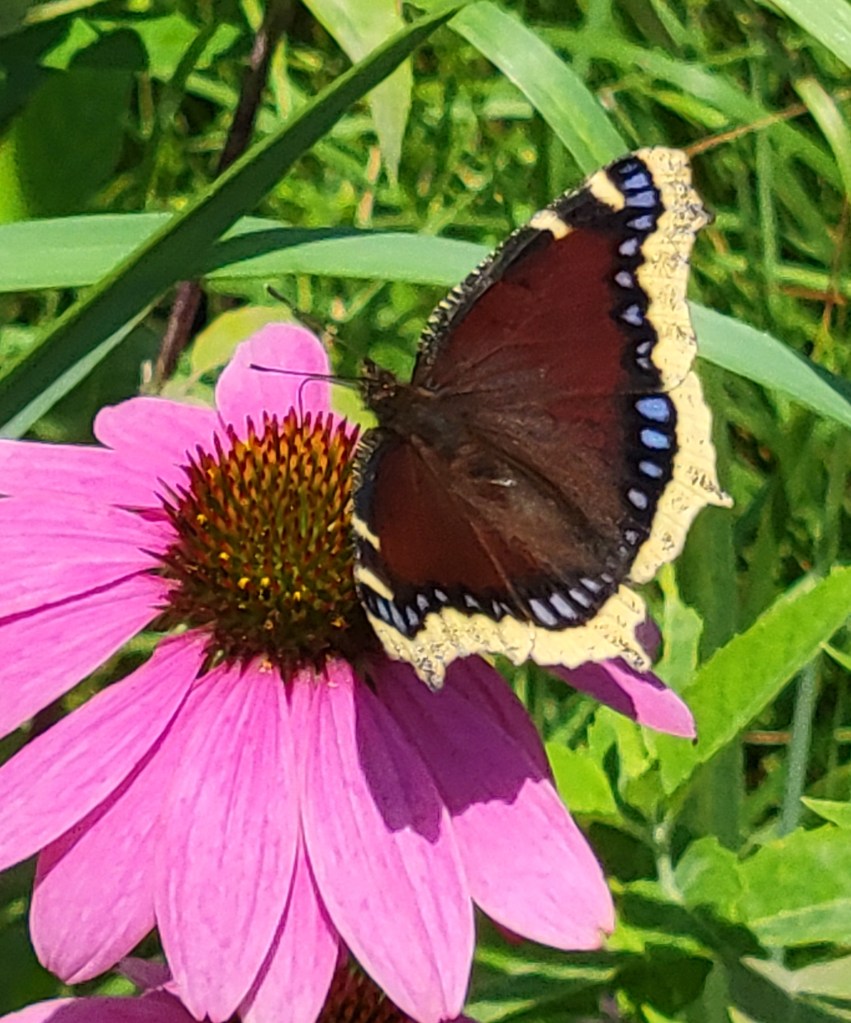
Mourning Cloak 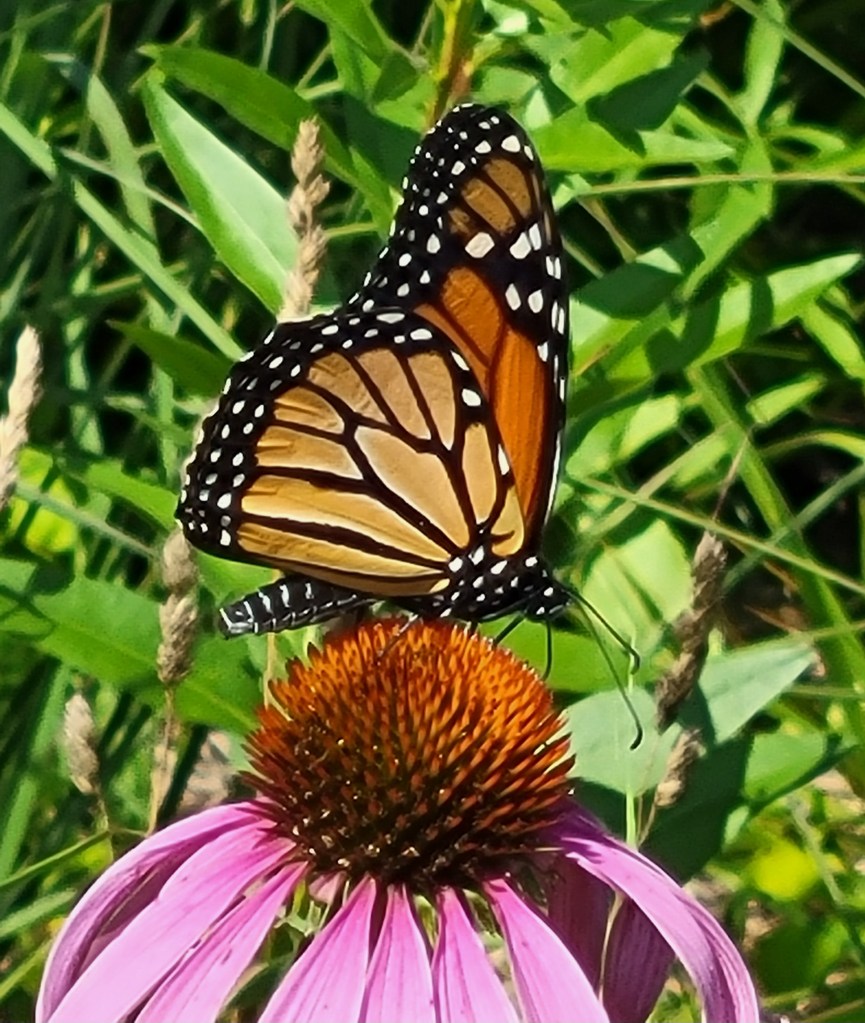
Monarch 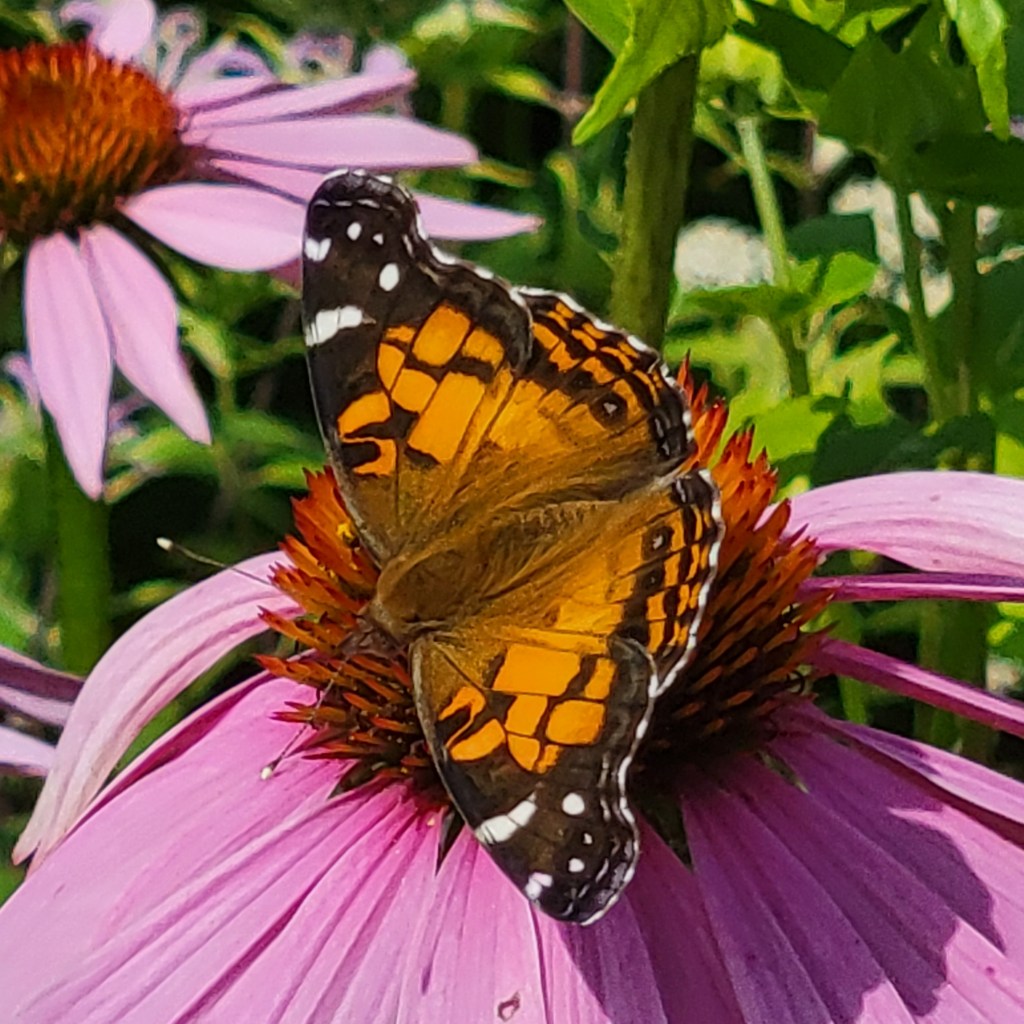
American Lady 
Eastern Tiger Swallowtail 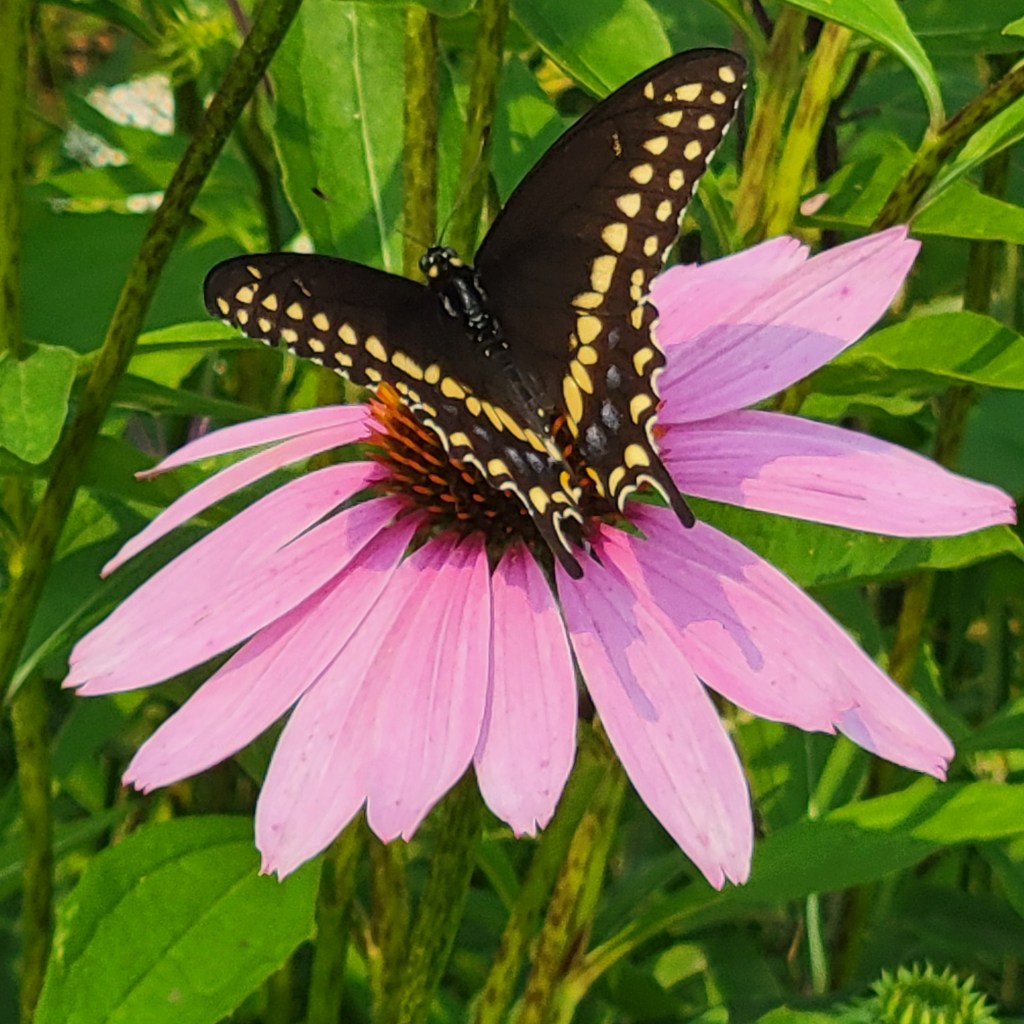
Black Swallowtail 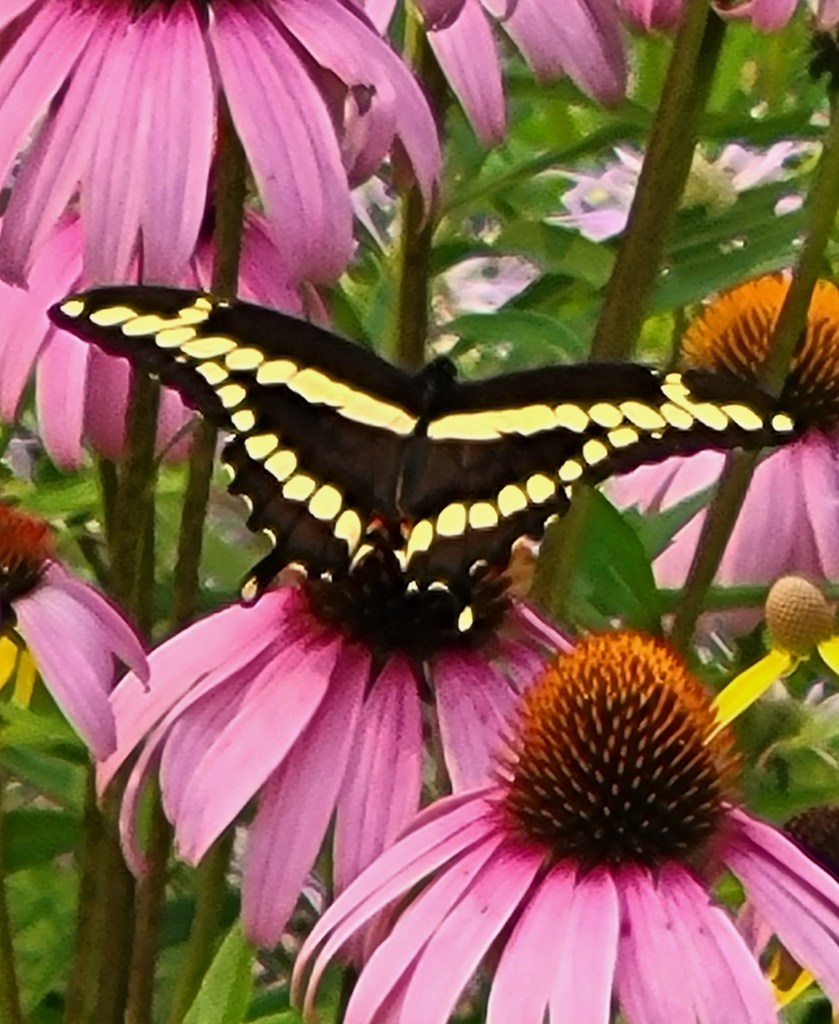
Giant Swallowtail 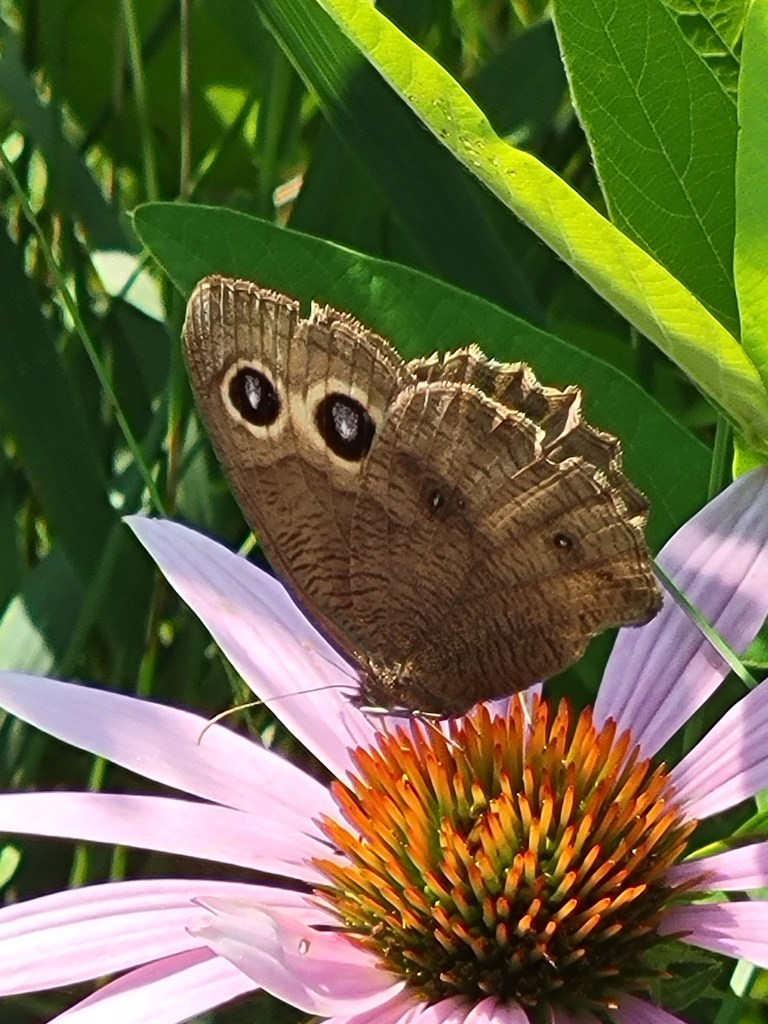
Common Wood-Nymph 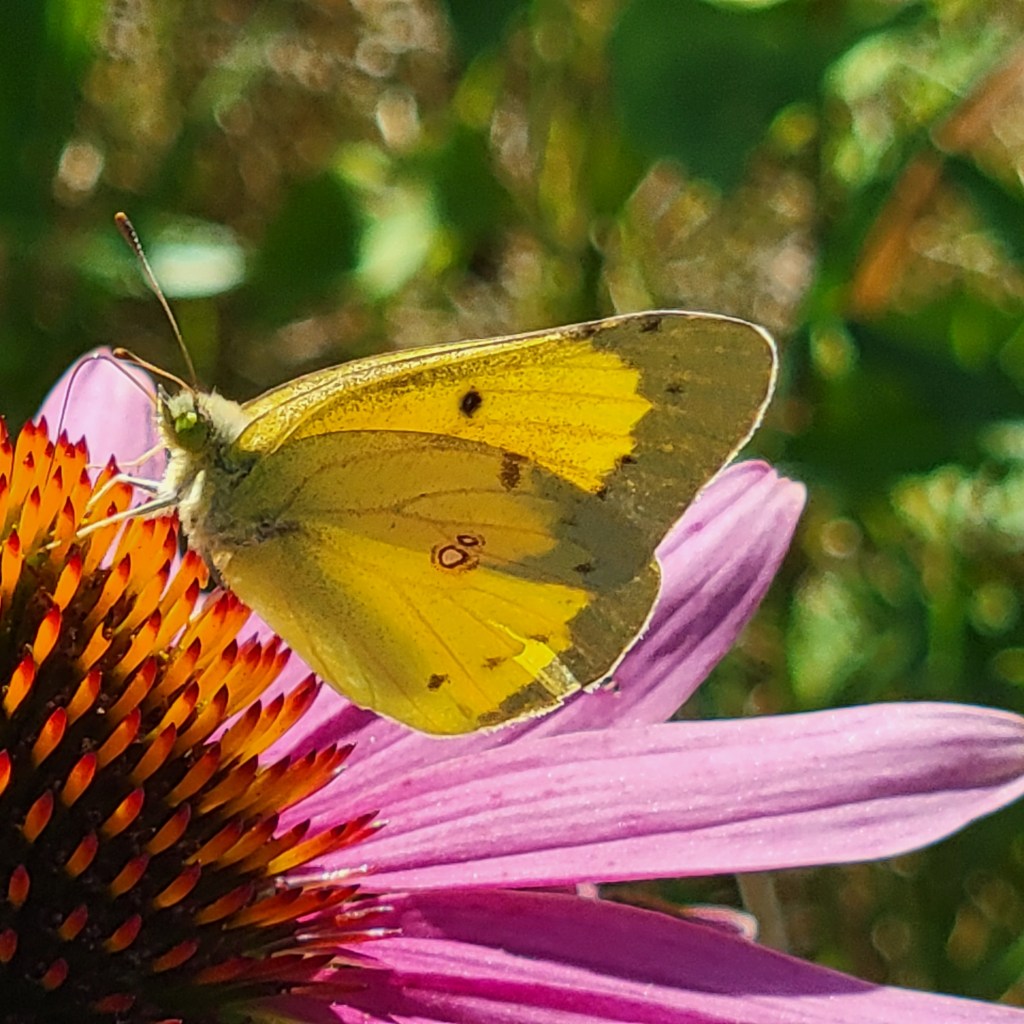
Orange Sulphur 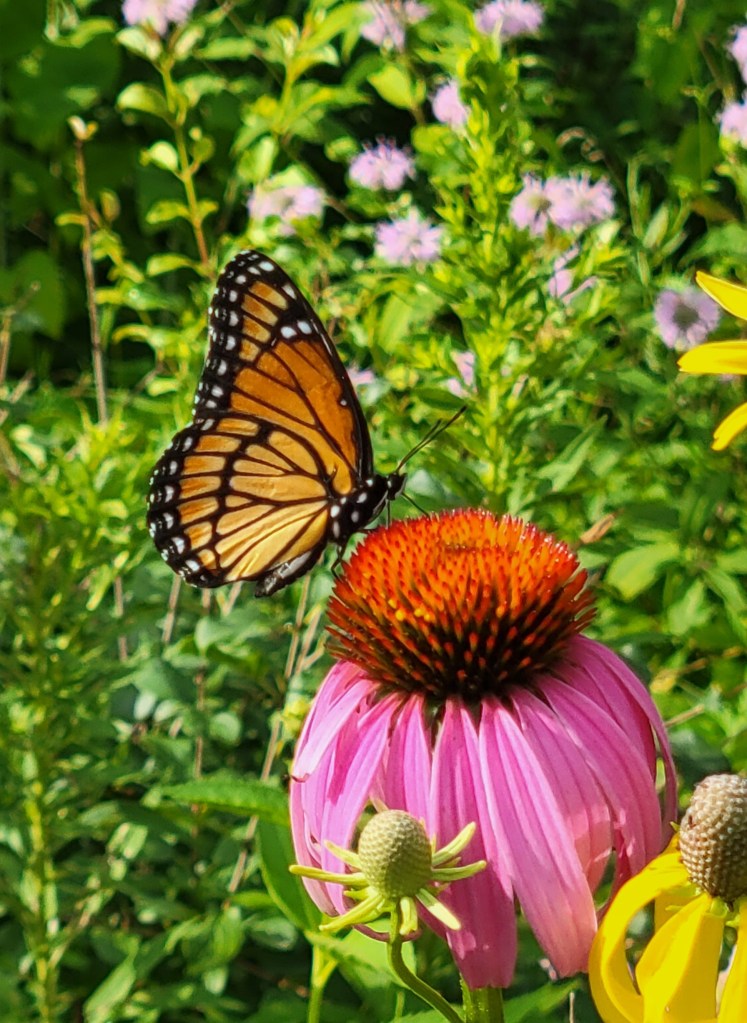
Viceroy 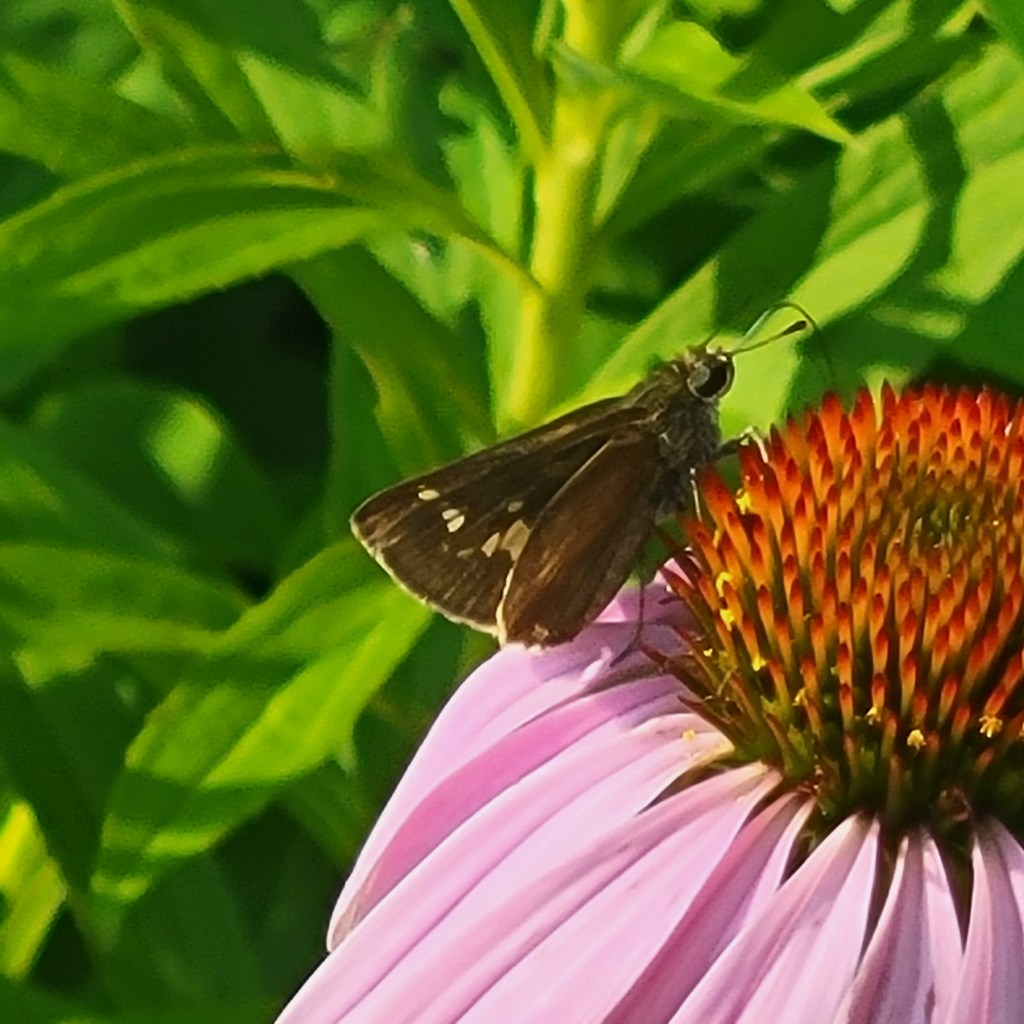
Little Glassywing 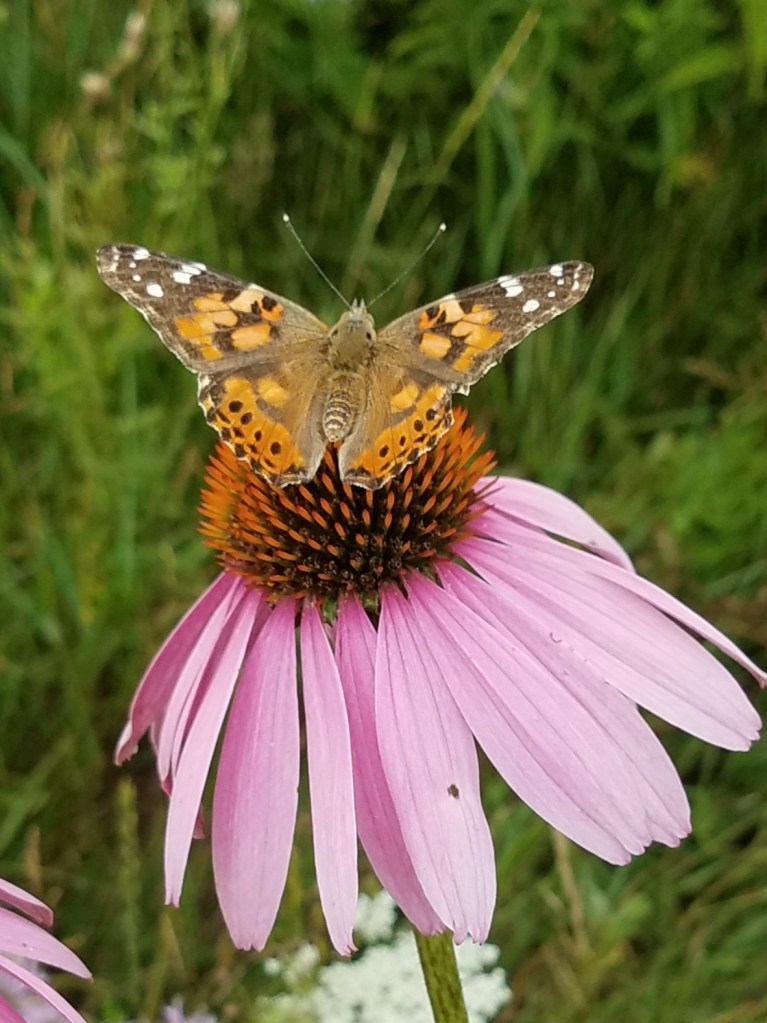
Painted Lady 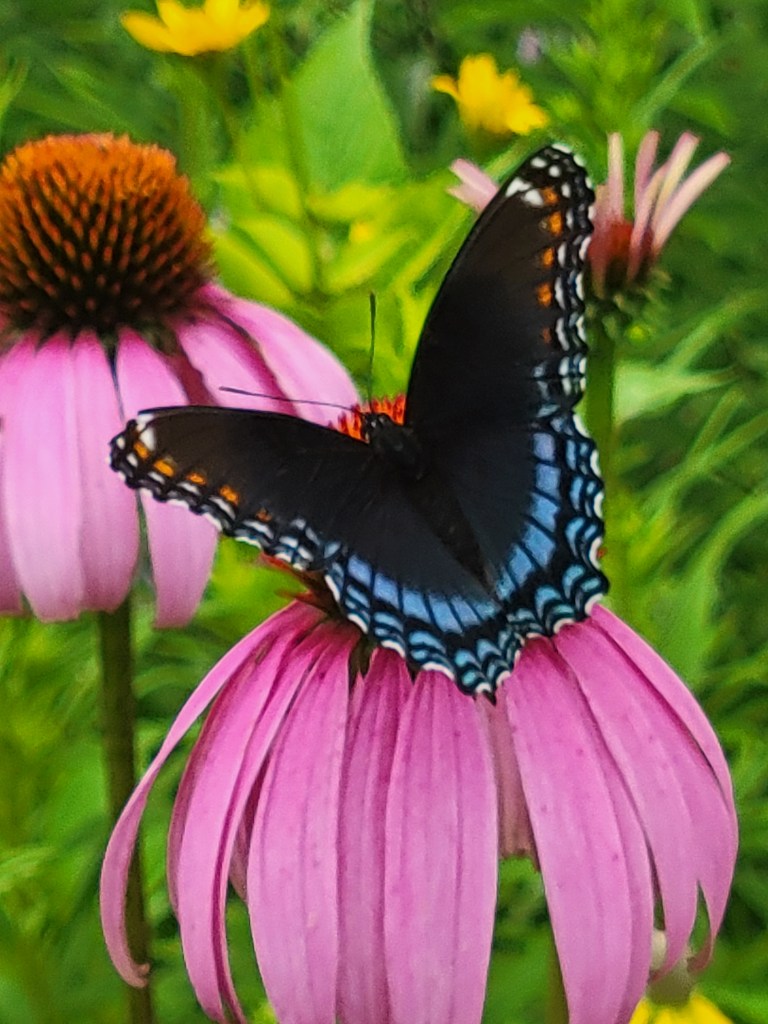
Red-spotted Purple 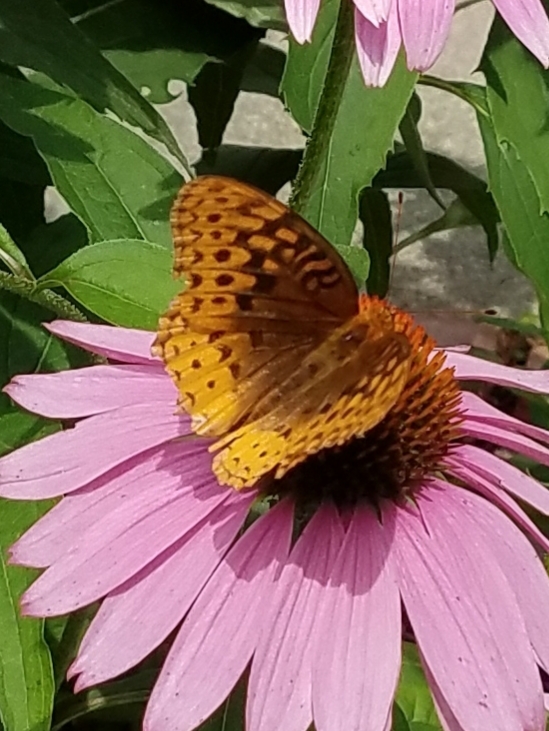
Great Spangled Fritillary 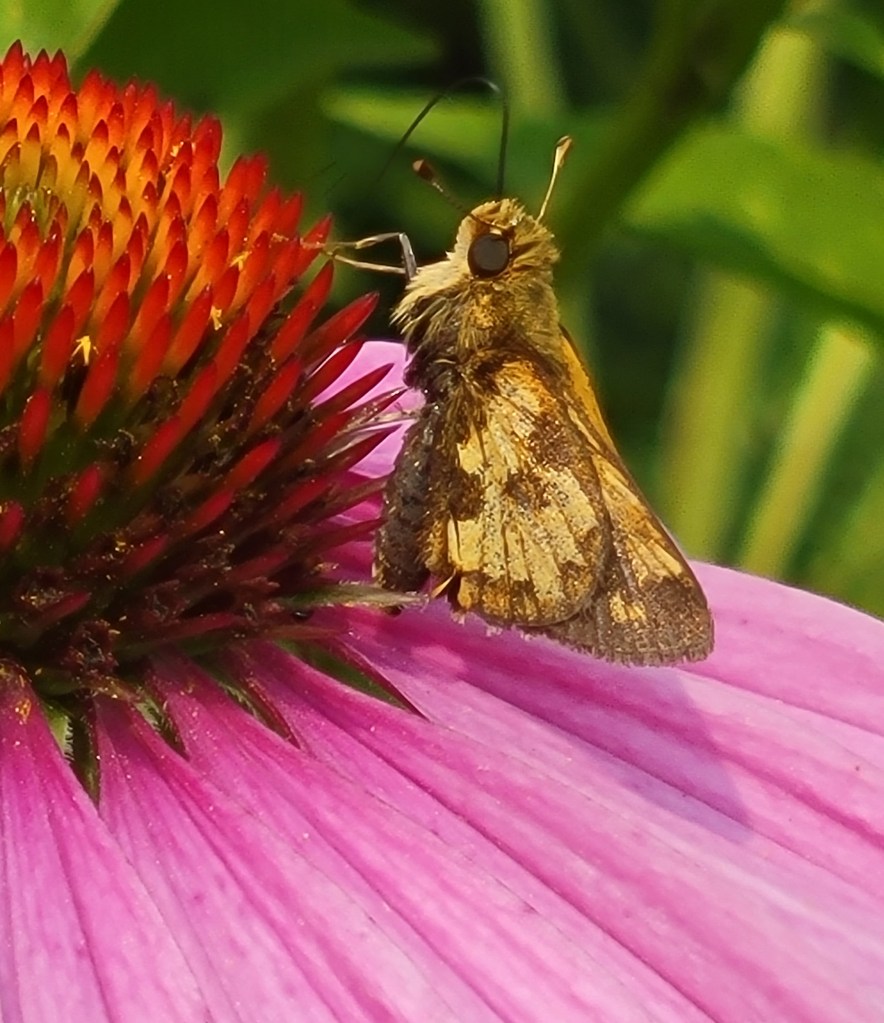
Peck’s Skipper 
Variegated Fritillary 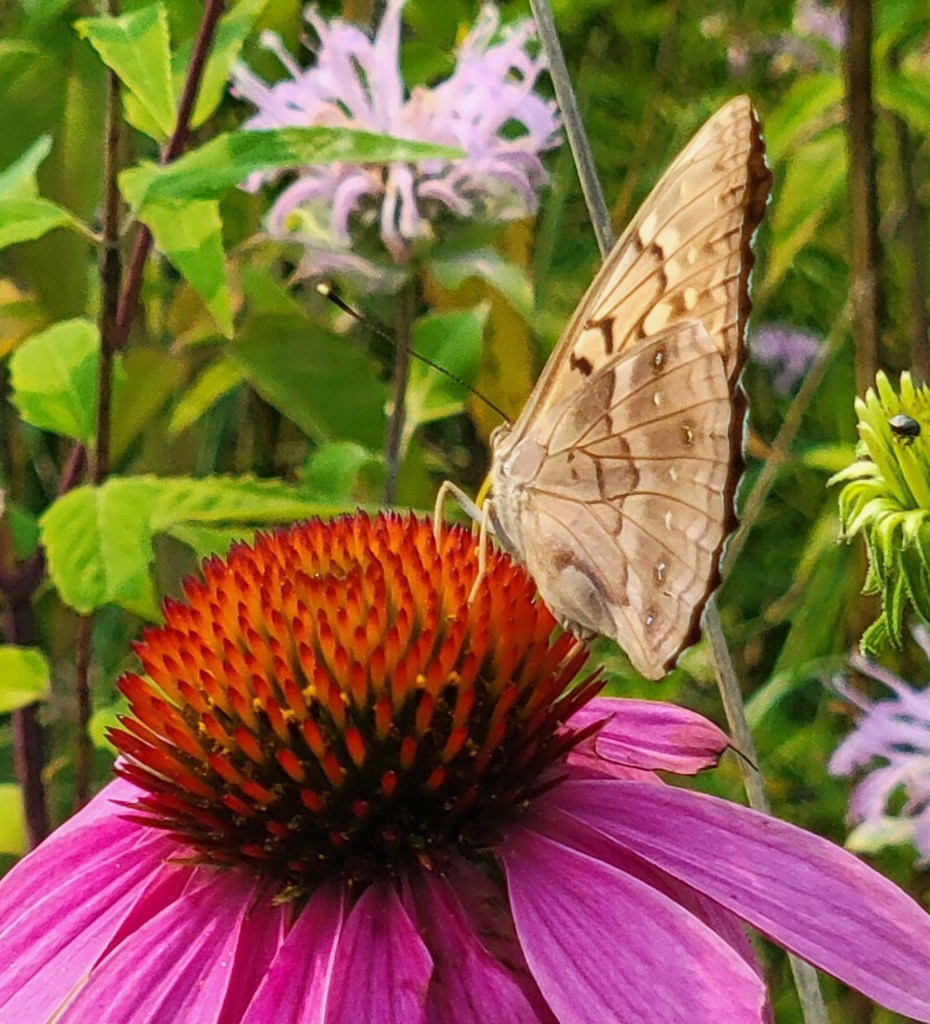
Tawny Emperor The wildflowers of Eliza Howell Park provide great butterfly watching. And, among the wildflowers, none is more effective at attracting butterflies than Putple Coneflower. I will be returning!
-
Hummingbird Moths: Three Species in the Park
Leonard Weber
July 28, 2023
While I often have butterflies on my mind when I visit the wildflower field in Eliza Howell Park in late July, there are many other fascinating pollinators that catch my attention.
Perhaps especially worthy of note are Hummingbird Moths. These are daytime flying moths that are referred to as “hummingbird moths” because, while sipping nectar from flowers, they hover, suspended in the air, as hummingbirds do.
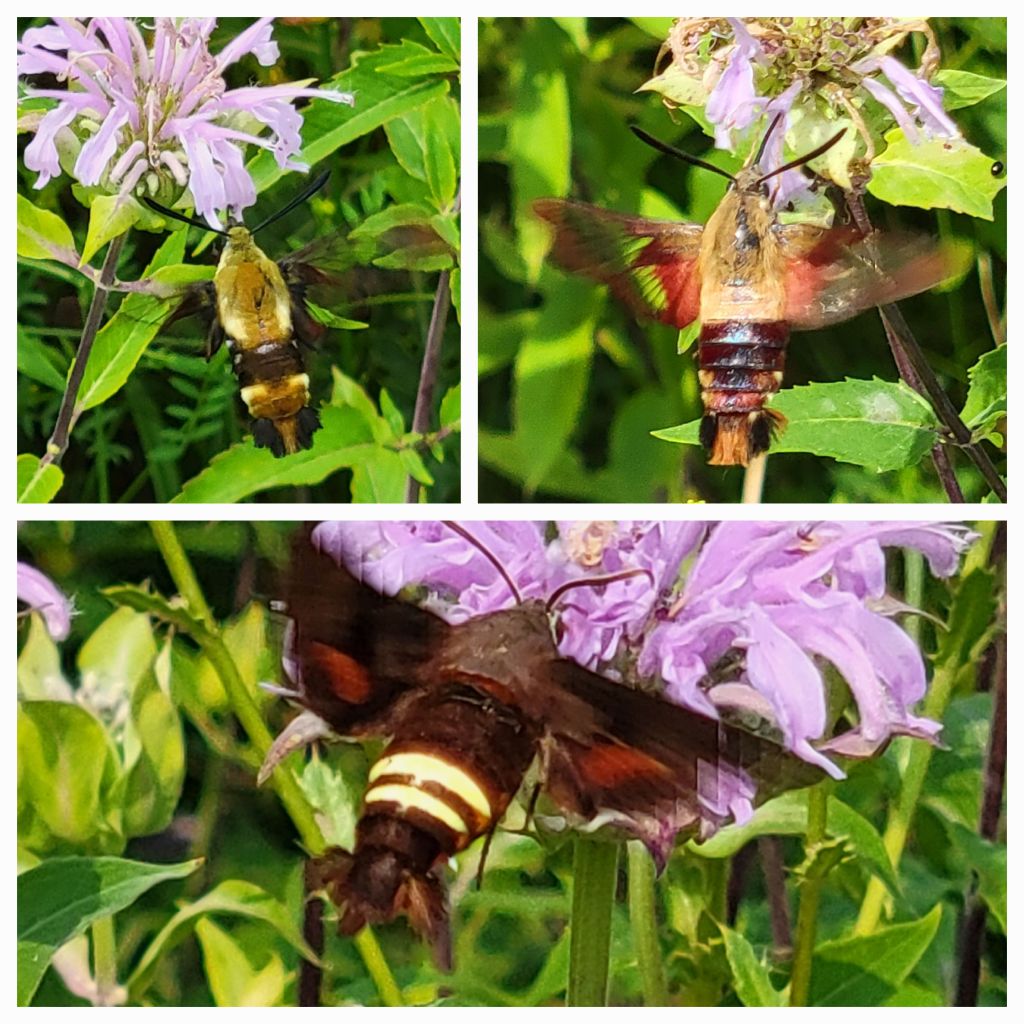
Three different hummingbird moths Hummingbird moths are not abundant in Eliza Howell Park, but it is possible to see three different species visiting flowers here during July and August.
1. Snowberry Clearwing Moth.

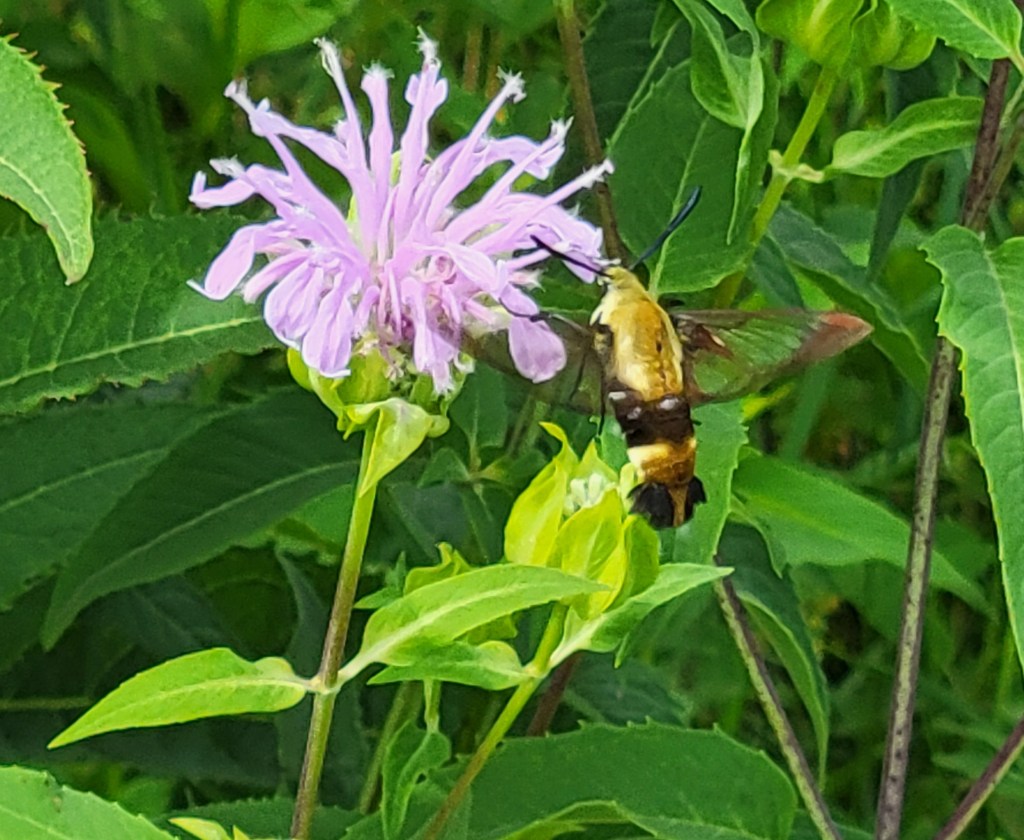
Smowberry Clearwing Moth is small, about 1.5 inches. Being yellow and black, it looks similar to a bumblebee as it visits flowers. I usually see it at Wild Bergamot.
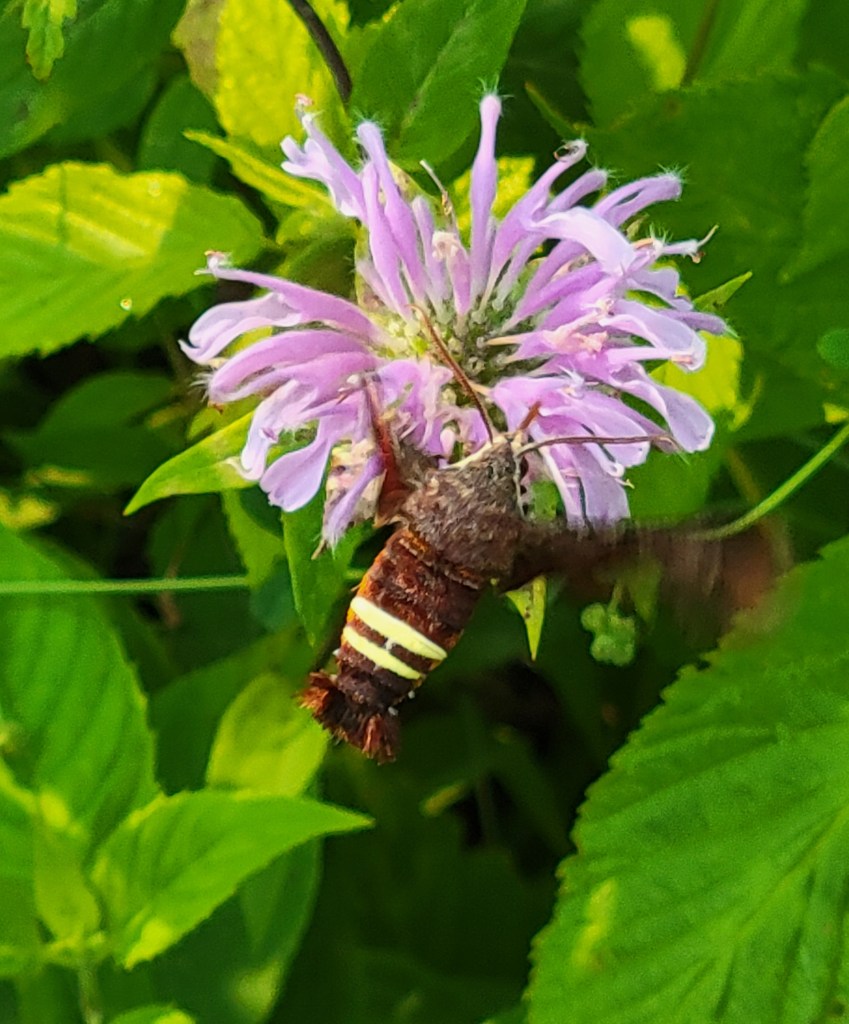
2. Nessus Sphinx Moth.
Nessus Sphnix Moth is a little larger than Snowberry Clearwing, with a wingspan of about 2 inches. The two yellow bands on the abdomen are distinctive. It too hovers as it uses its proboscis to drink nectar.

3. Hummingbird Clearwing Moth.
This one has been named after its hummingbird-like behavior. It is about the same size as Nessus Sphnix Moth. I find the wings especially attractive.
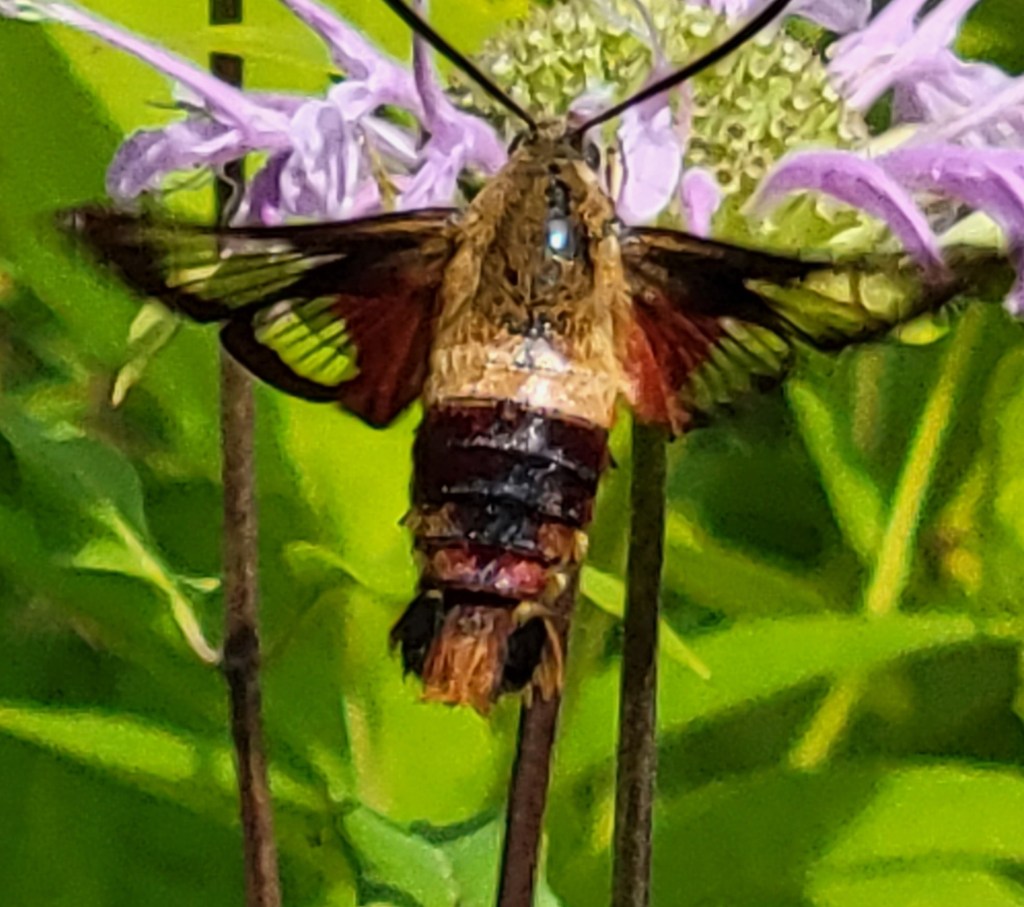
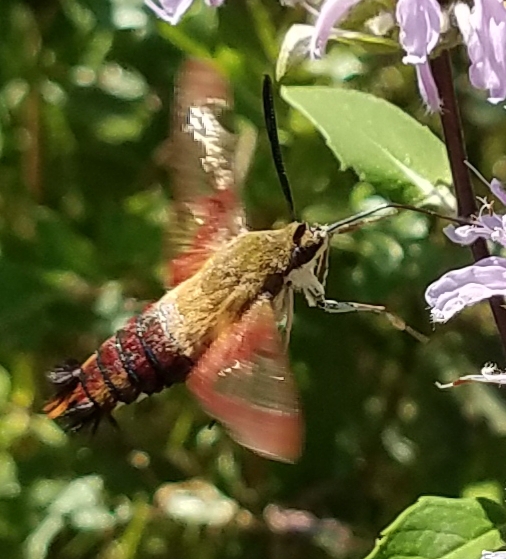
In a close-up view, it is possible to see the use of the proboscis to get the nectar.
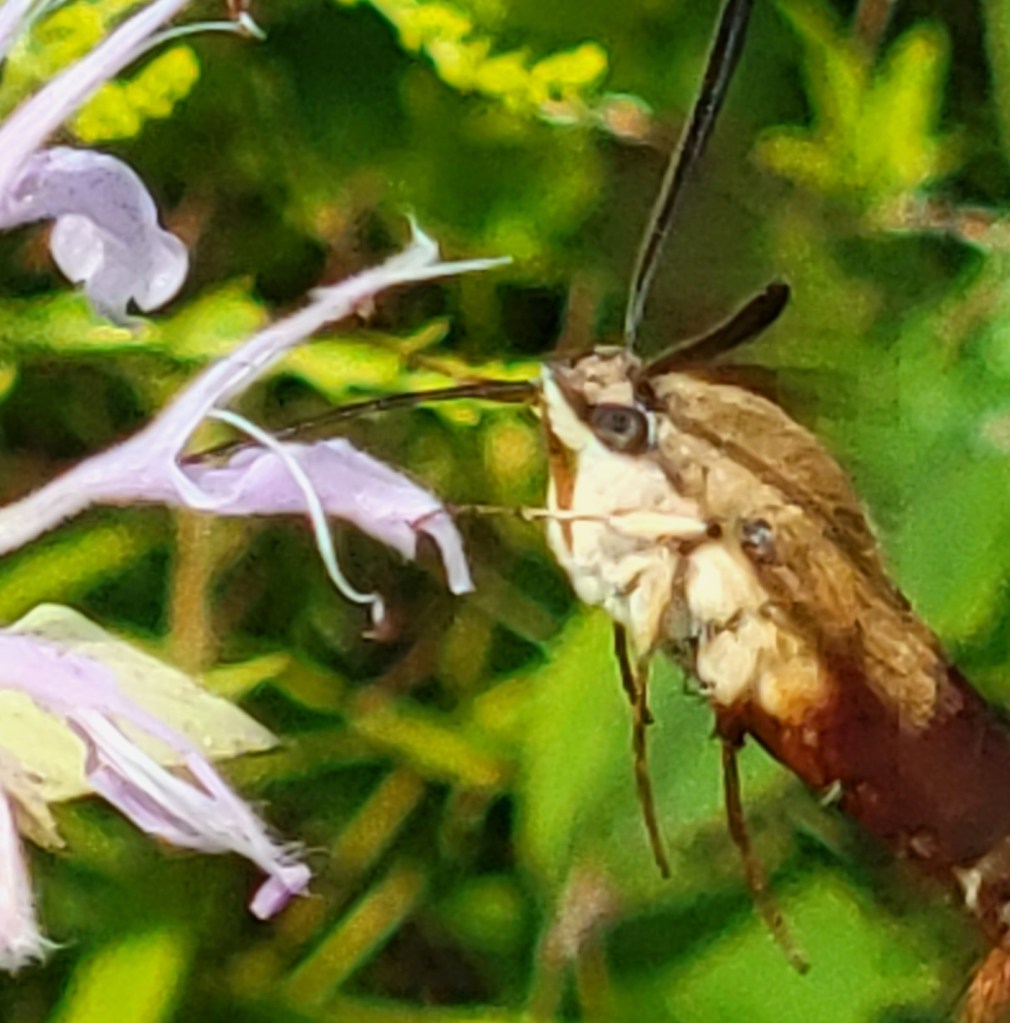
I remember the first time I saw a hummingbird moth and my “what’s that” reaction. The reaction was both lack of familiarity and excitement. I have, over the years, become familiar with these moths, but excitement remains a big part of my reaction when I begin to see them each July.
-
Red Aphids and Ladybugs: On False Sunflower
Leonard Weber
July 16, 2023
On my nature walks in Eliza Howell Park at this time of the year, I regularly stop by patches of False Sunflowers. I look at — and sometimes reflect upon — the relationships that exist among a particular species of flower and two insect species.
Red aphids love to suck sap from the stems of False Sunflower.

And Ladybugs love to eat the aphids.

Seven-spotted Ladybug False Sunflower is a perennial that is abundant in the wildflower field where I watch butterflies. It is in full bloom now, in the middle of July. It grows 4 – 5 feet high and has daisy-like flowers.

False Sunflower 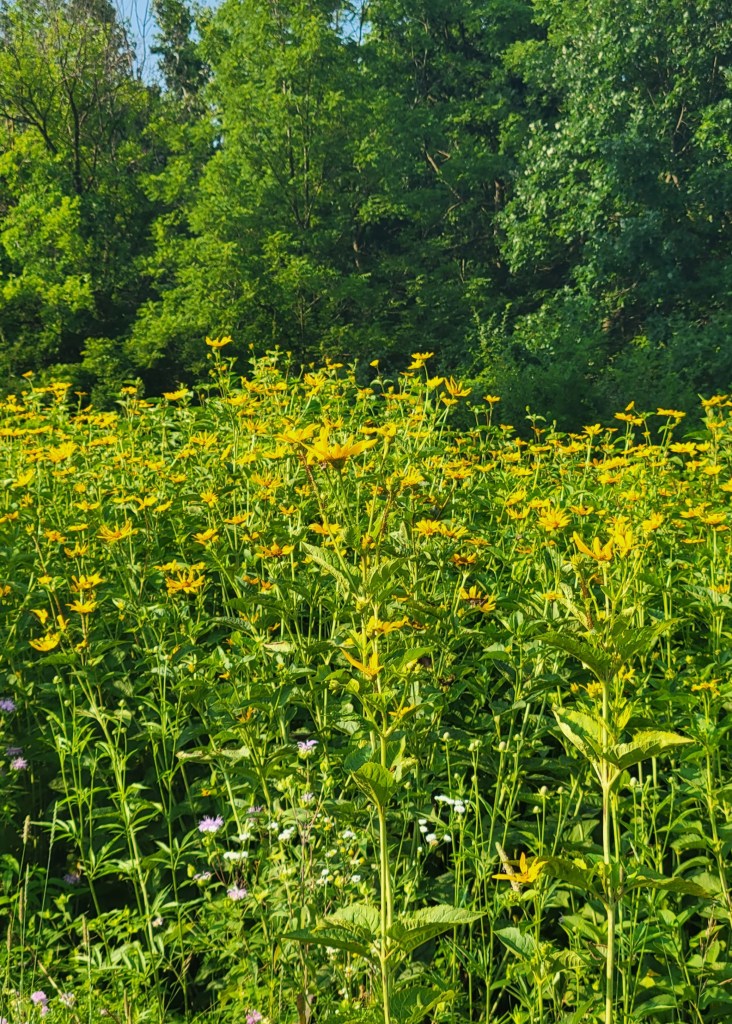
A False Sunflower patch in the park In Eliza Howell, Red Aphids clearly prefer False Sunflower to other plants. There are dozens of plants that have stems lined with dozens of sap-eating Red Aphids.

Red Aphids are tiny, only about 0.15 inches in length. There are tiny, but collectively they can take enough sap to harm plants. One of the methods that humans have used to control this “pest” is biological, using aphid-eating insects.
Seven-spotted Ladybugs, the kind present here, were introduced from Europe in the 20th century for the purpose of biological insect control. They can now be found pretty much wherever aphids are abundant.
Seven-spotted Ladybugs are voracious aphid eaters; it’s been estimated that each adult beetle is capable of consuming 50 aphids a day.


When looking for some of the glamorous butterflies that visit the Eliza Howell wildflower field these days, it is easy to miss or downplay the story of Red Aphids and Seven-spotted Ladybugs that is happening daily on the stems of False Sunflower.
I am finding it very much worth it, however, to stop and watch and, perhaps, to gain a little more understanding of nature’s fascinating ways.
-
Seven Butterflies and a Moth
Leonard Weber
July 11, 2023
This is the time that Eliza Howell Park butterfly enthusiasts have been waiting for! The wildflower field is now ablaze with blooms and the butterflies are coming for the nectar.
Hete is a photo report of some of my favorite observations from yesterday and today.
1. American Lady

On Purple Coneflower 
On Wild Bergamot 2. Black Swallowtail
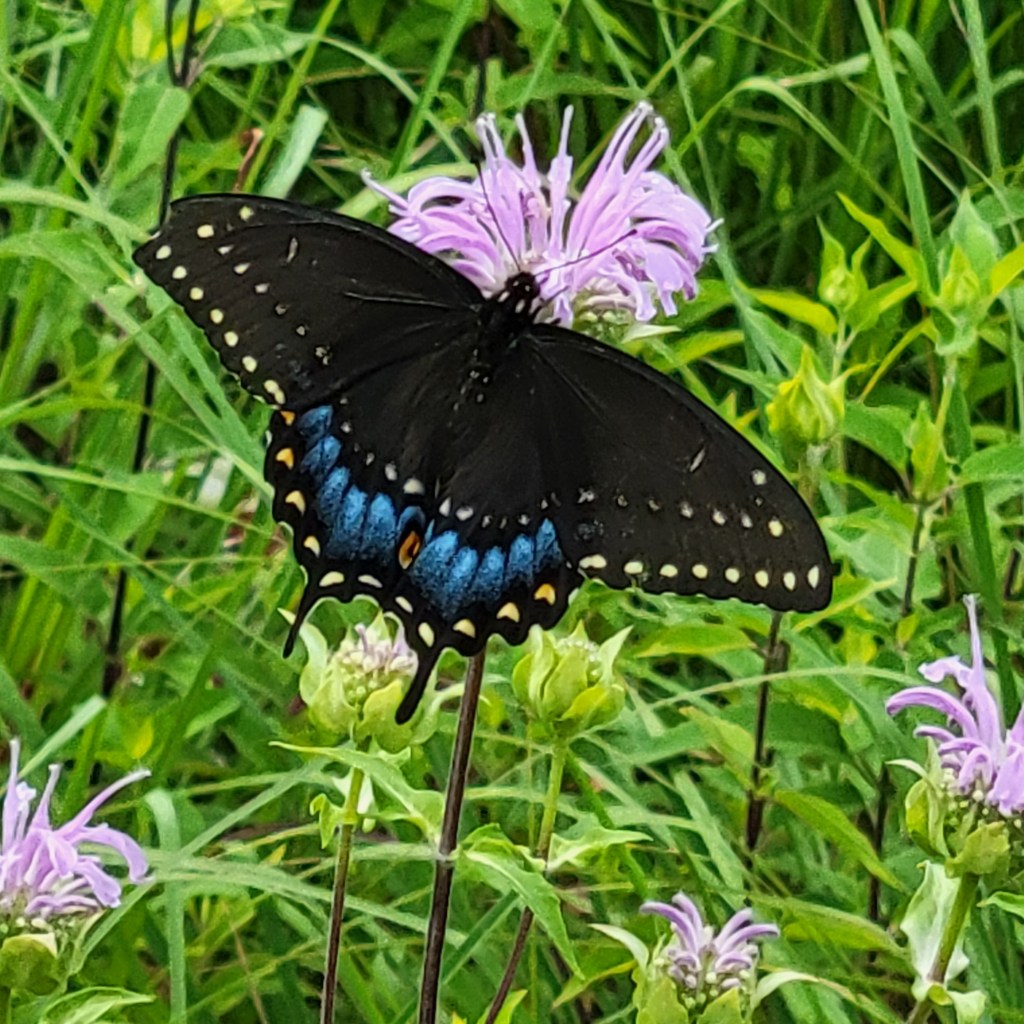
On Wild Bergamot 
On Wild Bergamot 3. Monarch
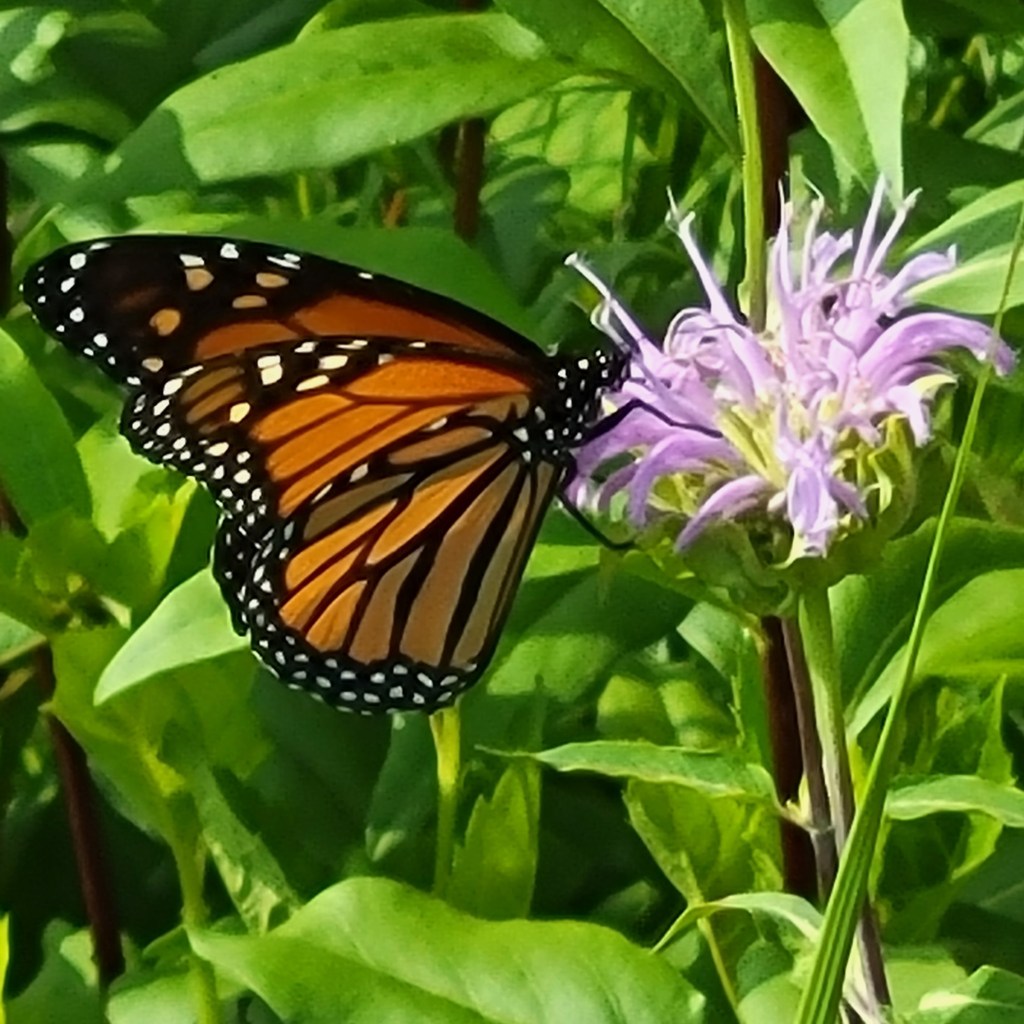
On Wild Bergamot 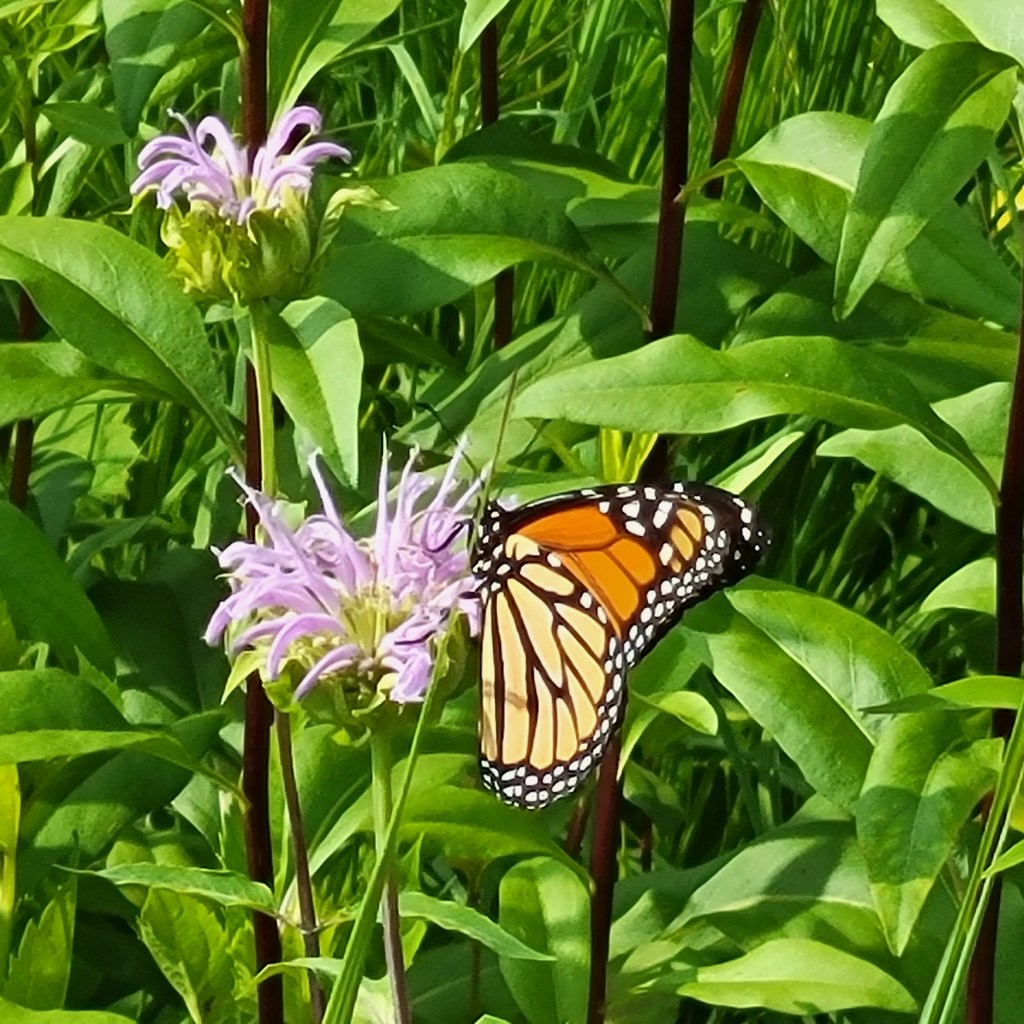
On Wild Bergamot 4. Red Admiral

On Canada Thistle 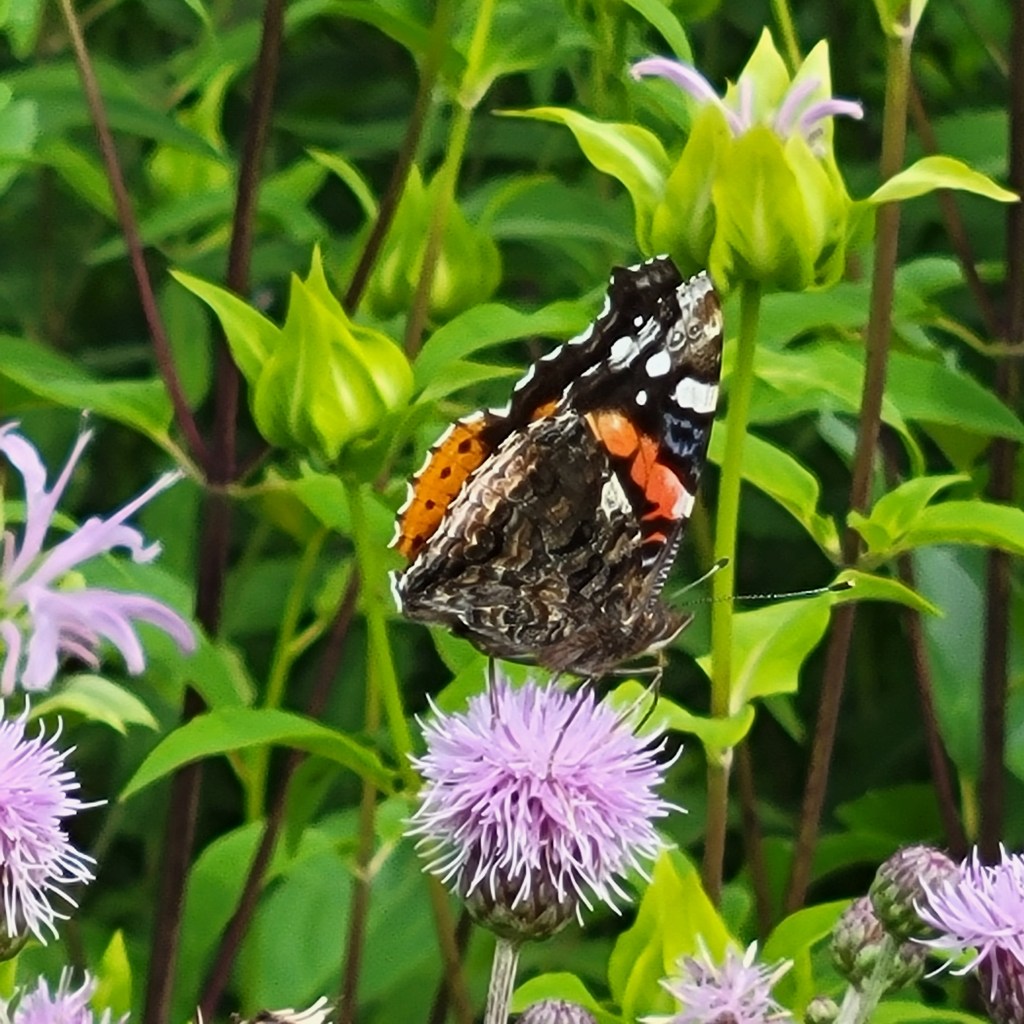
On Canada Thistle 5. Common Wood-Nymph

On Wild Bergamot 6. Great Spangled Fritillary
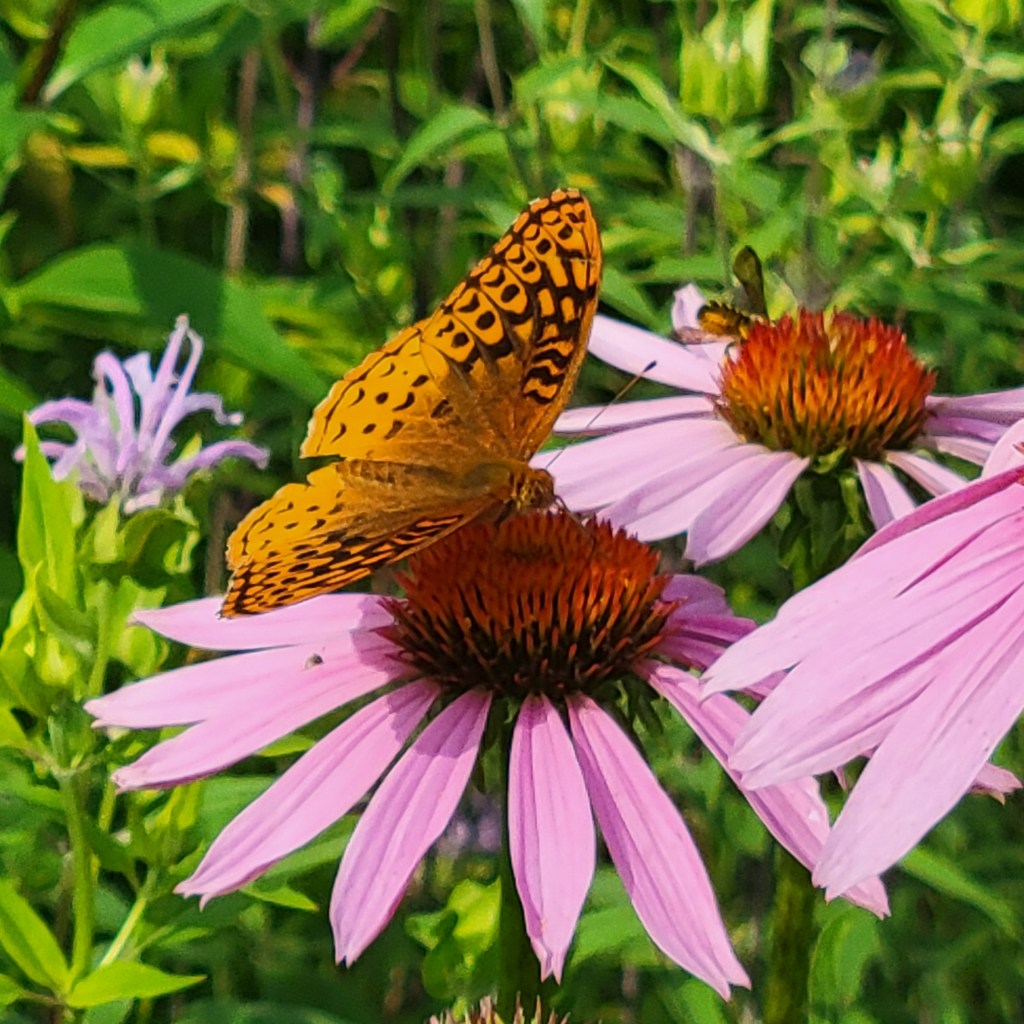
On Purple Coneflower 7. Eastern Tiger Swallowtail
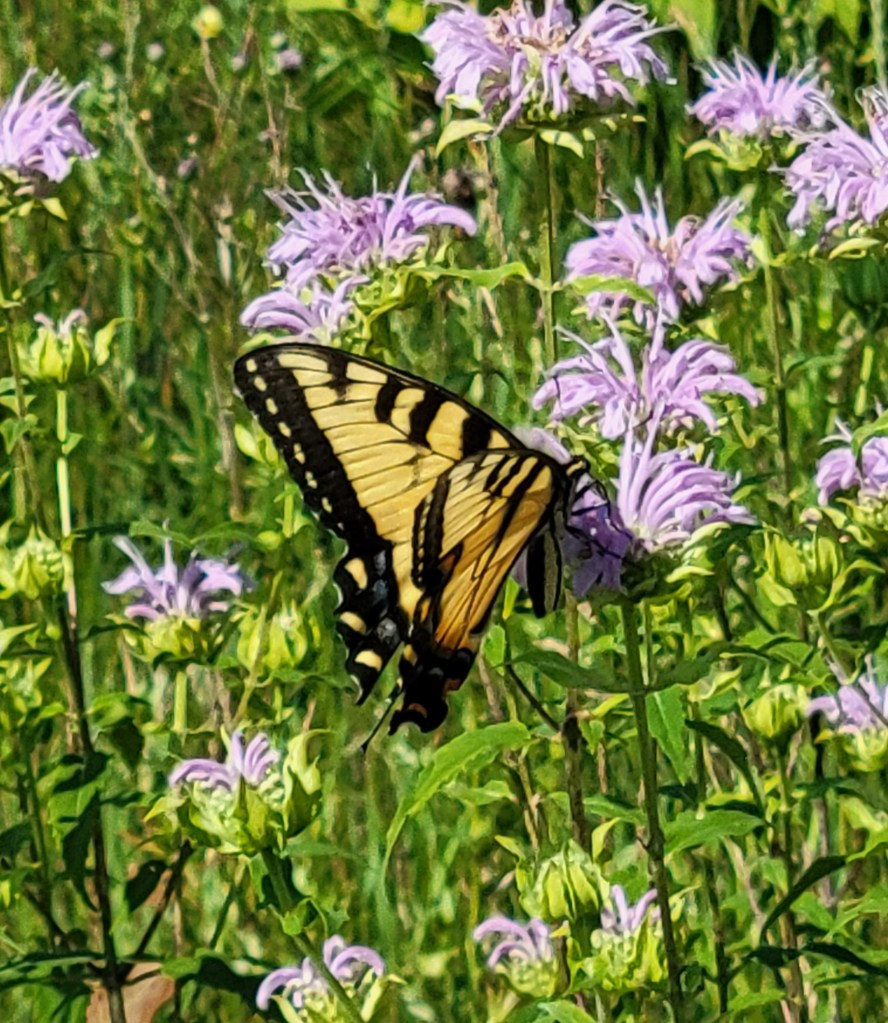
On Wild Bergamot Snowberry Clearwing. (This is one of the day-time moths that are sometimes called “hummingbird moths” because they hover at flowers like hummingbirds.)
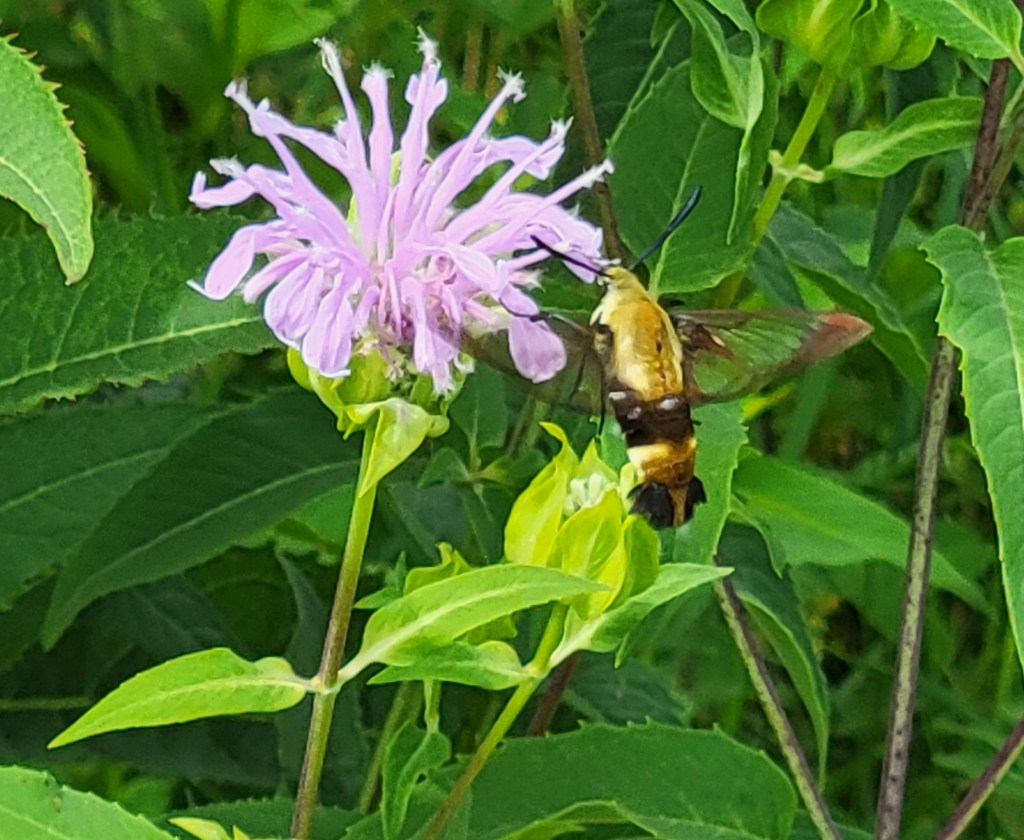
At Wild Bergamot 
At Wild Bergamot Butterfly Watching has been getting better almost daily. I am looking forward to my next visit to the park.
-
Picking Black Raspberries: An Annual Adventure
Leonard Weber
July 5, 2023
For those of us who enjoy finding and picking wild Black Raspberries, there are few sights more satisfying than a large raspberry bramble with plenty of reachable ripe fruit.
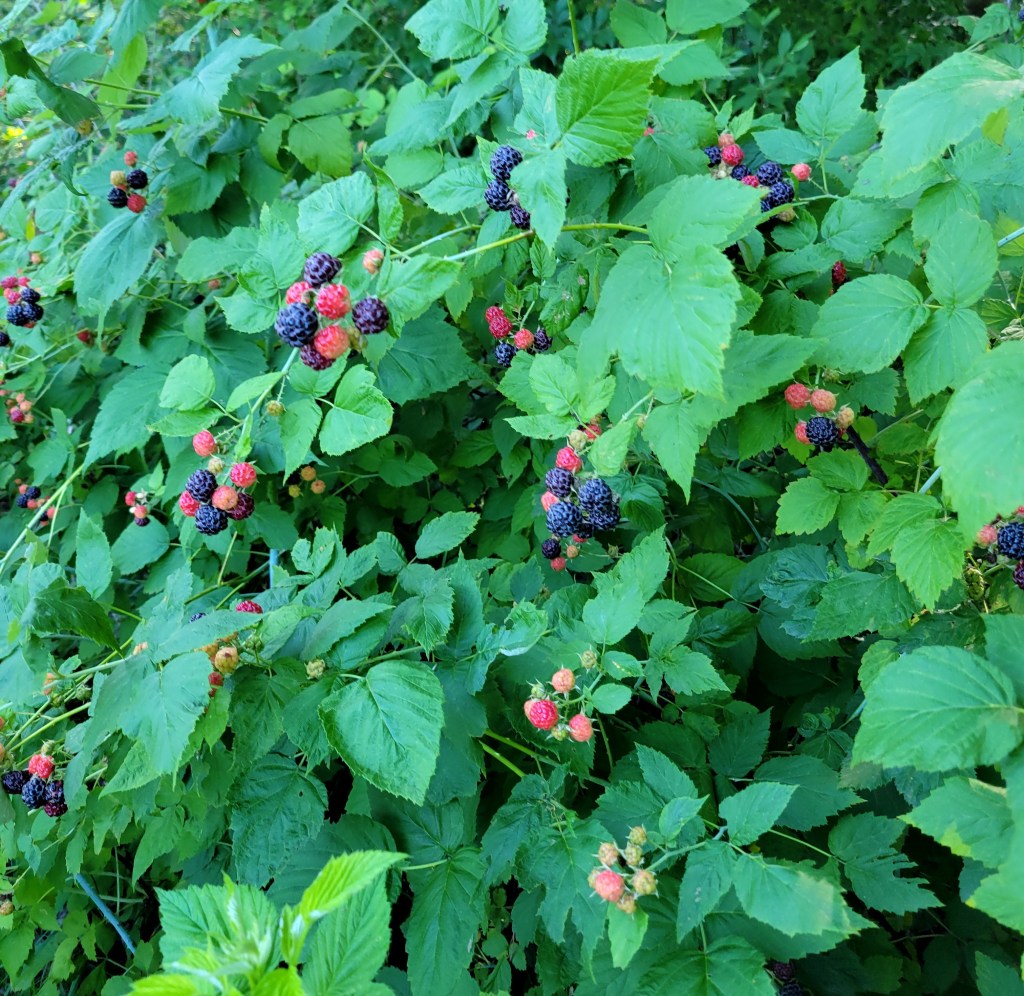
I regularly walk in Detroit’s Eliza Howell for nature study and enjoyment, not to collect food. But some of what nature offers is simply too good not to enjoy. Black Raspberry tops that category.
The picking season usually starts at the end of June. The fruit does not all ripen at once, so the same patches can be visited several times over a period of about two weeks.

Black Raspberries are sometimes confused with Blackberries, but they are quite different in taste. The raspberries usually grow in clumps with the berry in the center often ripening first.

Ripe berries come off the stems easily. If a berry doesn’t, if I have to pull, it is not ready. Often, picking is one berry at a time; sometimes, I can get two or three at a time. Picking a’quart is not a quick project.
(The next photo shows the remaining stems look like when the berries are picked.)

Black Raspberry is sometimes called “blackcap” and sometimes called “thimbleberry.” Both of these names refer to the shape of the picked berry.

Black Raspberry is native to Eastern North America and often grows at woodland edge. It is a prickly shrub, sometimes as tall as 6 feet. Picking frequently means reaching through and around thorny canes, resulting in many arm scratches.
Scratches are one risk. Another is the risk of losing the berries by failing to keep the container balanced as I lean and stretch, often with at least one foot in the brambles.

The berries are excellent eating right off the bush, and they make great jam and pie.
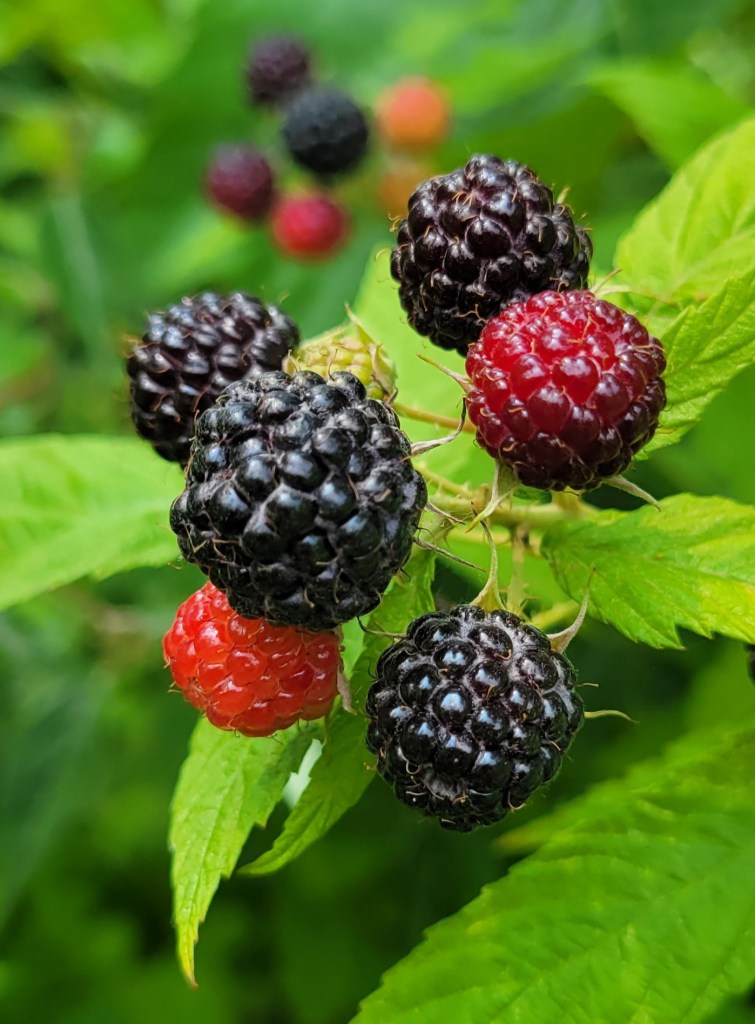
Black Raspberries are perennials but with a limited lifespan of probably less than 10 years. And other plants in rapidly growing thickets might overwhelm them. So patches that I have picked in three years ago might not be so productive this year.
On the other hand, there are always new stands appearing, probably thanks to the wildlife that eat the berries and spread the seeds. So part of the adventure each year is finding new picking lications.

I enjoy eating Black Raspberries. Sometimes, however, I think that I enjoy the challenge of finding new productive locations and bringing home berries in quantity even more than the eating.
-
Milkweed Is Beginning to Flower: It’s Insect-watching Time
Leonard Weber
June 26, 2023
As happens every year near the end of June, Common Milkweed is now beginning to bloom in Eliza Howell Park. This is always a noteworthy development, the point at which my insect watching begins to get more intense.
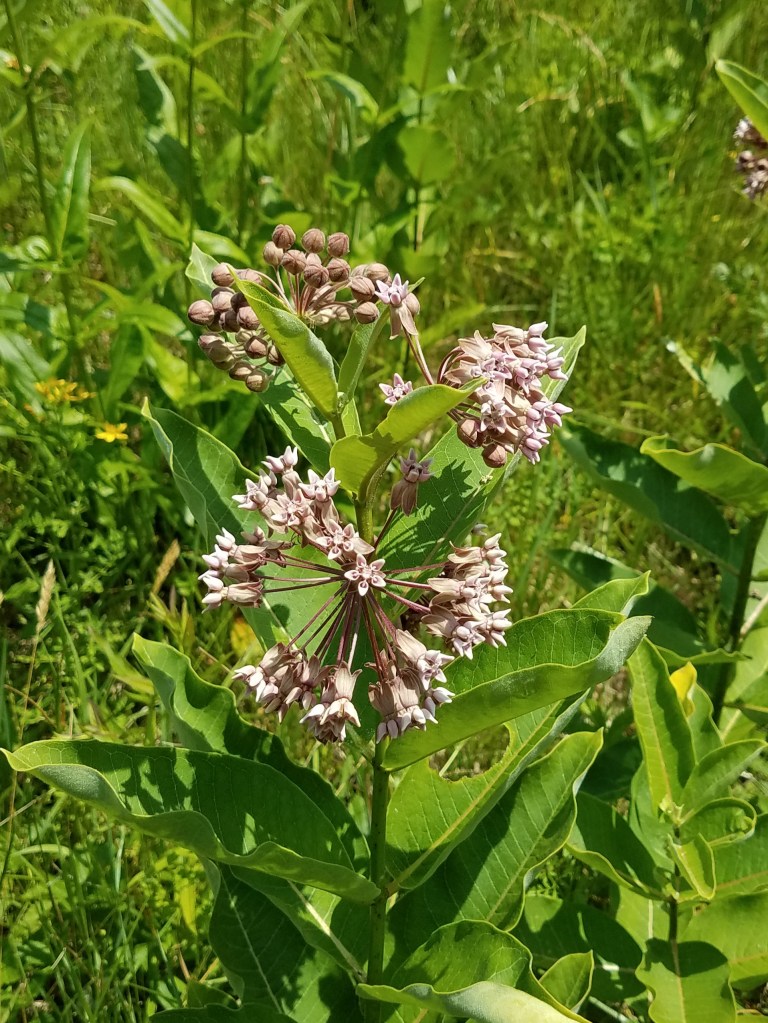
June 25, 2023 Almost everyone knows of the relationship between milkweed and Monarch butterflies, but milkweed attracts a variety of other insects as well. As I watched recently, a couple tiny European Skippers were trying to get to the nectar. They fluttered their wings repeatedly, suggesting to me that maybe it was difficult to get in a good position for their little proboscis to reach deep enough into the flower for a hearty drink.

European Skipper on Milkweed, June 25, 2023 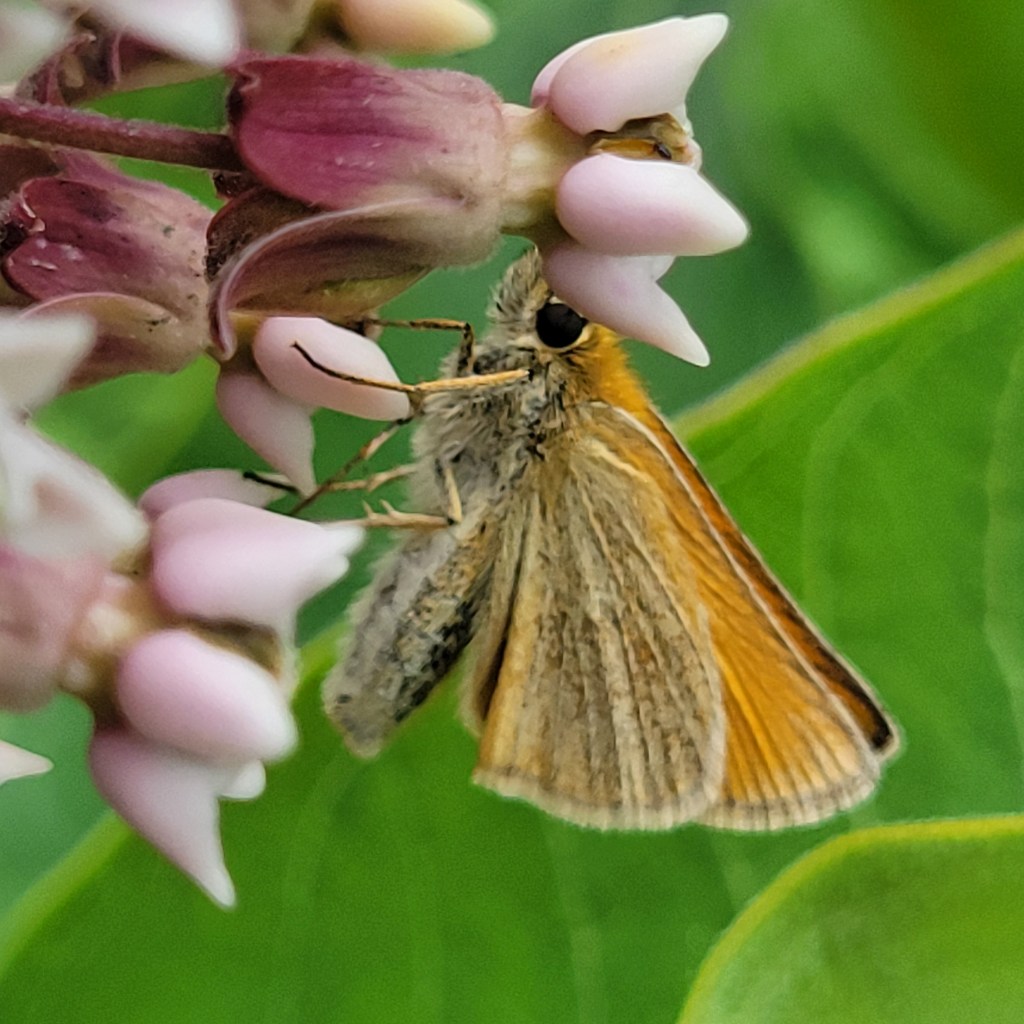
European Skipper on Milkweed (close up) Note the size of a Monarch in relationship to the size of the flower and compare with the European Skipper above.
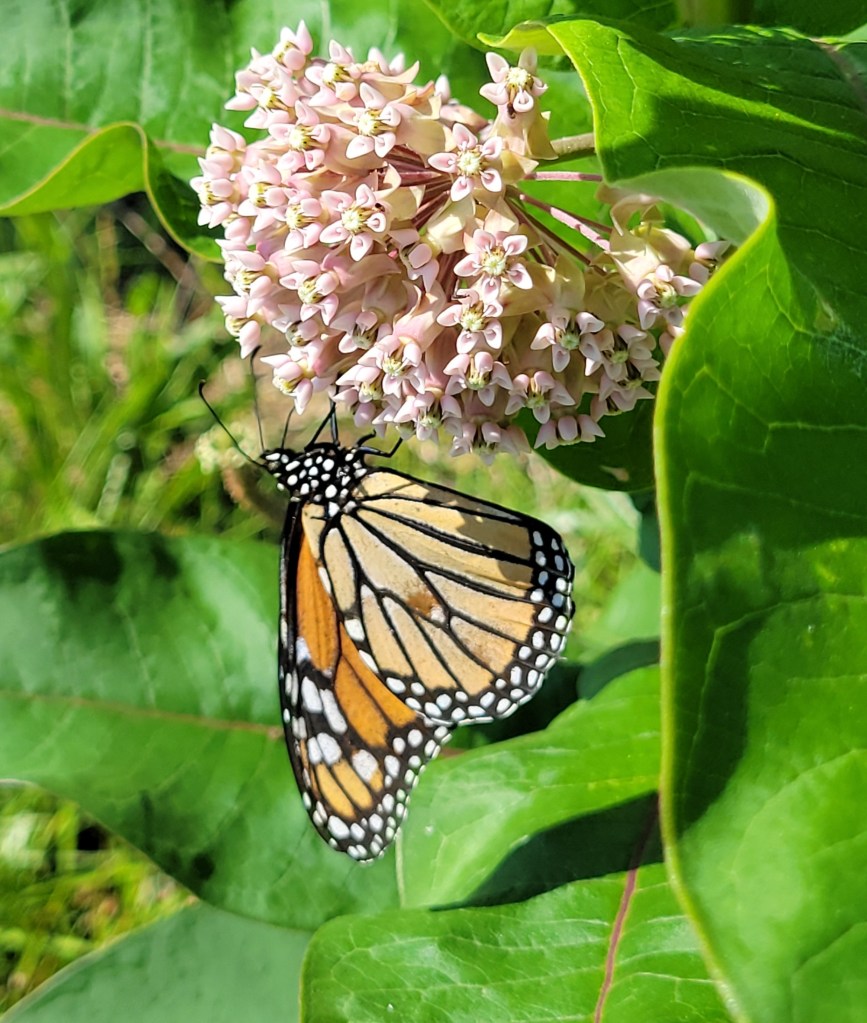
Monarch, June 29, 2021 I’ll definitely be visiting flowering milkweed during upcoming visits for insect observation.
On this rainy day, however, I was satisfied with a quick search of some past photos, reminding myself of some enthralling insects to be encountered at milkweed flowers at this time of the year.

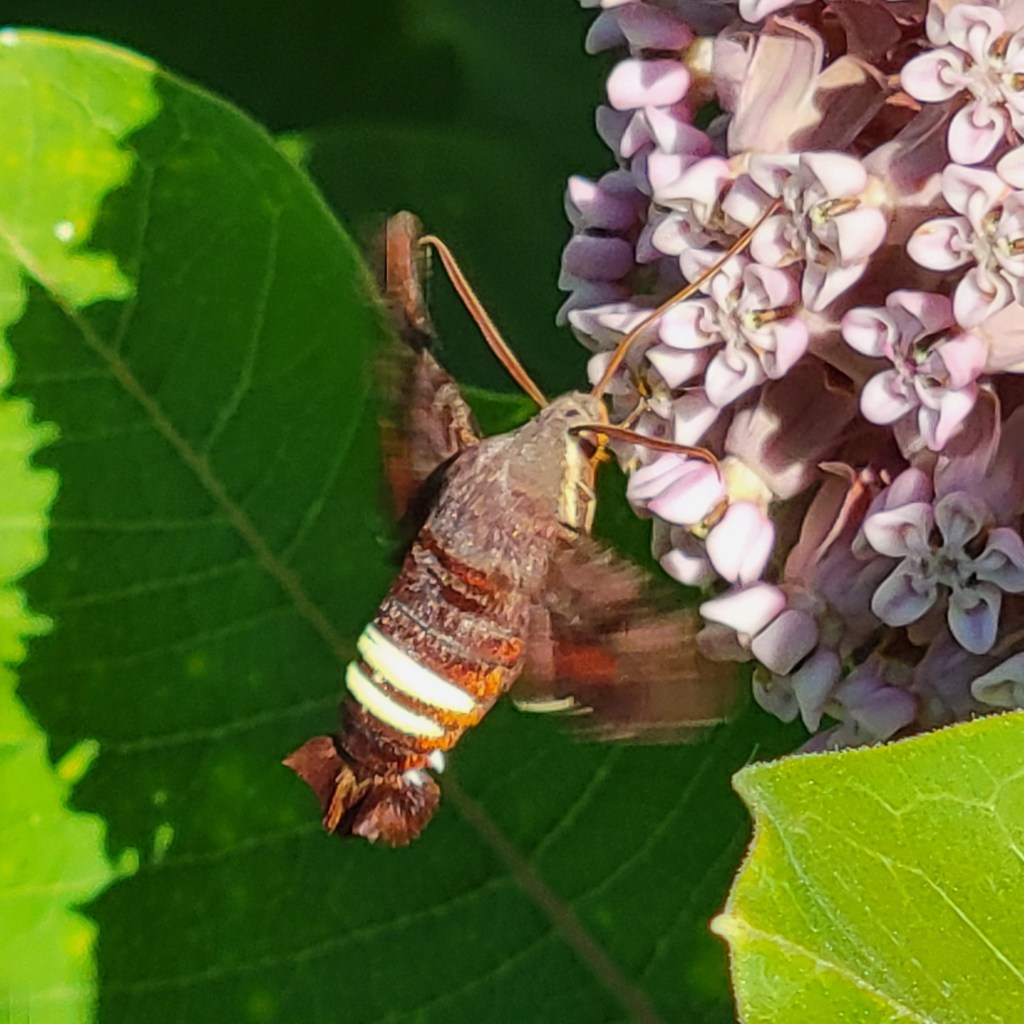
Nessus Sphnix Moth, June 24, 2022 Nessus Sphnix Moth is one of the “hummingbird moths” that are occasionally seen in Eliza Howell Park, a favorite of some park visitors.

Great Golden Digger Wasp, July 4, 2020 Great Golden Digger Wasp is a large non-threatening wasp, easy to admire on blooms all summer.
Different Common Milkweed plants bloom at different times. These are just the first. Soon, however, many of the other insect-attracting wildflowers will begin to dominate my attention, so…

…milkweed is in focus now.

-
Cabbage White: # 20 of “23 Butterflies in 2023”
Leonard Weber
June 23, 2023
One of the most common butterflies in Detroit’s Eliza Howell Park is a medium-sized white butterfly (with a wingspan of 1 and a half to 2 inches). It can be seen many, many times from spring to fall.
Cabbage White is white, except for a dark patch at the wingtips and one (male) or two (female) spots on the forewing.
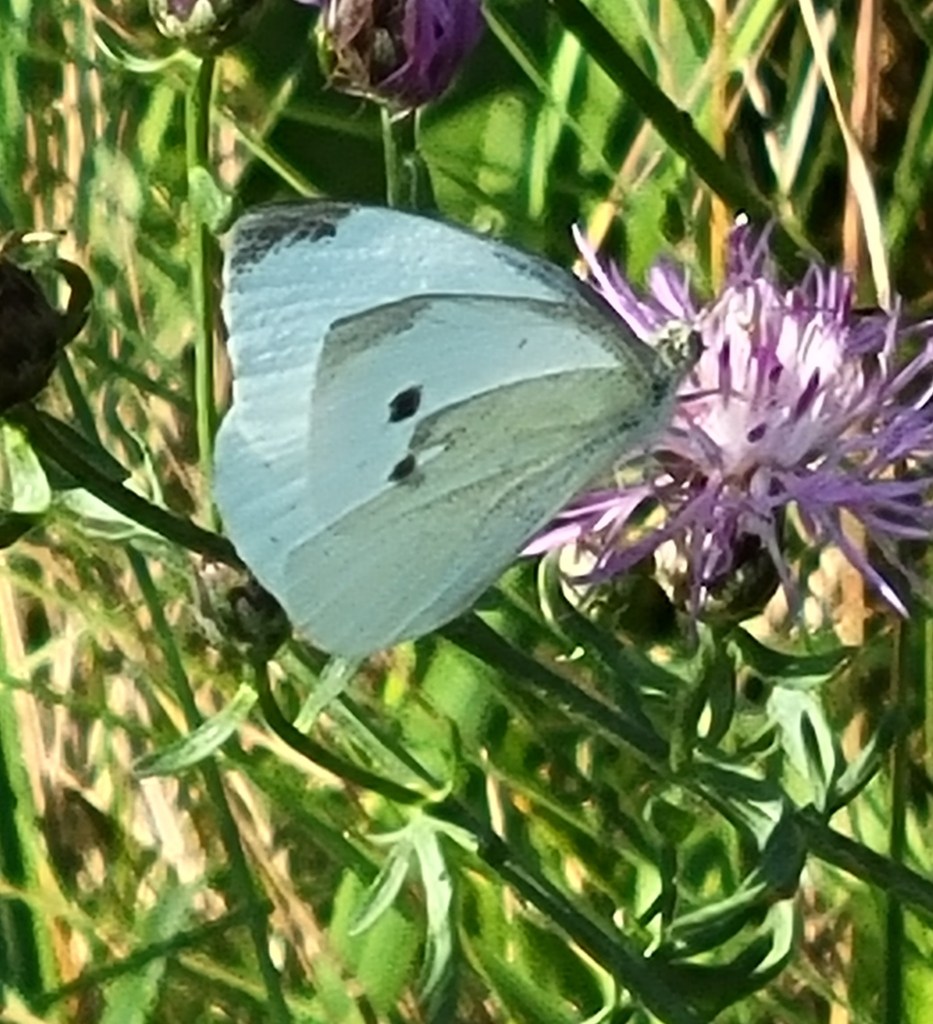
Female 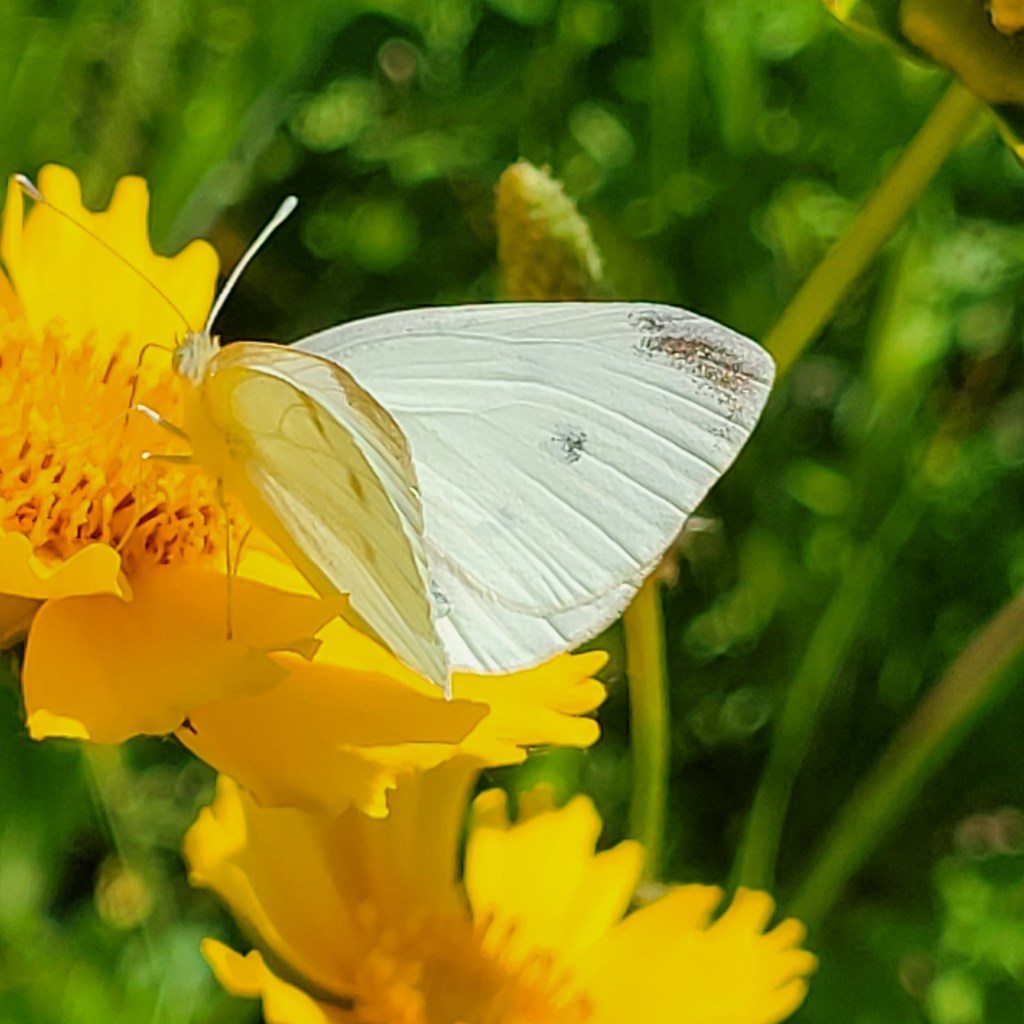
Male Cabbage White is one of only two butterfly species that I see in Eliza Howell Park that are not native to North America. (The other is European Skipper.) It was introduced in Canada from Europe in the 19th century and has since become both common and widespread.

Kaufman Field Guide to Butterflies of North America The name cones from the fact that the caterpillars feed on the leaves of plants in the mustard/cabbage family.
Sometimes the handwings of a Cabbage White are pale yellow, noticeable when wings are closed.


Cabbage White probably has three broods a year in this part of the coubtry. It spends the winter in the chrysalis stage.
It’s easy to think that such a common species is un-interesting, especially when it is not as colorful as many others in the park (“it’s just a Cabbage White”), but I recommend giving some attention to this species.
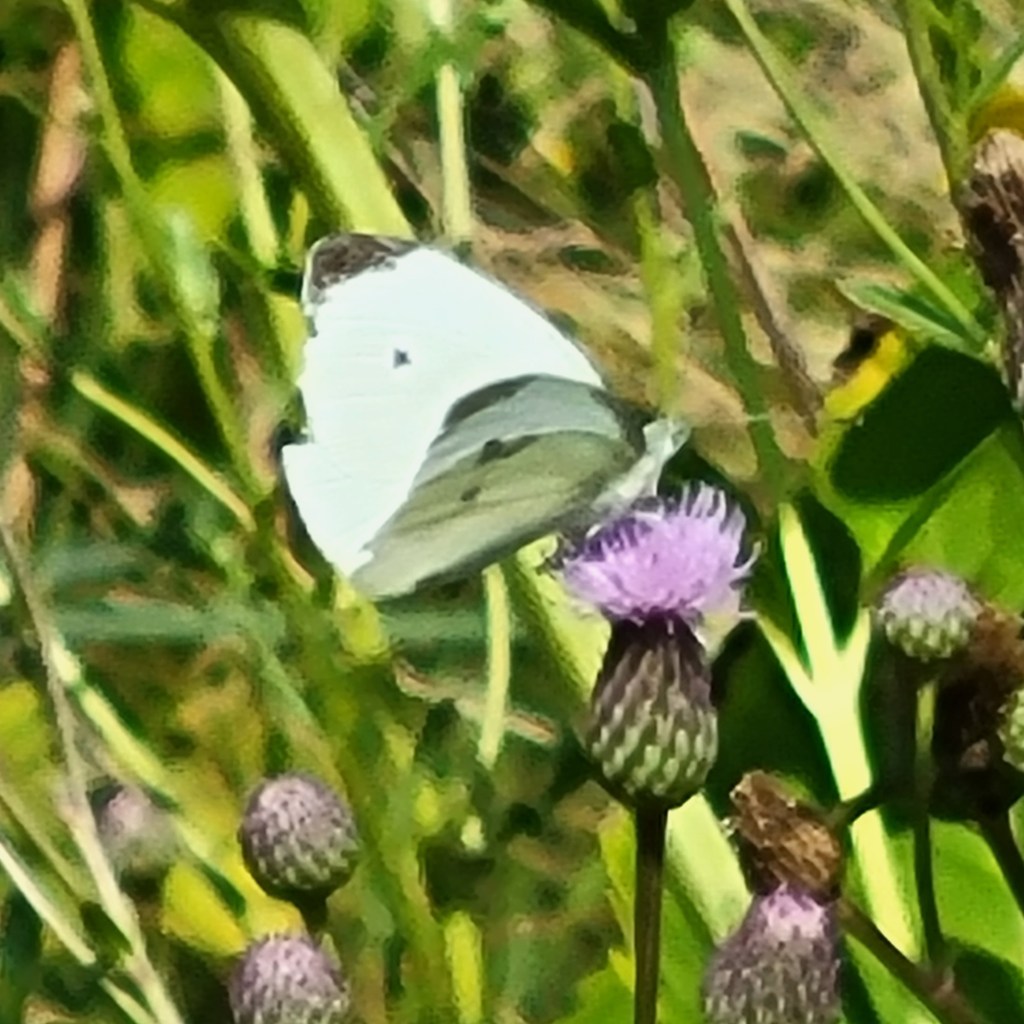
It is another fascinating butterfly to get to know.
-
Black Cherry Trees in Eliza Howell Park
Kathleen Garrett
June 16, 2023
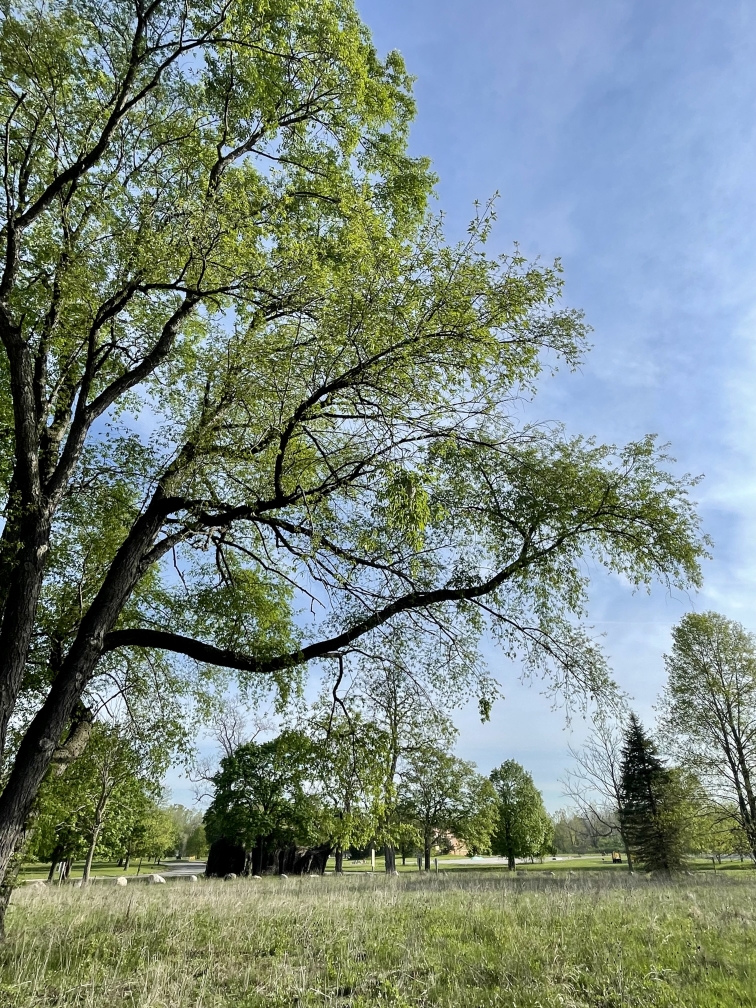
Black Cherry trees, both young and old, are easy to find at Eliza Howell Park. While Black Cherry trees are native to Michigan, the artistic arrangement of the trees in the open fields indicates that these trees were planted some years ago. In this open space, the crowns of these fast-growing trees are broad with some branches dipping low enough for a close look at the flowers.
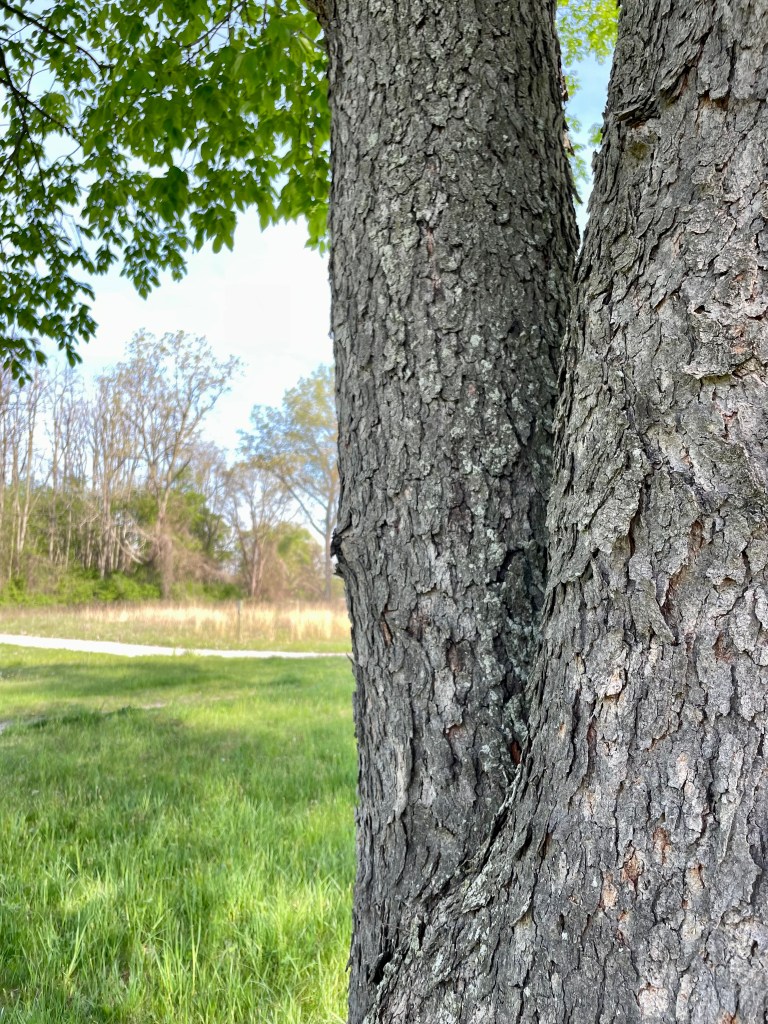
Most often described as “burnt potato chips,” the bark is very distinctive. To me it looks as if someone was using their thumbs to sculpt dark clay, pushing up. The bark and roots of Black Cherry trees are rich in hydrocyanic acid, which has been used as a cough suppressant and as flavoring in rum and brandy.
Baltimore Orioles often choose mature Black Cherry trees in the open fields as excellent spots to build their woven, hanging nests. If you are lucky, you can watch Orioles build their amazing nests in the outer, drooping branches of Black Cherry trees while the leaves are still young and small and the branches thin enough to sway in the breeze. Once fully leafed, the nests can be hard to spot.
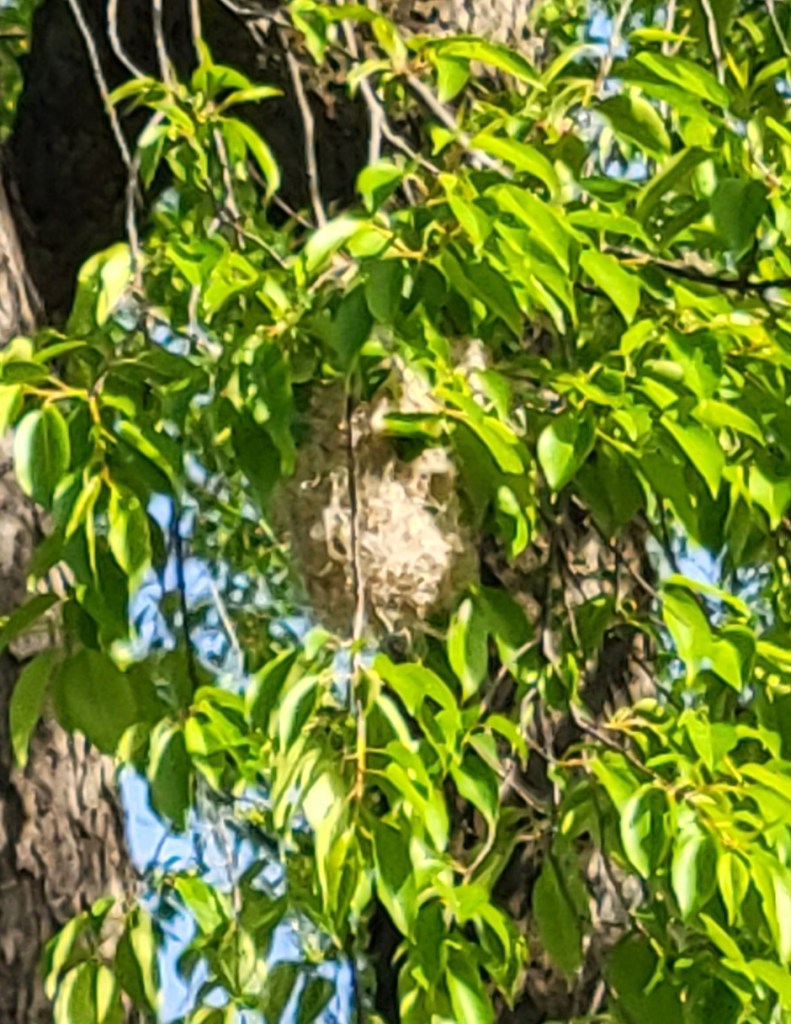
Photo courtesy of Leonard Weber 
Female Oriole feeding young in nest.
Photo courtesy of Margaret WeberWhite, pendulous flowers come next on the hanging branches of the Black Cherry.

Photo courtesy of Leonard Weber The pea-sized fruit that follows is not the kind we put in pies, but maybe in jelly with enough sugar. Bees and birds such as Robins, Cedar Waxwings, Grosbeaks (all seen at EHP) kindly scatter the seeds of the Black Cherry as they gorge on the fruit.
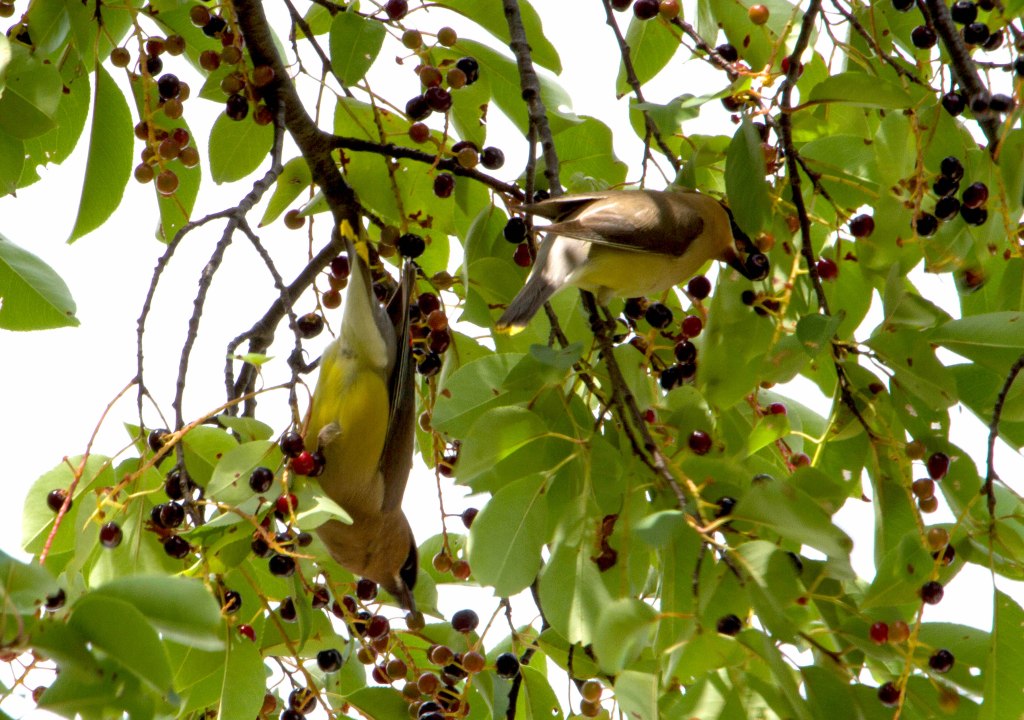
Cedar Waxwings in Black Cherry.
Photo courtesy of Margaret WeberThe birds know when to eat the fruit because the color of the berries changes as it ripens. It is thought that the color changes may also signal potential fruit-dispersing animals that the cherries are about to ripen, convincing them to stick around to feed on the ripe fruit.
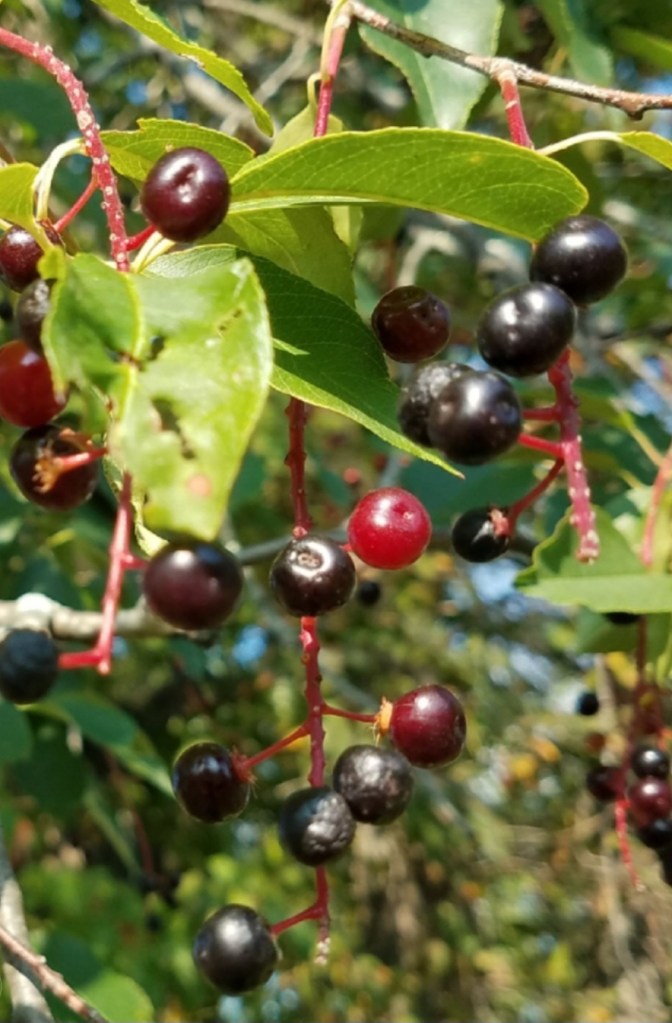
Photo courtesy of Leonard Weber Red foxes, raccoon, fox squirrel, white footed mouse, and bear (not (yet) seen at Eliza Howell Park), also eat the berries, dispersing the indigestible seeds along their way. Most trees rely on the wind to do their pollinating. Known as a “foraging-hub,” Black Cherry trees are one of the few native trees that need pollinators to help them bear fruit just as the pollinators need the trees.
The Black Cherry trees in the open fields are showing their age. Large, dead limbs and the appearance of fungi on the trunks are signs of this.

Photo courtesy of Leonard Weber 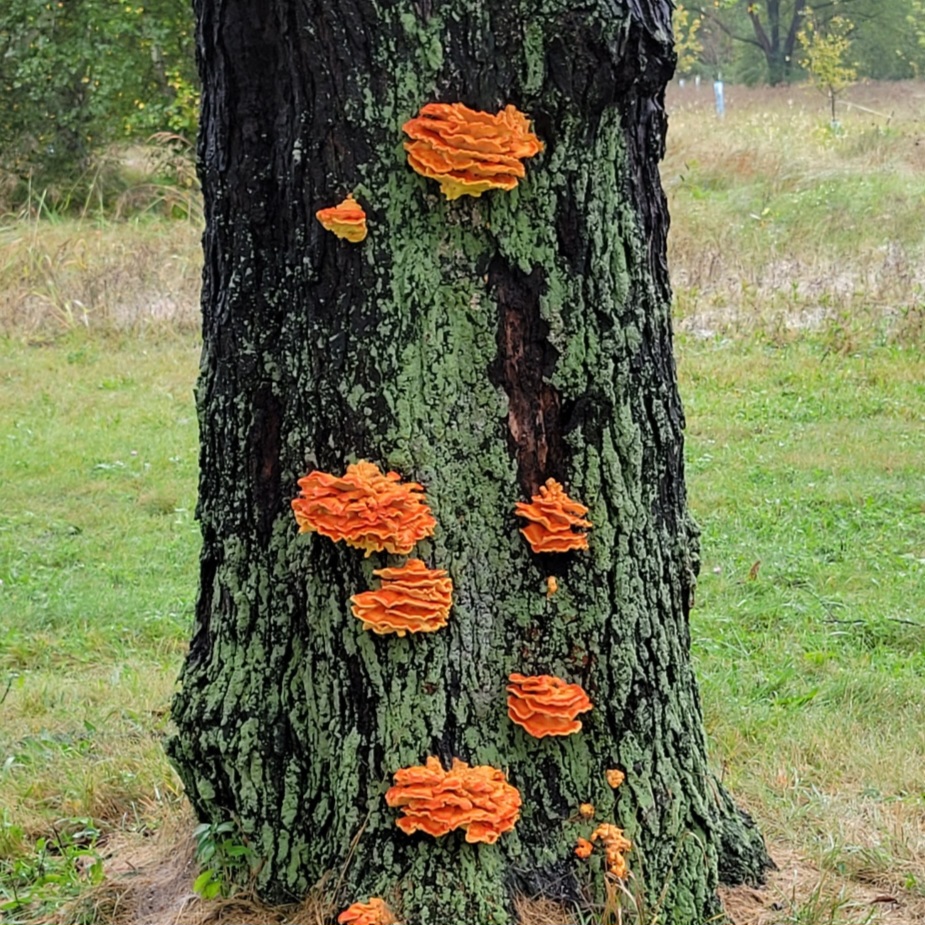
“Chicken of the Woods” mushroom.
Photo courtesy of Leonard WeberThere are young Black Cherry trees along the path in the woods, however. These most likely were not planted by humans, but in the woods these trees compete with many others for sun. In the woods, the trunks of these trees are long and narrow heading straight for the sun, and the much smaller crowns are without drooping branches. Binoculars are needed to look at the flowers of these trees.

Time and Nature will tell which trees will survive to maturity.
-
Flowers and Insects: “June Is Bustin’ Out All Over”
Leonard Weber
June 14, 2023
Knowing that my walk on June 14 in Eliza Howell Park needed to be very limited in both distance and duration, I decided to focus on my favorite wildflower field.
The walk demonstrated clearly that (giving credit to Rodgers and Hammerstein) “June is bustin’ out all over.”
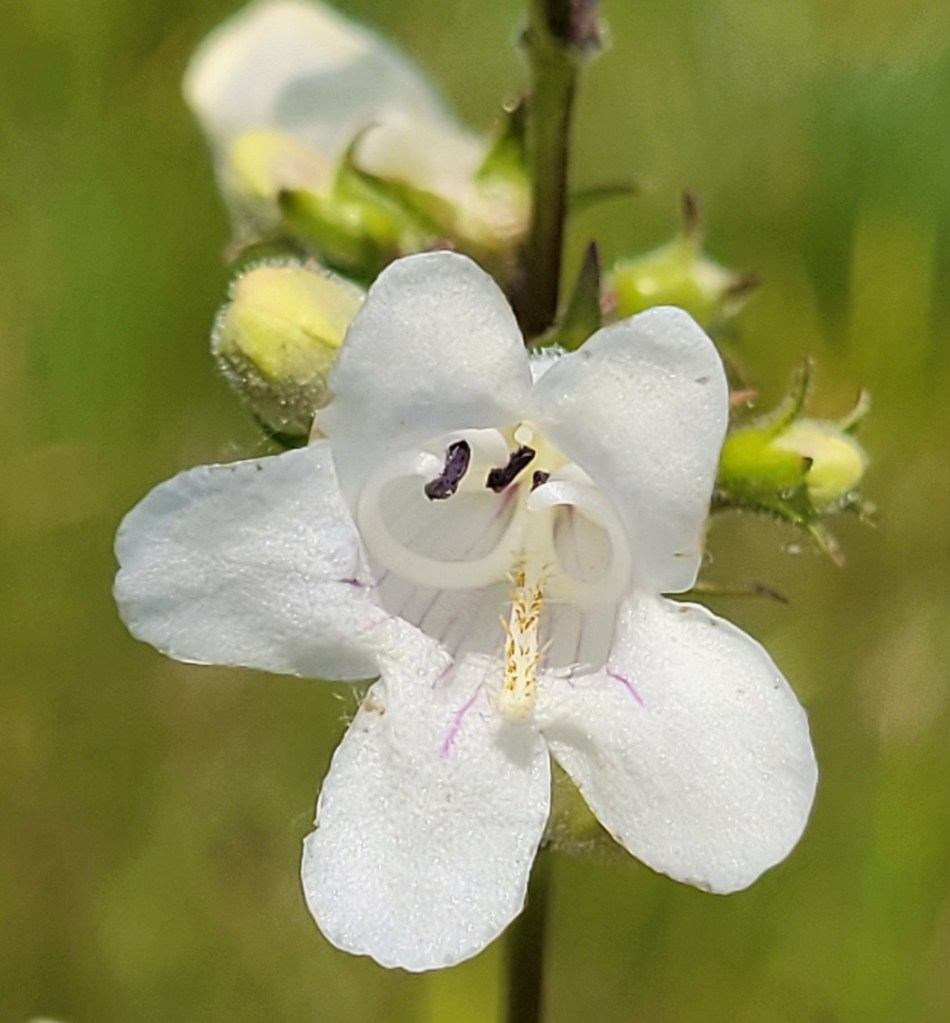
Foxglove Beardtongue The larger wildflowers that attract so many insects — like Joe Pye Weed, Purple Coneflower, Ironweed, Wild Bergamot, Goldenrod — are not yet mature enough to produce flowers, but the “blooms and bugs” season is definitely beginning.

European Skipper on Cinquefoil Crown Vetch is starting to bloom.

Crown Vetch And when flowers bloom, insects come.

Little Wood-Satyr on Crown Vetch Wood-Satyr is common in this part of the park in spring, but they rarely come to flowers. Here are two of the others I saw on this walk, one showing evidence of considerable wear and tear.

Little Wood-Satyr 
Little Wood-Satyr Near the wildflower field, in a patch of woody plants, there are a couple Silky Dogwood shrubs. They are now in flower.

Silky Dogwood These flowers also bring pollinators.
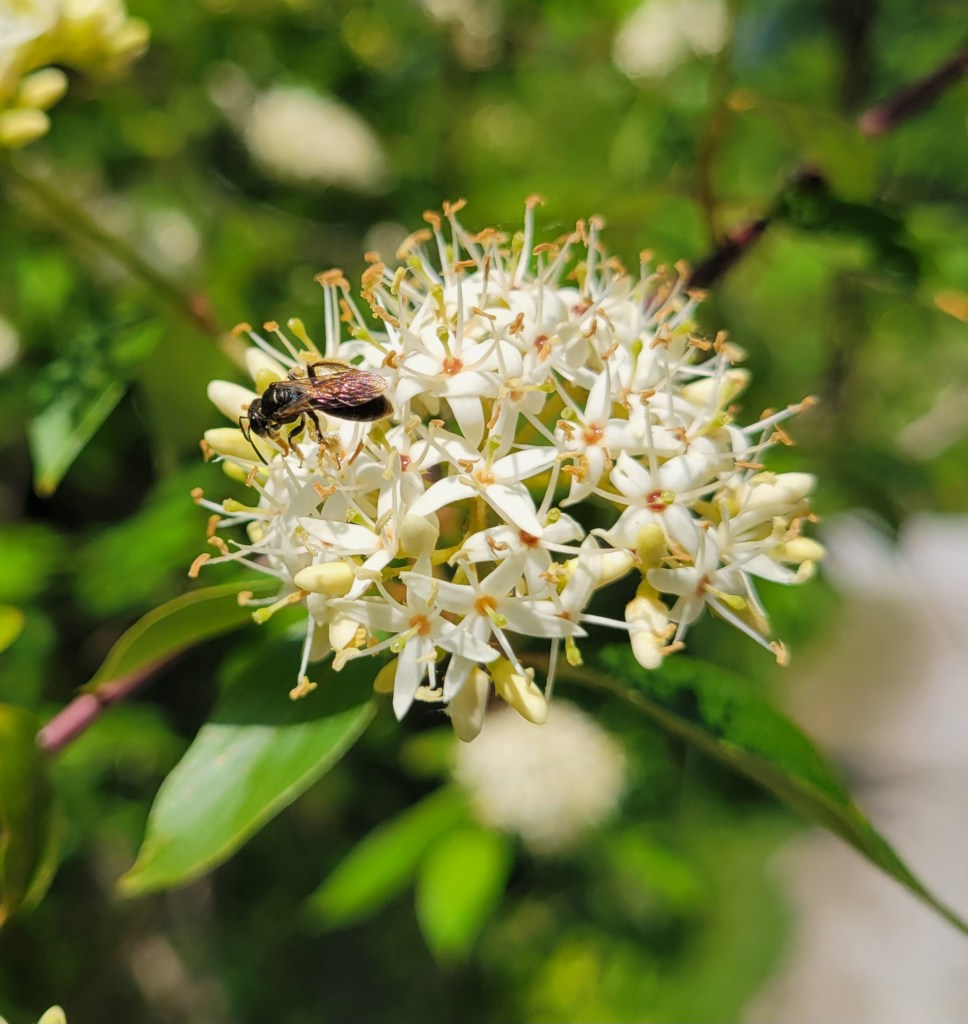
Insect on Silky Dogwood 
A Close-up Back in the wildflower field, Common Yarrow is blooming. It, too, often attracts visitors

A Fly on Yarrow Many insects, of course, are content to ignore the flowers.

Pearl Crescent The flowers and insects have begun an eye-catching show that will last well into autumn. I hope to be present for many of the different scenes as the show goes on.
-
Eastern Comma and Question Mark: # 18 and # 19 of “23 Butterflies in 2023”
Leonard Weber
June 9, 2023
Two of the butterfly species that are seen every year in Eliza Howell Park are so similar that it can be useful to present them together.
Eastern Comma is often one of the first butterflies to appear in the spring, having spent the winter as a hibernating adult.

Eastern Comma Question Mark is not quite as common as the Eastern Comma in the park, but it too can be seen at various times during the season.

Question Mark These “punctuation butterflies” are named for markings on the underside of the wings, markings that look like punctuation marks (perhaps).

Eastern Comma 
Eastern Comma Both butterflies look like a little like dead leaves when perched with the wings closed.

Question Mark 
Question Mark The difference between the two with wings open is also suble. The number and shape of the spots on the forewing can help to identify..

Eastern Comma 
Question Mark For most purposes, there is no need to identify which is which. They are two related butterflies that look alike and have similar habits and life cycles. They only occasionally come to flowers, seen much more often on leaves or on the ground. They both spend the winter as adults. They both have an approximate 2-inch wingspan (though the Question Mark may be slightly larger).

Eastern Commoa They present a challenge for those who would like to recognize which is which. These attractive orange butterflies can be admired and enjoyed, however, even if we are not at all sure which we are seeing right now.
We know a lot about the butterfly by recognizing that it is one of these two.
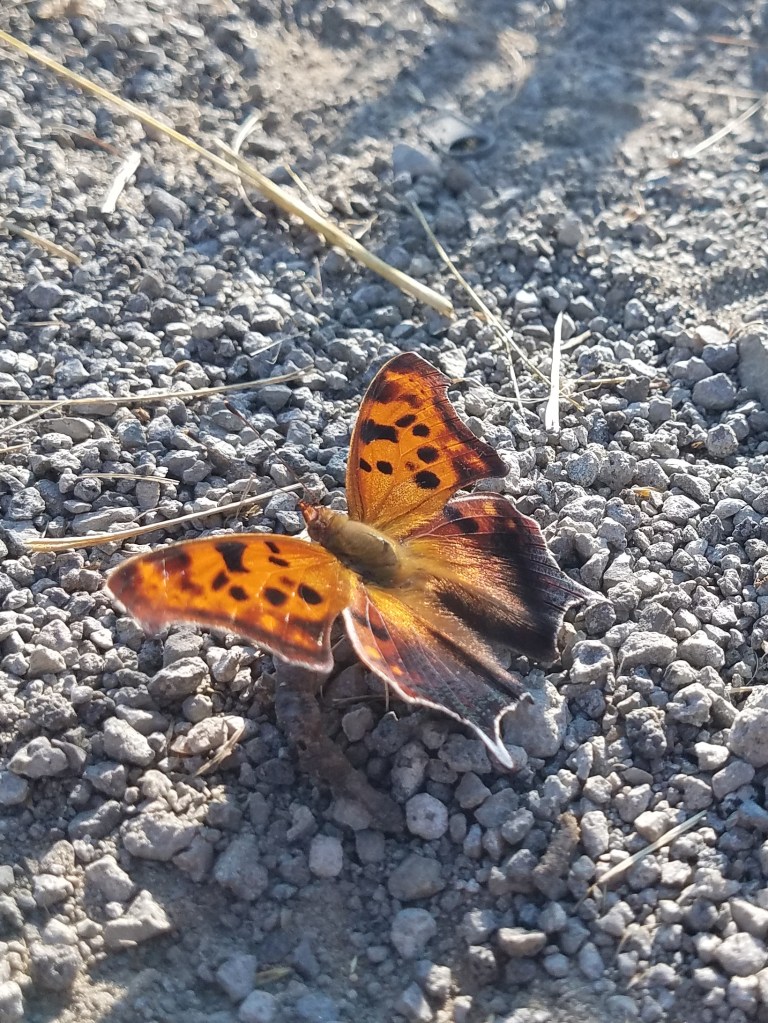
Which one? 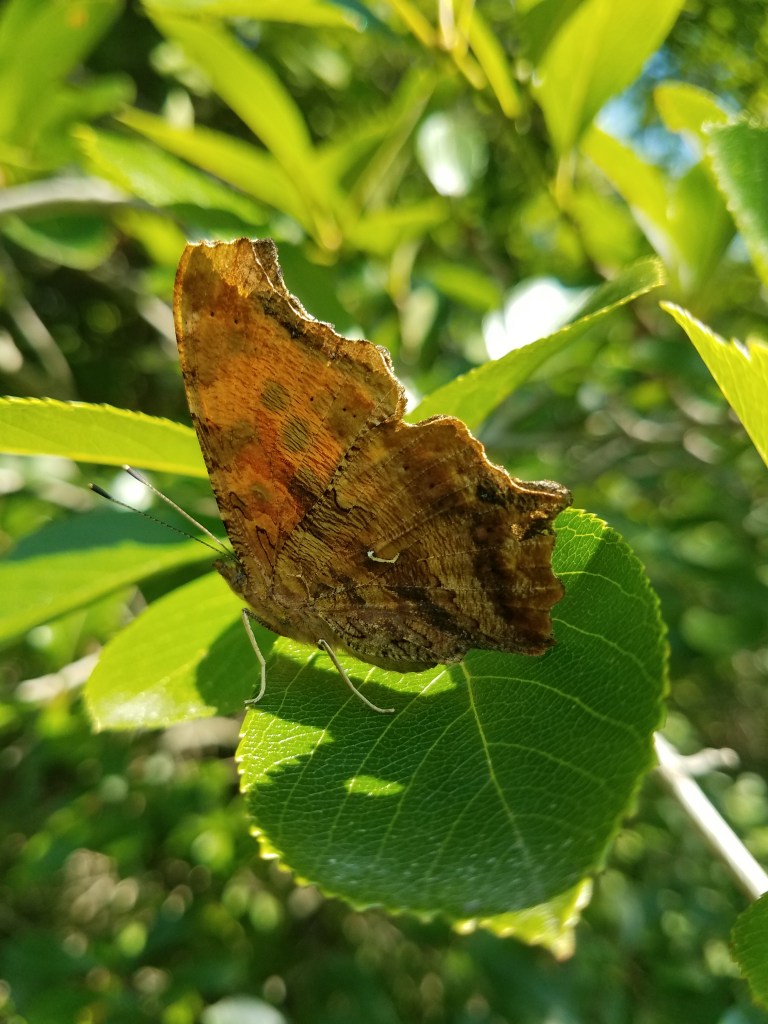
Which one? There are other closely related butterflies, other “Commas,” that are sometimes seen in Michigan, but they are not likely to be seen in Eliza Howell.
Happy punctuating!
-
Subscribe
Subscribed
Have a WordPress.com account? Log in now.

