-
Yellowjackets: The Death of a Colony
Leonard Weber
November 1, 2023
There are two related social wasps that I have paid special attention to over the years in Eliza Howell Park: Bald-faced Hornets and Yellowjackets. Most years, I find at least one active nest of each.
This year, I have visited the site of an underground Yellowjacket nest regularly over the past 10 weeks.
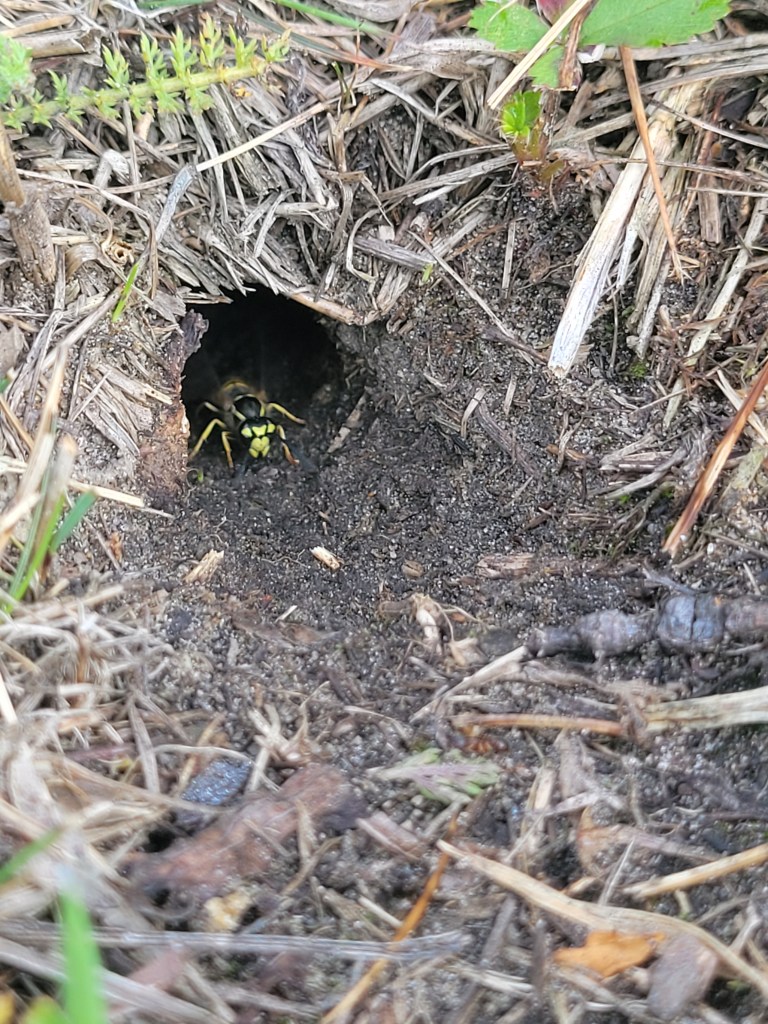
There was always a stream of wasps entering and exiting the hole in the ground.
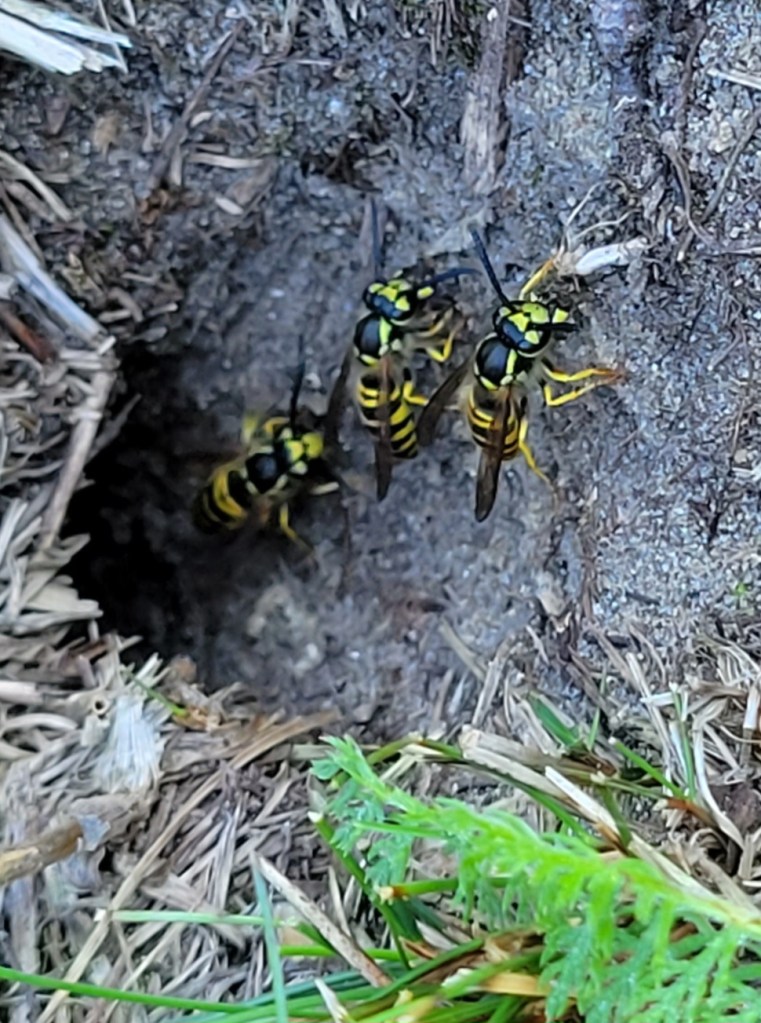
The life cycle of the colony is fascinating. In the spring, a single fertilized female (the queen), who has spent the winter in hibernation, chooses the location (perhaps a former rodent burrow) and starts the paperlike nest, made of wood fiber mixed with saliva. She lays the eggs and feeds the first young, all of which are infertile females. The new generation (the workers) then take over expanding the nest and feeding the many additional young. The queen focuses on laying eggs.

Gathering food (sap) from
an oak insect gallThe colony continues to grow — and I continue to watch the entrance, being careful to be as non-threatening as possible. Most Yellowjacket stings are the result of workers protecting against what they perceive as threats to the nest.


Later in the season, the queen produces males and fertile females. When mature in the fall, they mate. The males die, and the mated females seek a safe place to spend the winter (I have seen them under logs). The new queens that survive the winter start new nests / new colonies in the spring.
The old queen and the workers die when the weather turns cold. I recently noted that those gathered by the entrance were not moving or very sluggish.
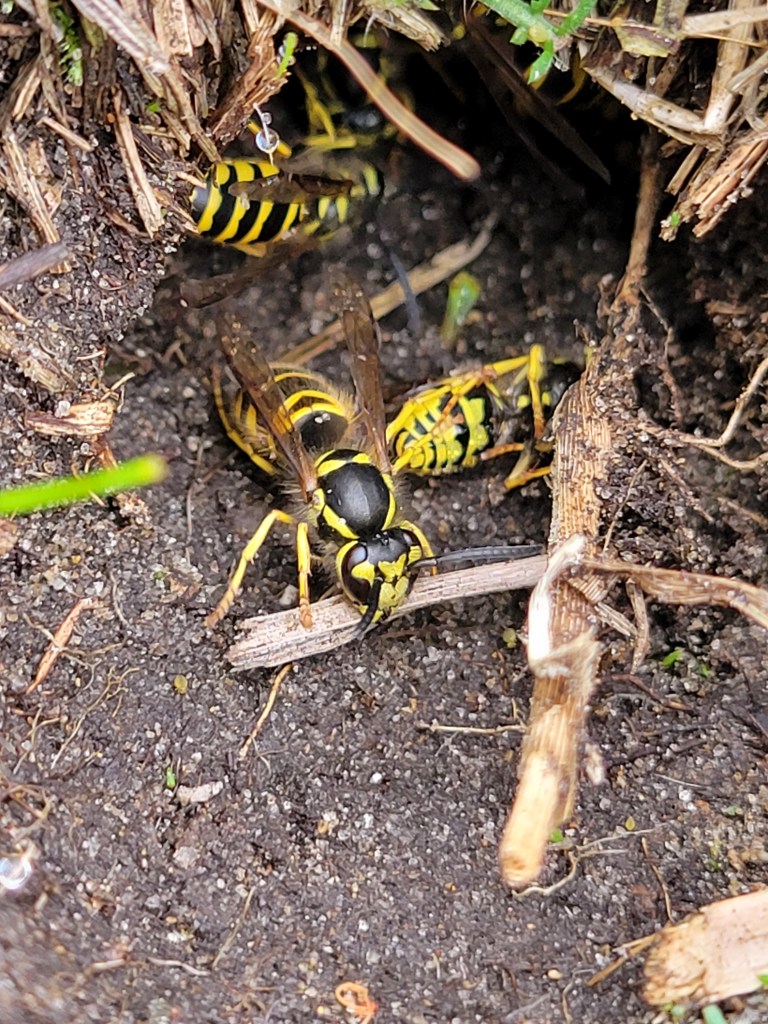
Since Yellowjackets do not reuse nests, the death of the colony is a time to attempt an excavation of the hidden underground nest.
My colleague Kathleen Garrett and I dug around the entrance hole today. The top of the nest was only a couple inches under the surface.
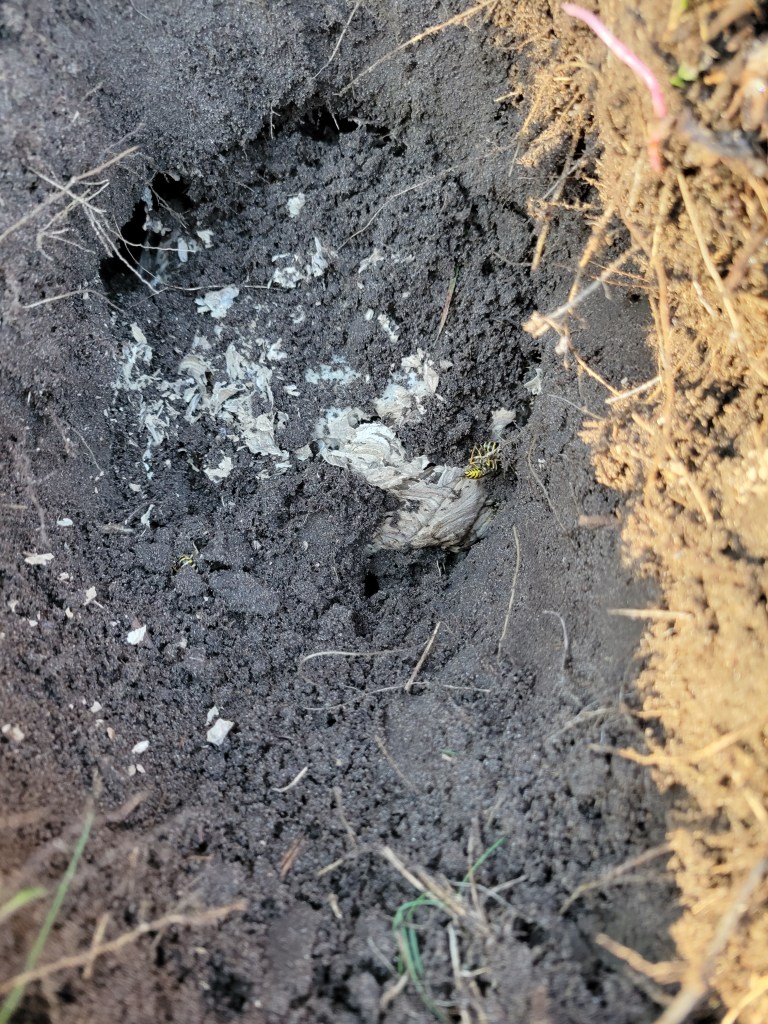
The nest itself was about 6 inches high and fairly easy to lift out. The paper covering didn’t stay fully intact, but that provided an opportunity to see some of the cells inside.

In the last several months, hundreds of insects have lived here. Worker wasps have made many, many trips in and out providing food for larvae. They have built and managed a complex nest and social system. Now it is done.
The colony is dead, but it was a successful one. Somewhere in the park, new queens are beginning their dormancy. And people like me have hopes of witnessing and observing another active colony or two next year.
-
Frost on Flowers: A Late October Walk
Leonard Weber
October 23, 2023
It was cold and sunny when I arrived at Eliza Howell Park this morning. As soon as I realized the extent of the frost, I focused my attention on some of the flowers I have been watching this fall.
It’s fascinating to see how different they look when frosted.

Sneezeweed 
Chicory 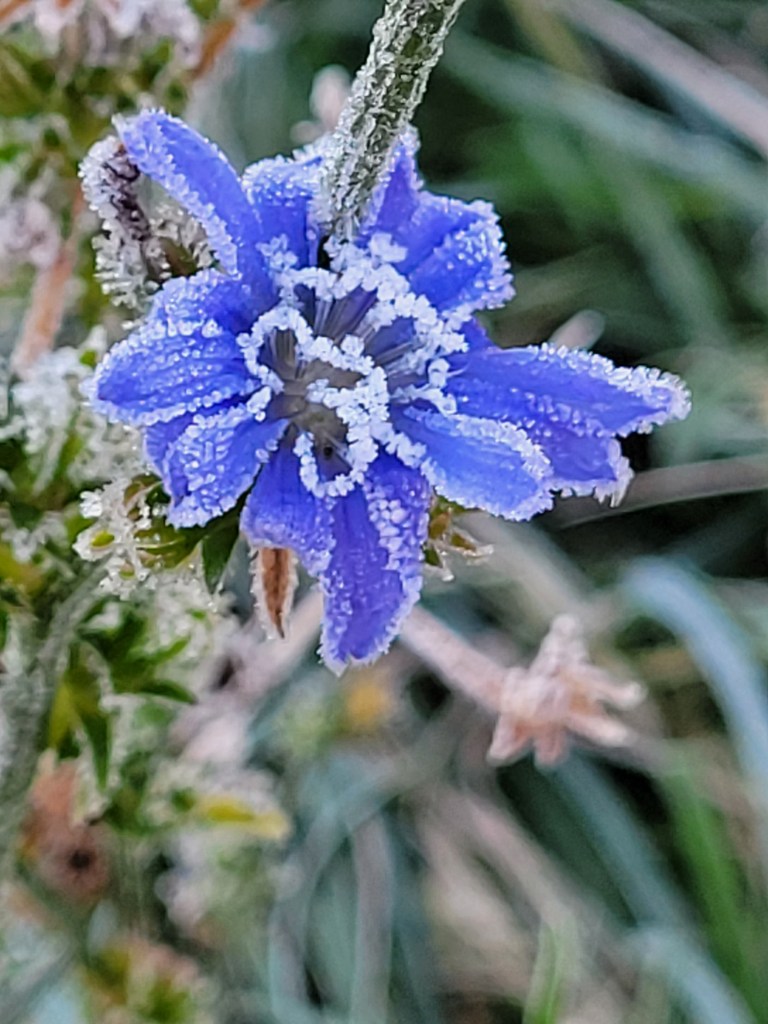
Chicory 
Yellow Coneflower 
Swamp Milkweed Seeds 
Staghorn Sumac Seed Cluster A bright sunny fall morning has other attractions as well. When there is little or no wind, as was the case today, it is a good time to enjoy the pond’s reflection of trees.

Wild Black Cherry trees Some other trees are nearing their peak fall color. Two caught my attention.
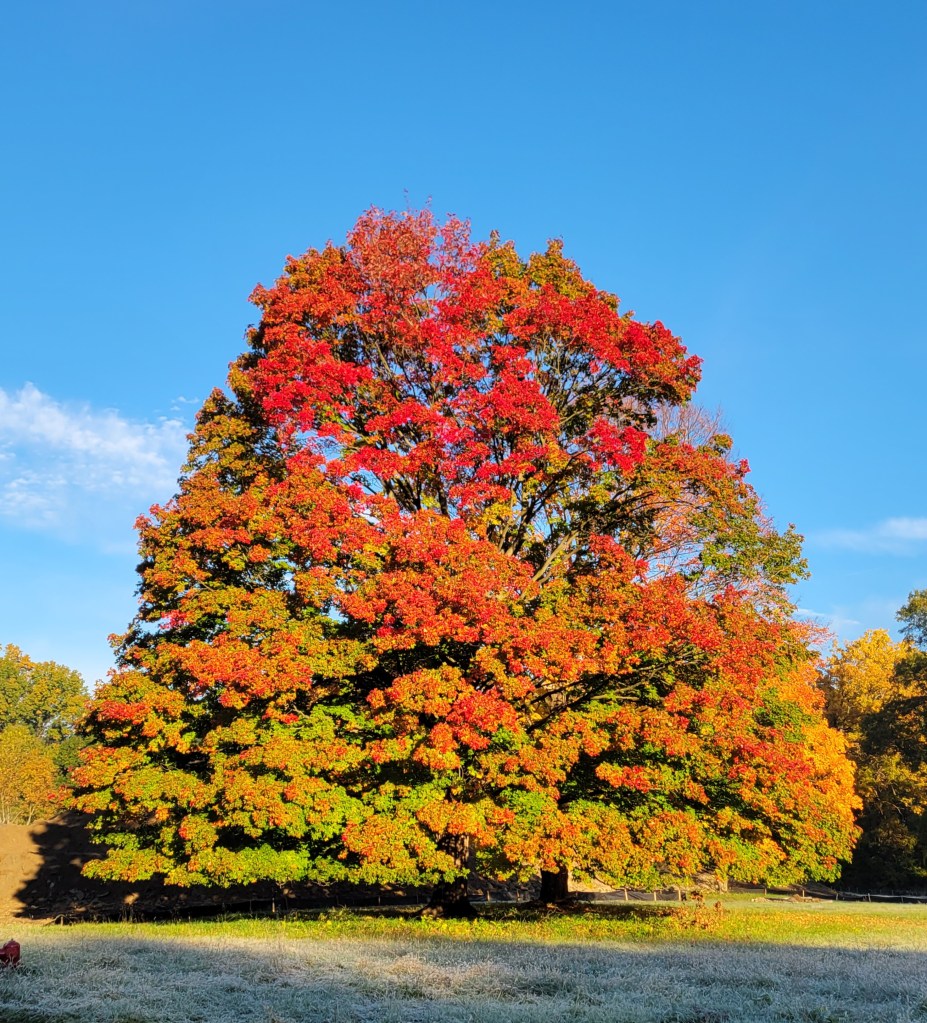
Sugar Maple 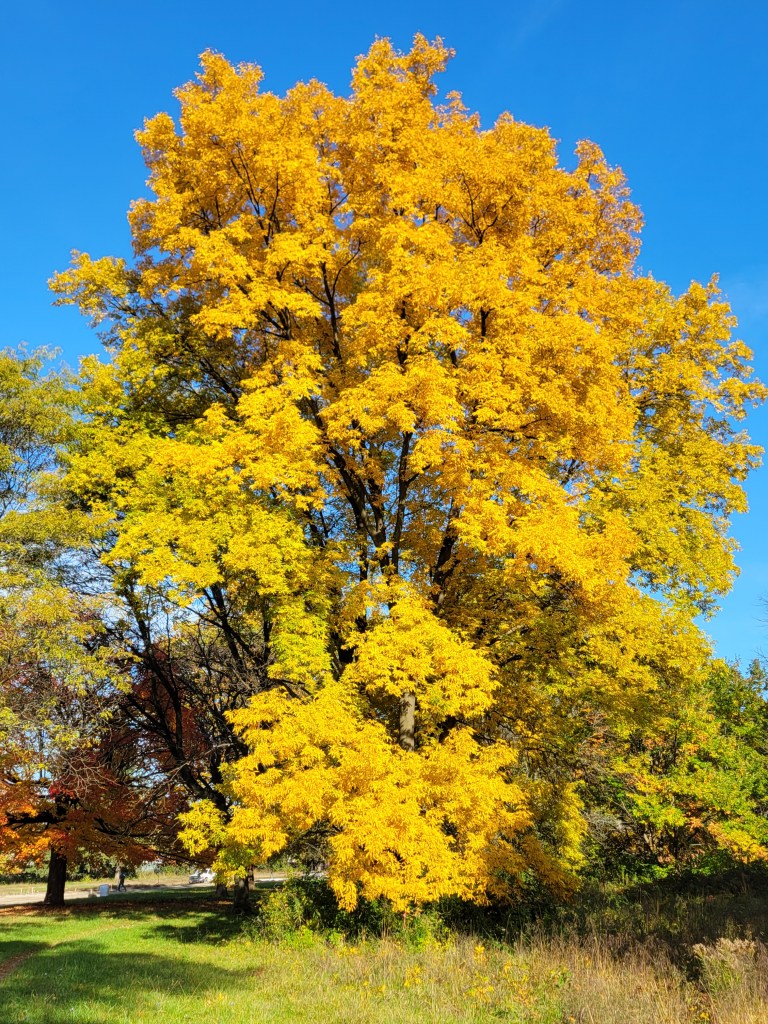
Yellowbud Hickory
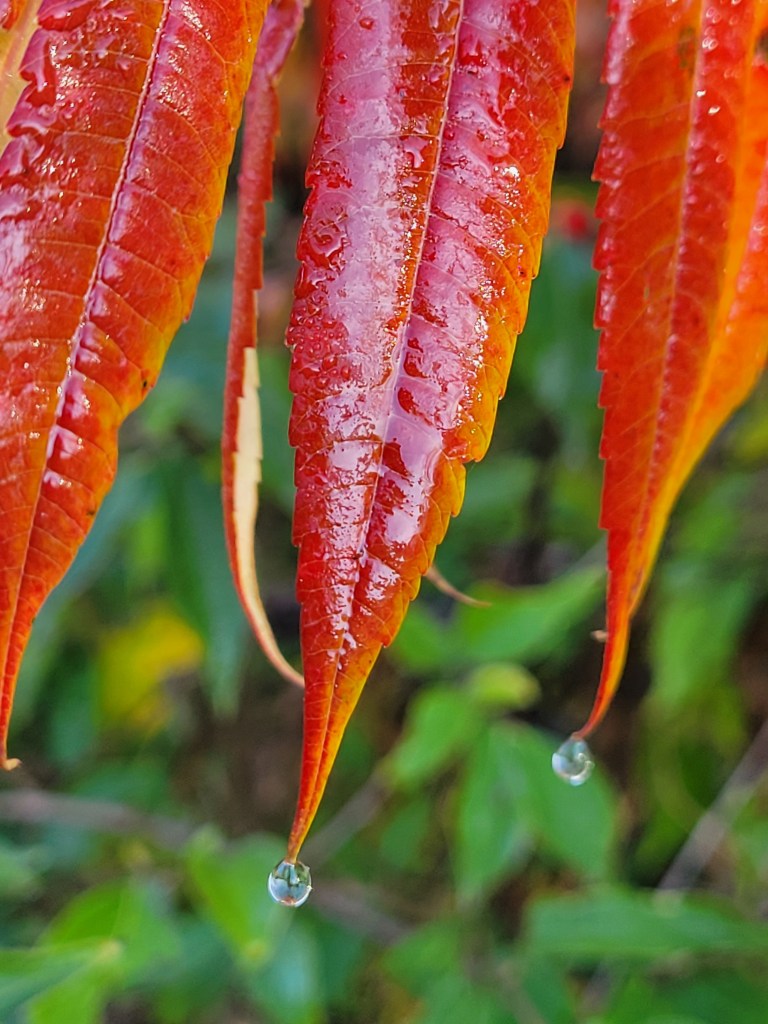
(often called Bitternut Hickory)An hour after I started my walk, I stopped at another Staghorn Sumac to admire the shiny leaves, now dripping melted frost.
As I turned my attention to other observations today (including two recently arrived species of wintering birds — Dark-eyed Junco and American Tree Sparrow), I was grateful to have had my first frost walk of the Fall 2023.
-
A “Black-footed Ploypore” Log: How Many Years?
Leonard Weber
October 9, 2023
This is the third consecutive fall that I have noted a number of large mushrooms (up to 8 inches across) growing on the same log near a woodland path in Eliza Howell Park. The mushroom is known as Black-footed Polypore.


The log is large and has been here for some time. It is approximately 18 inches in diameter and the bark is long gone.

Most of the mushrooms are on the top of the log, with only a few on the sides. The number of fruiting bodies has increased to about 40 this year. The distance covered on the log also appears to have grown, now about 22 feet long. (The photo here does not cover the full extent.)
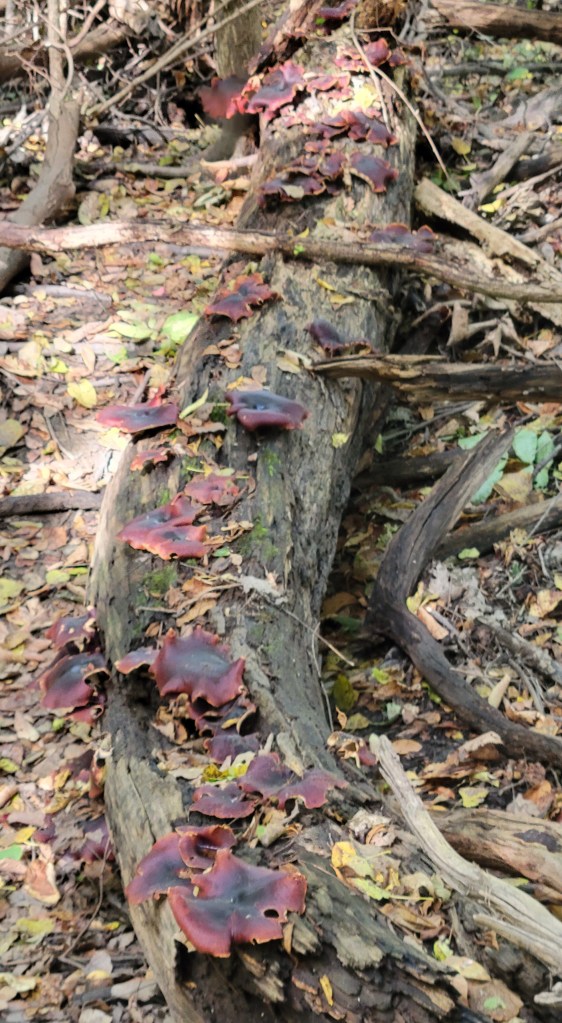
The mushroom is called “Black-footed” because of the dark color of the stem next to the white under-surface, as can be seen when it is cut or broken off from the log.

Mushrooms that grow on wood are decomposers (or recyclers), helping to speed the return of the wood to nutrients for the soil. What we see is only a small portion of the organism. The large network of cells (mycelium) in the log digests the wood and decomposes it.
It is a long process. The log looks pretty much the same from one year to the next, just a little more decayed. The presence of the Black-footed Polypore caps each Fall is a reminder that change is definitely taking place within.
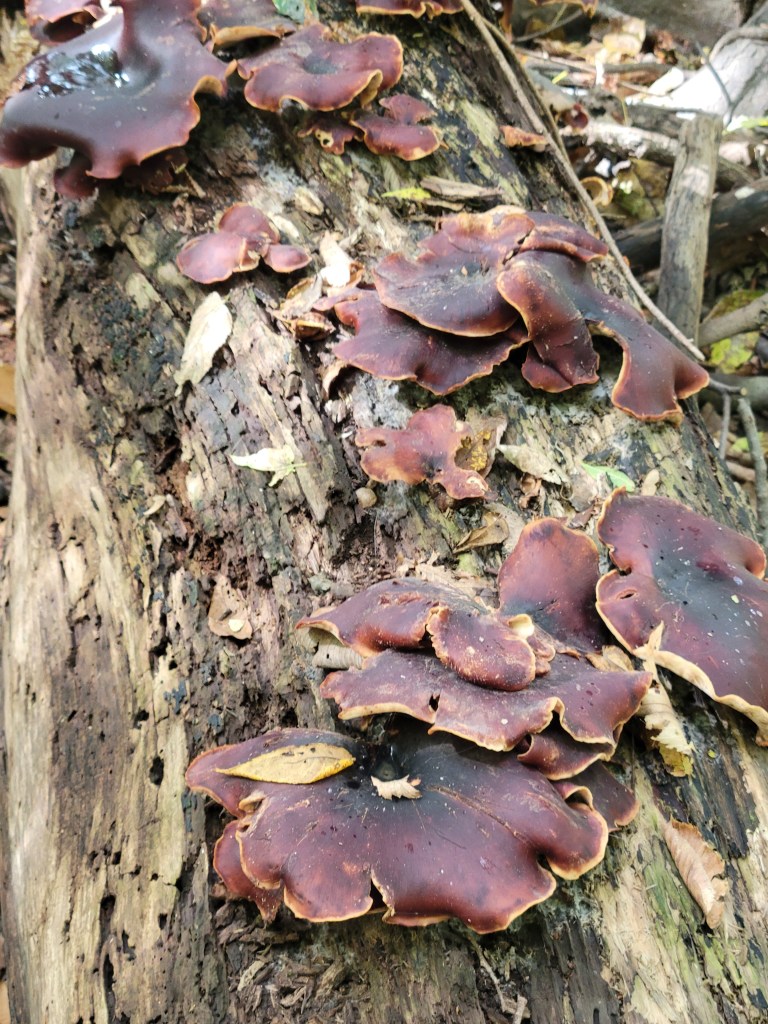
What I do not know is how long this particular mushroom will live in and on this log. It is well established now, but can we expect to see it again and again in the future?
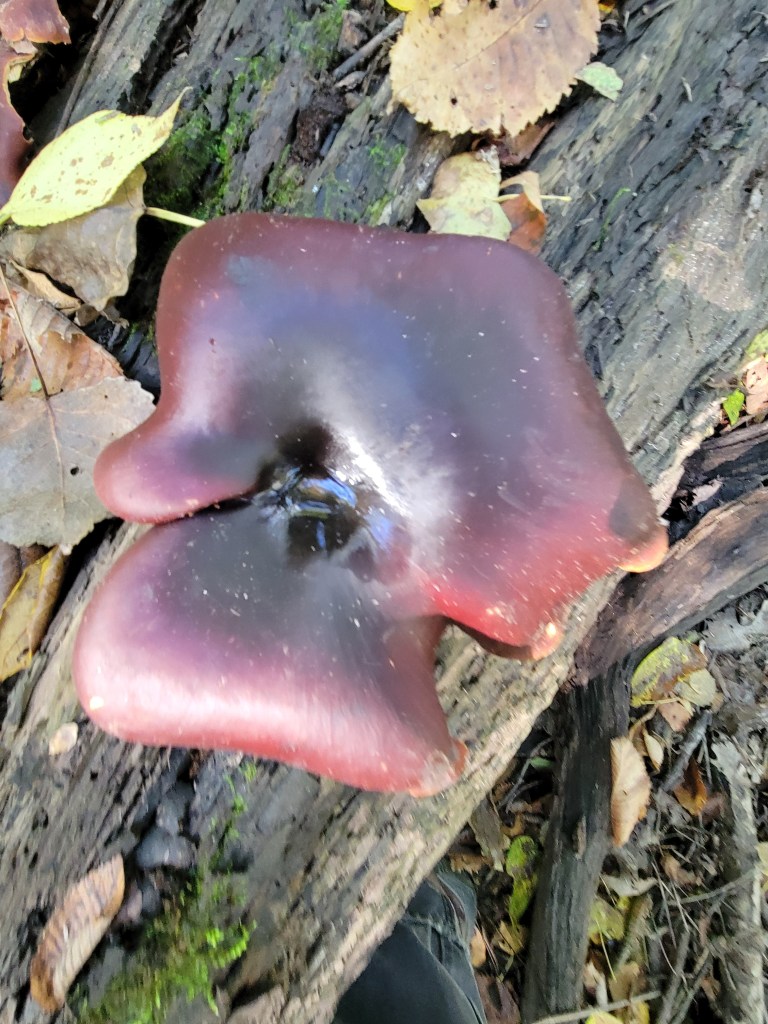
The caps turn darker as they age and hang on into the winter. I expect to see bright and fresh new ones here next September, but the annual reappearance may well continue for more years than I will be able to observe.
-
Late Season Monarchs: An Update
Leonard Weber
October 4, 2023
A little more than three weeks ago, I reported seeing several Monarch caterpillars in Eliza Howell Park and noting that they will not be among the early departures on the long migration to Mexico. (See “Monarch Caterpillars in September,” September 11.)

September 11 Since then, I have been looking for their chrysalises (without success) and have been seeing a few adult butterflies still seeking nectar from park flowers.
On October 4, I saw four Monarch butterflies, their bright colors suggesting that they had recently emerged as adults.

October 4 I am not suggesting that these four are the same four that I saw as caterpillars on September 11, but it’s fun to speculate that one or two might be.
Three of the new adults were busy hunting and eating nectar. The fourth (the one in the photo above) was on the ground.

October 4 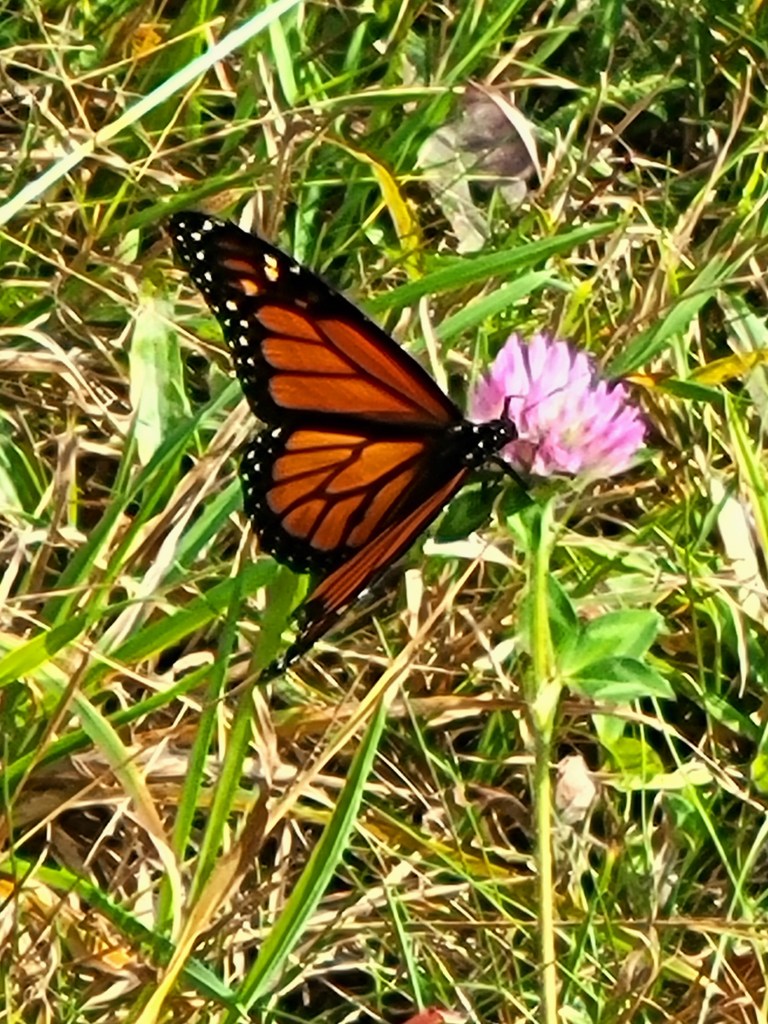
October 4 
October 4 Monarchs generally are not especially particular about which flowers they visit, but at this time of the year, Red Clover is definitely a frequent stop

Red Clover I don’t see many Monarch butterflies here in October. When I do, I wish them a “Safe Flight!”
-
Sneezeweed: Flower and Insects
Leonard Weber
September 25, 2023
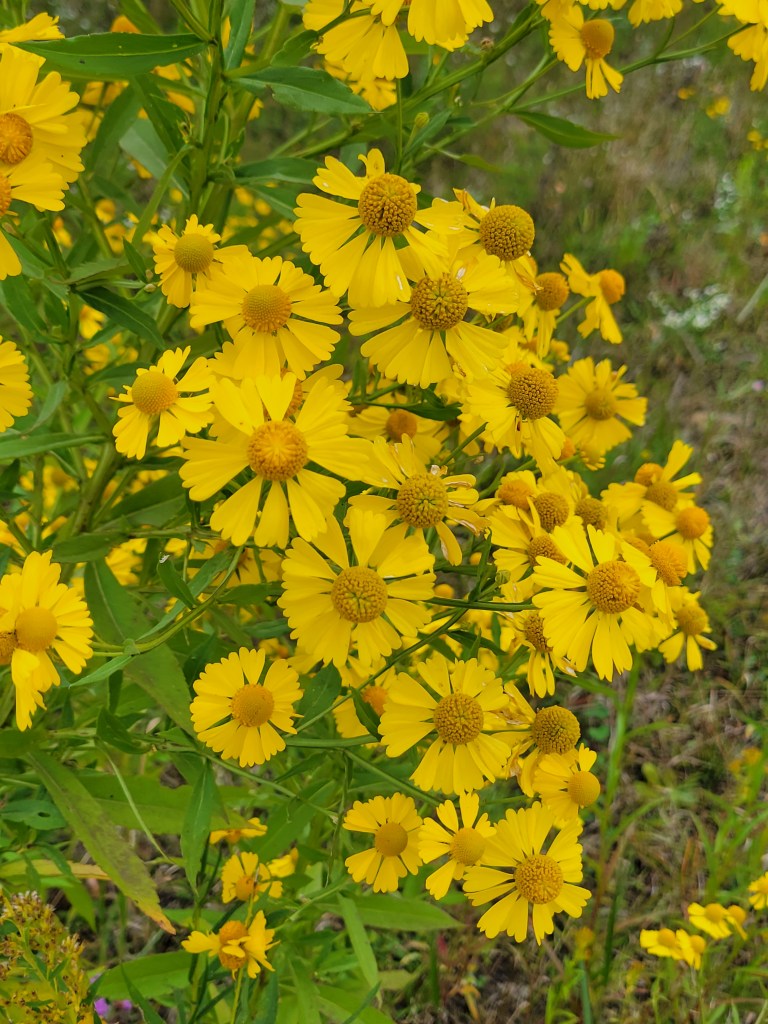
When I think of late September wildflowers in Eliza Howell Park, I usually think of goldenrods and asters. This year, however, I am spending more time in a patch of a different species: Common Sneezeweed.
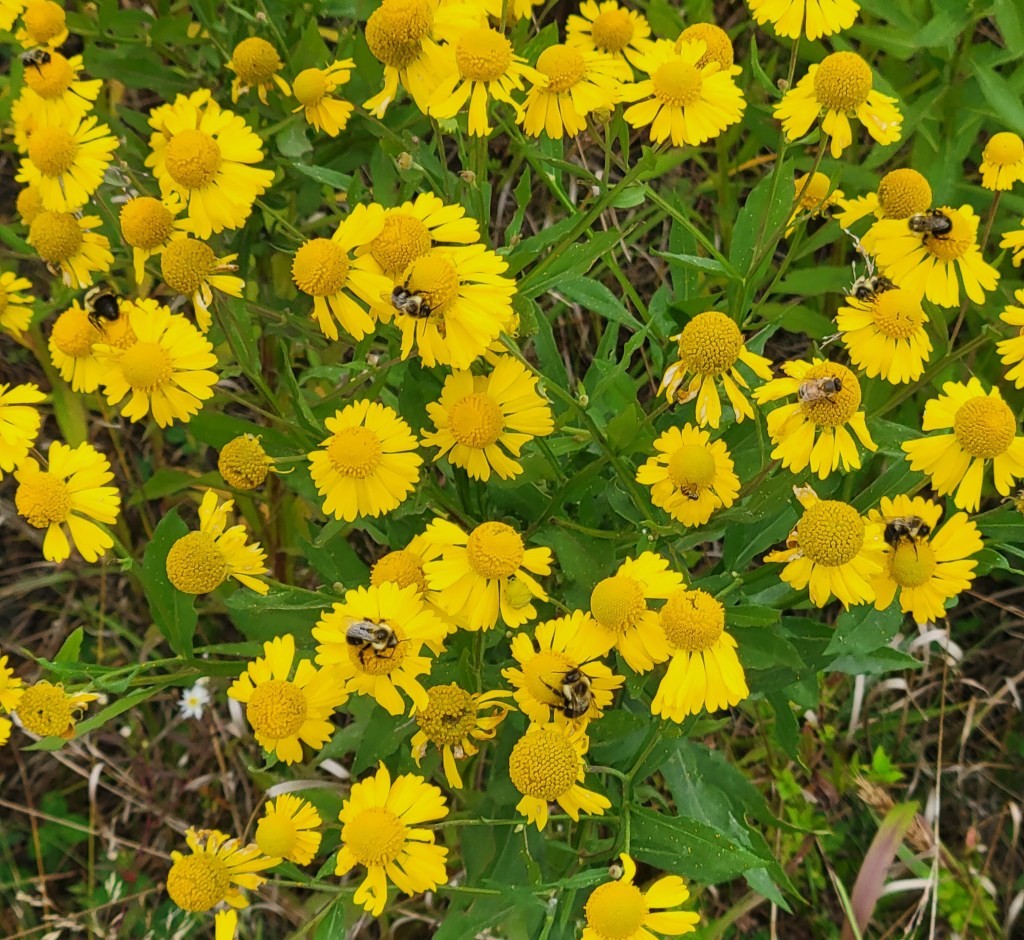
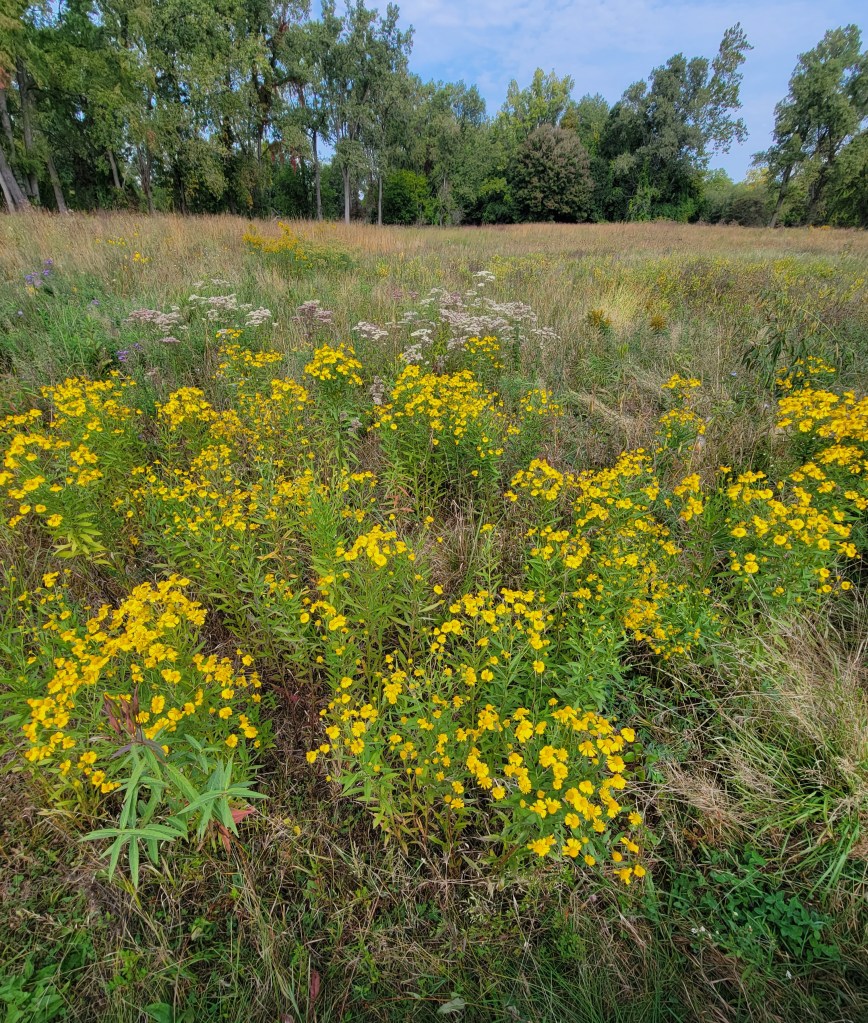
Common Sneezeweed is a perennial that grows well in wet soil; this patch is in an area that often holds water after a heavy rain.
It grows 3 – 5 feet tall and has multiple bright blooms. The round centers of the flowers are surrounded by notched yellow petals.

I have been primarily focused this year on the variety of insects Sneezeweed attracts.
There are very many bees. When I looked carefully at the first photo above, I counted nine bees. Many of the bees on Sneezeweed are bumblebees, but there are also honeybees and sweat bees.

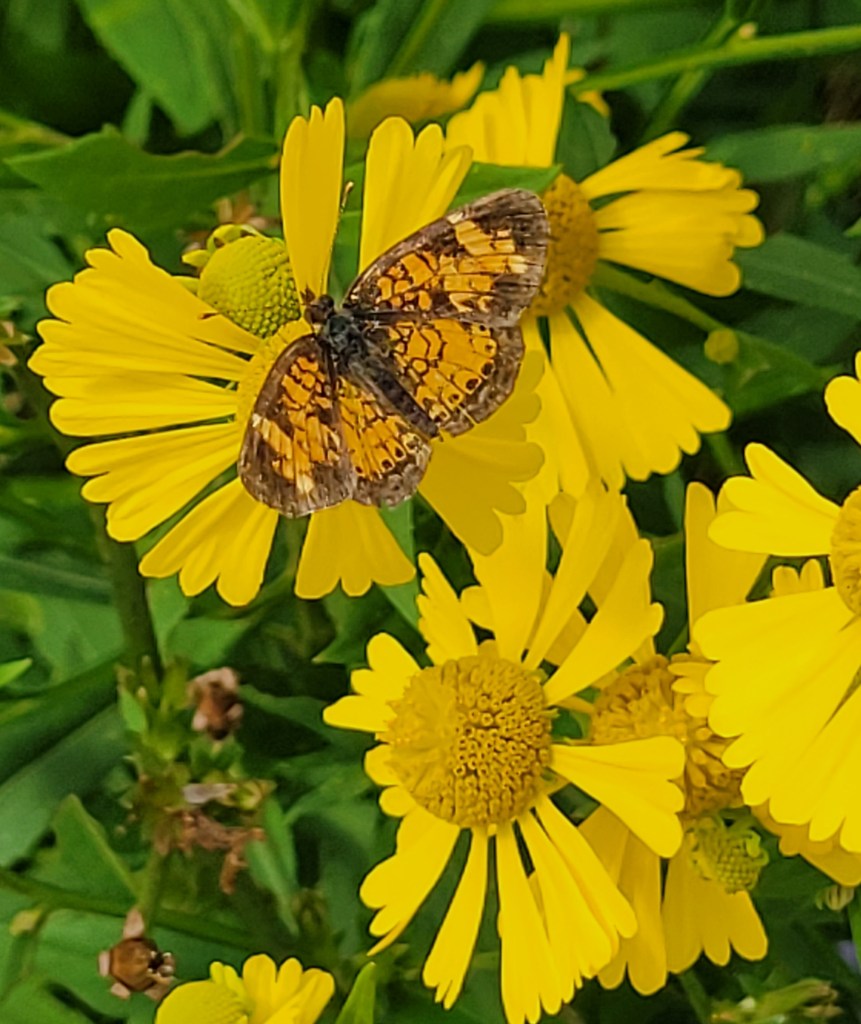
Other insect species drawn to Common Sneezeweed are Ailanthus Webworm Moths,


Pearl Crescent butterfly,
Goldenrod Soldier Beetle (orange and black),

grasshoppers,

and tree crickets.


Though the name might seem to suggest that Sneezeweed pollen is in the air and causes sneezing, this is not the case. The name apparently comes from the historical practice of using its crushed dried leaves and flowerhead to make a type of snuff.
I will continue to enjoy goldenrods and asters as special late September flowers — colorful and insect-inviting.
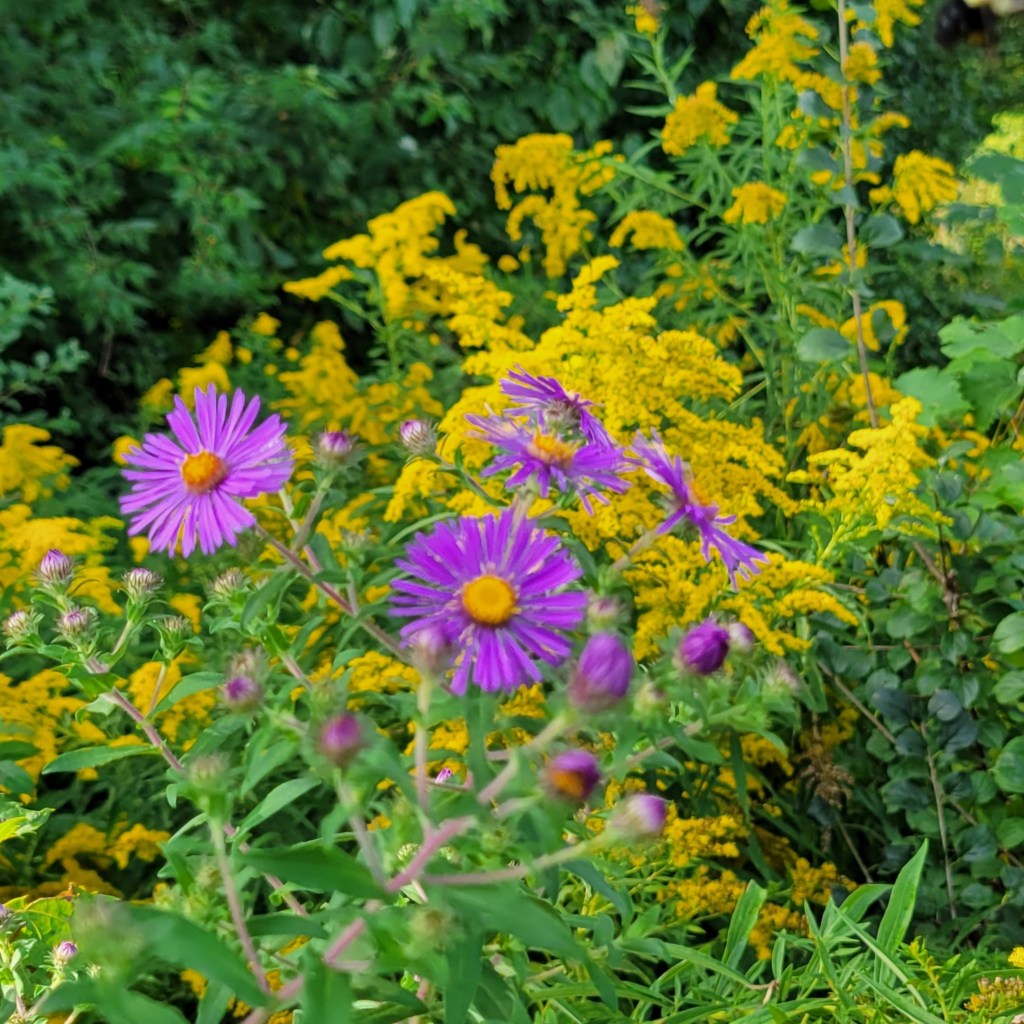
Now that I have become better acquainted with Sneezeweed, I think it just might qualify to join this select group.
-
Nine Fruiting Vines: Annual September Walks
Leonard Weber
September 20, 2023
Nature is cyclical. The same phenomena can be observed at approximately the same time each year.
One of the items on my annual September nature-walk agenda in Eliza Howell Park is to check on the fruit of a variety of vine species.
1. Virginia Creeper

Virginia Creeper Virginia Creeper is one of my favorites. I love the look of red stems holding ripe blue berries (here, not quite fully blue). It ripens earlier than many, usually well along in the middle of September when I first start my vine rounds.
I focus these fruit walks on vines that a) climb trees and shrubs and that b) are perennials. When I first started some years ago, I had only five on the list. Since then, I have become aware of other, less widespread species that I now include.
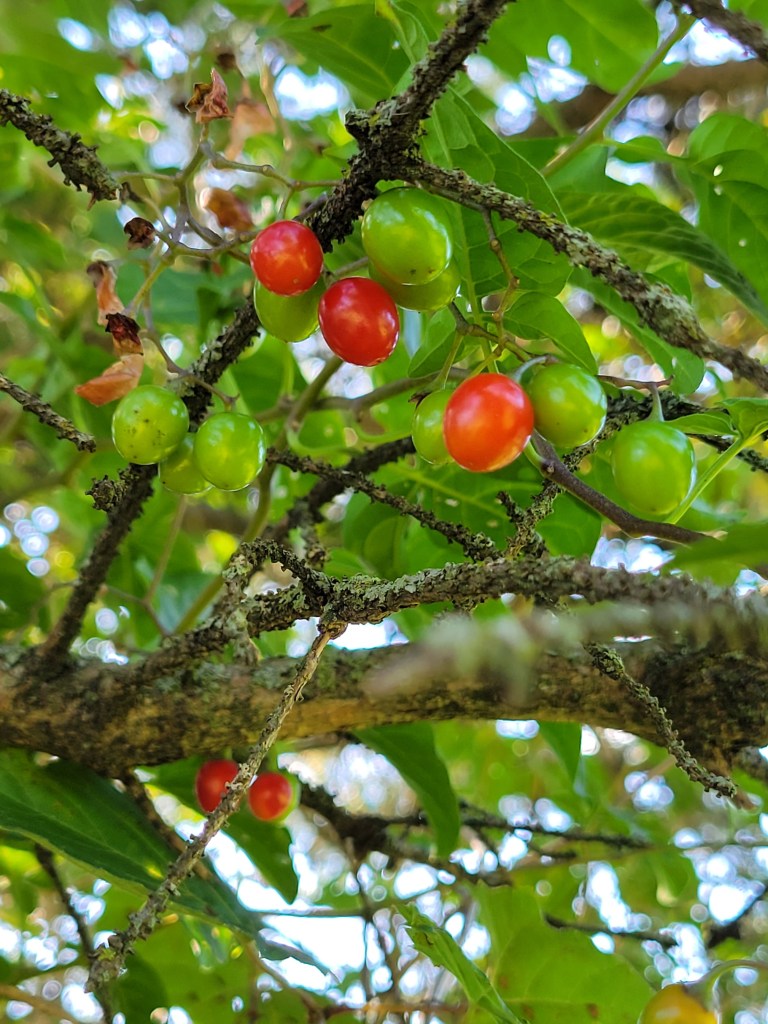
2. Climbing Nightshade
Climbing Nightshade 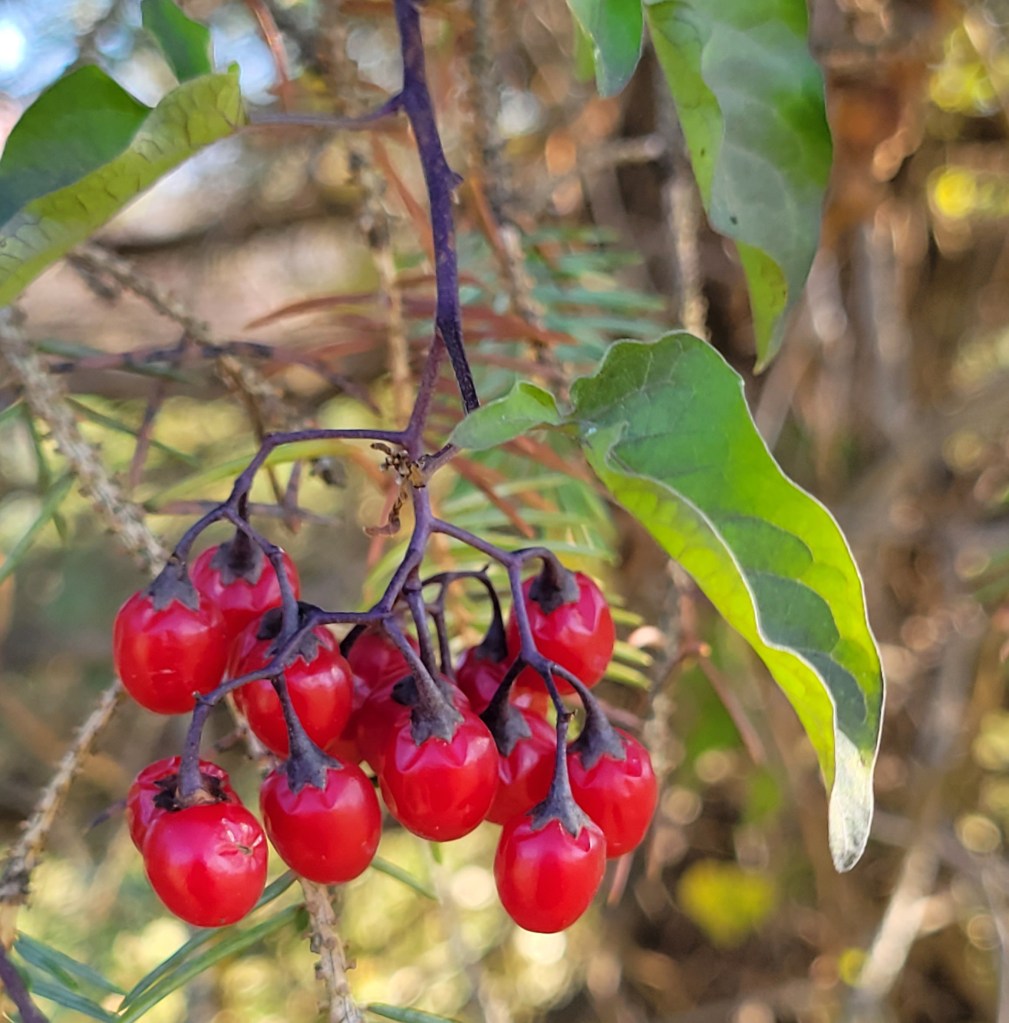
Climbing Nightshade To my knowledge, there is only one location in Eliza Howell Park where this vine grows. It has worked its way around some of the lower limbs of a spruce tree and is the most recent addition to the September vine walk
The berries turn from green to a bright red at this time of the year. They are lovely to look at, but this fruit is not for eating.
3. Wild Grape
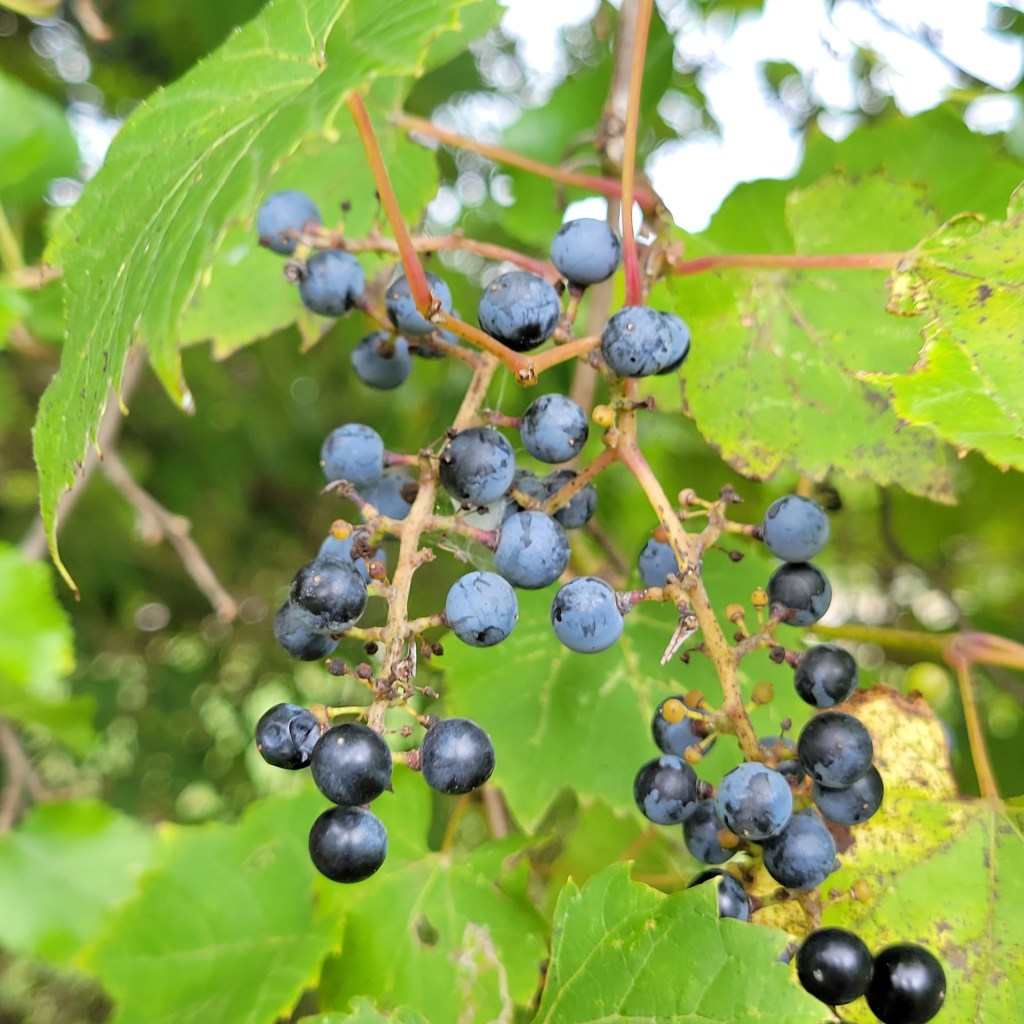
Wild Grape Grape is a common vine in the park, sometimes growing high in large trees. The vine is very common, but the fruit is not always easily found. I often check out several lower growing vines in the summer to find bunches that can be observed as they ripen.
Grape is another species that ripens early, often being past its peak in mid-September.
4. Poison Ivy
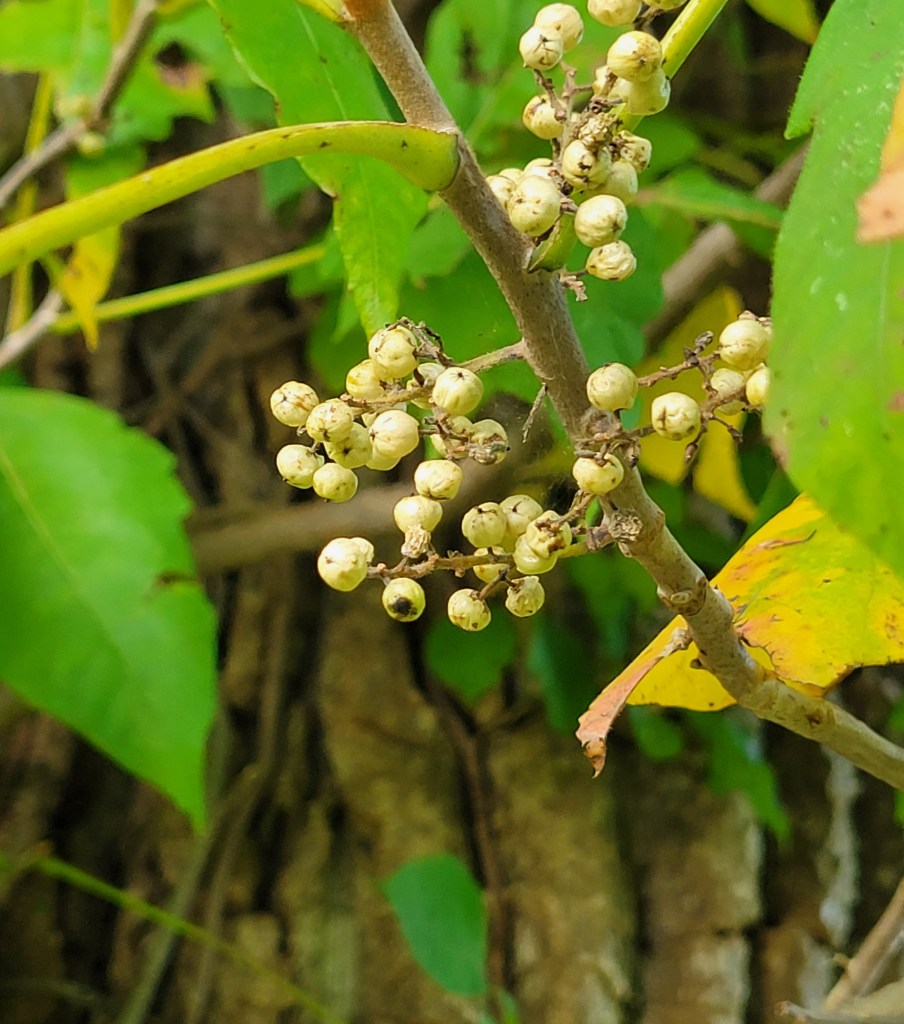
Poison Ivy Poison Ivy is common in Eliza Howell and climbs a number of large trees. Many people recognize it by the leaves; the fruit is less well known.
Even if we weren’t afraid of an allergic reaction from coming into contact with the plant, we probably wouldn’t try too hard to get close-up photos of Poison Ivy fruit. It is not as eye-catching as many other berries.
5. Moonseed

Moonseed Moonseed is an uncommon species here. I have seen it in only one area, under trees, near the river. It is sometimes not easy to discern the true color of the fruit because of the deep shade.
“Moonseed” is given that name because the seed in the berry is crescent-shaped.
6. Porcelain Berry
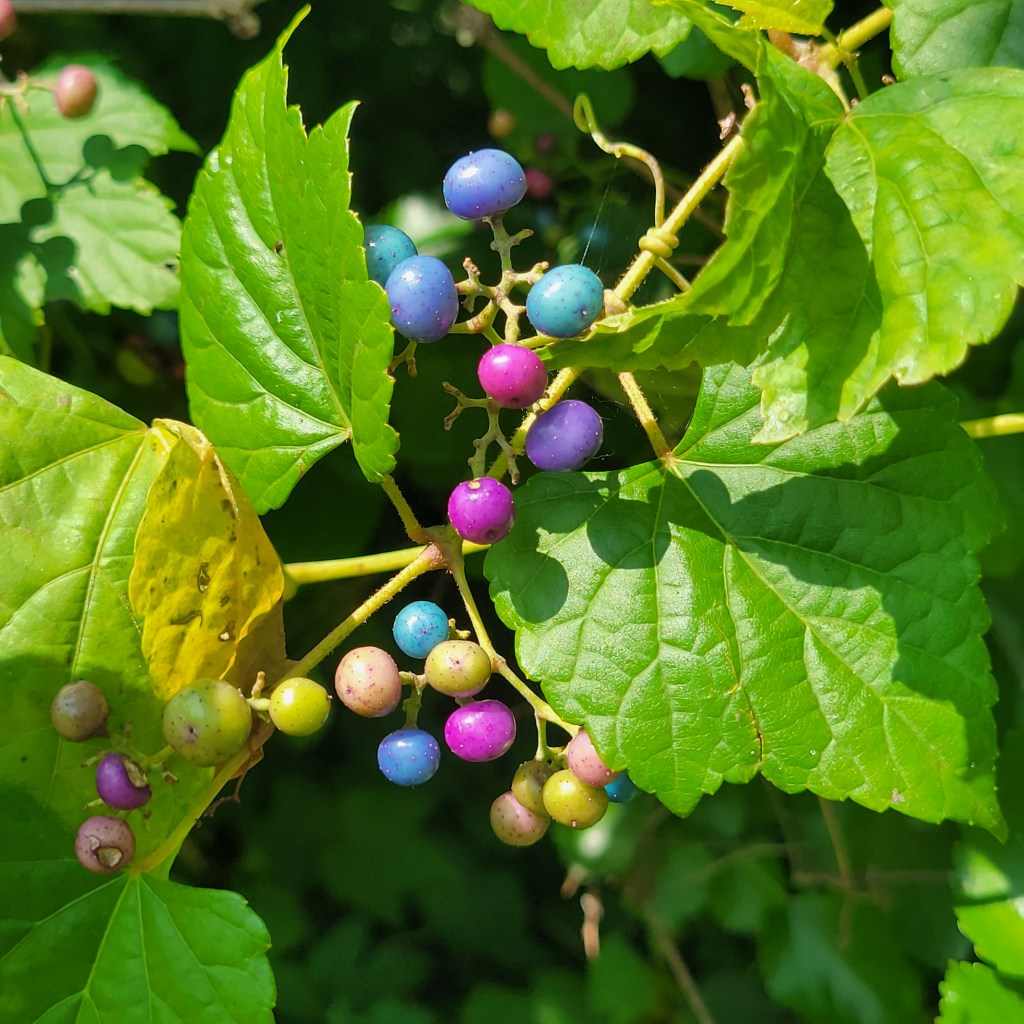
Porcelain Berry Porcelain Berry is widespread in Eliza Howell, climbing trees and shrubs where the trees are scattered and along woodland edges. It is not found inside the wooded sections of the park.
It grows fast and spreads fast.
The multicolored berries are numerous and popular with several bird species. Birds eat many of the nine berries pictured here, but Porcelain Berry is the most popular berry food in mid-September.
7. Greenbrier

Greenbrier Greenbrier grows in a few locations in the woods near the river. The particular species here is, I think, Bristly Greenbrier. It is not showy, in leaves or vining or fruit, and can be easily overlooked.
The brightest color is seen when the berry is opened.

Greenbrier seed 8. Oriental Bittersweet
Bittersweet in September 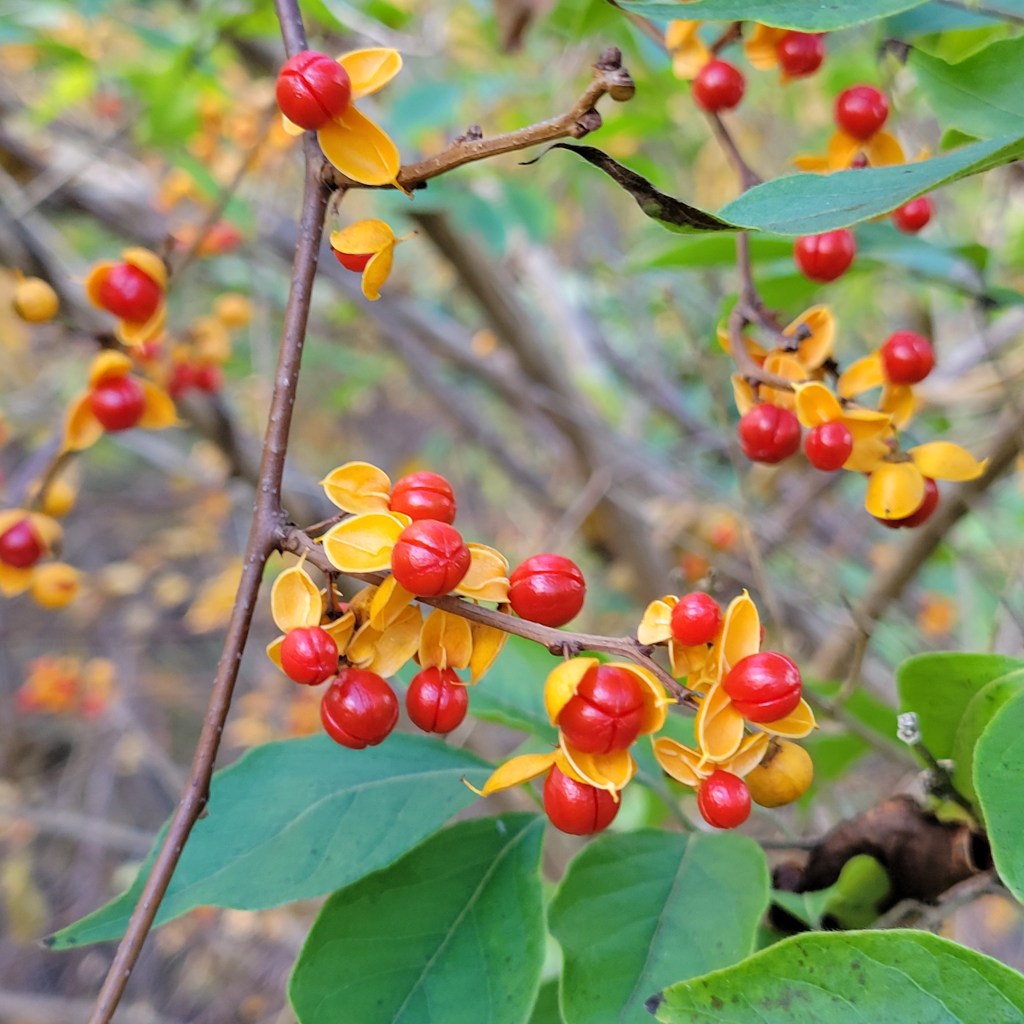
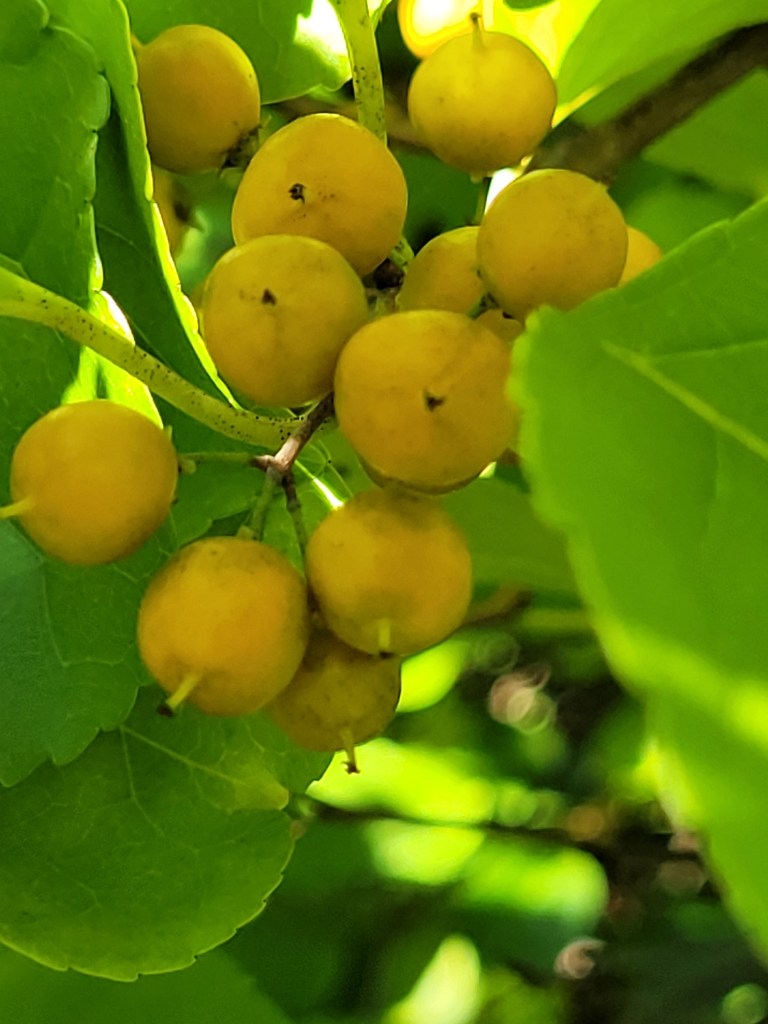
Bittersweet at end of October Oriental Bittersweet is widespread and is an aggressive grower at woodland edges. It doesn’t appear in deeper woods.
The fruit reaches maturity later than many of the others. In September, the clusters are easy to find, but the outer layer of the berries is not ready to open and reveal the red inside. When it does ripen, birds have finished some of the other fall berries and turn here.
9. Winter Creeper
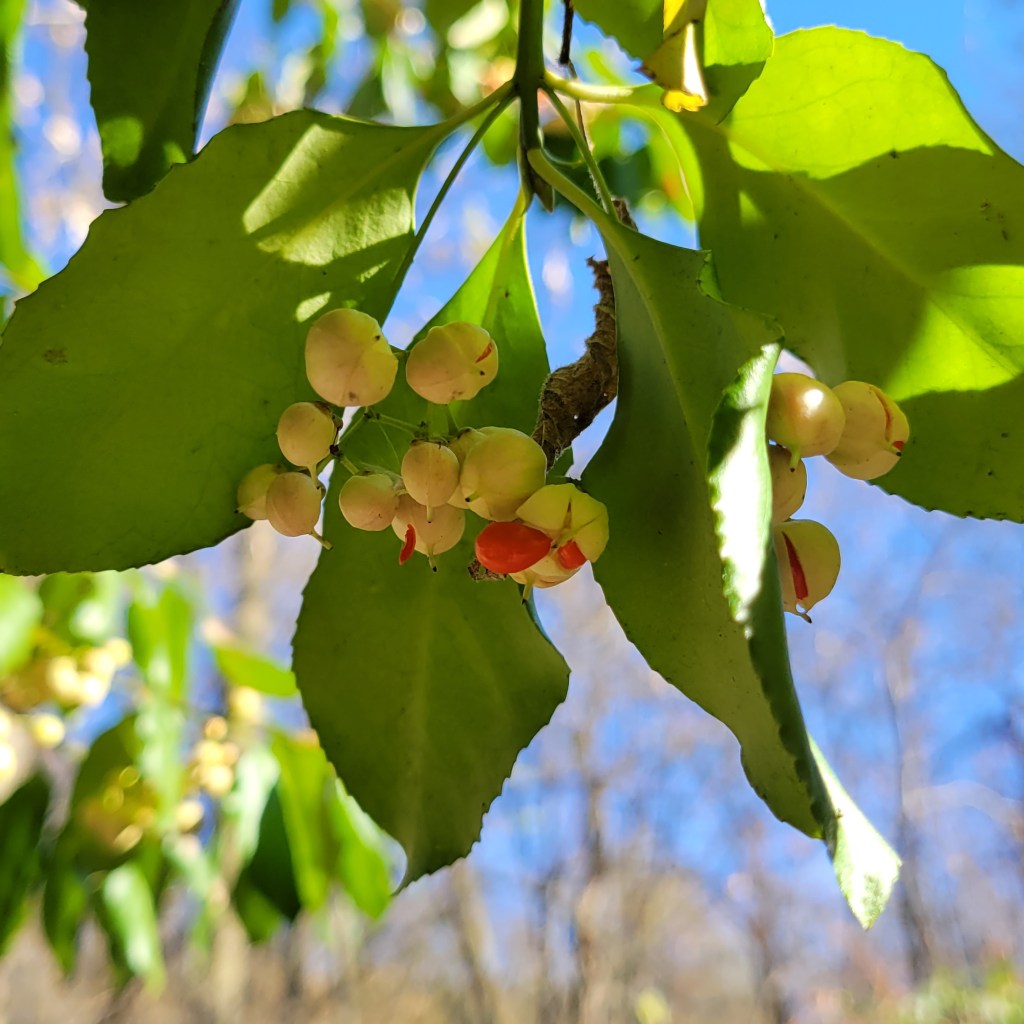
Winter Creeper This is the only evergreen vine in the park (as far as I know). There are a number of them climbing trees in one part of the woods near the river. I have seen them nowhere else.
Winter Creeper ripens later in the fall, and the berries often hang on into the winter (the probable reason for the name).

Winter Creeper in early December Having made the September vine rounds for many years, I know where to walk to find each species, to see some long-time acquaintances and some newer ones.
And I remain alert to the possibility of finding additional perennial fall fruiting vines. Nature is cyclical, but there is always something new for us to discover or learn.
-
Monarch Caterpillars in September: Not Quite Ready to Migrate
Leonard Weber
September 11, 2023
There are many Common Milkweed plants in Eliza Howell Park, in various locations, and I sought out a significant number of them on my most recent walks in the park.
By the second week in September, the seedpods have developed but are not yet open for dispersal of seeds. Many of the leaves are yellowing.

September is the month when most of the Monarch butterflies that we see in Michigan leave on their migration to Mexico, flying something like 50 – 100 miles a day, for a total of about 2000 miles.
I suspect that many of us, if undertaking a journey like that, would want to be ready ahead of time and get an early start. But it is not unusual to find Monarchs still in the caterpillar stage, eating milkweed leaves, in the second week of September. They have not even begun the final stage of metamorphosis.
On September 10 and 11 this year, I saw several caterpillars, each appearing to be nearly full size.

Caterpillar 1 When I see Monarch caterpillars this late in the season, I wonder whether they might be late for migration. Many Monarchs are already migrating through this area, but most typically leave Michigan on their migration to Mexico in middle or late September, according to published reports. These Eliza Howell individuals will have to spend appropriately 10 – 14 days in the chrysalis stage before they can even fly for the very first time.

Caterpillars 2 and 3 These new adults that migrate south in the fall have a much longer lifespan than their summertime parents, who only lived a few weeks. These, if all goes well, will make it to Mexico, spend the winter there, and start back before they stop in the southern U.S. in early spring to breed (and then die).
Just as they somehow know the way to the wintering grounds without having been there previously, some of the next generation will find their way here next May, never having been here before. And some of the same milkweeds, being perennials, will be here to host them.

Caterpillar 4 
Caterpillar 5 There is still time, but if they succeed in emerging from the chrysalis as adults, they will not have much time to drink nectar and try their new wings before undertaking that enormous migration feat.

A Monarch chrysalis I have known about Monarch migration for a very long time, but as I watch these caterpillars eating milkweed leaves in September, I find myself again totally fascinated by nature’s wondrous ways.
-
Milkweed Tussock Moth: Another Milkweed Caterpillar
Leonard Weber
August 28, 2023
It is widely known that milkweed leaves are eaten by the Monarch butterfly caterpillar. What is not so well-known is that another colorful caterpillar also feeds on the leaves of the Common Milkweed.
August is a good time to seek an introduction to the Milkweed Tussock Moth caterpillar.

Milkweed Tussock Moth caterpillar on Common Milkweed leaf There are many milkweed plants in Eliza Howell Park and I often check a few to look for insect activity. One of the insects I am hoping to see is the Monarch caterpillar.

Monarch caterpillar Earlier in August this year, I noticed that some of the milkweed leaves on one plant had been partially eaten. When I looked underneath one leaf, I found dozens of caterpillars — Milkweed Tussock Moths.

Young Milkweed Tussock Moth caterpillars They were very tiny, magnified in the next photo for a better look.

They are eager eaters, but they carefully avoid eating the leaf veins, apparently so that they do not get too much of the latex-like sap.

The caterpillars go through several stages of growth. When I next saw them, recently, they were much larger, very different looking, and feeding one or two at a time on nearby milkweeds. They were now eating the smaller leaf veins.
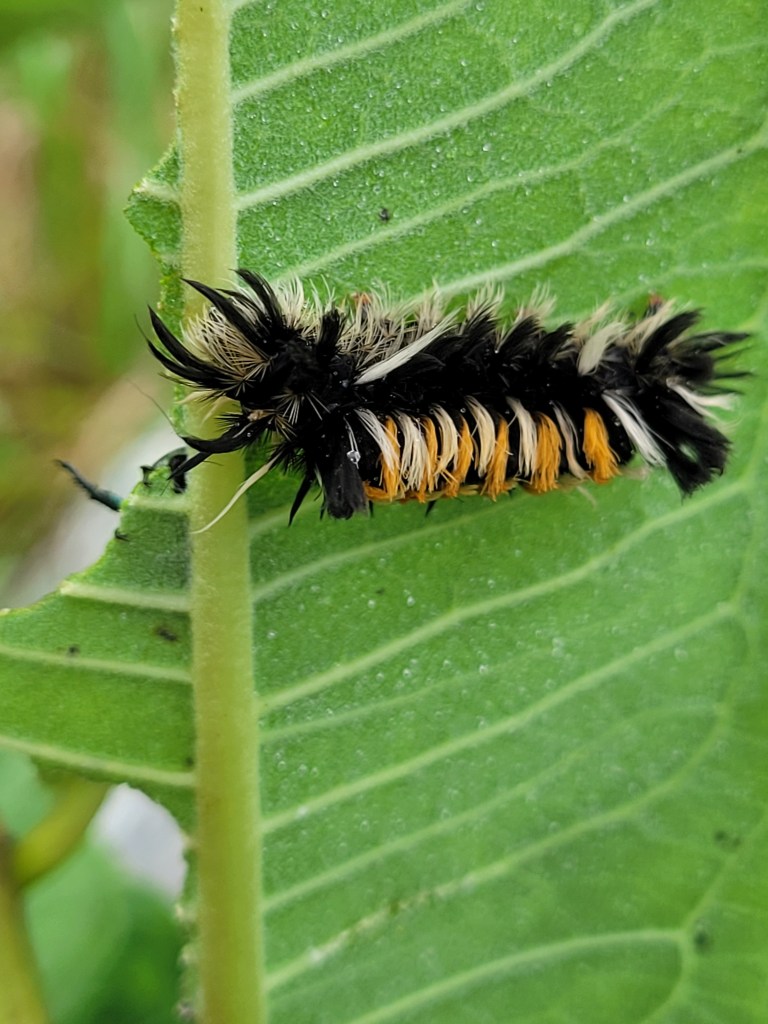
The Milkweed Tussock Moth is sometimes called Milkweed Tiger Moth because of the coloring. Like the Monarch caterpillar, it acquires some toxicity from the milkweeds, and (some? most?) predators have learned not to eat it.
When it reaches full size, the caterpillar goes into a cocoon, where it spends the winter, emerging as an adult in the spring.
The adult moth is mostly gray-brown, much less colorful. It is active primarily at night and I have no photos of it to include here. It is the caterpillar, not the adult moth, that is memorable.
This August I have been enjoying getting to know the Milkweed Tussock Moth caterpillar much better.


When I check milkweed leaves for caterpillars now, I am no longer thinking exclusively of Monarchs.
-
Goldenrod Soldier Beetle: Abundant in August
Leonard Weber
August 20, 2023
While insect watching in the Eliza Howell Park wildflower field recently, I have been impressed by the presence of a large number of Goldenrod Soldier Beetles.
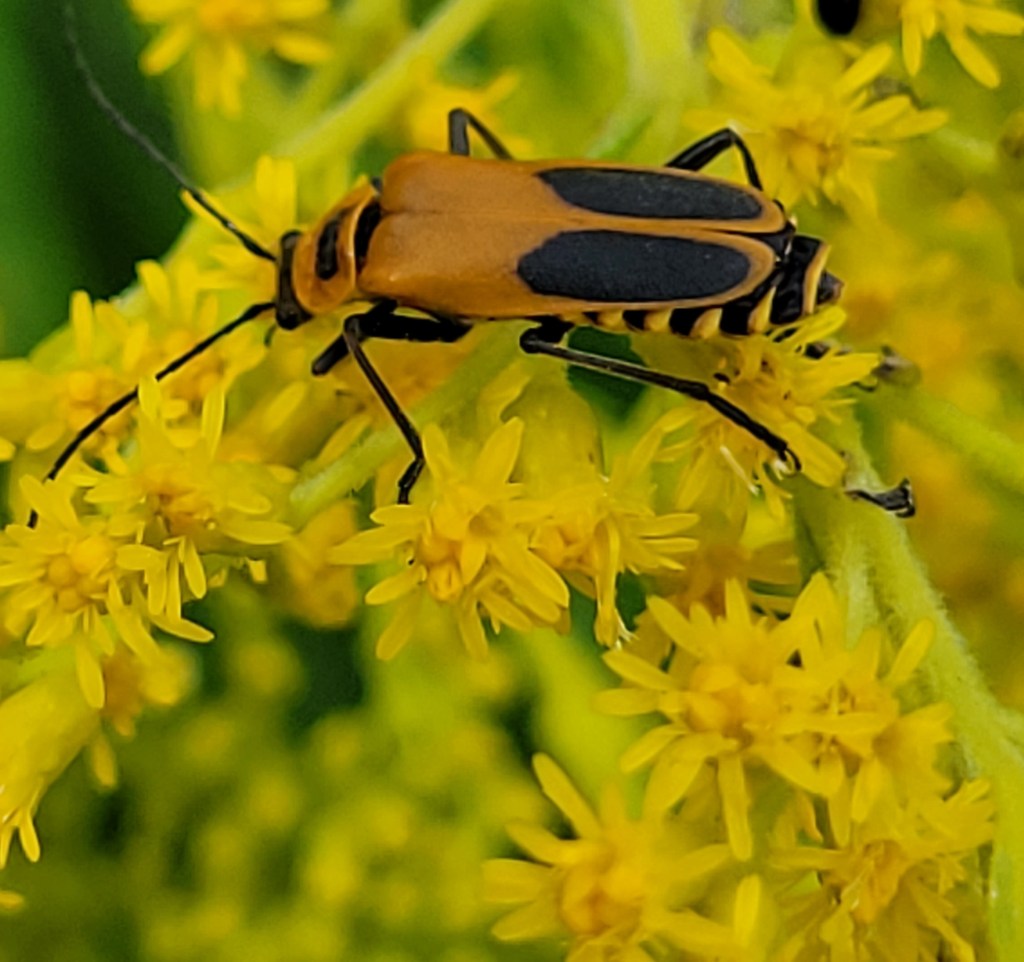
On Goldenrod Given the name of the beetle, it is no surprise to find them nectaring on the goldenrods that are just starting to bloom.
What the name does not suggest, however, is that the beetle is also attracted to a wide variety of other flowers.
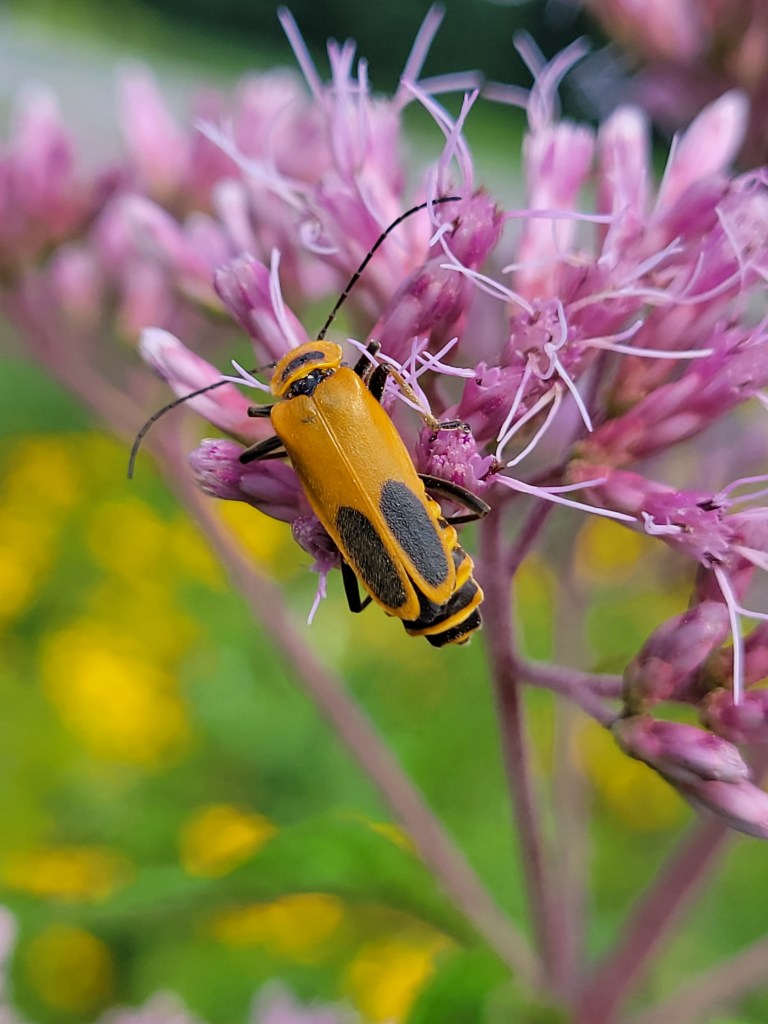
On Joe Pye Weed 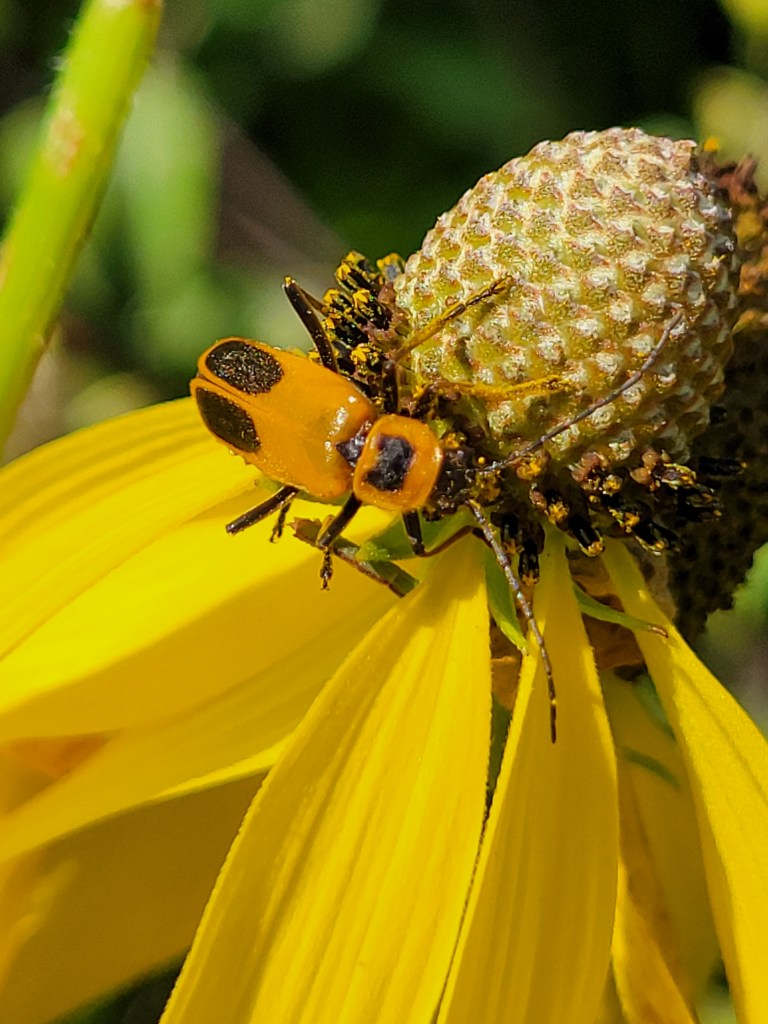
On Yellow Coneflower 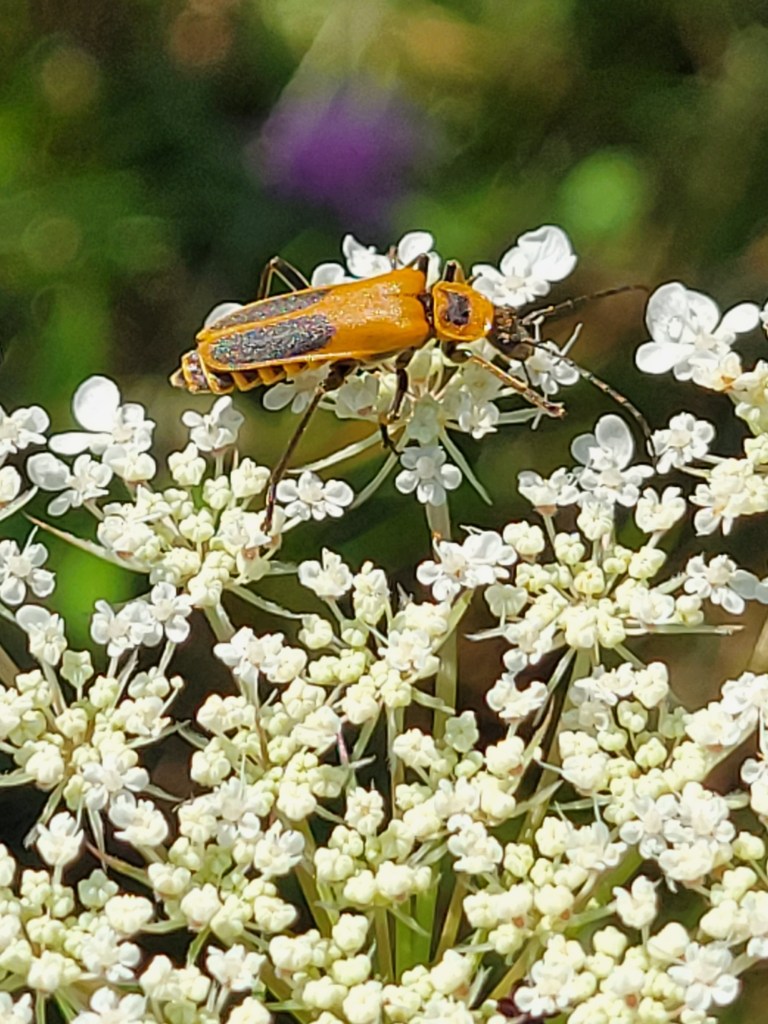
On Queen Anne’s Lace 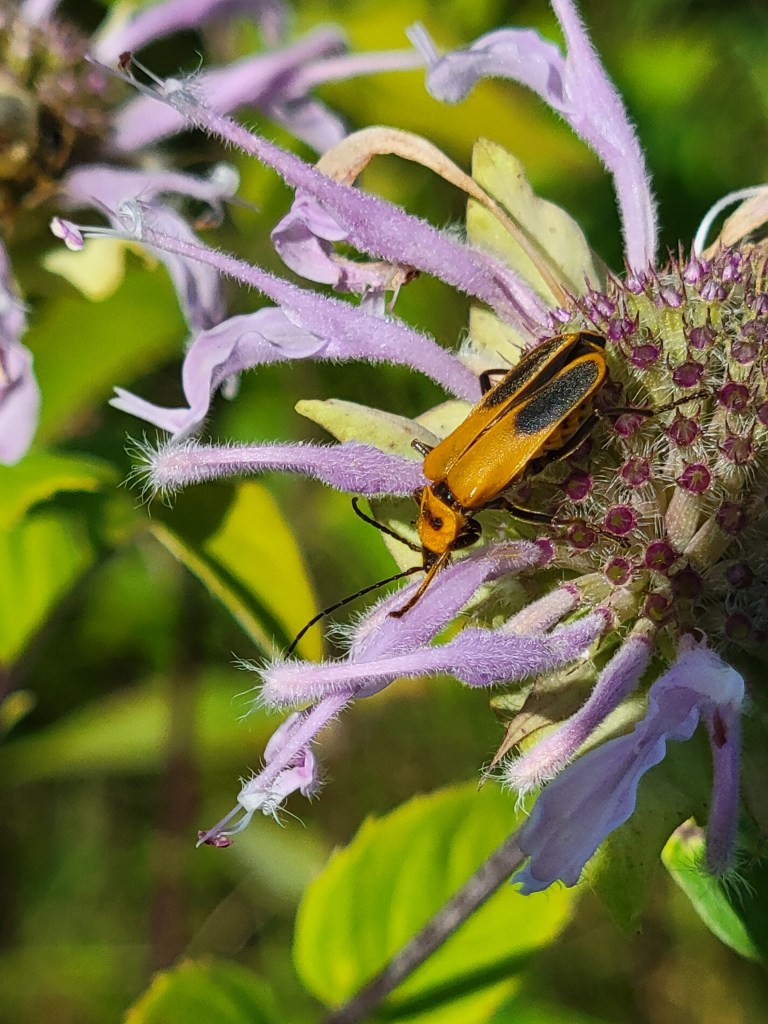
On Wild Bergamot The Goldenrod Soldier Beetle, sometimes called Pennsylvania Leatherwing, is one of the most common soldier beetles in the Midwest. “Soldier beetles” are called that because their colored wing covers suggested to someone military uniforms worn in the past.
The beetle is about 1/2 inch long, and adults are visible here from late July till September, peaking in August. Right now, they are abundant.
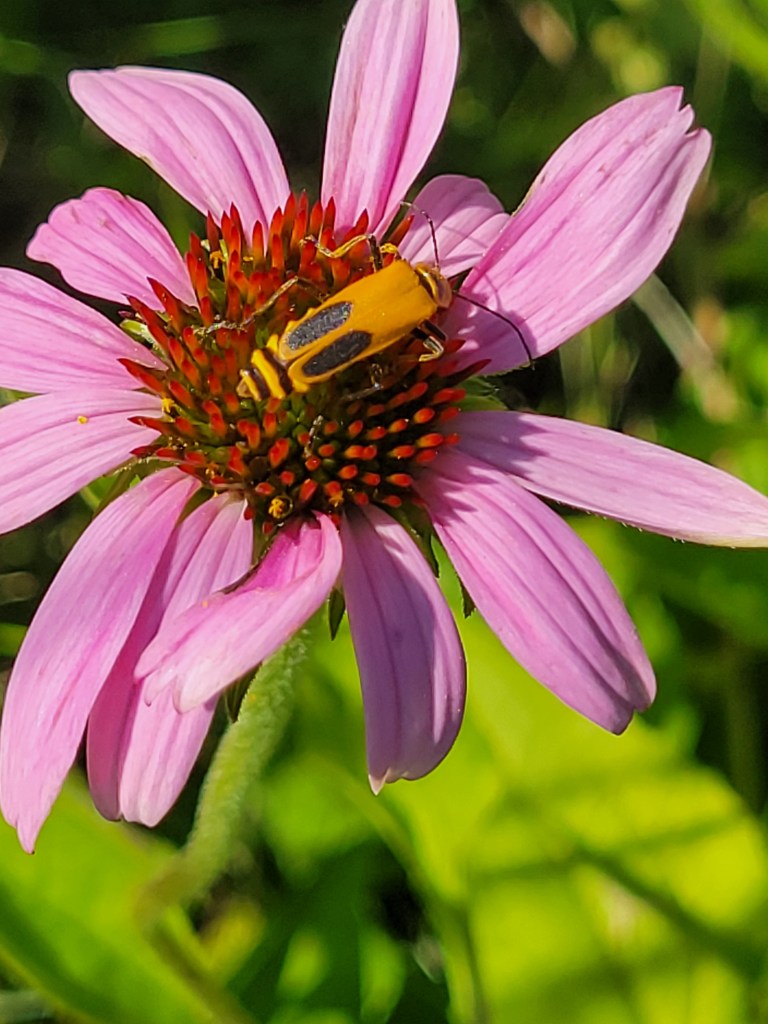
On Purple Coneflower 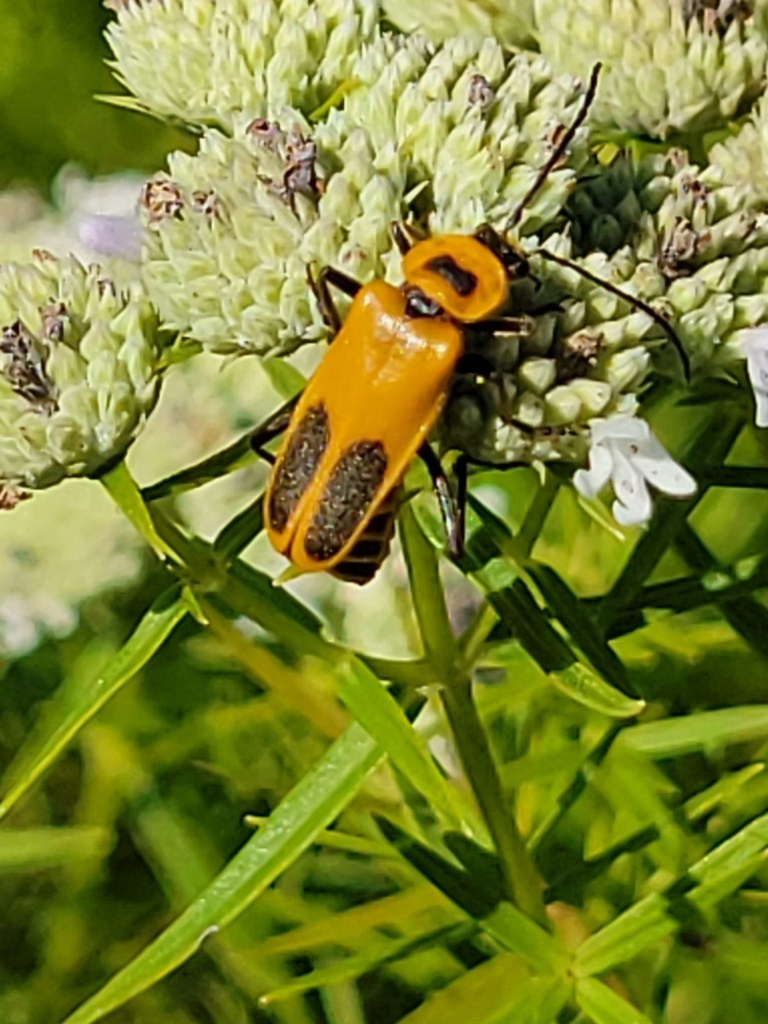
On Mountain Mint 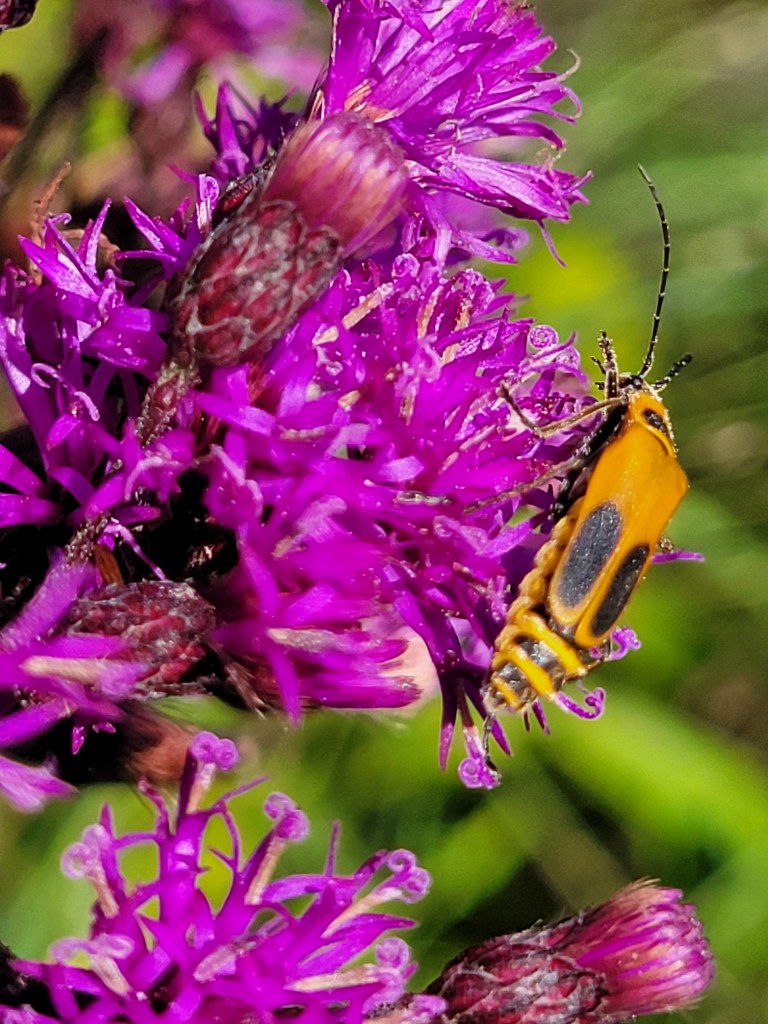
On Ironweed There is only one generation a year. It is not unusual to spot a mating pair at this time. The young will spend the winter in the larvae stage, completing development to adults by next July.
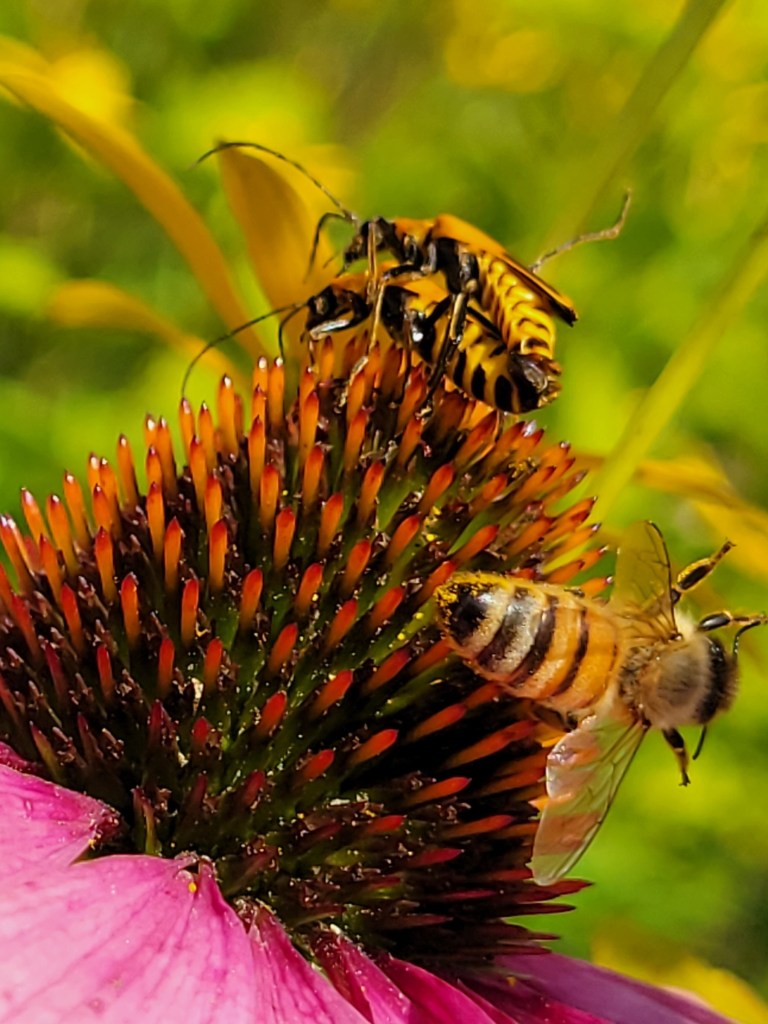
Mating pair on Purple Coneflower Because they are sometimes found together, I tend to associate Goldenrod Soldier Beetle with another colorful late summer insect that likes goldenrod, the Ailanthus Webworm Moth.
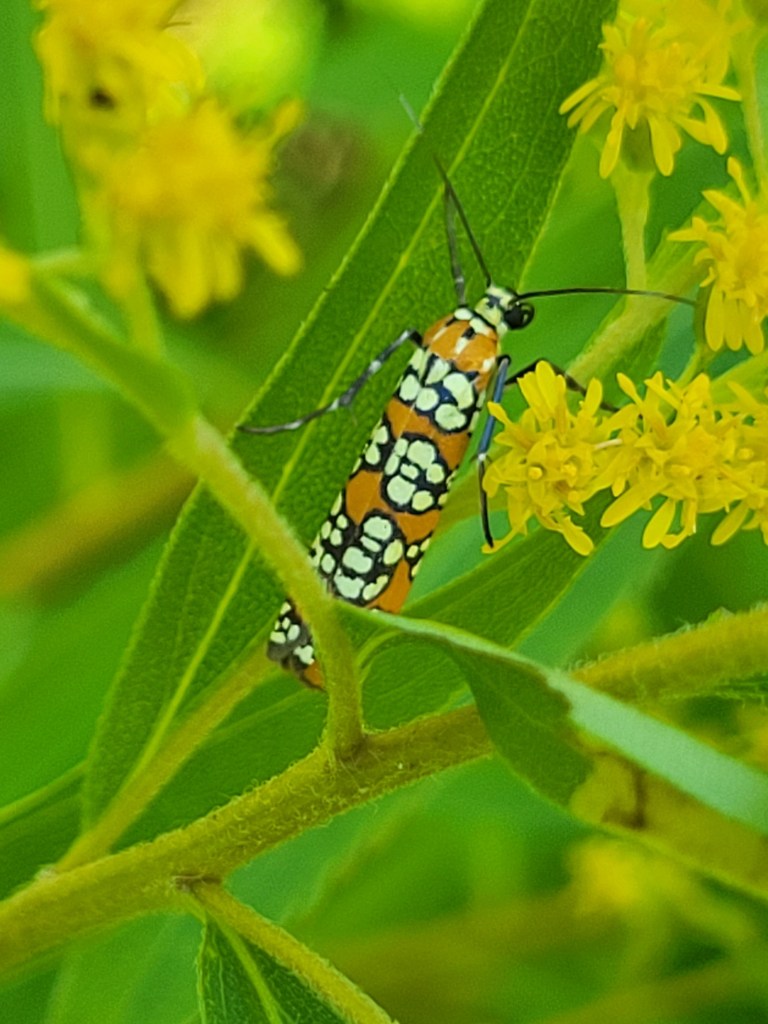
Ailanthus Webworm Moth on Goldenrod There are many markers of each stage of nature’s annual cycle. One that signals the coming transition from summer to fall is the abundance of Goldenrod Soldier Beetles. It is happening now.
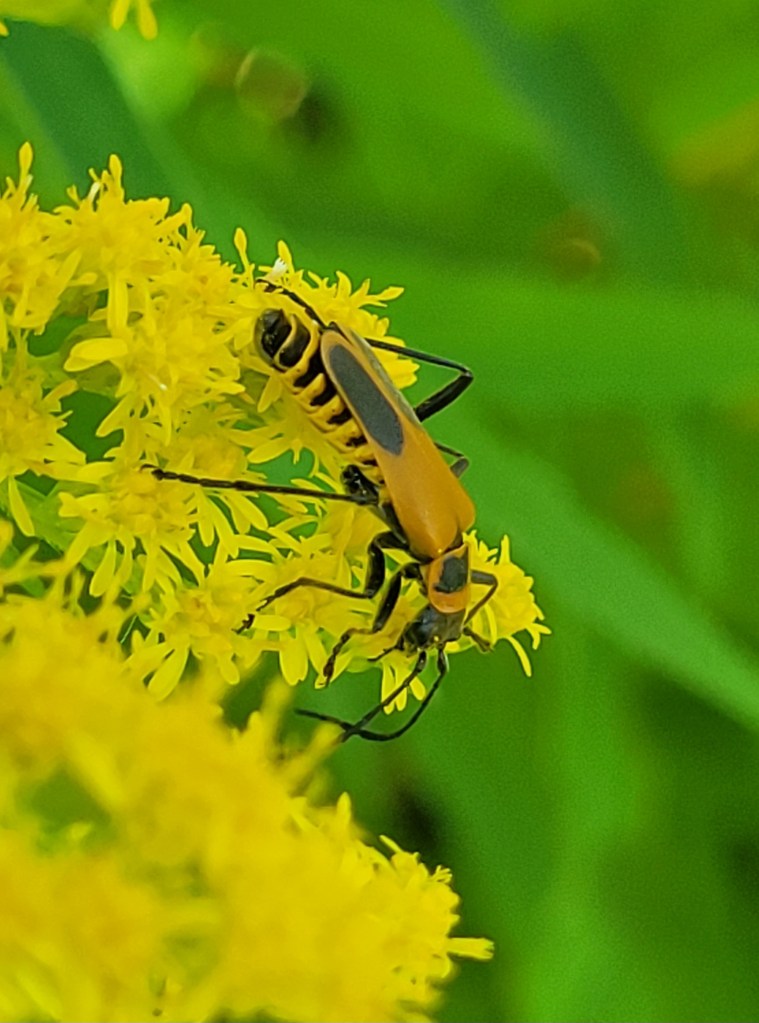
On Goldenrod -
Dogbane Leaf Beetle: An Introduction
Leonard Weber
August 14, 2023
As is often the case with insects, the first time I saw a Dogbane Leaf Beetle, I didn’t immediately know what it was. After identifying it, I followed up with a little research.
Today, I went looking for the beetle in Eliza Howell Park and was pleased to find three after about 10 minutes.

Dogbane Leaf Beetle on Hemp Dogbane I knew where to look for the beetle because of its relationship with Hemp Dogbane. Hemp Dogbane is a host plant for the beetle: adult, eggs, and larvae. The plant grows about 3 – 4 feet high and there are several patches of it in the park. Right now, it is mostly finished flowering and starting to produce hanging, beanlike seed.
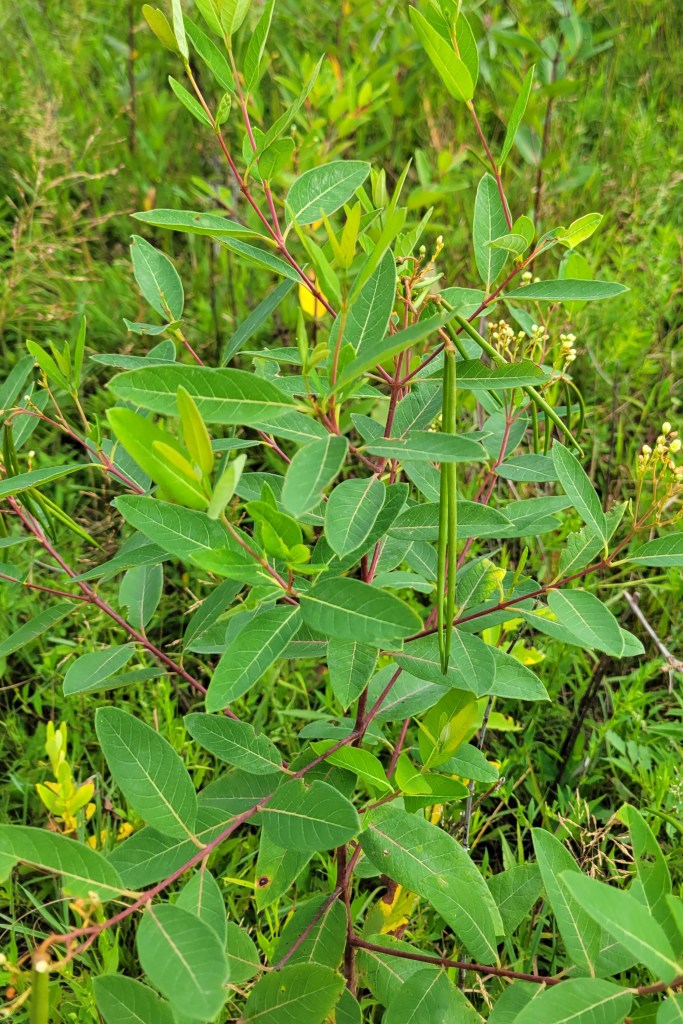
Hemp Dogbane plant Though the beetle is only about 1 centimeter long, its flashy iridescent colors make it quite visible. It feeds on dogbane leaves, a plant in the same family as milkweed, and the beetle acquires a toxicity similar to that of Monarch butterflies.
Its bright visibility might be nature’s way of advertising the beetle’s toxicity to potential predators.
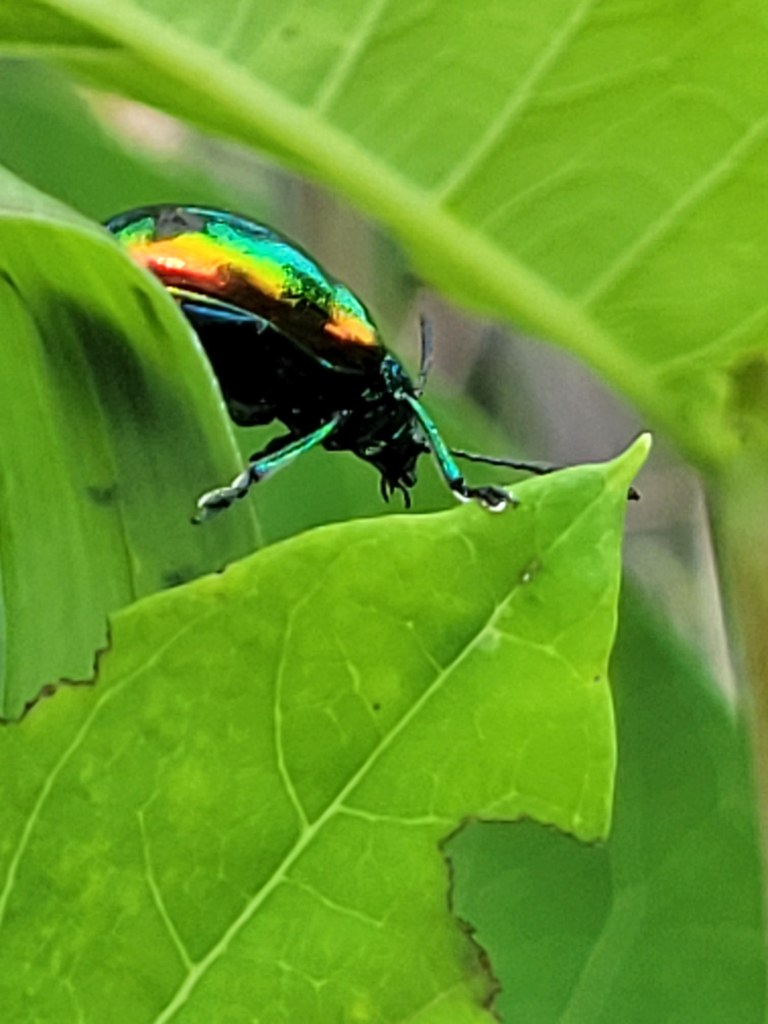
(EvenThe legs are green The larvae spend the winter underground anong the dogbane roots, and the new adults emerge from the pupa stage in the spring. They can be found on or around the dogbane plants during the summer.
Since the iridescent colors look different from different angles, it is tempting to take photo after photo after photo.

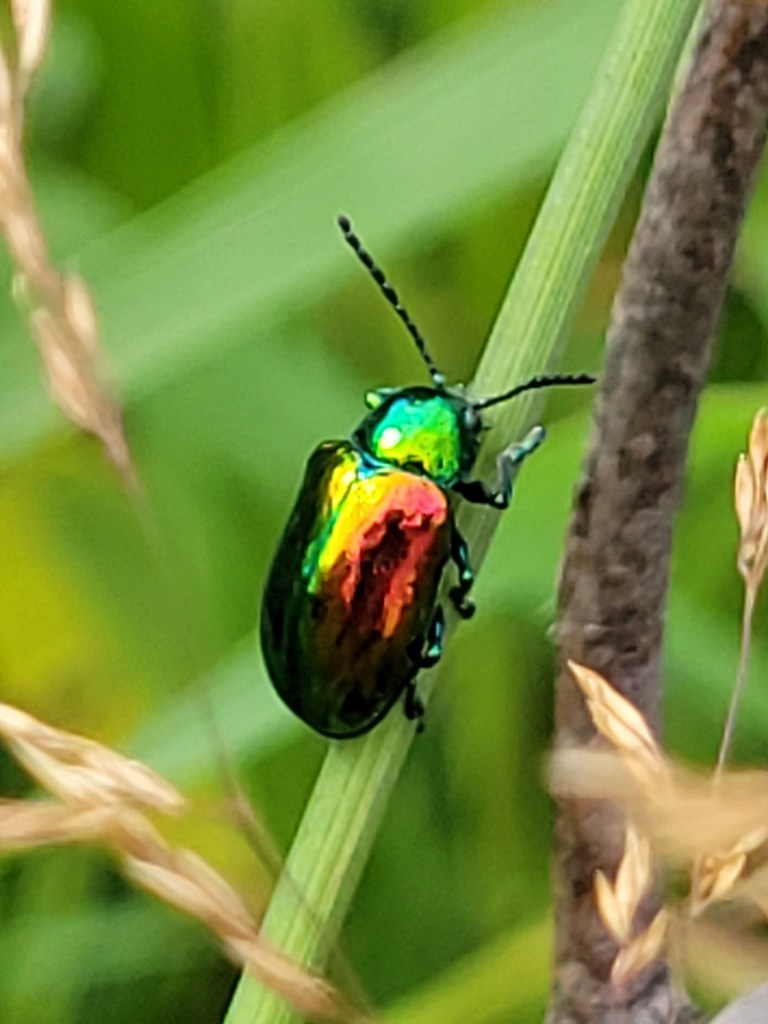
Hemp Dogbane is called “hemp” because its fibers have historically been used to make rope. It is called “dogbane” because it is toxic to dogs (and other mammals). The seedpods hang on late into the fall, and the seeds are dispersed by wind when they open, similar to milkweed seeds.
Dogbane also spreads by underground rhizomes, the reason many plants are frequently found in close proximity.

Part of a Hemp Dogbane “thicket“ One commonly seen shiny beetle in southeast Michigan is the Japanese Beetle, and, on first glance, someone might think “Japanese Beetle” when seeing Dogbane Beetle for the first time. A comparison makes the differences clear.
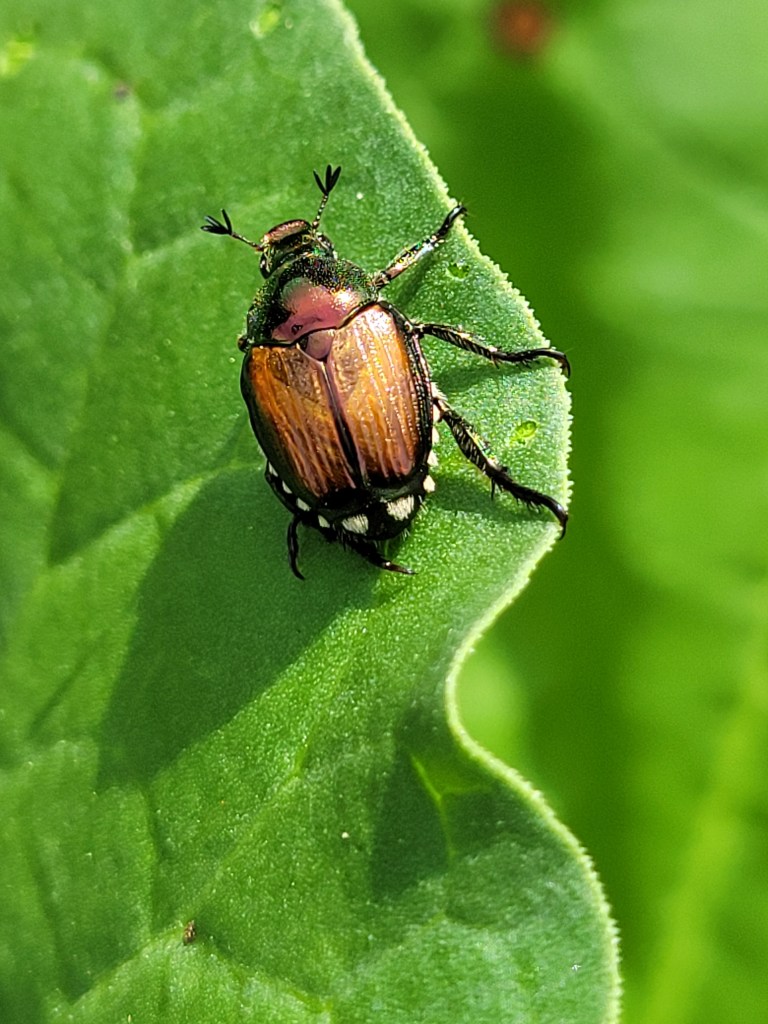
Japanese Beetle 
Dogbane Leaf Beetle Given its striking appearance, combined with its close connection with the Dogbane plant, it is not easy for me to confuse this beetle with any other. I now count it among my favorite bugs!
-
Subscribe
Subscribed
Have a WordPress.com account? Log in now.

