-
Cutleaf Teasel: Getting Acquainted
Leonard Weber
August 6, 2024
Among the flowers beginning to bloom as July turned to August in Eliza Howell Park this year is one that I have not observed carefully in past years: Cutleaf Teasel.
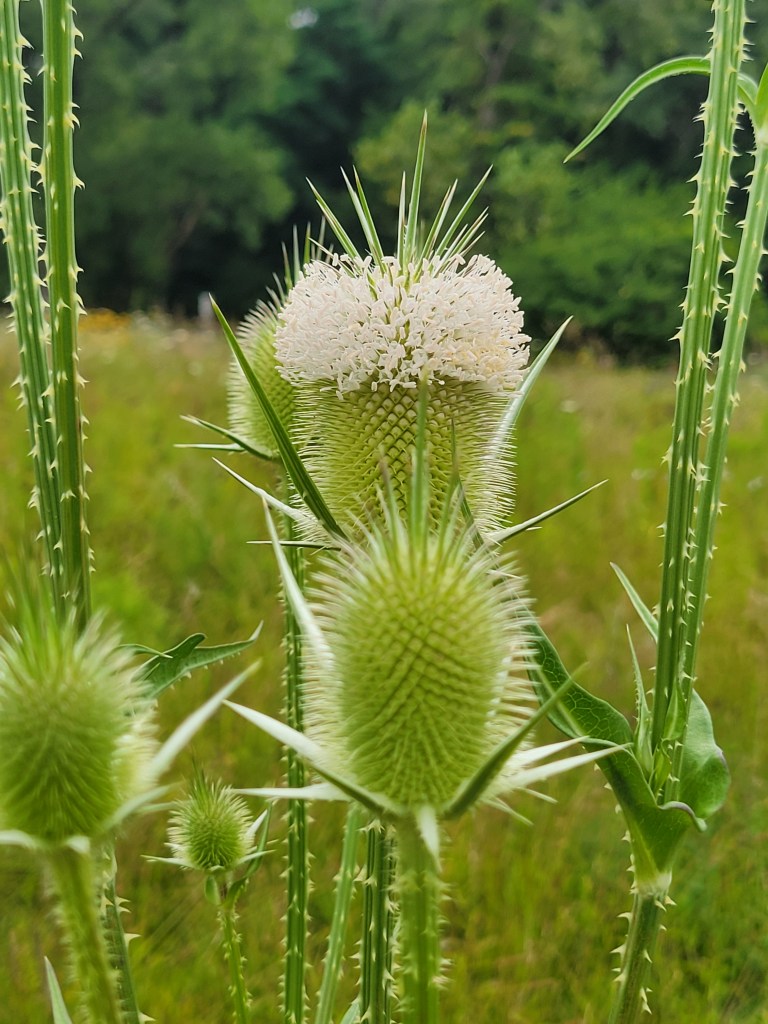
First flowers, July 29 There are, to my knowledge, only a very few of these plants in the park, located in one area within the road loop. Having spotted a couple Teasel plants earlier this year,
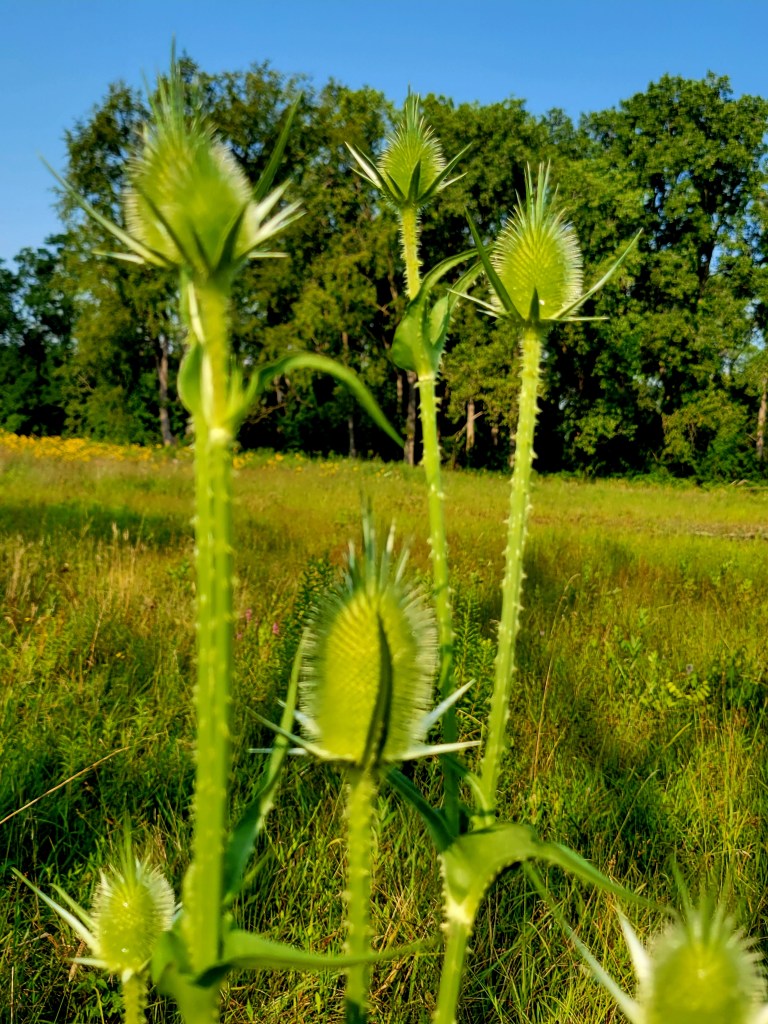
a colleague and I have been waiting for them to bloom.
When blooming began, the flower color was a little different from what I was expecting. Based on a little prior experience of Teasel elsewhere, I expected lavender to purple flowers, not white.
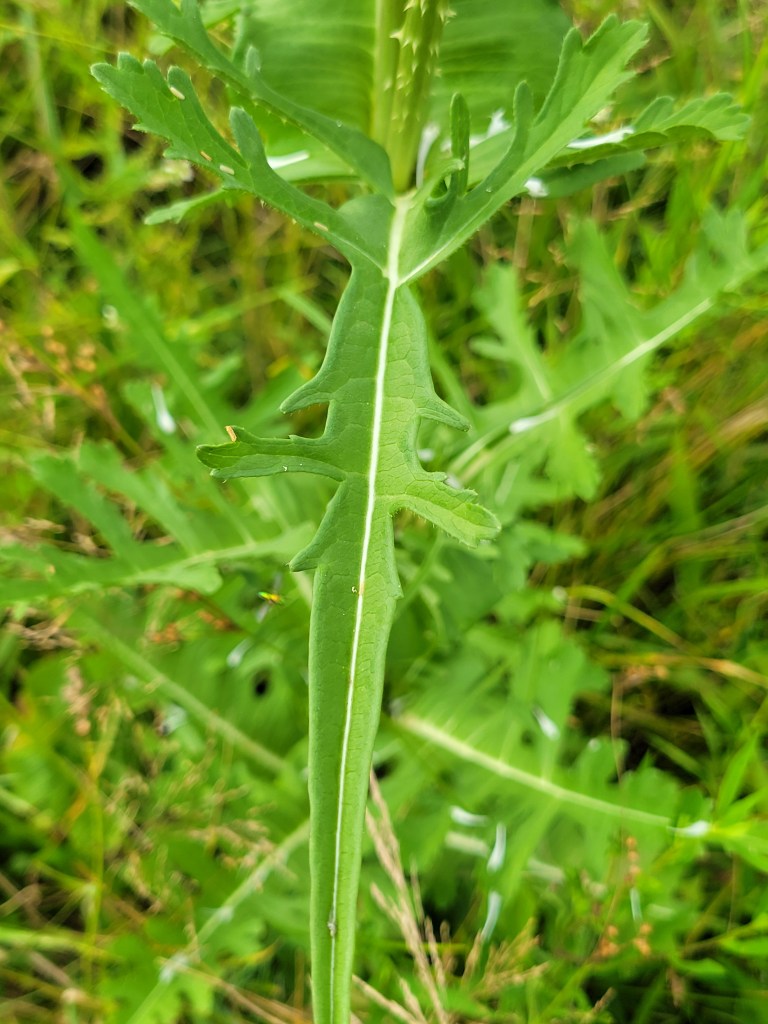
I now know that there are two species of Teasel, Common Teasel and Cutleaf Teasel. The one with white flowers is Cutleaf. As the name indicates, another difference is the fact that the leaves are lobed rather than entire.
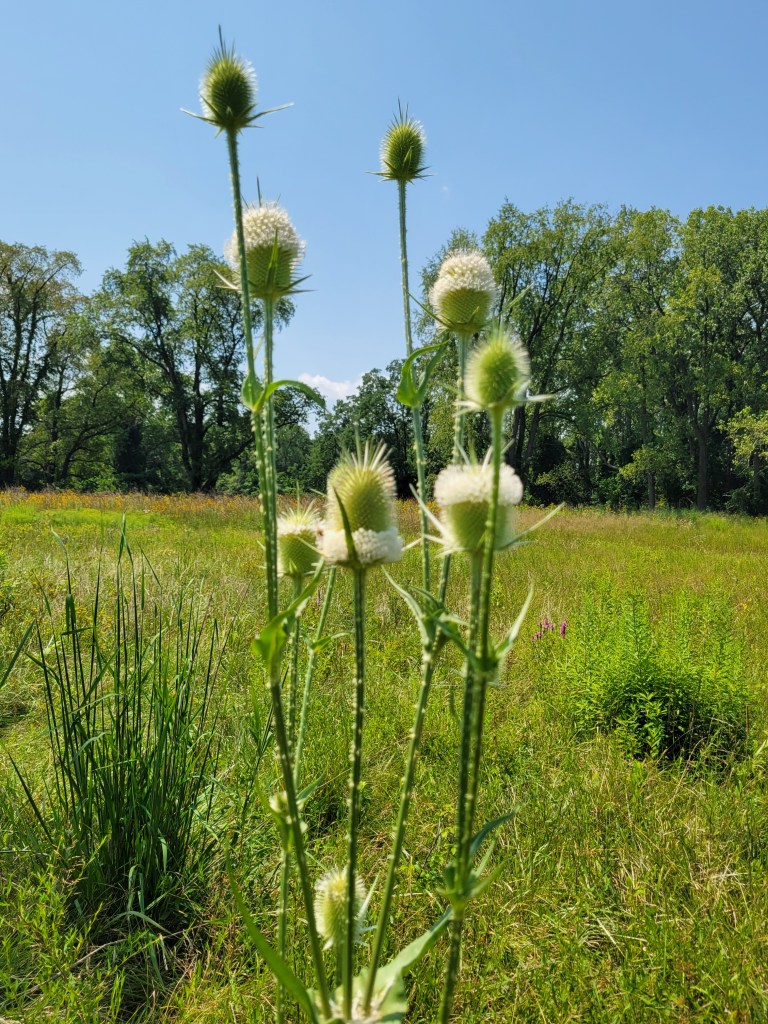
The flowerhead has many small individual flowers that each bloom for only one day. Each day, a different part of the cone-shaped flowerhead is white. The pattern observed is, for the most part, blooming first at the top of the cone and moving down.
The plant is also notable for its many prickles, similar to thistles.
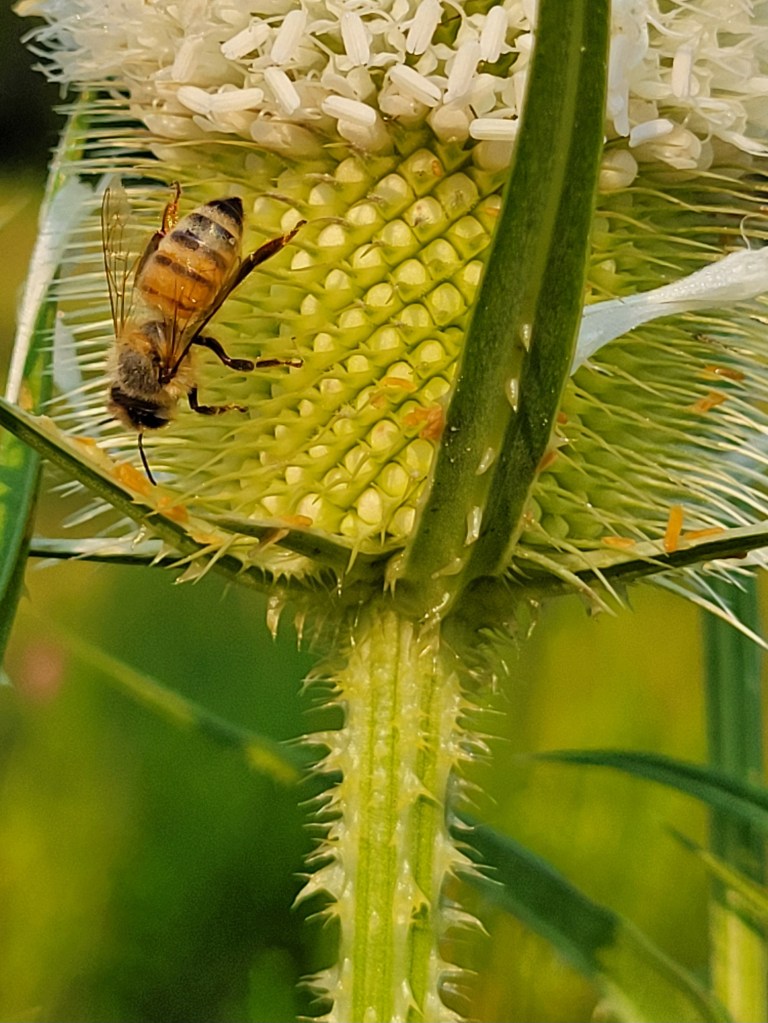
Honeybee and prickles In addition to bees, the flowers attract a variety of other insects.
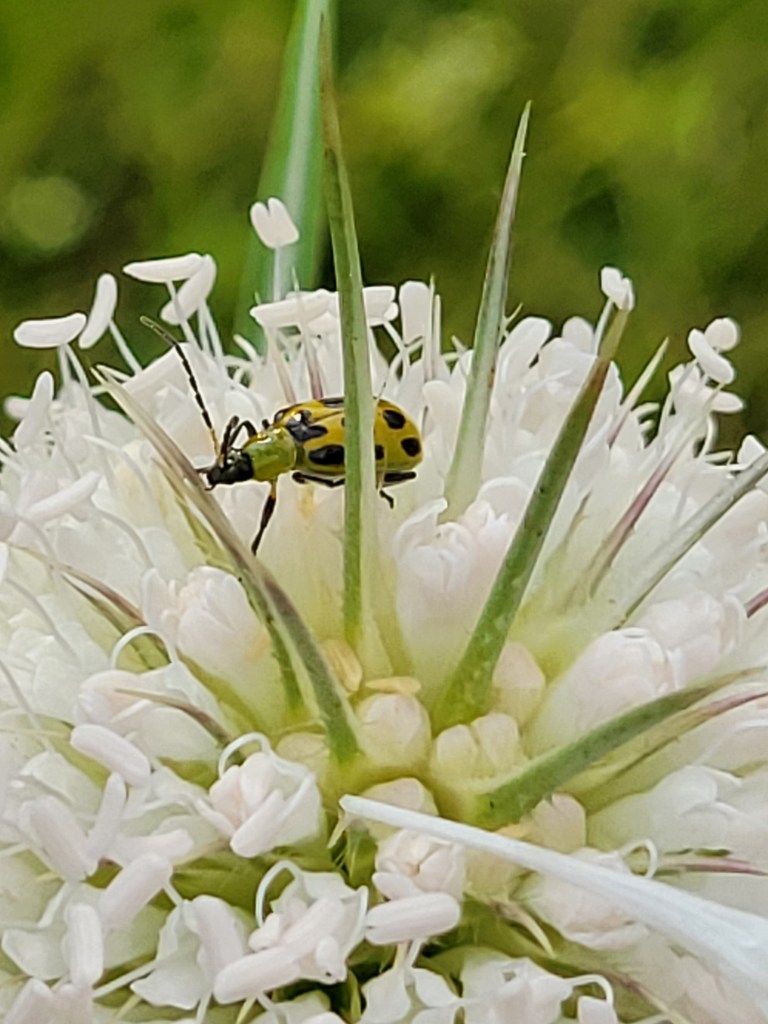
Spotted Cucumber Beetle 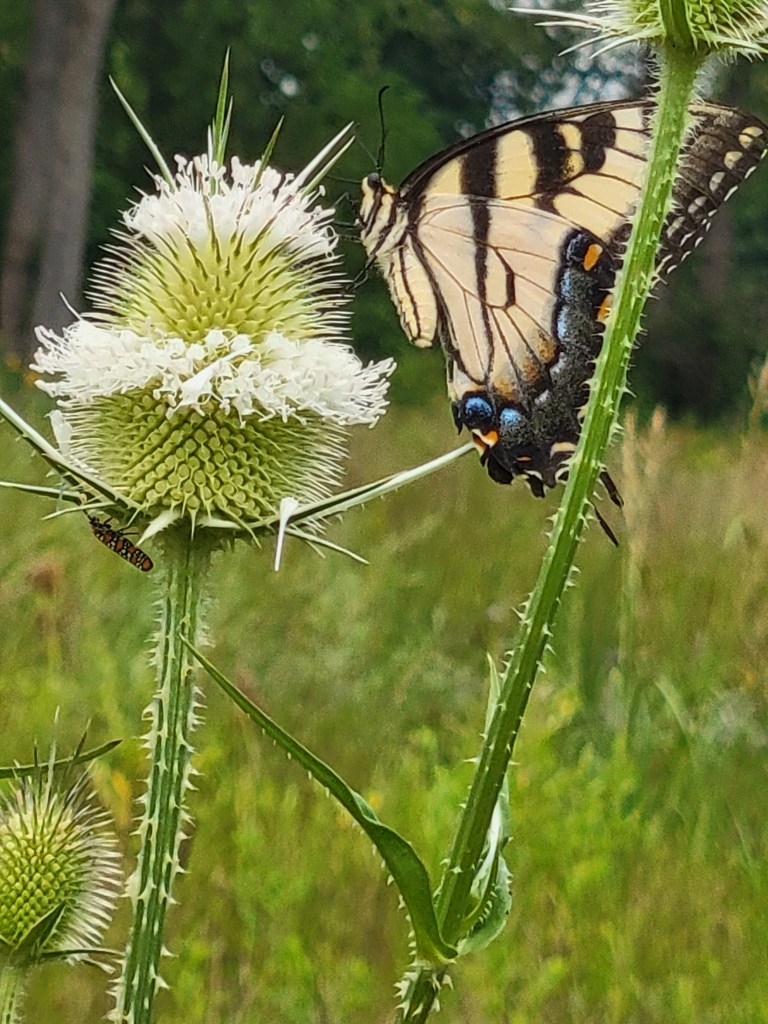
Estern Tiger Swallowtail 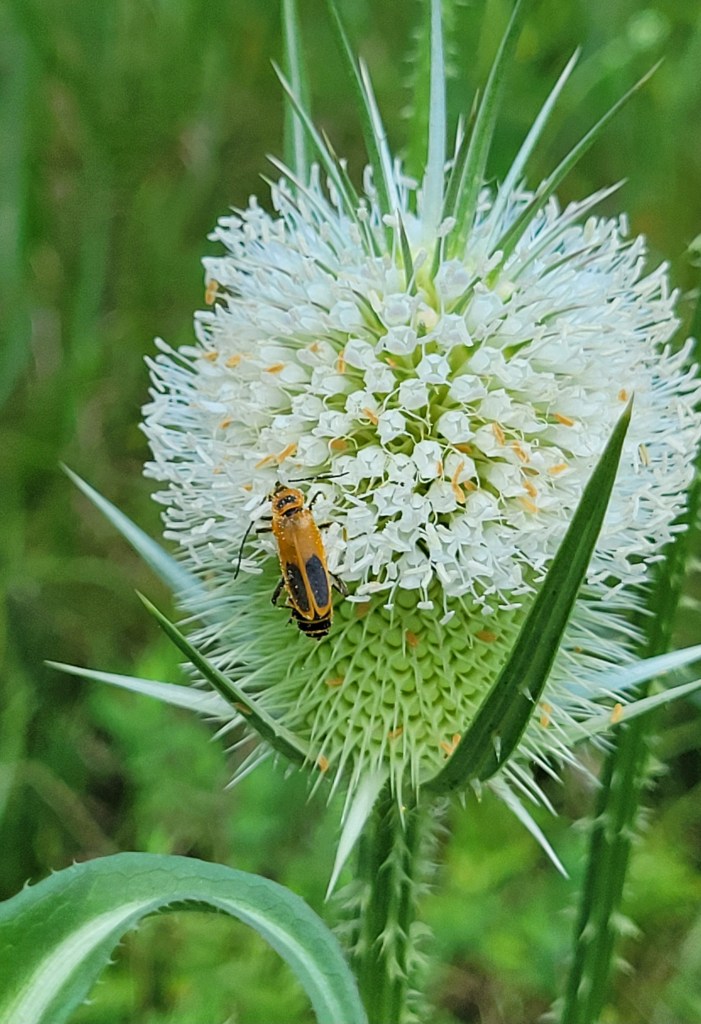
Goldenrod Soldier Beetle 
Ailanthus Webworm Moth Another fascinating characteristic of Teasel (both species) is that the opposite leaves are joined at the stem, forming a cup that holds rain water. Some published reports refer to Teasel as semi-carnivorous because the plant appears to use nutrients from decaying bodies of small insects trapped in the cups.
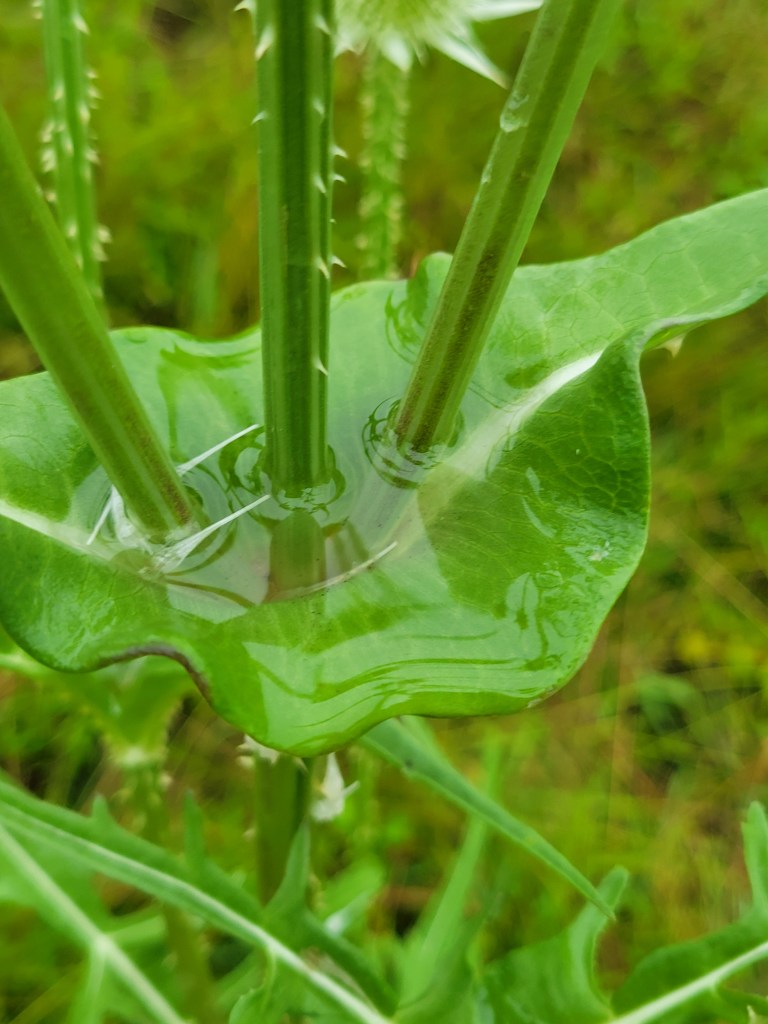
Cup with rain water Teasel is not native to North America; it was introduced as early as 1700 for horticultural reasons. Historically, the spiny dried seedheads were used for hand carding of wool (untangling and aligning wool fibers).
In some locations, Teasel is now considered an invasive species, a commentary on the human practice of moving plants from one environment to another, not a commentary on the plant itself.
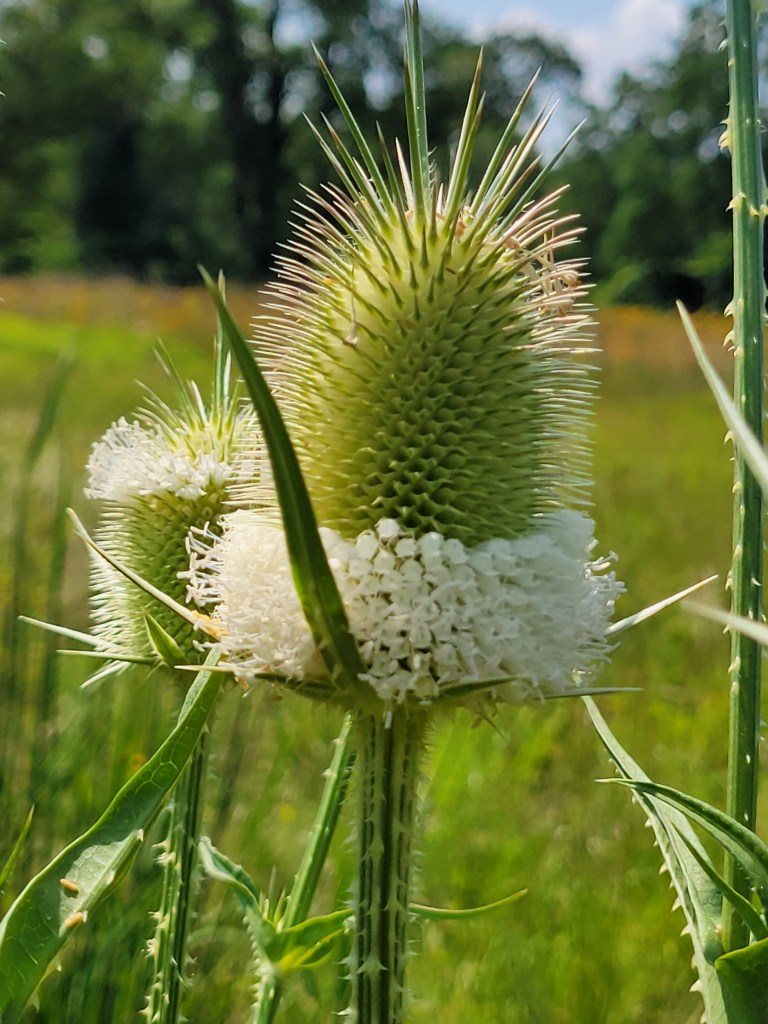
I have not previously followed Teasel from flowering through seed growth and dispersal. I am looking forward to the opportunity to do so this year.
-
Butterfly of the Year 2024: The Nominees
Leonard Weber
August 1, 2024
If we were to name an “Eliza Howell Park Butterfly of the Year” for 2024, the winner would be one that:
a) is being seen frequently in the park this year;
b) is attractive or striking enough in appearance that it catches our attention and invites a photograph.
The following 8 are worthy of consideration for the hypothetical award (the listed order is not intended to suggest likelihood to win).
1. Red Admiral
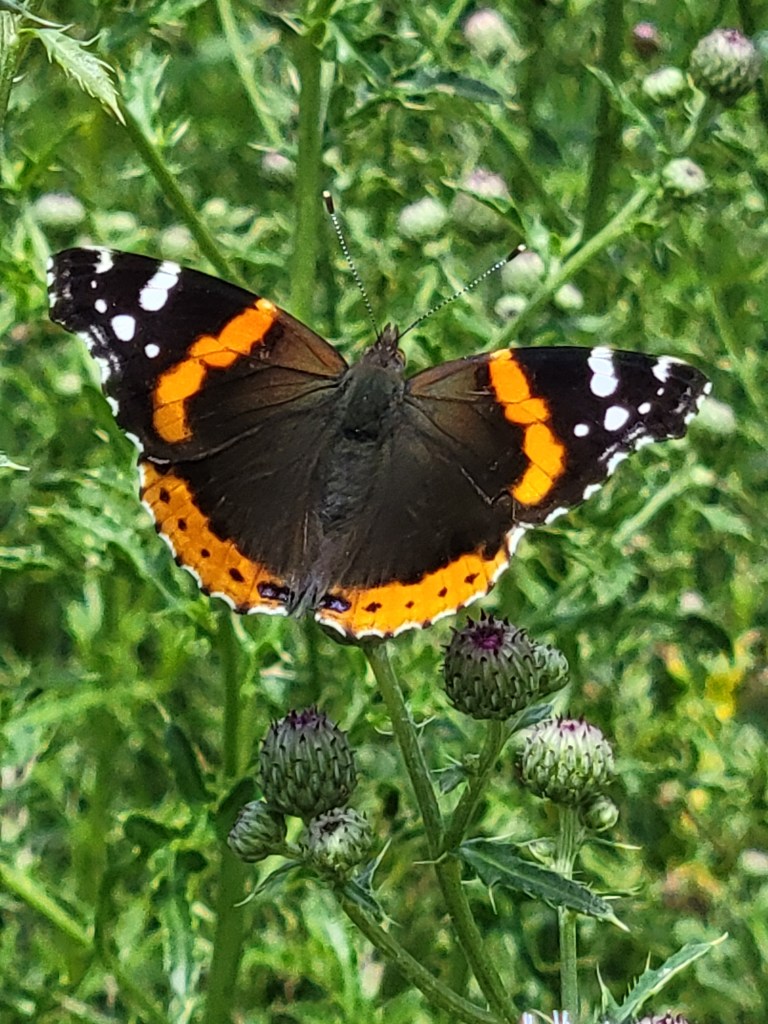
Red Admiral was unusually numerous this spring and has continued to be seen throughout the summer. This has definitely been a year for Eliza Howell nature walkers to get to know this species.
2. Common Buckeye.

Common Buckeye is usually a late summer uncommon presence in the park. This year, it arrived earlier and is being seen more frequently. It isn’t always easy to catch a good view of this fascinating insect, but its more frequent presence makes it considerably easier in 2024.
3. Silver-spotted Skipper.

Silver-spotted Skipper is perhaps the smallest butterfly on this list (but the largest skipper in the park). It is perennially common here and is seen during nearly every walk among the wildflowers.
4. Monarch.

Probably the best known of all butterflies in Michigan, the Monarch is frequently seen in Eliza Howell Park. This year is not significantly different from past years; it remains common and popular.
5. Question Mark.

Question Mark makes the list because of its increased numbers. It is not abundant but there seems to be a notable increase this year; the likelihood of seeing this species is considerably better than in previous years.
6. Hackberry Emperor

More often found on the paths than on flowers, Hachberry Emperor is another species that is much more common than usual this year. It is one of the few butterflies that will alight on us, the butterfly watchers.
7. Viceroy.

This year is a continuation of the last several years. Viceroy has become a regular presence in the park, so much so that butterfly watchers look twice, no longer just assuming that the orange and black butterfly is a Monarch.
8. Eatern Tiger Swallowtail.

This is the largest of the butterflies on the list and one of the most common. Because of its size and numbers, one is often able to spot a Tiger Swallowtail by looking out over a wildflower field. And, because it is a dedicated nectarer, it is also relatively easy to get close to one for a photo while it is sucking on a flower.
—-
One can generally expect to see the same butterflies in Eliza Howell Park year after year. Occasionally, something different shows up (always a highlight).
Almost as fascinating as finding different species is recognizing the way the presence of common species varies from one year to the next.
Perhaps by the time August is over, the Butterfly of the Year list will be narrowed to 2 or 3 (I doubt we will be able to select just one).
-
Ants Herding Aphids
Leonard Weber
July 22, 2024
A little more than a year ago, I wrote about watching “Red Aphids and Ladybugs” (July 16, 2023), having watched them on False Sunflower plants.
Today, I started watching another interaction between insects involving aphids. In this case, the aphids are Oleander Aphids, the other insects are ants, and the plant is Common Milkweed.

Common Milkweed,
with aphids visible at top centerOleander Aphid is sometimes called Milkweed Aphid. This far north, these aphids are not likely to find any oleander to feed on, but there is plenty of milkweed.
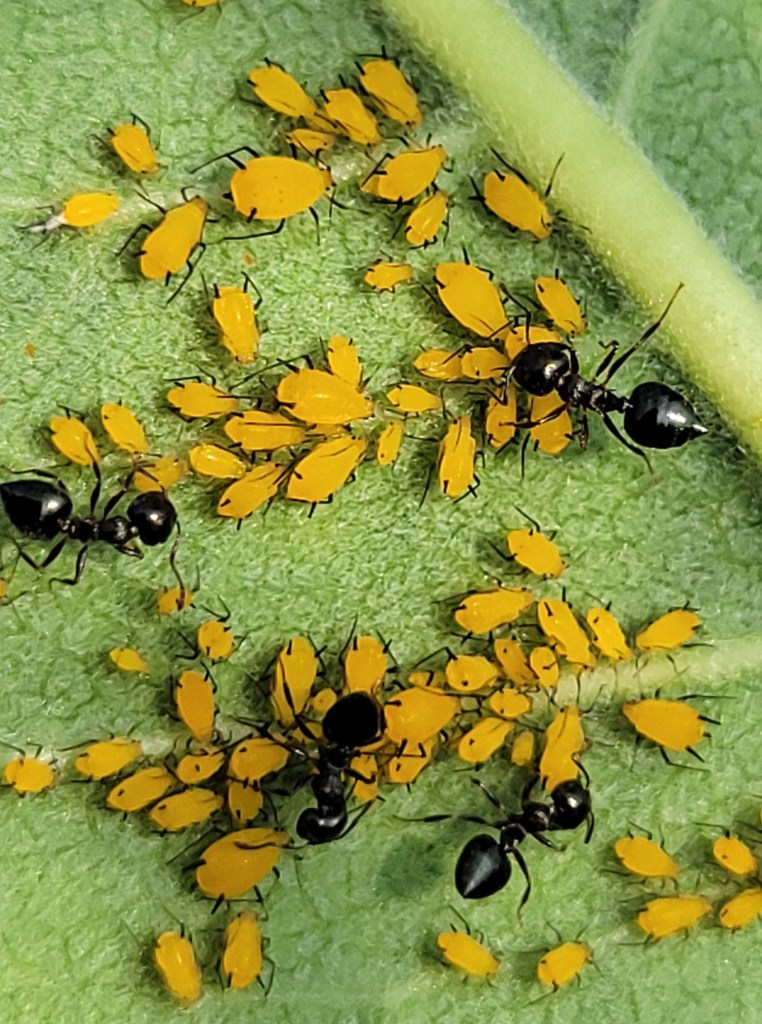
Aphids and ants
on underside of milkweed leafAphids suck the sap from plants, secreting a sweet liquidy waste called honeydew. Various insects, including some bees and ants, consume honeydew.
At some point in the past, some ants initiated a systematic approach to getting honeydew. They acquire a herd of aphids and “milk” them for the honeydew.

In published reports, the relationship of aphids and ants is often described as one in which both species benefit. The ants milk the aphids by taking the honeydew that is released when an aphid is tapped by an ant. The aphids benefit from the protection from potential predators provided by the ants.
I have been aware of this fascinating relationship for some time, but this is the first time I have observed aphid herding in Eliza Howell Park.

There is much that I do not yet know. I don’t even know whether they are likely to be on the same plant tomorrow.
I look forward to learning more, especially about the ways in which the aphids benefit.

Especially at this time of the year, a slow walk among the park’s abundant wildflowers, with frequent stops for taking close looks, sometimes leads to new experinces, to observations that deepen one’s appreciation of the natural wonders to be found in this urban park.
-
Yellow Coneflower: Summer in Full Bloom
Leonard Weber
July 17, 2024
Now, in the middle of July, there are thousands of Yellow Coneflowers blooming in Eliza Howell Park.
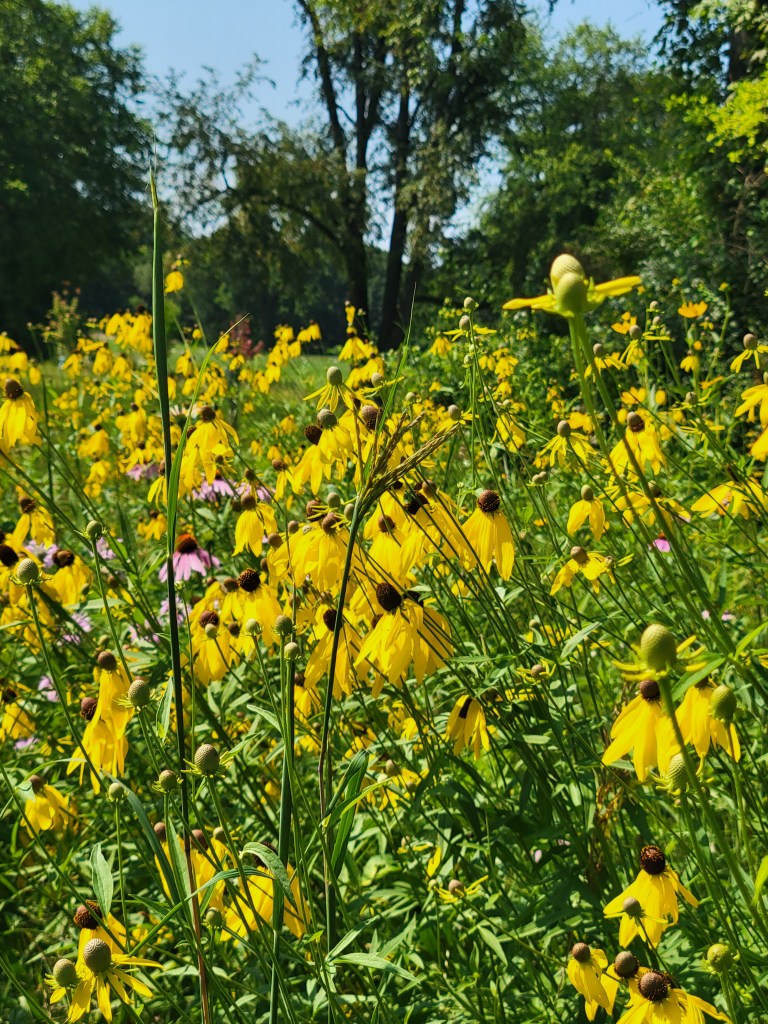
Yellow Coneflowers reach a height of about 4 feet. The flowers are characterized by droopy yellow ray florets surrounding a cone-like center disk.

The core disk, which can be up to 3/4 of an inch tall, changes color as it matures from a light green or gray to a dark brown.


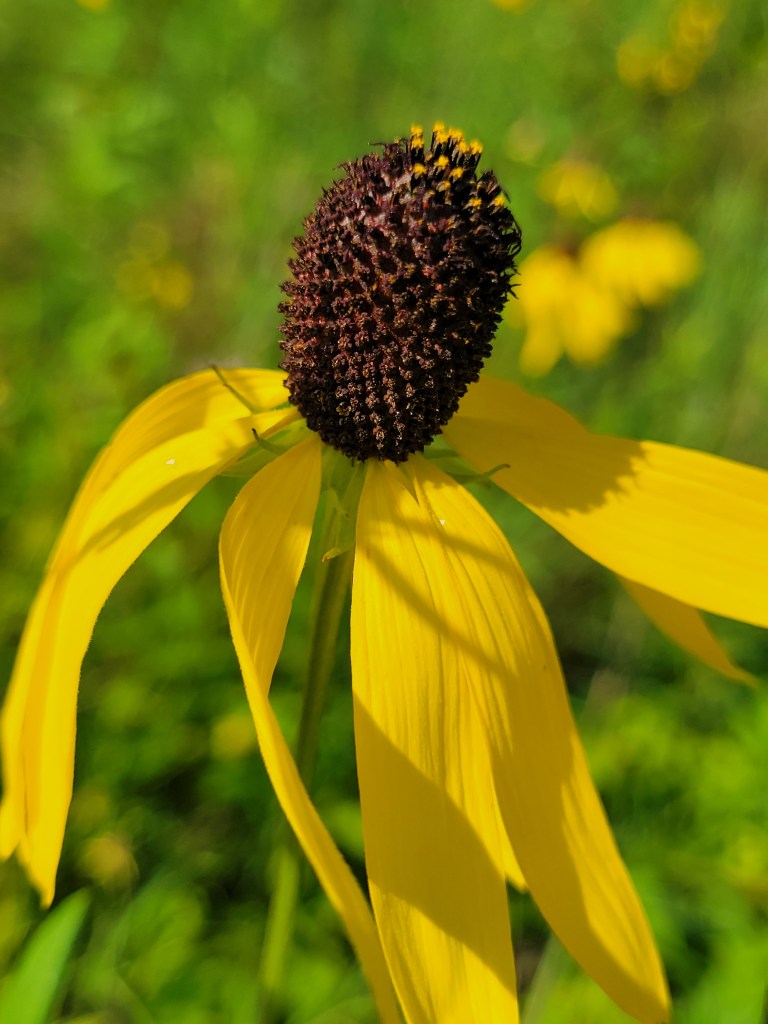
Each plant has several stems rising above the lower leaves and topped with a flower.

The plant, being a little top-heavy and kind of delicate, sways when the breeze blows.
Yellow Coneflowers attract a number of insects, but they are not the same kind of insect magnet as some other summer flowers, such as Wild Bergamot and Purple Coneflower. The larger butterflies clearly prefer Purple Coneflower to Yellow Coneflower.
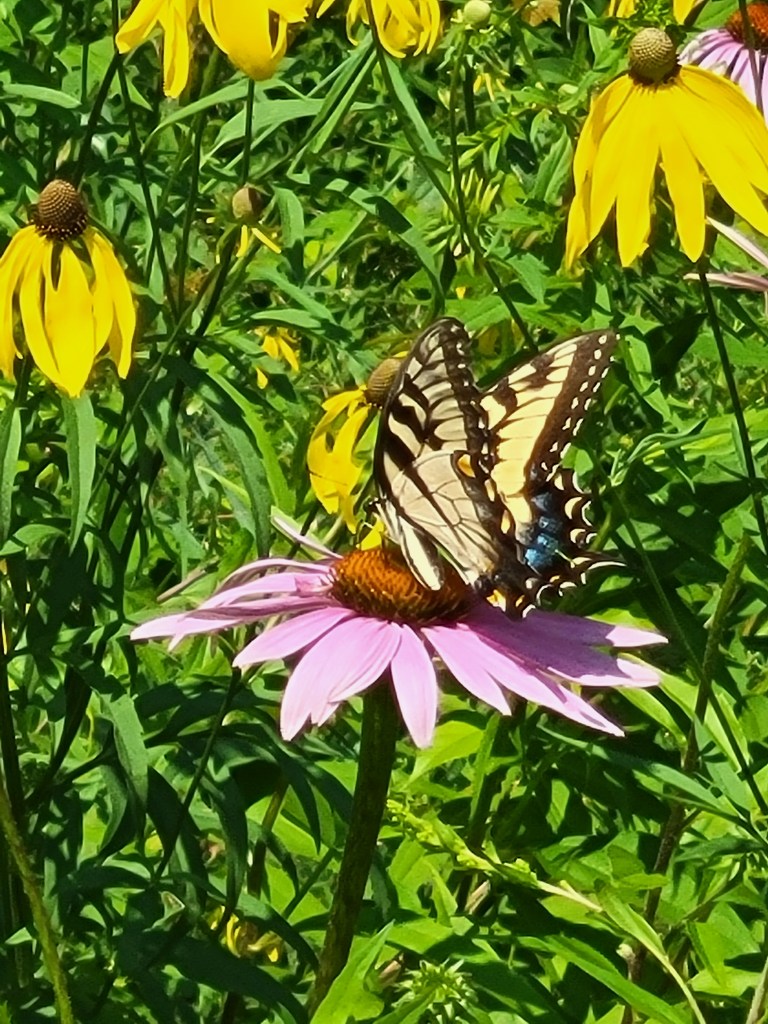
Eastern Tiger Swallowtail
on Purple ConeflowerYellow Coneflower is a prairie native and there is nothing quite like a field of mixed prairie flowers that includes an abundance of these drooping yellows to provide a sense that the summer wildflower season has fully arrived.

-
Five Colorful Insects: What’s That?
Leonard Weber
July 10, 2024
Summer time in Eliza Howell Park, when wildflowers are in bloom, is a wonderful time for insect watching. Attention is often – and understandably – focused on the attractive butterflies that can be seen, but there are other colorful insects that are present as well.
Here are five that tend to bring out the “what’s that” question.
1. Ailanthus Webworm Moth
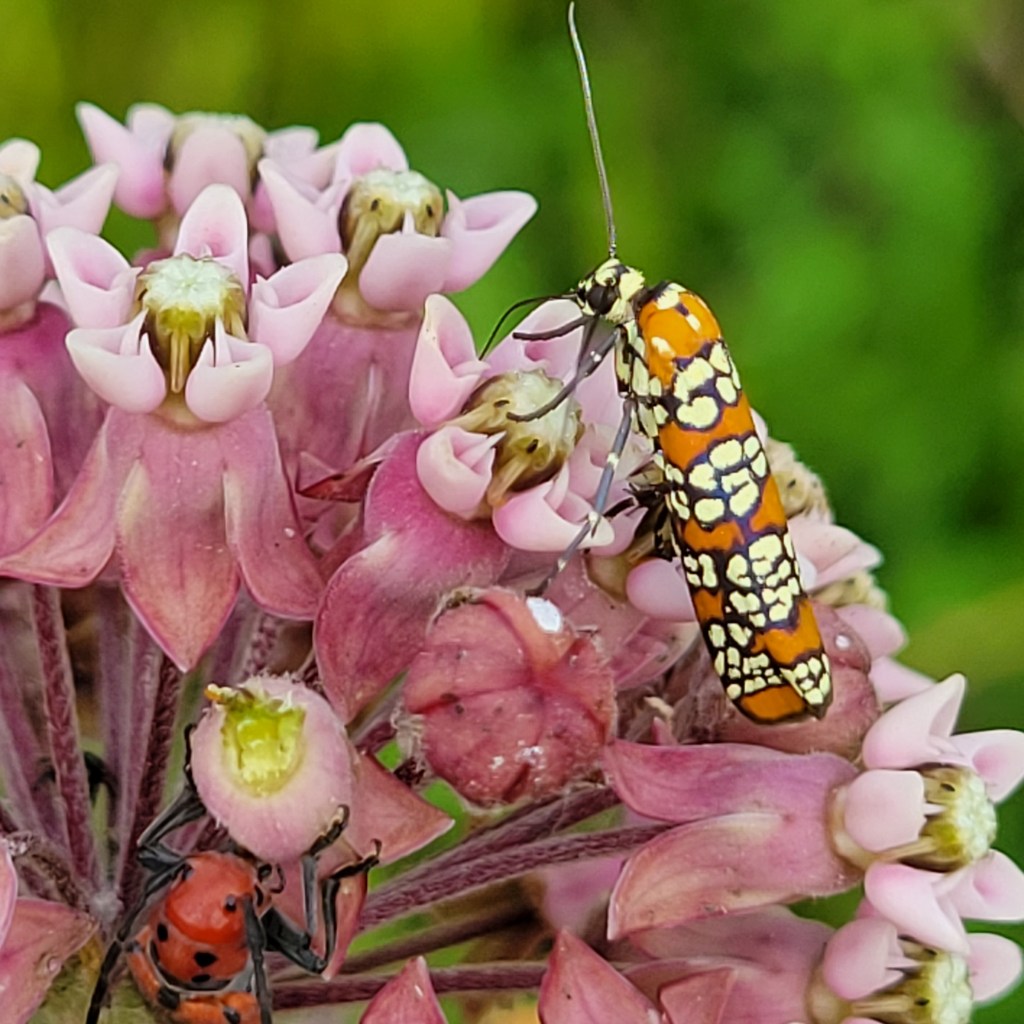

When not in flight, this insect does not look like a moth, but it is. It is named after a host plant for its larvae, the ailanthus (or tree-of-heaven) tree. The adult is found among the wildflowers throughout the summer.
2. Candy-striped Leafhopper
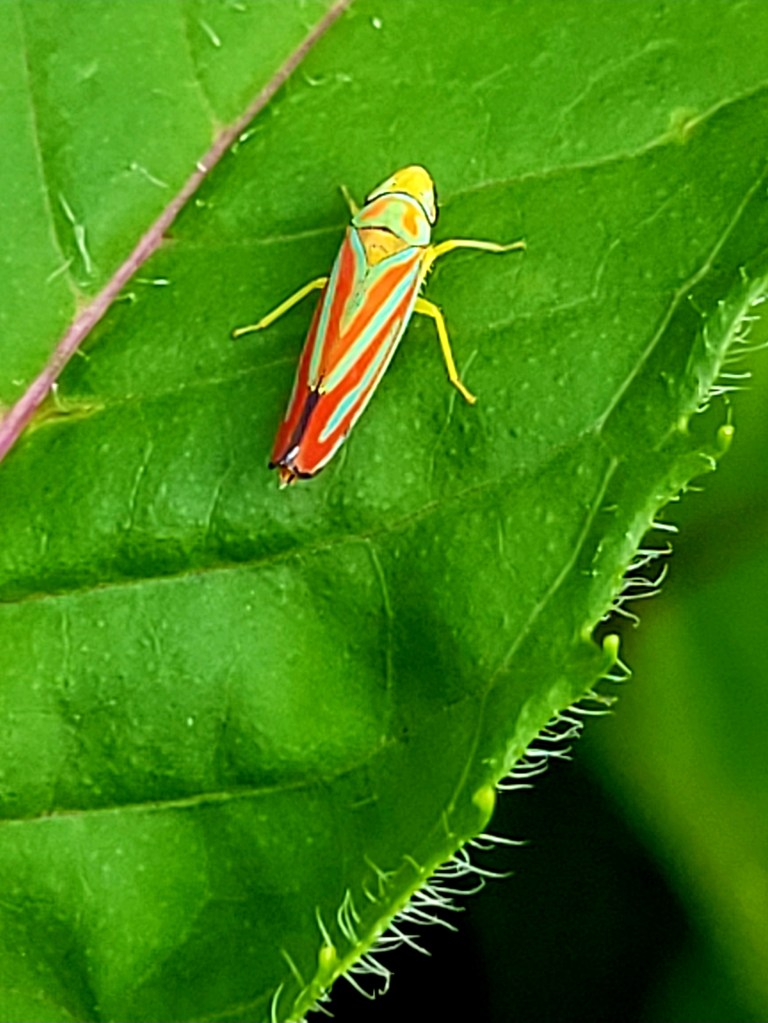

Candy-striped Leafhoppers are very small, easily missed despite their bright colors. They can be found on the leaves of plants like blackberry and roses, sucking out sap. True to the name, they quickly hop away when one gets close.
3. Bi-colored Sweat Bee


These small metallic green bees can often be found gathering pollen from flowers to feed their young. They seem to favor purple or blue flowers, such as the thistle and chicory shown here.
4.Goldenrod Soldier Beetle


Some Goldenrod Soldier Beetles can be found earlier in the summer, but, as the name suggests, they are most common in late summer when goldenrod blooms. The “soldier” part of the name comes from the way the wings seem to resemble a coat of the sort worn by soldiers in the past (remember the “red coats” name for English soldiers).
5. Locust Borer
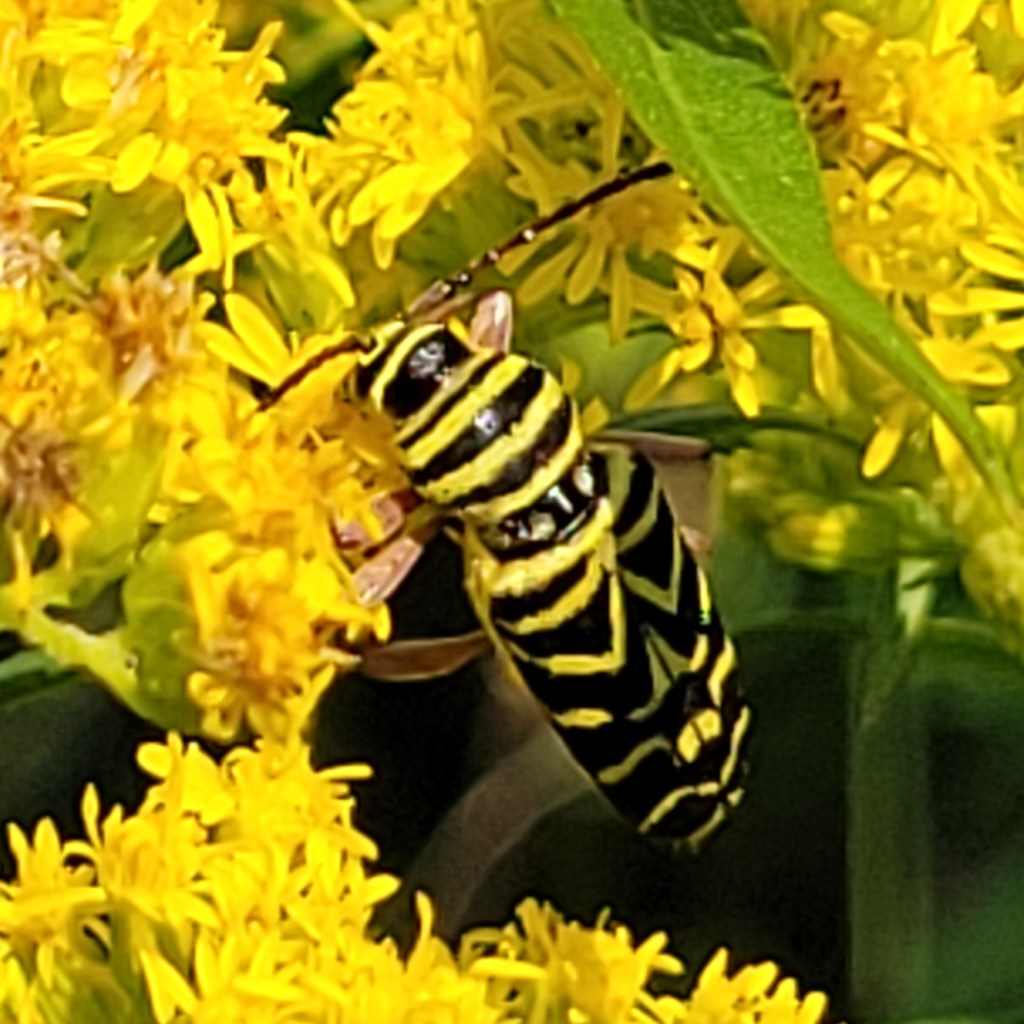

Locust Borer is a beetle that feeds almost exclusively on goldenrods. Its name come from the fact that females lay their eggs in bark crevices of Black Locust trees. Both goldenrod and locust trees are common in the park, providing a good habitat for this beetle.
…
These are a few of the fascinating insects that one can get to know when spending time among the flowers of summer. Enjoy.
-
Dragonflies: Five Distinctive Skimmers
Leonard Weber
July 1, 2024
Dragonfly watching is challenging. They may not be small for insects, but they are often on the fly — and are fast flyers. When they perch, they are not easy to spot.
I am not well-informed about many of the dragonflies of Eliza Howell Park, but I do have a few that I am getting to know better each year.
Here are five dragonfly species found in Eliza Howell Park, all members of the skimmer family. (Some have “skimmer” in the name; some do not.)
1. Common Whitetail

Common Whitetail (male) The female Common Whitetail (not pictured here) has spots on the wings, but does not have a white abdomen.
2. Twelve-spotted Skimmer
Dragonflies have four wings and the nature, color, and location of spots on the wings are often noteworthy.
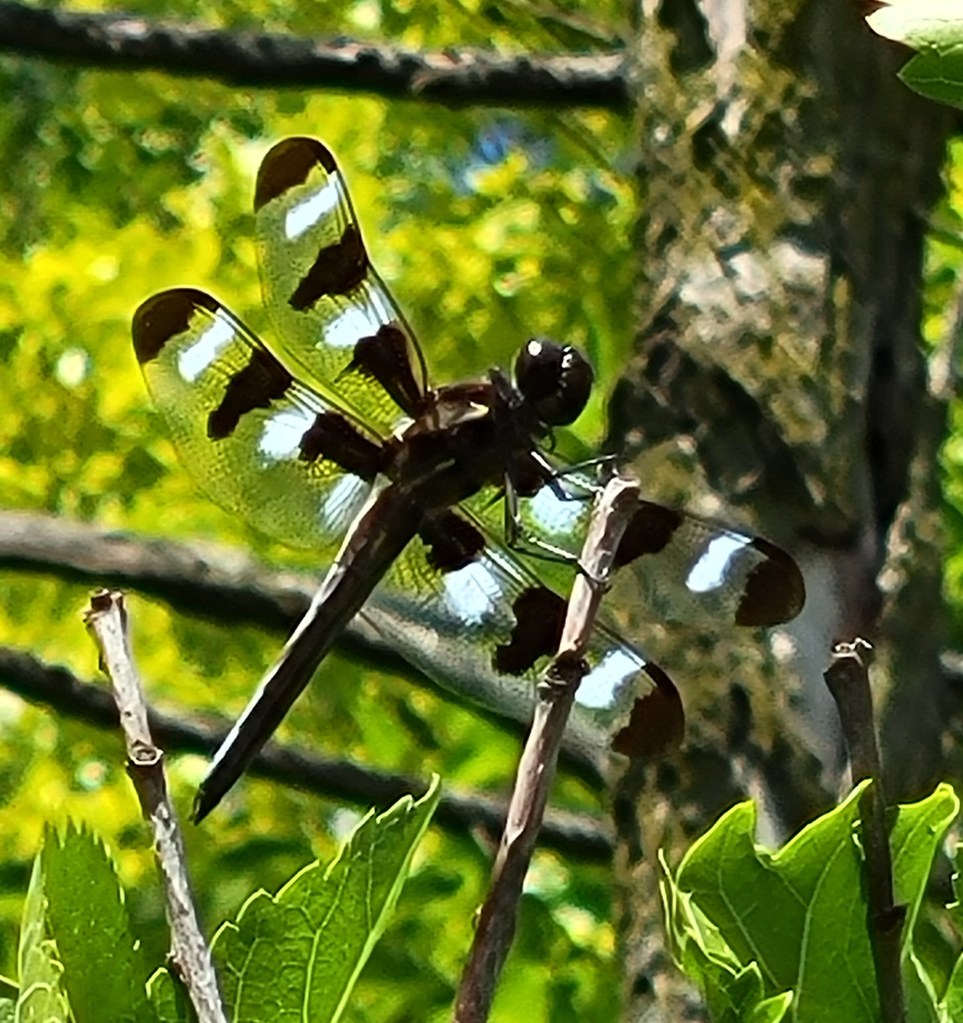
Twelve-spotted Skimmer (male) The twelve spots are the dark spots (3 on each of 4 wings). The female also has the 12 dark spots, but not the light colored ones.
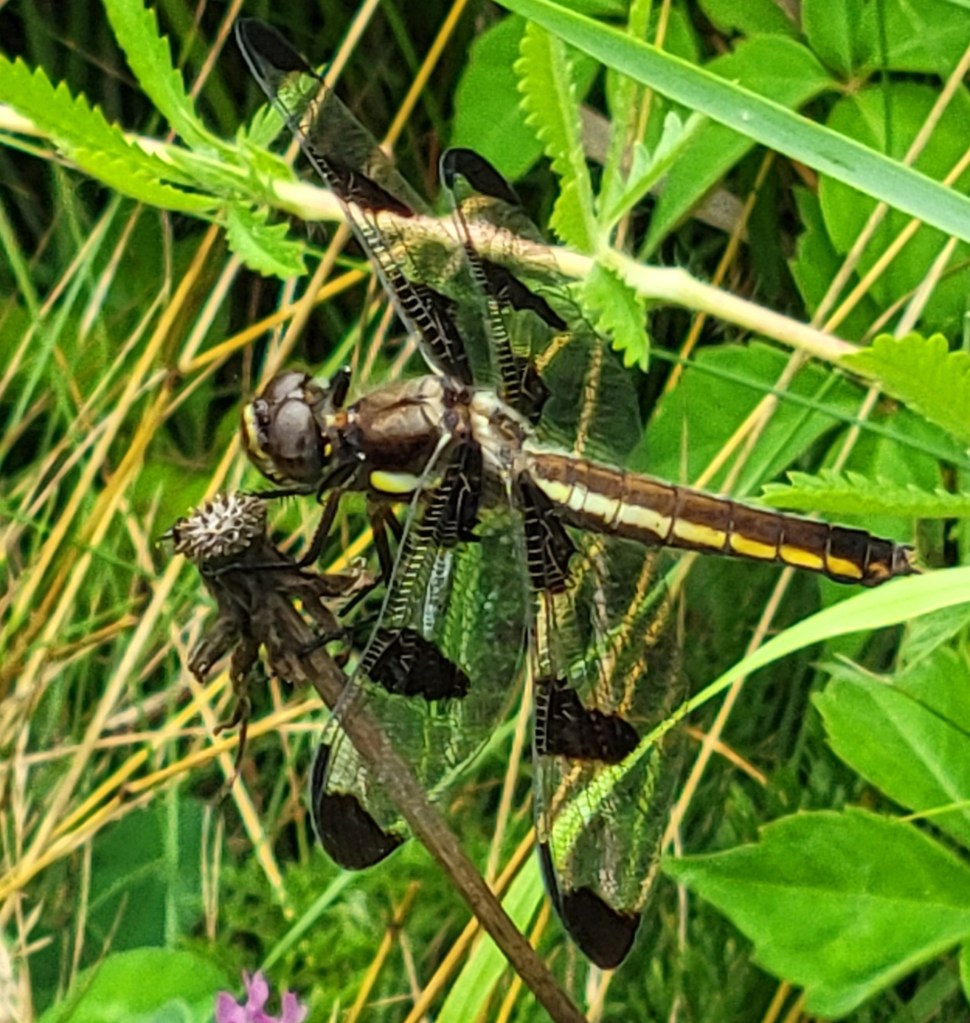
Twelve-spotted Skimmer (female) 3. Four-spotted Skimmer
The difference in appearance between the female and the male is not significant in the Four-spotted Skimmer.
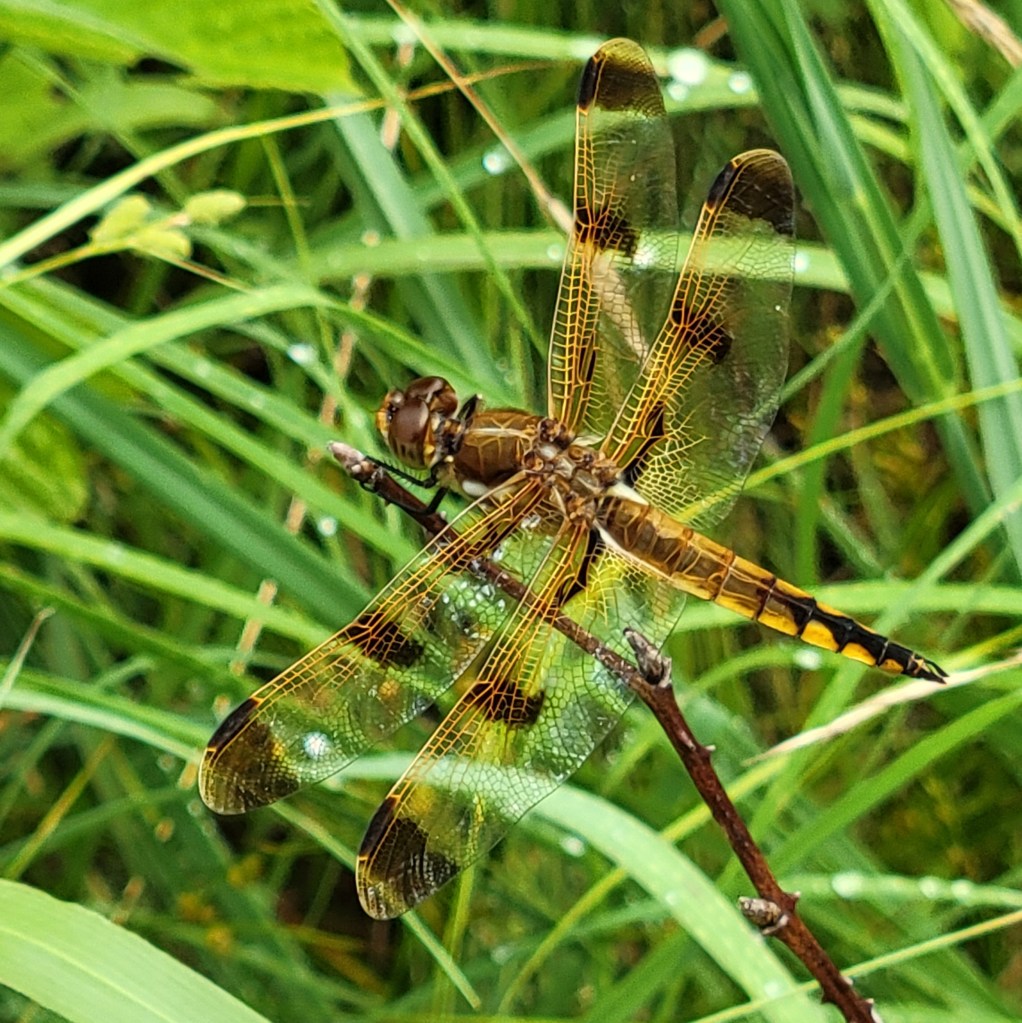
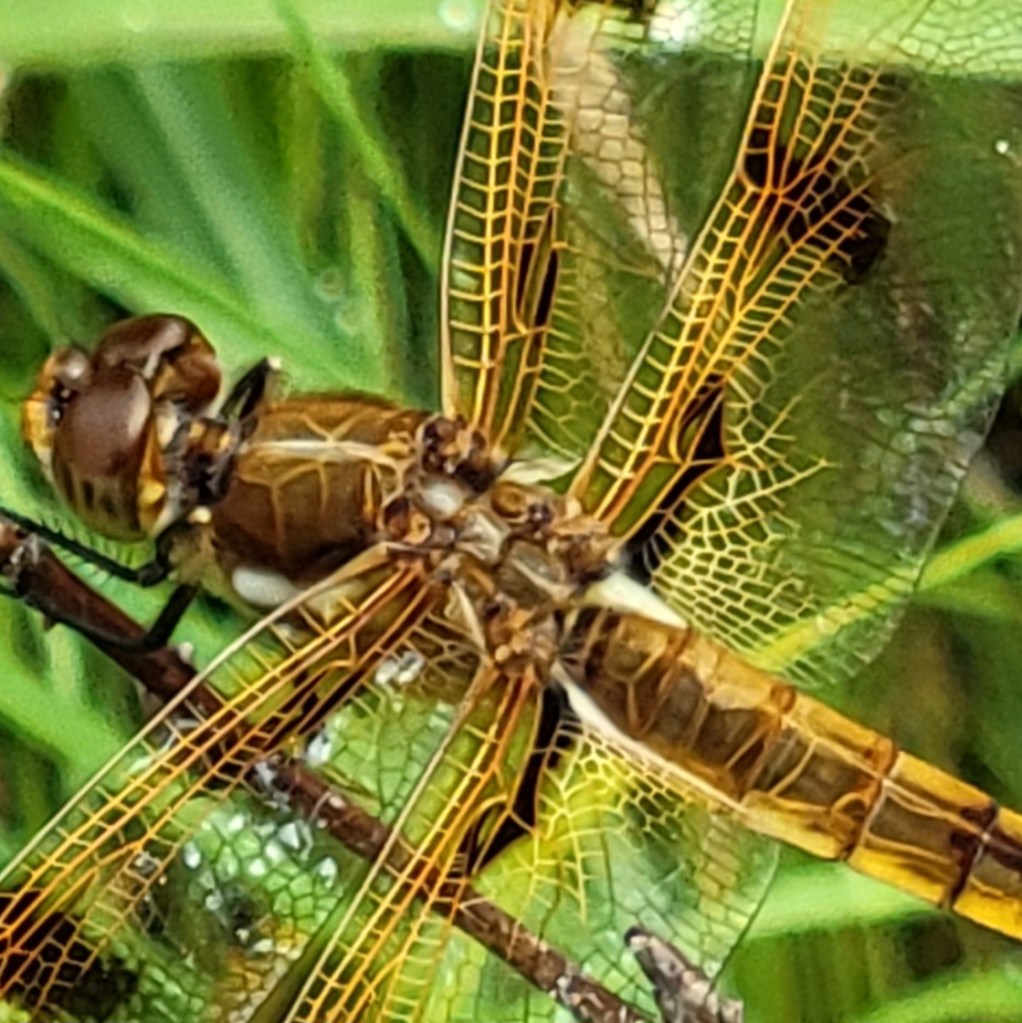
Four-spotted Skimmer The coloring of the wings is distinctive in this species. Here is the same photo in close-up.
Four-spotted Skimmer 4. Widow Skimmer
I tend to see the female Widow Skimmer more often than the male. Both sexes have a dark spot on each wing next to the abdomen.

Widow Skimmer (female) The adult male (not shown here) has a large white spot on the wings in addition to the dark spot.
The next photo is of a Widow Skimmer that has some characteristics of a female, but it might be an immature male.

Widow Skimmer
(perhaps immature male)5. Black Saddlebags
A member of the skimmer family that somewhat resembles a Widow Skimmer is Black Saddlebags. The name comes from the resemblance of the dark spots on the hindwings to saddlebags.

Black Saddlebags Both sexes are similar in appearance. The fascinating saddlebags call for a close-up.

Black Saddlebags There are many other dragonflies in Eliza Howell Park. These five are both common enough and distinctive enough to be on my list of ones to get to know.
-
Butterflies on Gravel: Watchful Walking
Leonard Weber
June 25, 2924
Recently, I have been seeing Common Buckeye butterflies in Eliza Howell Park, the first year that I have seen them here before July.
I was surprised to see Common Buckeye this early, but I was not at all surprised that the first ones of the season are on and along a gravel path.
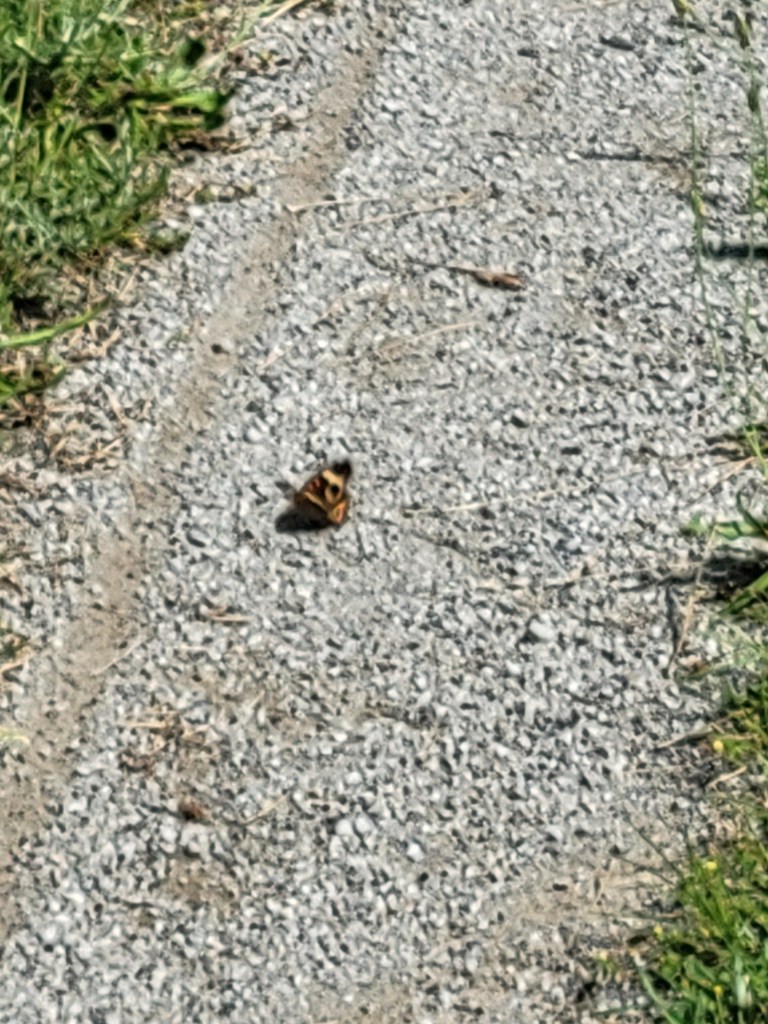
A long-distance view of a
Common Buckeye, June, 2024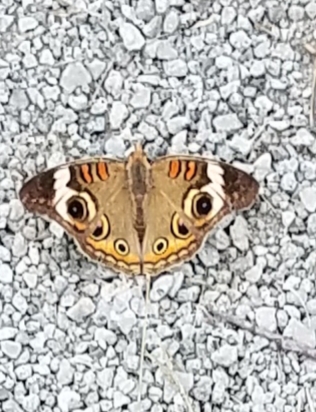
Another view of a Common Buckeye (photo from a previous year) Common Buckeye is one of several butterfly species that can be spotted on gravel paths, especially early in the season.
The Red-spotted Purple is often seen nectaring on flowers in the heart of summer, but I sometimes see the earliest ones on gravel or pavement.
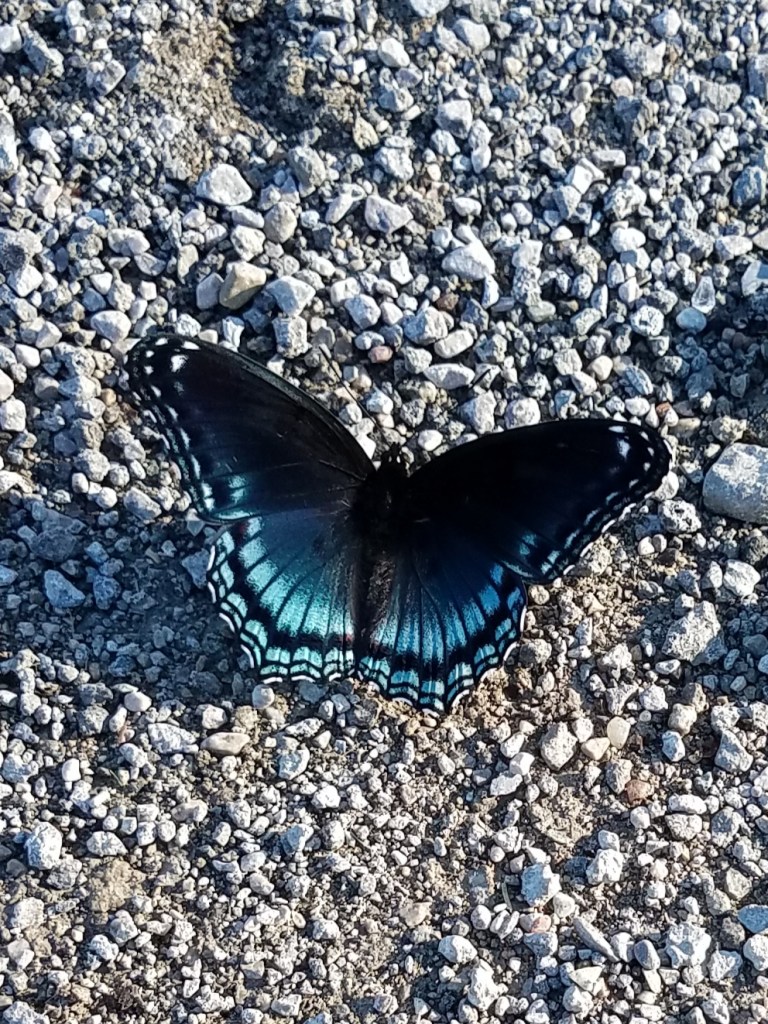
Red-spotted Purple It is not unexpected to see the two “punctuation butterflies” found in this area, Question Mark and Eastern Comma, basking on gravel.
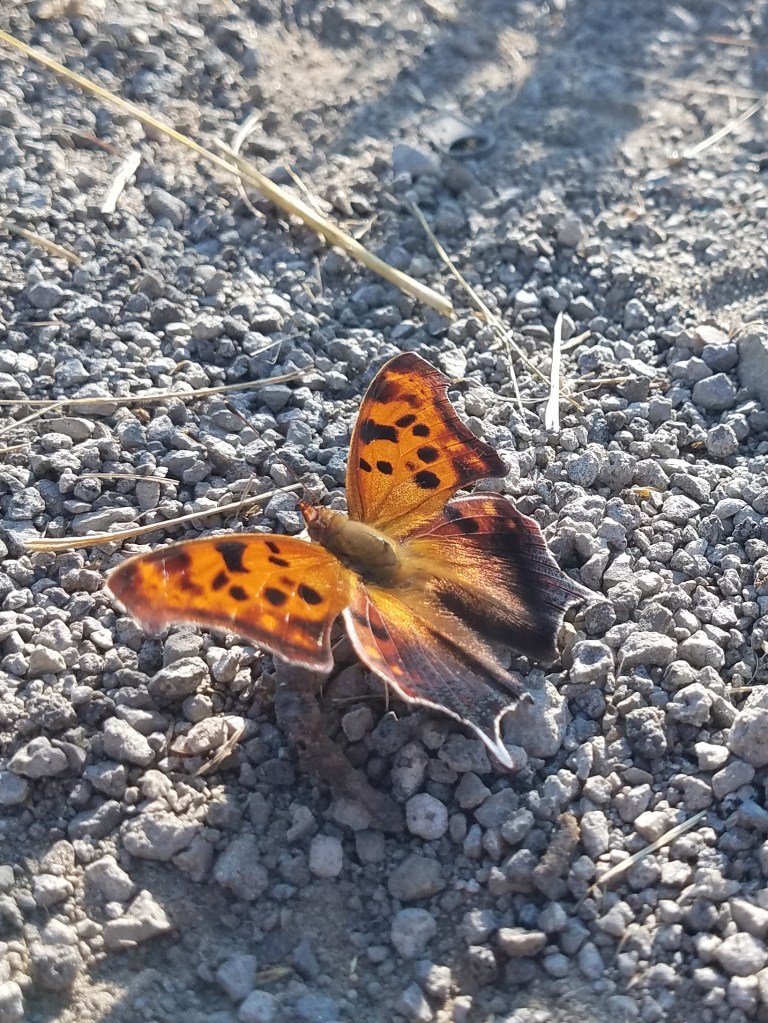
Question Mark 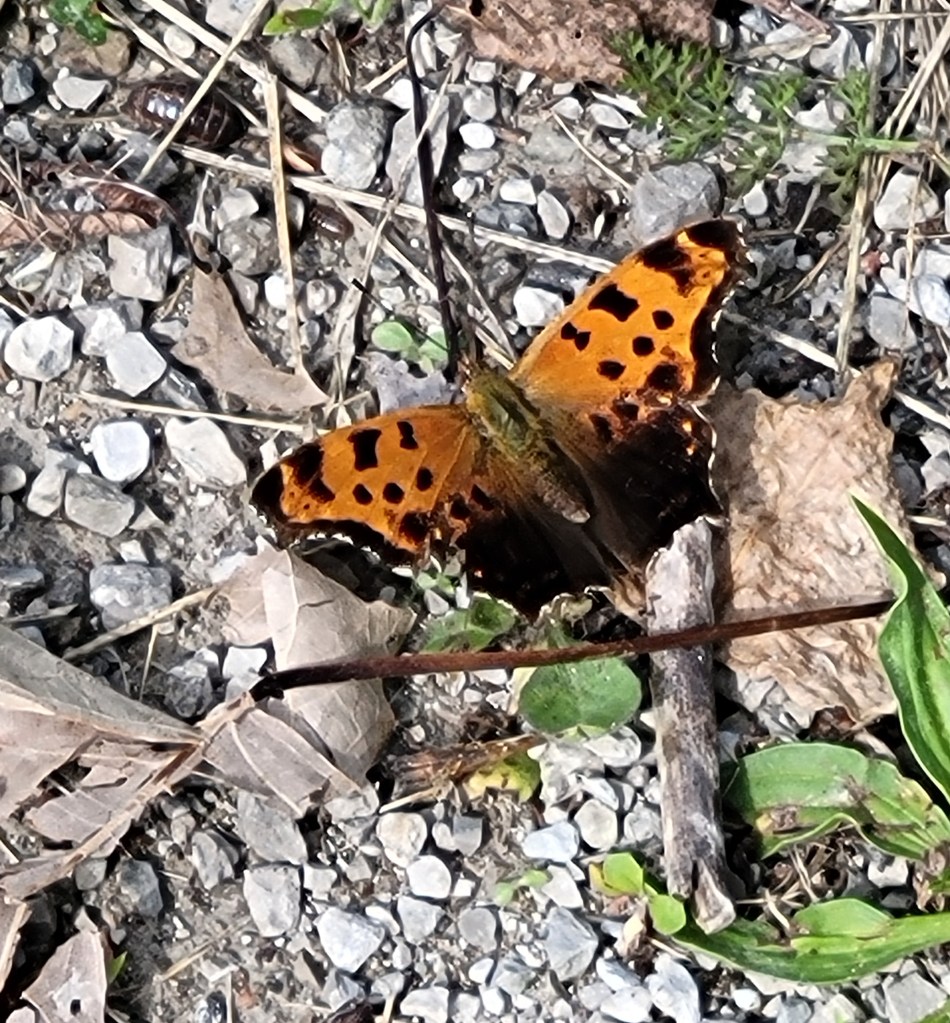
Eastern Comma A post earlier this year featured the Hackberry Emperor, another of the species attracted to gravel.
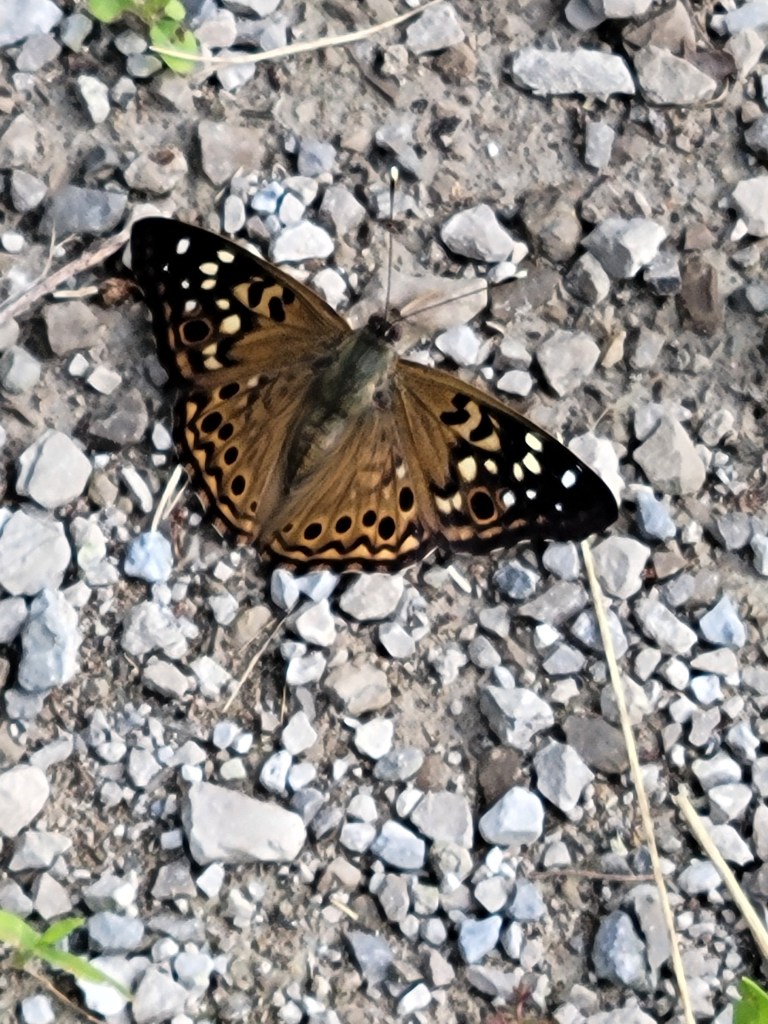
Hackberry Emperor Butterflies sometimes choose a spot on gravel as a sunny location for warming up in the morning. Sometimes, they are feeding, getting minerals and other nutrients from the moisture and organic materials present.
American Lady is another species that I have been seeing frequently this spring on the paths.
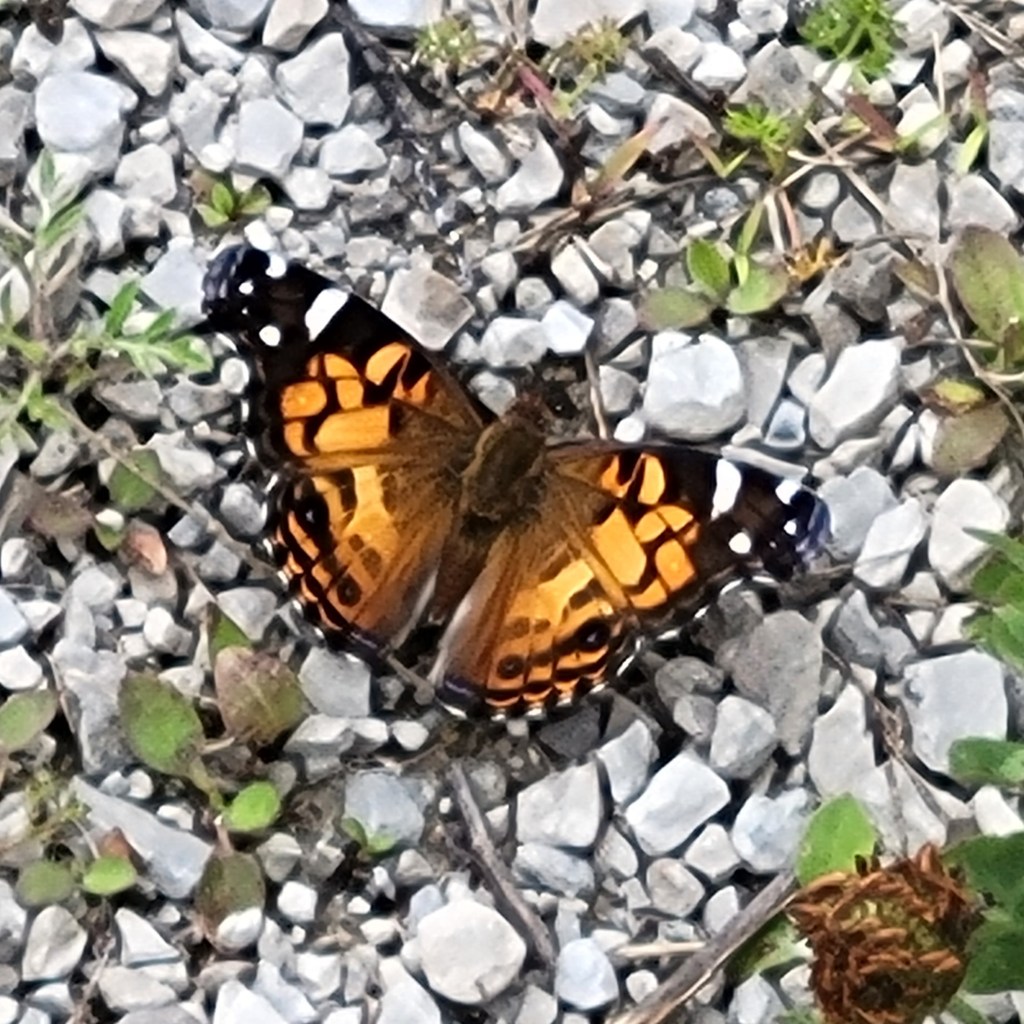
American Lady Red Admiral is numerous so far this year and is often visible on or near a gravel path.
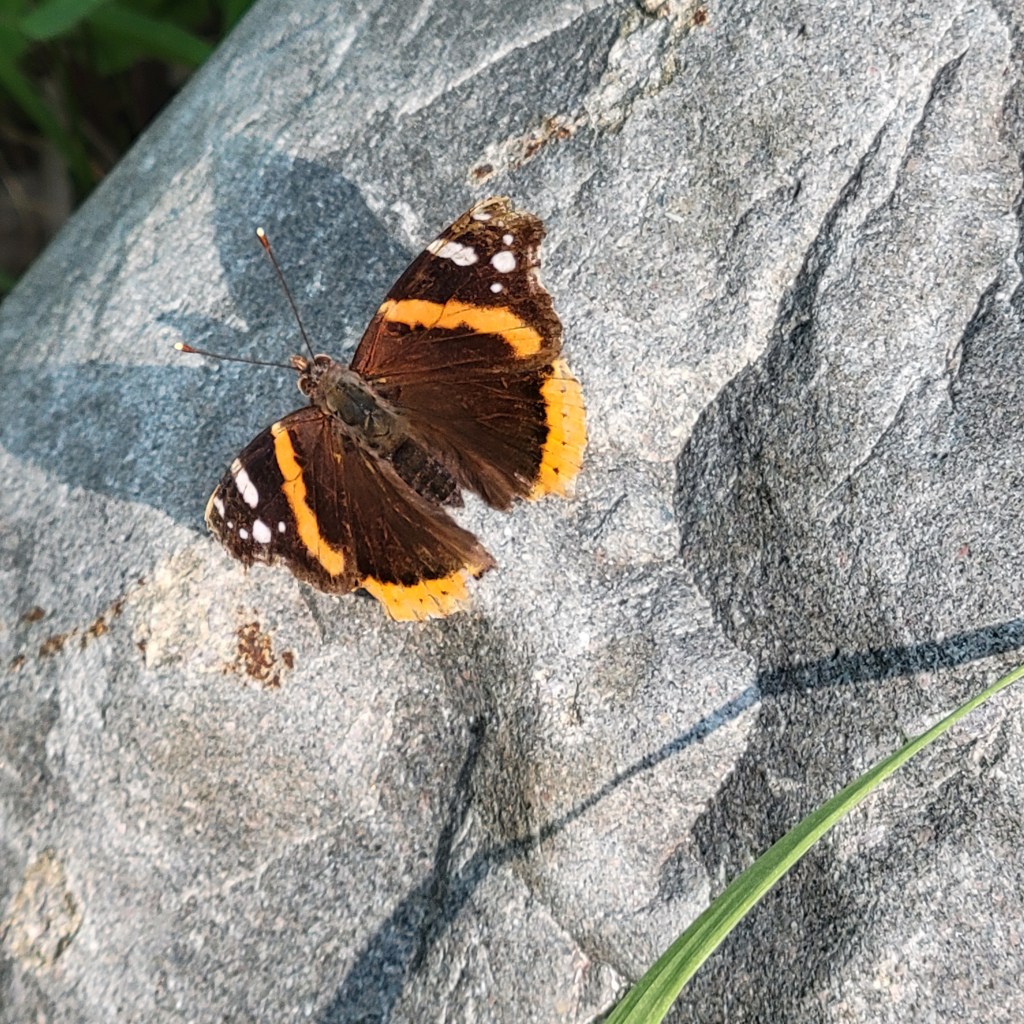
Red Admiral Starting in July, I usually spend much of my butterfly watching time in the perennial wildflower fields, observing and admiring different species nectaring on summer flowers.
June is not a time for waiting, however. Walking the paths provides its own butterfly treats, especially when I look ahead to see them before my approach scares them away.
Nature walking always means watchful walking. Sometimes, it means watching to see what is on the path itself.
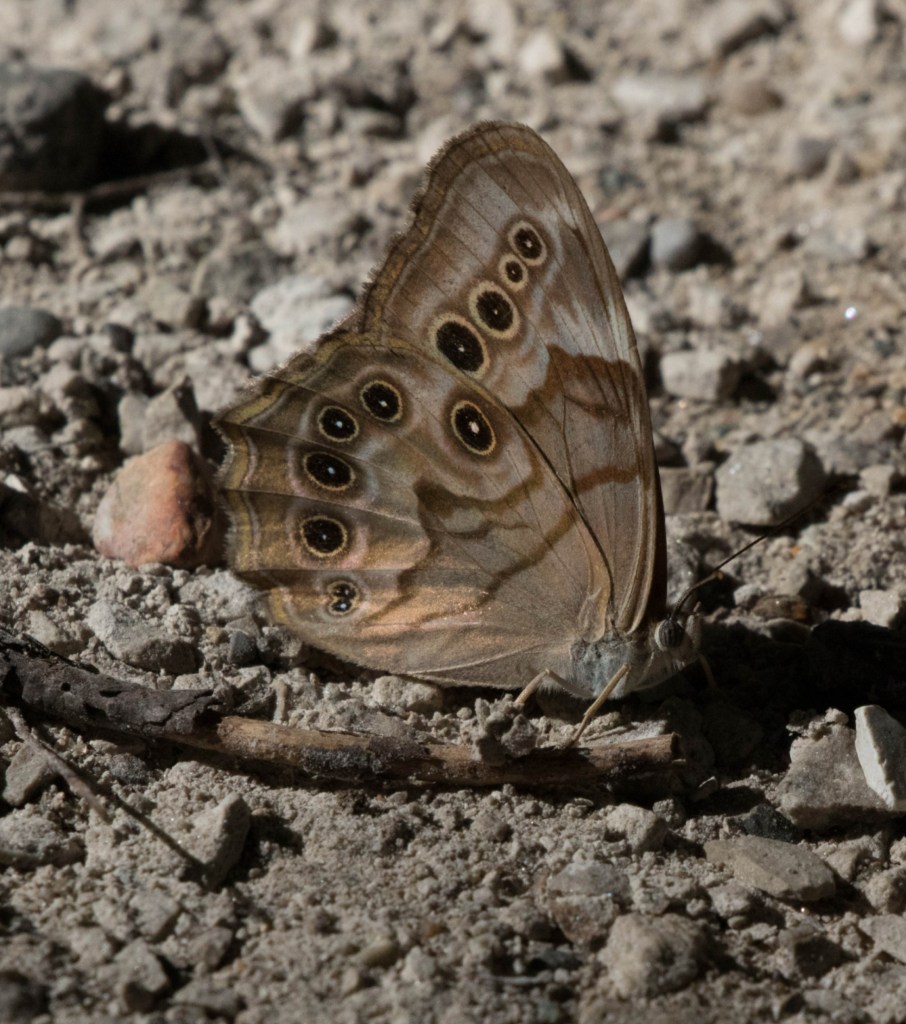
Northern Pearly-eye -
“June Is Bustin’ Out All Over!” Summer Flowers Starting to Bloom
Leonard Weber
June 16, 2024
As I was walking in Detroit’s Eliza Howell Park recently, I thought of the Rodgers and Hammerstein “June Is Bustin’ Out All Over” song from about 80 years ago. June is indeed a month when something new is busting out nearly every day in the park.
In June, many of the perennial wildflowers that are identified with summer begin to bloom. Just since the beginning of the month, flowers that have begun to bloom here include these ten.

Common Milkweed 
Oxeye Daisy 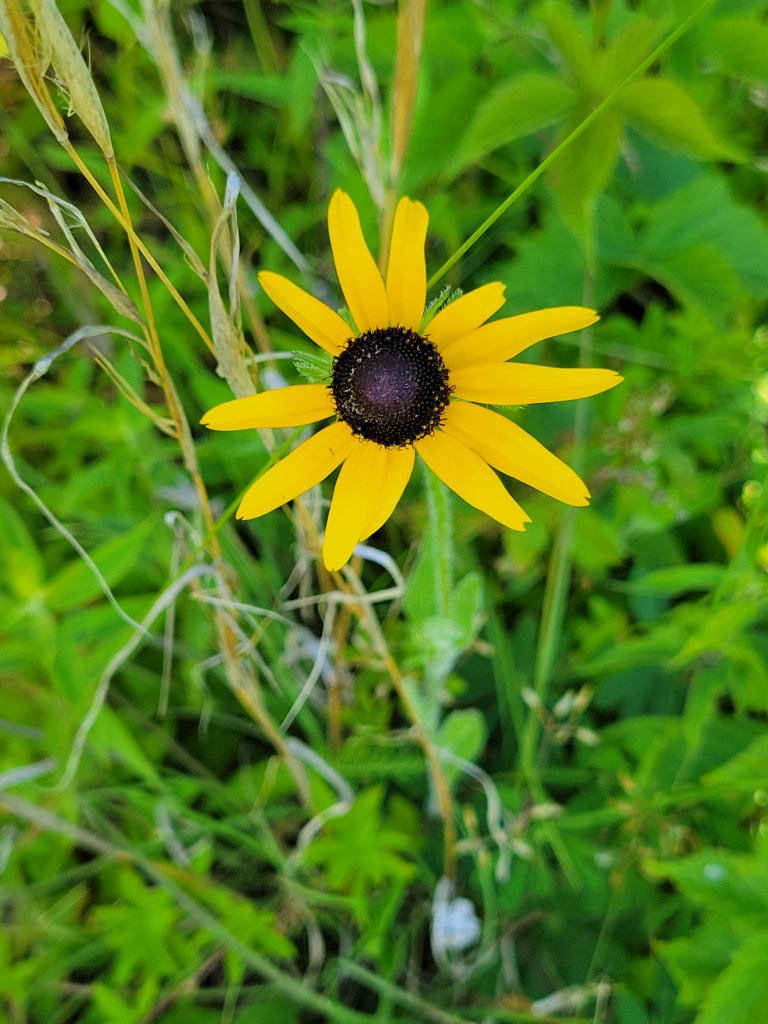
Black-eyed Susan 
Spiderwort 
Swamp Milkweed 
Chicory 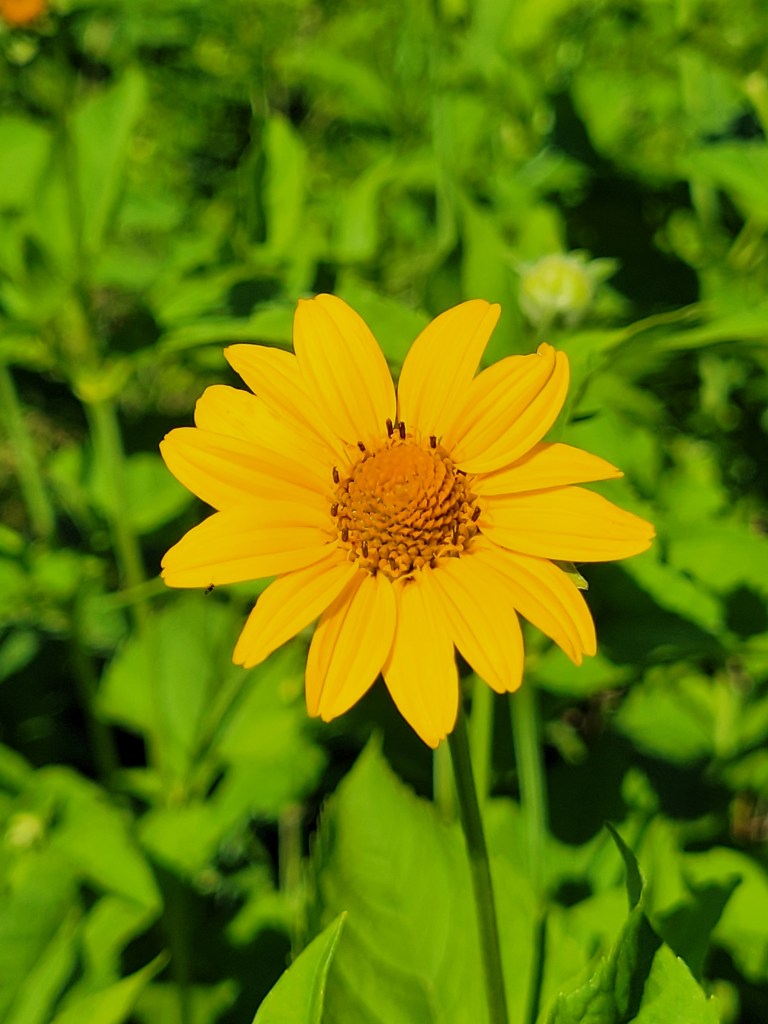
False Sunflower 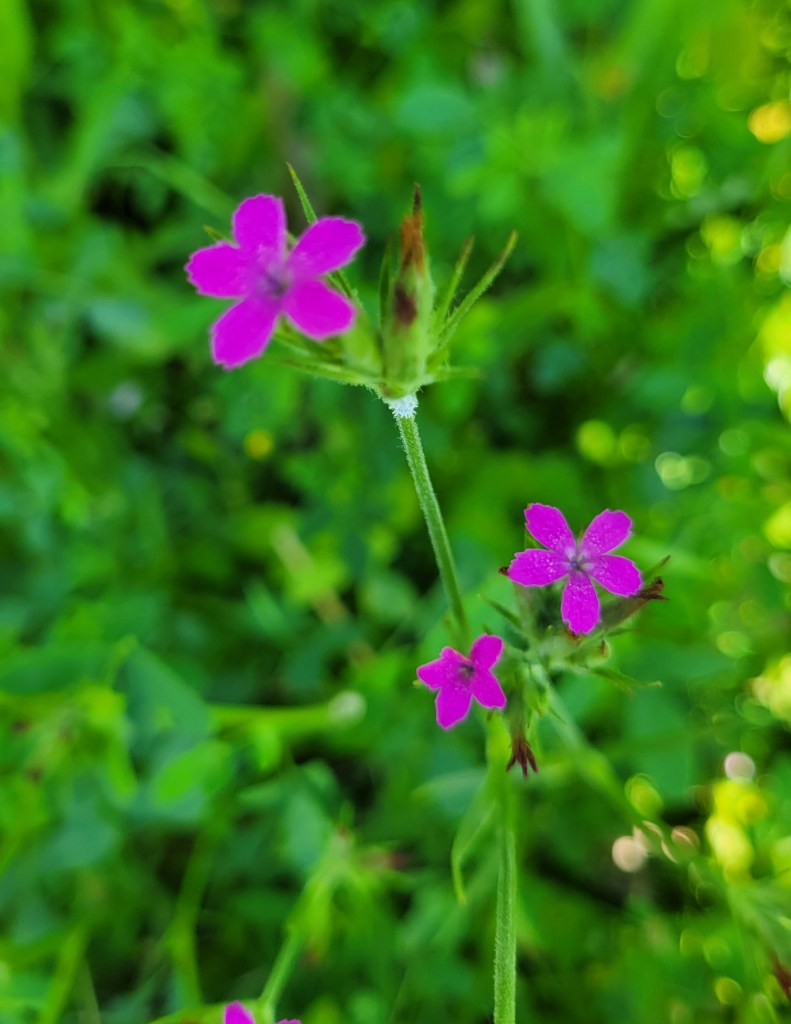
Depford Pink 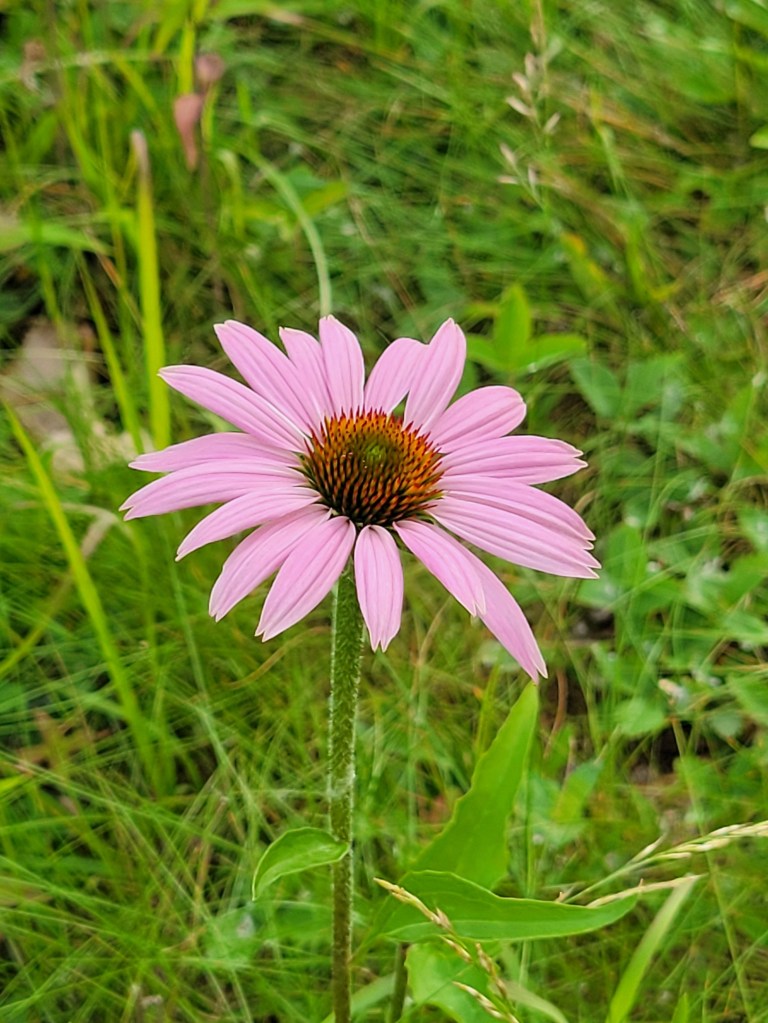
Purple Coneflower 
Yellow Sweet Clover There are two more weeks left in June, with more flowers busting out. In addition, the number of butterfly (and other insect) species visible is also increasing rapidly.
The abundance of summer is about to begin!
-
Hackberry Emperor: The Butterfly and the Bridge
Leonard Weber
June 10, 2024
One butterfly that regularly appears in Eliza Howell Park in June is Hackberry Emperor.

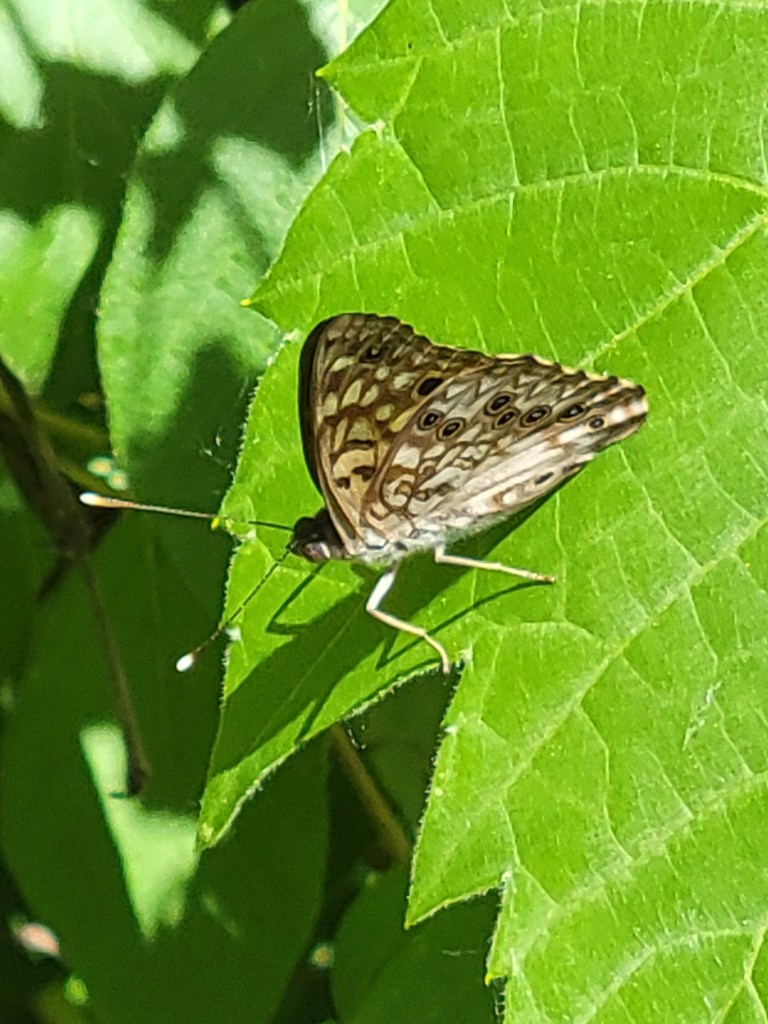
On the path It is somewhat small (wingspan of about 2 inches), flies swiftly and alights frequently – on the ground, on trees, sometimes on people.
It frequently opens its wings when perched, but it is also possible to get a view of it with the wings closed.
Over the years, I have been able to observe not only when Hackberry Emperor first appears each year, but also where in the park I am most likely to see the species.
I often find it on or near the foot bridge over the Rouge River.
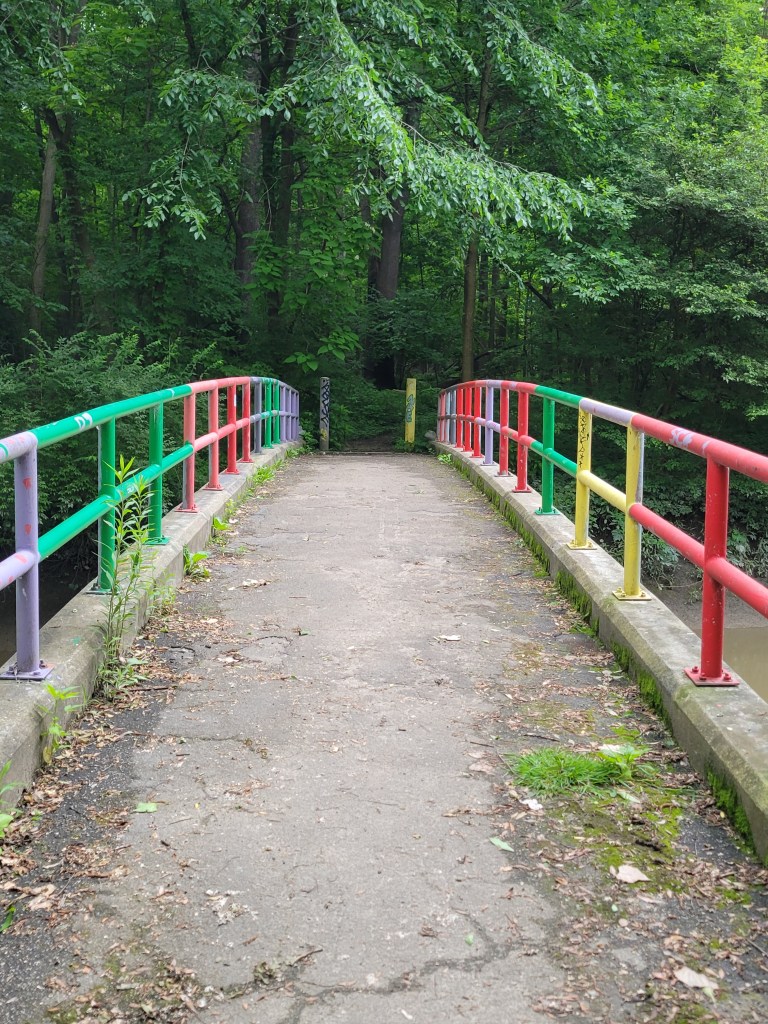

I have been seeking to understand why they are found so frequently around the footbridge at this time of the year. Perhaps it is a combination of two factors.
A. Hackberry Emperor butterflies are reported to be attracted to bright colors. If so, they would likely find the painted railings of the footbridge very inviting.
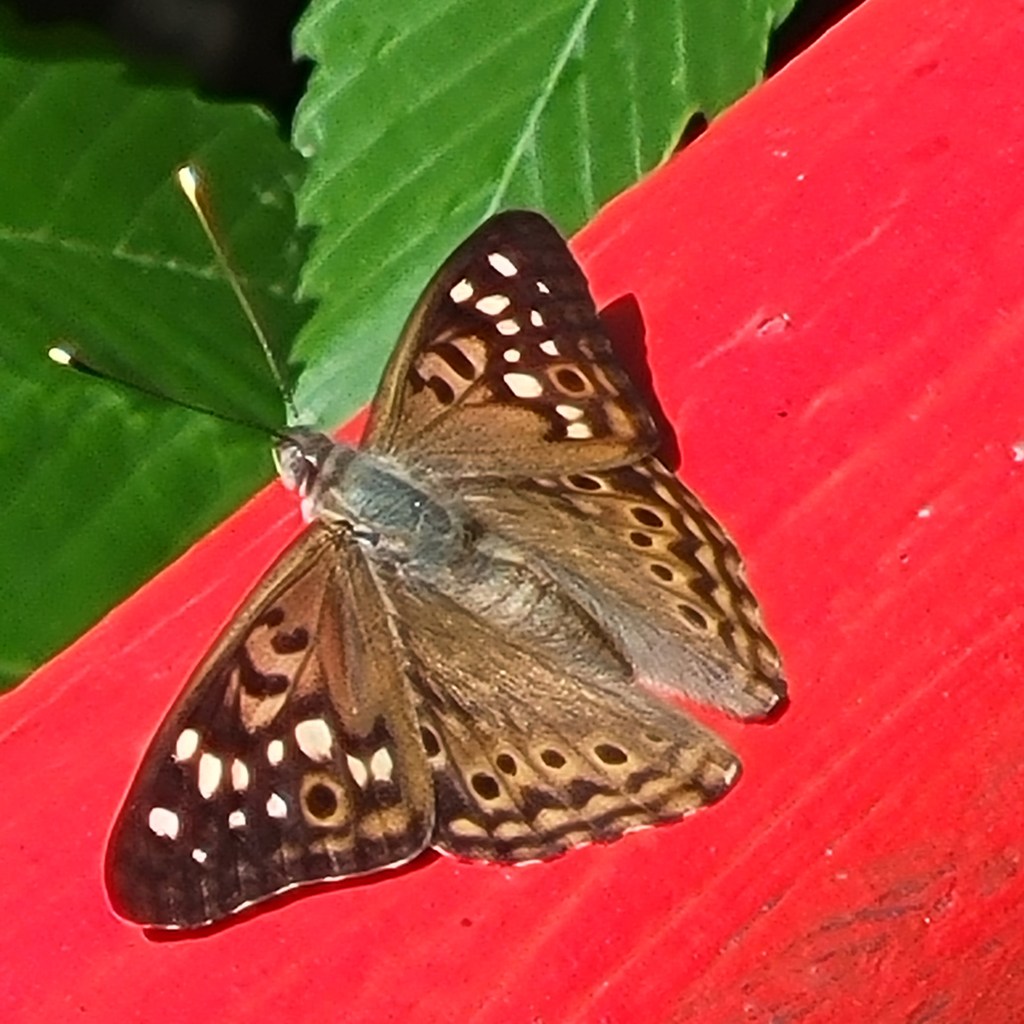
On the footbridge railing 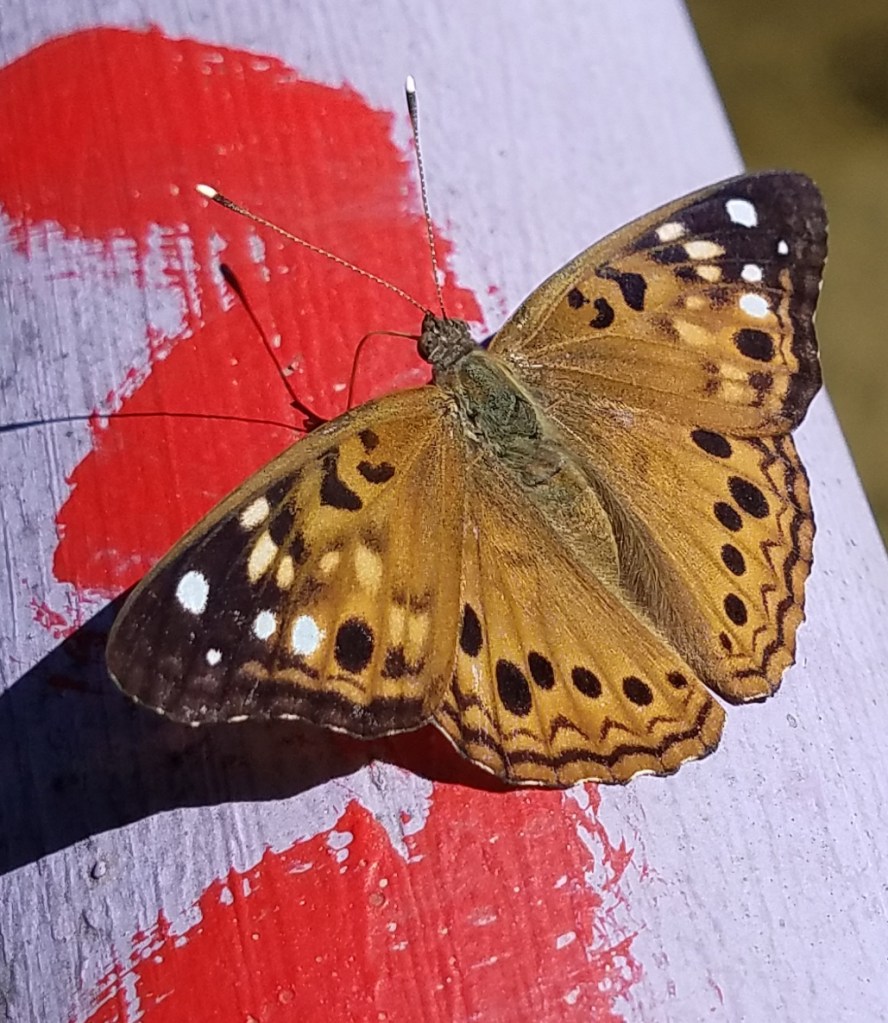
On the footbridge railing B. The second factor relates to the butterfly’s life cycle. Hackberry Emperors lay eggs on hackberry trees and the caterpillars eat hackberry leaves. The caterpillars from the second brood are about half grown when fall comes. They pause their growth, spend the winter as half-grown caterpillars (in diapause), and finish development when the hackberry has new leaves in the spring.
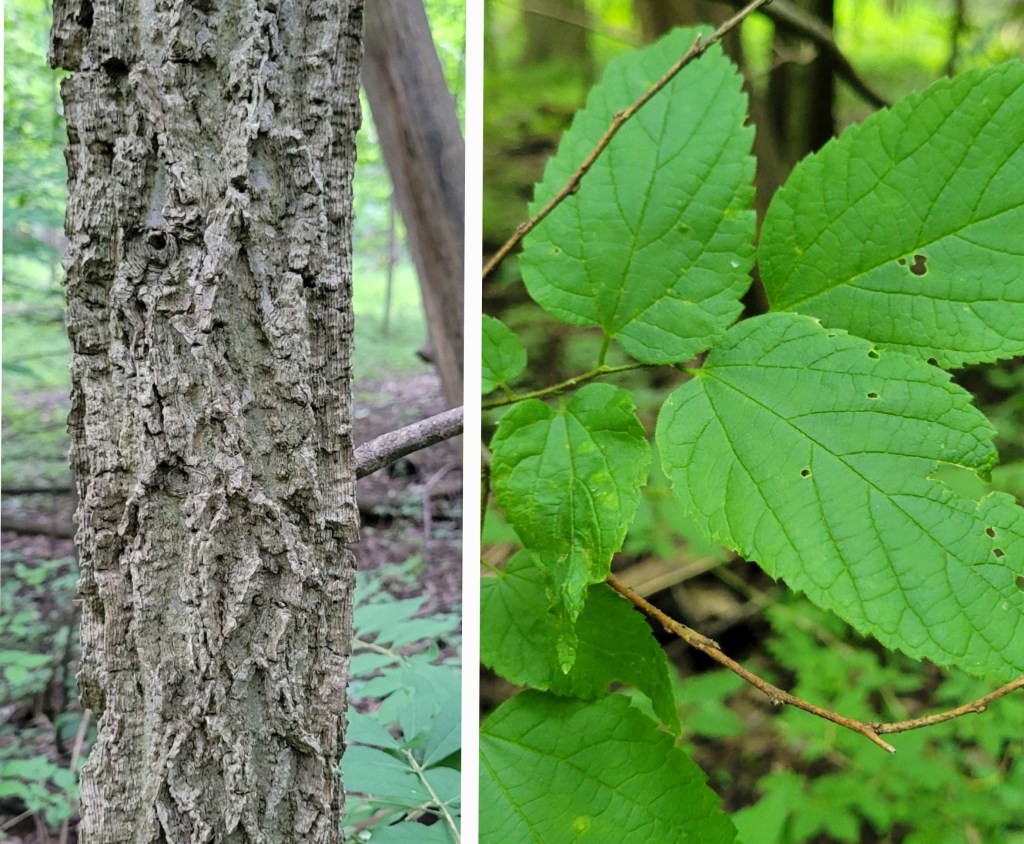
Common Hackberry The butterflies begin to emerge from the chrysalis stage in early June. In heading for a more open area of the park (the hackberry trees tend to grow in the heavily wooded area), the butterflies cross the river. The footbridge provides a pathway.
Whether my possible explanation is accurate or not, Hackberry Emperor butterflies can often be seen at this time of the year on the footbridge and along the gravel path that goes from the road to the river.
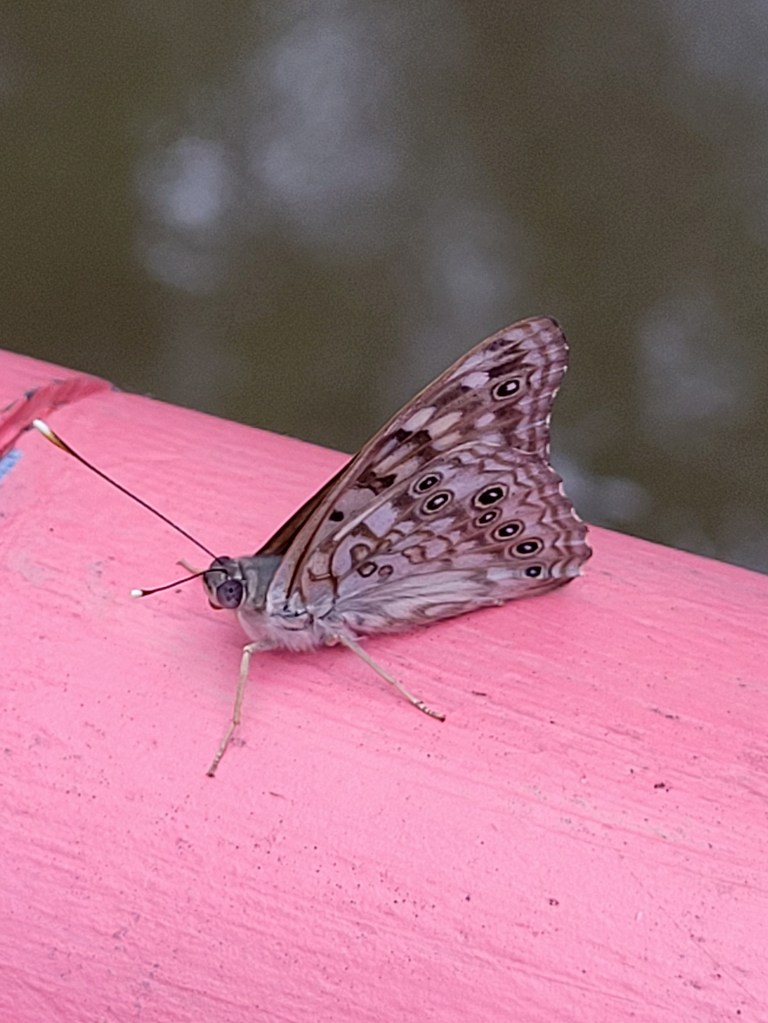
On the footbridge railing 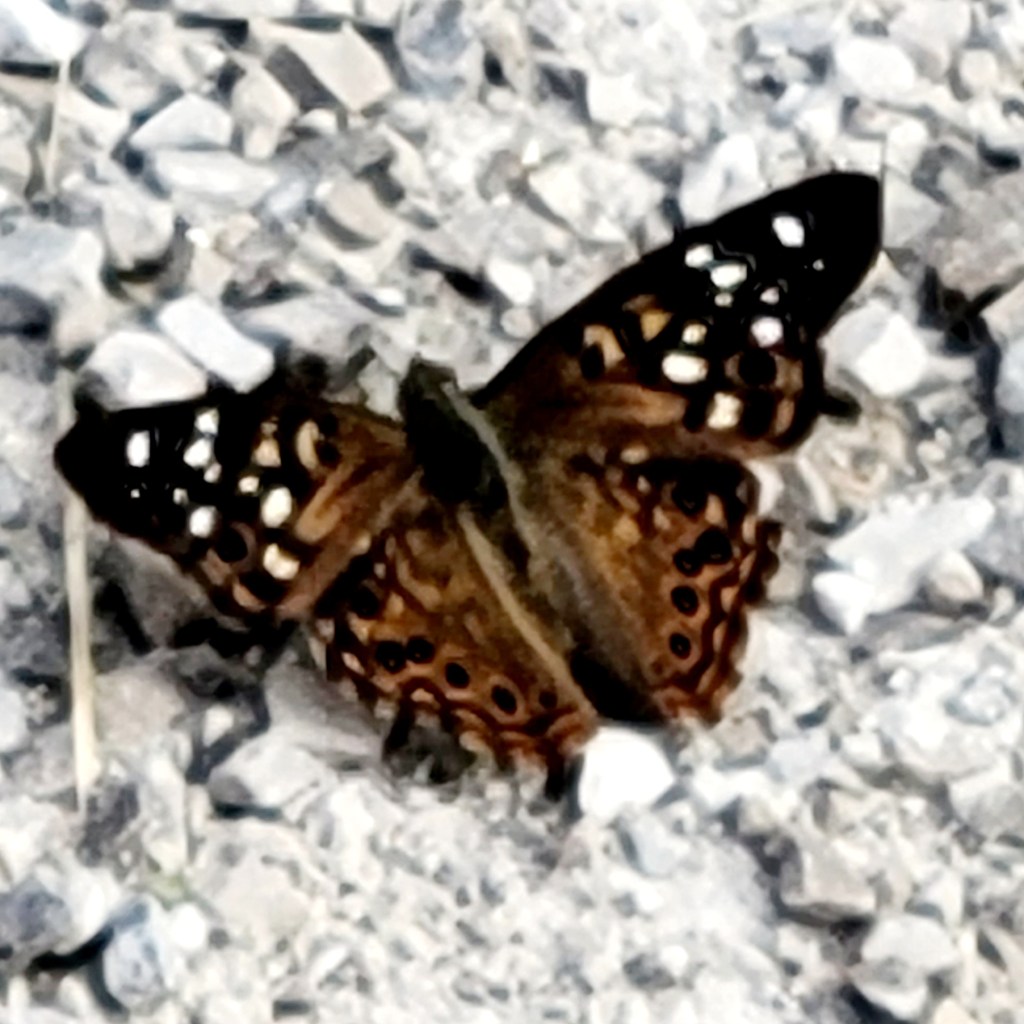
On the path Hackberry Emperor butterflies have been quite numerous so far this June. I am getting so accustomed to seeing them on or near the footbridge that I am, for the first time in all these years, starting to use a name when I think of the foot bridge.
It is the Hackberry Emperor Bridge.
-
Ruby-throated Hummingbird Nest: The Next Chapter
Leonard Weber
June 2, 2024
Sometimes, it’s wonderful to be wrong.
On May 19, I posted the story of a nesting attempt by a Ruby-throated Hummingbird in Eliza Howell Park. The first egg was laid in what looked like an unfinished nest. Not too surprisingly, the egg fell.

Photo courtesy of Kevin Murphy Shortly after the egg fell, the female left the nest. My observation, when she had not been seen again for a week, was that “the chances are very good that we will not know what happens next.”
I was wrong.
The Next Chapter
On May 30, I was near the sycamore tree and decided to take another look at the nest, not having seen any activity there since May 12. I was surprised to see the bird back in the nest, a nest that had been expanded.
At some point, perhaps a few days before, she had returned, worked on the nest, and moved in. She now appeared to be incubating.
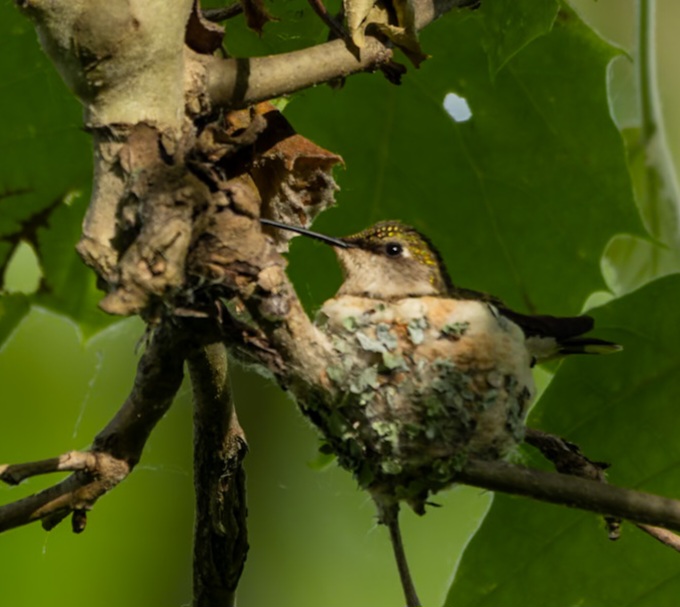
Photo courtesy of Reid Crawford (Note the difference in the size of the nest in the two photos above.)
Compared to the egg laying in the earlier instance, which appeared quite premature, the present nesting situation looks more normal.
Ruby-throated Hummingbirds usually have two eggs, laid a day or so apart. Incubation then takes about 16 days, all done by the female. She leaves briefly to eat but returns quickly.
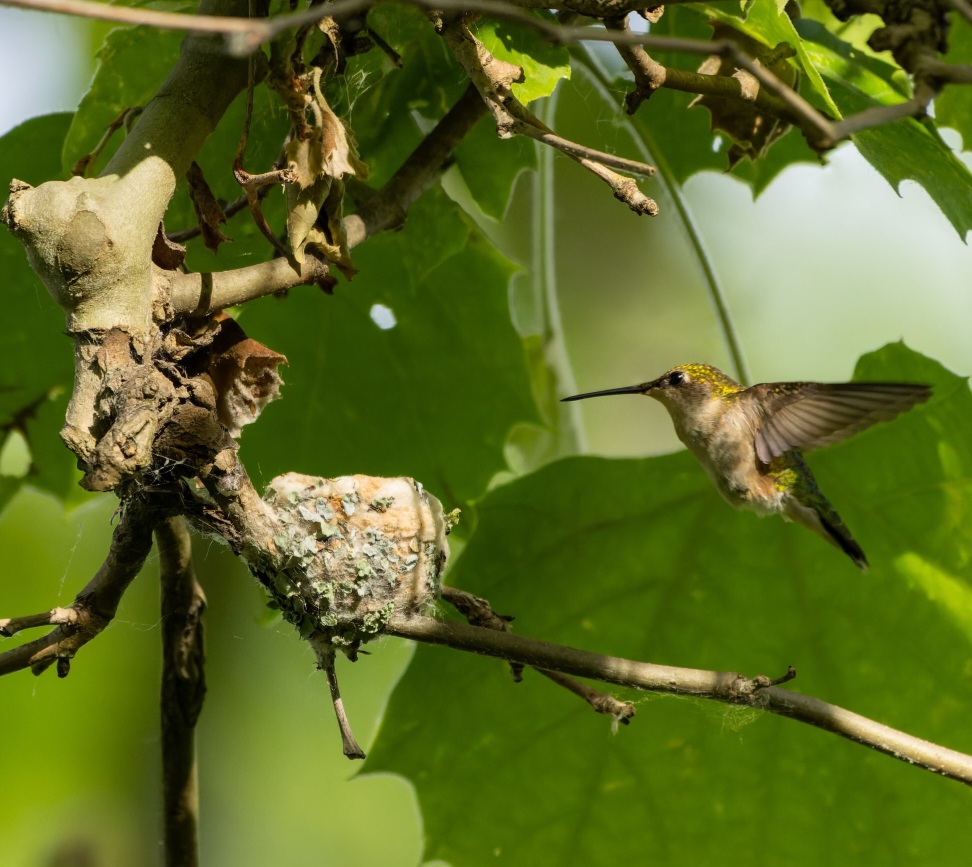
Photo courtesy of Reid Crawford When the eggs hatch, she will spend another couple weeks feeding the young.
I do not have an explanation for this course of events, but am once again excited to be able to watch (from a distance and in as non-threatening a manner as possible) as the story continues.
-
Subscribe
Subscribed
Have a WordPress.com account? Log in now.

